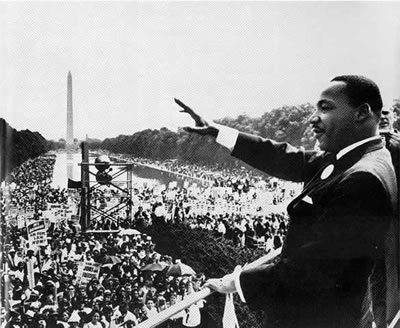
 On August 28, 1963, the Rev. Dr. Martin Luther King, Jr. gave a speech on the steps of the Lincoln Memorial that galvanized a nation, with echoes heard around the world. Coming from the airport in Johannesburg yesterday, the taxi driver who transported me listened to a radio discussion on to what degree King’s ideals have been realized in South African society. I’m proud that a fellow American like Dr King left a positive legacy that is still referenced 50 years later.
The story of Jackie Robinson is brilliantly portrayed in the film, 42. As a baseball player post-WW II, he faced blatant prejudices as he broke the color barrier in professional sports. There can be little doubt that we have come a long ways since the time when “Whites Only” signs were painted on the doors of public bathrooms or over water fountains. Yet much remains to be accomplished.
But let us narrow the focus from society in general to our own personal, daily choices. Here are a few small ways that in recent years I’ve tried to narrow the gap at least a little bit:
1. There is only one race, the human race. Dr Charles Gailey, Professor Emeritus of Missions at Nazarene Theological Seminary, spoke eloquently that there are not “races,” but only one, the human race. Within that race, there are certainly variations and diversity, yet there is so much more that unites us than what divides us! When a political pollster called one evening, at the end he needed to check off the boxes on his questionnaire. “What race are you?” he asked. “Human,” I replied. There was a long silence, then the pollster responded: “You are correct. I never thought of it that way before.” Thank you, Dr Gailey, for reminding us that what we share far outweighs what differentiates us.
2. Take a bus. You can have some amazing conversations on buses. Everyone is on a journey somewhere, and buses are among the best multicultural crossroads in our nation. (If I had more than one life, I would travel buses between cities and in cities for a year, just so I could write a book about my experiences). They say that love’s first duty is to listen, and on buses you get the chance to hear each other out. I spoke for 45 minutes with several African-American men headed to California, breaking into celebrity in the world of rap music. In that one hour, I learned more about that topic than I had learned before. I also learned that a few of my comments were perceived as racist, even though I had no idea they were coming across that way. They in-turn were interested in my experiences in Africa. We shook hands at the end, and wished each other well. My world expanded in a way that it likely would not have except for riding the bus together.
3. Gently correct. In a rural church, the greeter met me at the door and introduced himself. Within 5 minutes, he had asked me questions that were pejorative toward those who skin is of a darker color. I’ve learned that the best way to correct discordant notes in someone’s narrative is to give them a new narrative. After he had listened to our missionary presentation, you could see the wheels turning in his head as his conclusions about entire groups of people were challenged by new information. Now he knew names and details, a new narrative. At the end of my presentation, I closed in prayer, thanking the Lord that one day we would all gather in worship around God’s throne, black and white, men and women and children of all nations, to worship God eternally.
4. Go out of your way to welcome those different than yourselves. At a recent church gathering, I noticed that there were only two African-American women present. Understandably, they were sitting together. From what I could tell, no one engaged them in conversation. They looked uncomfortable, so I shook their hand and exchanged names, asked them where they were from, and welcomed them to the meeting. You could see them visibly relax as a smile replaced what had been a frown.
5. Grow beyond your biases. A friend recently talked about “Jewing someone down.” When I asked why she would use such an expression, she apologized. “My mother used to say that,” she said. “But you’re right. I’ll do better.” And so must I! You can’t help but breathe some biases growing up in an all-white neighborhood, attending a high school where perhaps only 1% of the student body was black. And I suspect that many Americans are in the same boat as myself. Limited experience with those of a different color or cultural background allows negative stereotypes to thrive since there is little first-hand experience to contradict it. But my world is growing, and as it does, I’m seeing it with new eyes.
6. Accommodate as much as possible the wishes of others. The other day I made a new friend. When I called him “Ed,” he gently corrected me. “Please call me Edward” he said. What would my new friend think if I had insisted on calling him “Ed” even though he had requested otherwise? Would that have harmed or hurt our budding friendship? Likewise, there are minority groups who are sensitive about how they are called. Out of love, we now say “little people” instead of “midget” or “dwarf.” The handicapped more positively are known as the physically challenged. When we accommodate others as much as possible, we are fulfilling the command of the Lord to do unto others as we would have them do unto us (Matthew 7:12).
Dr Martin Luther King held up a mirror to our collective face, and allowed us to gaze into it. He reminded us in his “I Have a Dream Speech” on that warm day in August 1963 that what matters is not the color of our skin, but the content of our character. Thank you, Dr King, for showing us the better path that – by the grace of God – we all can follow.

 Gregory Crofford