Posted in Bible, reflections

The high-wire of sound doctrine

high-wireFalse doctrine can have a ring of truth to it. That’s what makes it attractive. But there’s a catch: Wrong teaching results when a single truth is isolated from other balancing truths.



Two examples come to mind. The first is from Psalm 46:10a (NIV): “Be still and know that I am God.” In our frenetic world, many of us need to rediscover the practice of quietness. Catherine Marshall spoke of the “prayer of relinquishment.” We must come to a place of stillness where we acknowledge that God is God and we are not.

Yet for the person who has trouble gearing down and waiting on the Lord, there is a polar opposite. This is the individual who is passive almost to the point of fatalism. Their motto is que sera, sera – whatever will be, will be. Such a person doesn’t need Psalm 46:10; instead, give them a dose of James 2:17. Tell them that faith without works is dead. Remind them to put feet to their prayers.

A second example has to do with how we describe God’s character. I’m reading through A More Christlike God by Bradley Jersak. It’s representative of 21st century North American writers who emphasize the love and grace of God, and what amazing attributes of our Triune God these are! For those who have lingered in oppresssive, legalistic settings in the church, a book like Jersak’s is salve for a bruised spirit, just what the doctor  ordered.

But love and grace are not all Scripture has to say about God. Have we so emphasized these two truths that we risk losing sight of counterbalancing truths apparent in the life of Christ and the New Testament as a whole? Jesus was willing to make a whip and drive moneychangers from the Temple, an event so pivotal to the narrative that it is recorded in all four Gospels (John 2:13-17, Mark 11:15-17, Luke 19:45-47, Matthew 21:12-13). And the writer to the Hebrews thunders that our God is a “consuming fire” (Hebrews 12:29, NIV). The same Bible that affirms God’s love affirms God’s wrath. If we are unable or – worse yet – unwilling to hold these twin truths together, then we’ll merely repeat the mistake of the Israelites who got bored at the foot of Mt. Sinai, forging our own golden calf, reshaping God into how we imagine the LORD should be instead of bowing before who God actually is. God ends up as the stereotypical doting and permissive grandpa, the substitute teacher who kids at first think is fun but ultimately whose clueless classroom management cannot earn their respect.

Sound doctrine is a balancing act. Scripture is nuanced and we can’t afford to lean too far in one direction or another, or we may tumble off the high wire. Let’s avoid falsehood by continuing to balance truth with truth.

_________

Image credit: Music Teacher’s Helper


Posted in Christian ethics, movies, reflections

Mirrors and transformation

hand_mirrorWhen I was young, barbers cut your hair with the customer facing away from the mirror. Then, when the cut was done, they’d dramatically spin you around for the big reveal. It’s been a long time since I’ve had a barber do that. But even if you’re sitting facing the mirror throughout the hair cut, you’ll never know what it looks like in the back unless they give you a hand miror. Then, you can tell by the reflection of the hand mirror into the larger mirror whether the cut in back is correct.

The apostle James knew something about the value of mirrors. In James 1:23-25 (NIV), he writes:

Anyone who listens to the word but does not do what it says is like someone who looks at his face in a mirror and, after looking at himself, goes away and immediately forgets what he looks like. But whoever looks intently into the perfect law that gives freedom, and continues in it–not forgetting what they have heard, but doing it–they will be blessed in what they do.

James lived centuries before the invention of motion pictures, but if he lived today, I think he’d agree that film can serve as a mirror, revealing the character of the one who looks in it. I was reminded of this tonight watching the 1967 masterpiece, Guess Who’s Coming to Dinner?

John Prentice (played by Sidney Poitier) – an accomplished tropical medicine doctor – is a 39-year-old widower. On vacation to Hawaii, he meets the lovely 23-year-old Joey Drayton (played by Katharine Houghton). Together just 10 days, they fall madly in love and plan to marry. There is only one hitch. Prentice is African-American (or “Negro” as was the common label of the time) while Drayton is white. While the fiancée insists her liberal activist parents (played by Spencer Tracy and Katherine Hepburn) will have no problem with the union, the fiancé is not so sure. They fly to San Francisco to meet Joey’s parents and have dinner. Suffice it to say that the daughter has naively misread her parents, particularly her father. The angst ratchets up from there and the hard lessons begin.

The movie takes me back to a Sunday dinner conversation around 1975 when I was twelve. My paternal grandmother – a fine Christian  woman now decesased – was visiting. That Sunday our pastor and the evangelist (who was at our church holding a revival) were among our dinner guests. When we were all done eating, we lingered around the table, enjoying good conversation. Somehow, we got on to the topic of so-called “interracial marriage.” When my grandmother expressed her opposition to African-Americans and white people marrying each other, she point blank asked the ministers what they thought. There was a long, awkward silence. The question clearly made them uncomfortable. Instead of answering, they changed the topic.

Guess Who’s Coming to Dinner? (GWCTD) made viewers squirm in 1967, and eight years later around my family’s dinner table, the same topic made people squirm. I wish that I could say that in 2016 we’d put race issues behind us. Sadly, they seem as alive as ever. Yet when the topic does arise, instead of talking it through and listening to each other, are we like the pastor and evangelist? Do we squirm, anxious to change the topic?

It’s not fun to look in the mirror of movies like GWCTD. They force us – indeed, they force me – to take stock of my own prejudices. Do I really believe, like Martin Luther King, Jr., that what matters most is not the color of one’s skin but the content of one’s character? And surely this is larger than skin pigmentation. What about those who are followers of other religions not my own? To adapt King’s maxim, do I truly believe that what matters most is not the “color” of one’s religion but the content of one’s character? We say as followers of Christ that loving God and loving others is the essence of our belief system (Mark 12:28-31). But are we living up to that profession when we seem ready to write off more than a billion people in our world – to “other” them – because a tiny minority among them has done heinous things? Where is the Christian love in that? 

Film is a mirror. Sometimes when we look in the mirror, we don’t like what we see. Yet the jarring realization that our attitudes are ugly can be the opportunity for change. James 1:25 holds out the hope of “freedom.” When we listen to God’s law of love and continue in it, God can liberate us from the prejudices that bind us. Only then can we be “blessed” in what we do. Using the mirrors he places in our lives, may the Lord Christ open our eyes to the hidden but deadly hatred that lies in our hearts. May he transform us into the kind of people whose love knows no boundaries!

Posted in reflections

6 lessons from a climb

My companions on our November 12, 2016 excursion (left to right): Daryl Johnson, Matt Madtes, and Jordan North

It’s an exaggeration to call it a climb. Ascending to the top of Mt. Longonot (2,560 meters above sea level) in Kenya’s Rift Valley is more like a steep hike. While you may not need any gear beyond a good pair of running shoes or hiking boots, plenty of water in your backpack, and a camera, reaching the summit of Longonot yields some rich life lessons. Here’s what I’ve learned from three times up-and-down this fascinating dormant volcano:

  1. Walking alone is O.K., but having companions is better. Conversation along the path helps pass the time, and when you get tired, an encouraging word from a friend can do wonders. Sometimes, you can even lend a steadying hand when the path gets too rocky for a fellow-traveler.
  2. Be willing to guide another hiker on to the right path. A seasoned hiker on the way up saw that I had taken a wrong turn on the way down, that I was heading for a dead end. He spoke up, warned me of the danger, and voice-guided me back to the right path. I was grateful.
  3. You need nourishment on the trail. Even if you’ve eaten a good breakfast, the hike is a long one. Make sure to eat something along the way. I shared a bag of raisins – one of my favorite healthy snacks – and others shared their snacks with me.
  4. Stay together. One of our group got a burst of energy and blazed ahead. When he realized several of us were taking too long, out of concern, he doubled-back to check on us. We need people like that for whom “winning” is less important than making sure every one is still making progress.
  5. Carry a walking stick. Especially on the way down, your legs will weaken since the path is steep and you feel like an 18-wheeler braking as it descends. The stick helps you balance and takes some of the weight off your legs. And if a snake should appear – always a possibility in Kenya – at least you have a weapon for defense! I always carry my four iron. I’ve never hit golf balls far with it, but it’s plenty useful on Longonot.
  6. The scenic summit makes the tough ascent worth it. On the way back down, hikers verbally spur on those still struggling to ascend: “Keep going! It’s beautiful at the top.” In the case of Longonot, successful hikers are rewarded with the sight of a massive crater lined with verdant trees. The air is fresh and the view of the Rift Valley is breathtaking. All the effort pays off.

As in hiking, so it is in walking with Christ. It’s not “Jesus and me.” Rather, because we are part of a community of faith, it’s always “Jesus and we.” Take spiritual nourishment along the way and stay together.

Paul reminds us: “If only for this life we have hope in Christ, we are of all people most to be pitied” (1 Cor. 15:9, NIV). The goal for every follower of Christ is eternal fellowship with the Triune God, resurrected life together in a new heaven and a new earth (Revelation 21:1-5). This is the “view from the top” and it’s worth every sacrifice.

Posted in Christlike justice

Compassion and justice, God’s two strong arms

two-strong-armsOne of the noblest sentiments in the American pledge of allegiance is the final line intended to describe the United States of America: “…with liberty and justice for all.” As a people, we Americans have strived to live up to that ideal yet have often fallen short.

Psalm 146:6-7a says nothing of liberty, but it does address justice:

God: the maker of heaven and earth, the sea, and all that is in them, God: who is faithful forever, who gives justice to people who are oppressed, who gives bread to people are starving! (CEB, italics added)

The passage continues (vv. 7b-9), providing a seven-fold description of divine justice.  Our just God…

  • frees prisoners
  • gives sight to the blind
  • lifts up those who are stooped
  • loves the righteous
  • protects immigrants
  • helps orphans and widows
  • frustrates the wicked

The church’s mission in the world rests on a simple premise:

Find out what God is concerned about then join God in that concern.

The common denominator for five of the seven groups of people on the list is powerlessness. What can those who are incarcerated give us? Not much. Or how about the destitute woman who has lost her husband, or the child left alone after the death of their parents? As for immigrants, they are sometimes in the most precarious position of all. Yet it is not the rich and famous who receive the LORD’s special favor. Rather, it is those who seemingly have little to offer in return – the last, the lost, and the least – who have captured the loving heart of our Father. In a world that coldly pushes them to the margins as unimportant, God draws them in, wrapping them up in loving arms, whispering comfort. His compassion is naturally accompanied by the stubborn pursuit of justice on their behalf.

The parable is told of a farmer whose land was adjacent to a river. One day when tending his field by the river bank, he saw a woman flailing in the water. The farmer quickly called his family and together they fished her out of the water to safety. An hour later, the scenario repeated itself, except this time it was a man in peril. The rescues continued all afternoon, until they had saved half a dozen from the river. The farmer’s daughter finally spoke up. “Dad,” she asked, “I’m glad we’ve been able to rescue these people from drowning. But I wonder: Shouldn’t we go up river and see who has been pushing them in?”

Psalm 146:6-7 carves out a place for both the exercise of compassion and the pursuit of justice. God feeds the hungry and gives justice to the oppressed.

Mercy and advocacy are the two strong arms that rescue and empower those most vulnerable.*

If God is concerned about prisoners, immigrants, widows, orphans, the blind and those crushed by life’s burdens, then how can the church – the People of God – not also be concerned?

Yet there are two more groups of people on the list, namely, the righteous and the wicked. If we as God’s people are to be like God, then we must do as God does. And what does God do? The LORD loves the righteous (v.8) but frustrates the wicked (v.9). Here is where the church can set an example for society. Do we praise our children when they do virtuous things or do we ignore them, thereby discouraging that behavior in the future? Similarly, do we disapprove of those among us whose self-centeredness makes them callous, even wicked, or do we elevate them? It pays to study what God does then follow God’s example. To do the opposite is to invite disaster.

We serve an amazing God! The LORD models how we can walk a different path, one of heartfelt concern for the powerless. Psalm 146 reminds us that this concern entails both compassion and the pursuit of justice, Gods two strong arms. In times that risk frustrating the righteous and rewarding the wicked, let’s reverse the order. Let’s love God’s way, resisting the urge to marginalize the powerless. Instead, let us enfold the last, the lost, and the least.

_____

*Note: I am indebted to former Nazarene Education Commissioner, Dr Jerry Lambert, who spoke of evangelism and education as the “two strong arms of the Body of Christ.” I have adapted that imagery for this essay.

_____

Image credit: Estudos Gospelmais

Posted in reflections

Longing for the unshakable kingdom

crossOn the morning of November 9, 2016 – barring any recounts – roughly half the population of the United States will be disillusioned. Why? After an election where emotions have run higher than any election in recent memory, their candidate for President will have lost.

Let me prescribe a remedy for post-election malaise. Carefully read Hebrews 12:18-29. It’s a reminder to God’s people that nations are temporary. When all the shaking stops, only one thing is unshakable. Only one thing remains, and that is the kingdom of God:

 Therefore, since we are receiving a kingdom that cannot be shaken, let us be thankful, and so worship God acceptably with reverence and awe, for our ‘God is a consuming fire’ (vv. 28-29, NIV).

“When you pray,” Jesus advised, avoid “empty words.” Instead, we should pray to our heavenly Father: “Bring in your kingdom” (Matthew 6:10, CEB). When we seek God’s kingdom first, everything else falls into place (Matthew 6:33).

History is littered with nations and empires that were never supposed to end. The Roman Empire – though it continued hundreds of years – eventually crumbled. Hitler’s Third Reich was to have lasted a thousand years. Instead, it collapsed after a mere twelve (1933-1945), a single brush stroke on history’s broad canvas. The United States was born 240 years ago and is showing signs of old age. Yet whether she lasts another 200 years or only another 20, I will not despair. As a follower of Christ, my hope is not in the governmental structures of this world. Rather, my hope is in Christ and in his unshakable kingdom. His is a rock-solid promise that one day post-resurrection we will look back and celebrate that the “kingdom of the world has become the kingdom of our Lord and of his Messiah, and he will reign for ever and ever” (Revelation 11:15, NIV). When Presidents and the countries they preside have come and gone, we have an eternal King!

Christian, where is your hope? Look beyond the fleeting structures of this world. Instead, let us join hands, working in love and unity for the only kingdom that endures.

Posted in Christlike justice

Holiness as compassionate advocacy

wesley
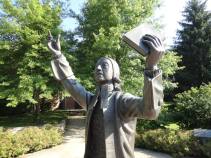
John Wesley often spoke up for the poor and their squalid living conditions in 18th century England.

When asked the nature of holiness, John Wesley (1703-91) often pointed to Mark 12:28-31. All of the commandments are summed up in just two: Love God and love your neighbor. This love is the essence of holiness and it is the foundation of all compassion.

In recent years, we’ve spoken of compassionate evangelism. Now it is time to lift the banner of compassionate advocacy. Advocacy is concerned for social justice. As such, it is hardly a distraction from Gospel work. Rather, it is part-and-parcel of the church’s holistic Good News. In his article, “Social Justice in the Bible,” Dominik Markl notes:

Prophets such as Isaiah and Amos raise their voices on behalf of the poor and the marginalised, those belonging to the ‘weaker’ social groups. God himself prescribes a brotherly and sisterly social order in his Torah, and, in the same divine wisdom, Jesus develops a Christian ethics of love.

Those who are not followers of Christ will judge those of us who are by how we treat people who have nothing to offer in return. Right now on the Standing Rock Sioux Indian Reservation in North Dakota, a few thousand Native Americans – water protectors, as they call themselves – are peacefully resisting the construction of a pipeline across their land. Their concern is that the pipeline is to pass under the Missouri River, potentially fouling its waters with oil in case of a spill. This is hardly an imaginary threat. On July 1, 2011, such a spill polluted the Yellow Stone River. So muscular has been the response to the current standoff in North Dakota that Amnesty International is sending human rights observers.

Why should followers of Christ care? The simplest answer is that we should care about what Jesus cares about. Isaiah 42:1-4a (CEB) is a prophecy of the coming Messiah:

But here is my servant, the one I uphold; my chosen, who brings me delight. I’ve put my spirit on him, and he will bring justice to the nations. He won’t cry out or shout aloud or make his voice heard in public He won’t break a bruised reed; he won’t extinguish a faint wick, but he will surely bring justice. He won’t be extinguished or broken until he has established justice in the land.

As a nation, we’ve done a lousy job of co-existing with those who were here before our European forbearers arrived. We haven’t cared much for these “faint wicks” or about justice in our dealings. But what about the church, particularly the Wesleyan-holiness tradition that I call home? If we are about making Christlike disciples – and that is a crucial task – then we need to cast a broader vision of what being Christlike means. It is more than abstaining from sins that defile us; it is also about coming alongside the weak and the oppressed in their time of need, standing with them in their fiery trial like Jesus stood with Shadrach, Meshach, and Abednego in the fiery furnace (Daniel 4:25). How can we read a passage like Isaiah 42 then yawn as if nothing is happening in North Dakota?

Perhaps our inaction stems in part from few of us ever being water deprived, yet water security is a growing issue around the world. Drought can drastically alter how we view this precious gift. When I visited the city of Lubumbashi in the Democratic Republic of the Congo in September 2015, they were suffering an extended drought. The missionaries with whom I stayed sometimes had to decide whether they would wash the dishes or wash themselves. Thankfully, we prayed for rain and God answered our prayer. I went away from that stay taking water a lot less for granted.

Neither do the Sioux take water for granted. They cannot drink oil nor bathe in it. You need water for that.

Some churches are speaking up. Bishop Michael Curry of the Episcopal Church issued a statement last August in support of the water protectors. In his statement, he noted the theological importance of water in Scripture, including it being the baptism symbol of new life in Christ. I commend Bishop Curry for speaking up, but it makes me wonder: As holiness people, where is our voice? If the essence of holiness is love of God and neighbor, then here is a clear-cut chance to show a historically mistreated people that we care. These are our neighbors. Where is our love?

I’m glad that God is raising up around the world a generation of believers for whom justice isses are Gospel issues. May they be patient with us who have been around a bit longer, we who have been slower to see that holiness is both personal and social. And once we’ve seen, may the Lord move us to compassionate advocacy.

Posted in parables, pastoral care

Parable of the trapped weaver

weaverMy wife and I live in a 3rd floor flat. This morning as we walked down the stairwell, we heard the noise of desperately flapping wings. A little weaverbird was trapped behind a closed window pushing with its beak against the glass, trying with all its might to open the window and escape. But all her efforts were in vain. Not wanting to get too close to the bird (which probably would have sent the already terrified  creature into cardiac arrest), we opened a nearby window.

I’m not sure what the attraction was for the weaver to fly into that stairwell in the first place. Likely, she came in through the gate at the bottom of the stairs. I’m no good at puzzles, but even I could see the solution. Freedom was as close as that slotted gate through which the weaver apparently had entered. To get out, she just needed to turn around and fly back to where she got in.

All around us are people just like that weaver. They once flew free, but somewhere they took a wrong turn. Now they are trapped behind the glass window of addictions. They push against the thick panes of alcoholism, drugs, gambling, or pornography. The longer they’re trapped, the more desperate they become. Through the window, they see the freedom they once knew and they long to enjoy it once more. But to get out, we too must retrace our steps to where we got in. To go forward, first we must go back.

Scripture has a lot to say about repentance, this change of mind and heart that is a prerequisite for freedom. Repentance is letting God turn us around and head us in the opposite direction. In Acts 3, God used Peter as the divine instrument of healing for a man crippled since birth, a man who used to sit begging at the Temple gate (see Acts 3:1-10). Now as the restored man jumped for joy, a crowd gathered out of curiosity. What would Peter say?

  1. It wasn’t me or my companion, John, who did this. It was Jesus (v. 16).
  2. Turn to God (v. 19).

Peter advised:

Repent then, and turn to God, so that your sins may be be wiped out, that times of refreshing may come from the Lord (Acts 3:19, NIV).

I suspect there were a lot of people listening to Peter that day who were every bit as trapped spiritually as that crippled man had been physically. Just as Jesus freed the man physically, he was able to free the crowd spiritually. But there was something they needed to do first. They needed to repent, to be willing to let a loving and powerful God turn them away from their sinful habits and attitudes and lead them in a new and better direction.

It takes humility to admit that we’re trapped, that the only way forward is to go back. Too proud to ask for help, like the weaver, we keep pushing desperately against the window pane, thinking we’re strong enough on our own to escape some other way. Freedom only begins when we admit we that we’re powerless to solve our problem alone.

Peter’s advice to the crowd that day is the advice we need now. God longs to free us from our sin, from the dead end of our addictions. With Jesus by our side, let’s retrace our steps and head in the opposite direction. Freedom is glorious, and it’s closer than we think.

—————–

Image credit: Flickr.com

Posted in book reviews

A brew that is true?

Agbonkhiameghe Emmanuel Orobator, SJ

When I first drank coffee, let’s be honest: I hated the taste. The only way I could enjoy it was if I doctored  it with copious amounts of sugar and cream. Then, over time, I wanted more coffee and fewer additives. What happened? The taste grew on me.

As with coffee, so with theology. Having read Agbonkhianmeghe E. Orobator’s Theology Brewed in an African Pot (Orbis: 2008, Kindle edition), I really wanted to like it. After all, he is doing what I want my own Kenyan students to do, not to parrot theology seen through a Western lens but to contextualize theology for their own setting. But at least on a first read-through, I’m reminded of coffee. I may need some time for the taste to grow on me.

Let’s consider a positive aspect of Theology Brewed in an African Pot, namely, the strong chapter on ecclesiology. As a Wesleyan, I am closer in some ways to Orobator’s Roman Catholicism than a Baptist or Presbyterian would be. Both Wesleyans and Catholics emphasize the importance of holiness. Moreover, this holiness is never meant to be a solitary pursuit. John Wesley (1703-91) refused to advocate a kind of faith that was individualistic. Instead, he organized his followers into small groups for encouragement and accountability. In the same way, Orobator develops the nexus between the corporate emphasis of Catholicism as the people of God and the solidarity of African cultures, where “I am because we are.”  Church is not just a loose organization of individuals; rather, Church is family. He clarifies (locations 1465-1470):

In many parts of Africa, family is an important value and dimension of religious, socio-cultural, political, and economic life. Social systems in Africa pivot on the family. When Vatican II declares that the church is the people of God and a communion, we understand this to mean that within the context of the African Christian community, the church is family. Therefore, the corresponding and appropriate model of the local church in Africa is Church as Family of God.

In the Nazarene congregation where I grew up, our pastor had a time in the service where we would sing the Gaither standby, “I’m so glad I’m a part of the family of God.” While we sang it, we’d shake hands with others around us. Indeed, as I’ve traveled the world, the church as my extended family has been a comfort, an anchor when my life has been mostly sail. So when Orobator speaks of the church in this way, it resonates with my own heart, a reminder that the metaphor of the Church as family is not reserved just for African Christians. It’s an idea that resonates with many cultures on diverse continents.

While I appreciate Orobator’s ecclesiology, I cannot say the same about his view of the ancestors. Chapter 9 – “Our Fathers and Mothers Who Art in Heaven” – presents the conception of African Traditonal Religion (ATR) re. the ancestors as compatible with Christian faith, but is it? Some of what he claims is innocuous enough, such as the value of recounting the stories of those who have gone before us, what he calls the “communion of saints” (location 1865). Where he veers into dubious territory is when speaking of the “living dead” (ancestors) as protecting us (location 1889, emphasis added):

…Through the active presence of the living dead, the community grows qualitatively, because, as ancestors, they have only one duty: to protect the lives of their progeny. In many different ways we celebrate them. We rejoice in their presence.

Likewise, an ancestor is for Orobator an “intercessor,” taking petitions to a “Supreme Being” (location 1899). Roman Catholicism – through its cult of Mary and the other saints – is amenable to those like Orobator who want to maintain a place for the ancestors that goes beyond verbal honor to believing that ancestors are active in our daily lives.

Yet is the idea of ancestors as protectors and intercessors biblical? When Paul was caught in a storm, he did not ask an ancestor to intercede with God for their protection. Rather, God sent an angel to Paul who re-assured him that he and the others in the ship would be spared. “Be encouraged, men! I have faith in God that it will be exactly as he told me” (Acts 27:25 CEB). It is an angel in this instance (not an ancestor) who acts as a messenger of God, as a go-between, assuring him of God’s protection. Yet even here, we must be careful not to be distracted by the angel. Prayer is never directed to angels by Paul in any of his letters; rather, his prayers are addressed directly to God. (Ephesians 3:14-21 is one example). Intercession is the role neither of ancestors nor of angels. Rather, intercession is lodged squarely in the heart of the Trinity. Jesus is our High Priest and intercedes for us (Hebrews 7:25). Likewise, the Holy Spirit interecedes with the Father, even groaning on our behalf (Romans 8:26), a sure sign of his loving concern.

By attempting to reconcile Christian faith and the cult of the ancestors, Orobator has arguably opened a door to syncretism, an amalgam of religious worldviews that cannot mix and remain consistent with biblical faith. His may be a theology brewed in an African pot, but can the brew be healthy when it has been compromised in this way?

Orobator should be commended for wrestling with his own religious heritage passed down to him from his ancestors and the variety of Christian faith that as a young man he chose to follow. Indeed, we all must hammer out our own faith and do our best to see where our own culture of origin has made us blind to important aspects of the Bible. Theology, after all, is not only brewed in African pots. It has also historically been brewed in German, British, and American pots, among others. The challenge for any of us is to accept the critique of those who stand outside our culture. They can sometimes help us discern in the theological brew that we serve up distasteful elements to which we are oblivious.

By reading Orobator’s Theology Brewed in an African Pot, the reader discovers how theological contextualization can be an effective, positive impetus for evangelization. On the other hand, the book is simultaneously a cautionary tale of the doctrinal compromise that can be the unwitting result of the desire to make the Gospel more appealing in any given setting. May God continue to give us wisdom as we walk together as brothers and sisters in Christ, engaging this essential but delicate task.

Posted in Bible

Back to Genesis…and the First Testament

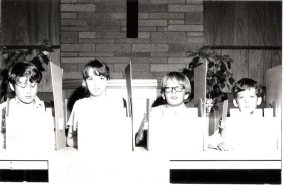
Behind our quizzing boxes. I’m the “I refuse to smile at this picture” boy on the right.

It’s hard for me to read Genesis without being transported back in time to the corner room under Lancaster Hall at Trinity church. There as a boy of 8, I came every Wednesday night and joined a dozen other children as my mother (Marilyn) and her friend, Judy, put us to the test. Perched behind our cardboard boxes, we’d listen to the multiple choice questions on Genesis then answer by pulling out one of the cards numbered 1 to 4. As a junior quizzer, I soaked up God’s Word; it still fascinates me.

We Christians underestimate the impact on our faith of Genesis and the Old Testament generally. Dr. Alvin Lawhead for many years taught Old Testament at Nazarene Theological Seminary. My wife and I attended the same congregation as he did in the Kansas City area. Sometimes he would preach and invariably his text came from the Old Testament. As he took his place behind the pulpit, some took out their New Testament and waited for him to announce his text. He’d ask us to turn to a portion in Jeremiah or Isaiah, then good naturedly would lower his glasses on his nose, smile, and query:

You haven’t left 2/3 of your Bible at home, have you?

Dr. Lawhead’s point was well-taken. Truth be told, we don’t practice a Christian ethic as much as we practice a Judeo-Christian ethic. The church decided early on – thanks to the controversy with Marcion – that we accept the 39 ancient books we inherited from the Jewish people as part of our Christian Scriptures. While it is true that we must always determine what a specific Old Testament teaching has to say to us in the light of Christ and the New Testament, it’s surprising how many Old Testament teachings are taken up without change by Christians.

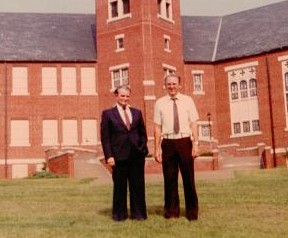
Dr Lawhead (left) poses with an unknown Seminary student
Dr. Lawhead (left) poses with an unknown Seminary student

When I’ve taught biblical interpretion to pastors in Africa, to explain the relationship between the Testaments, I’ve used the illustation of two e-mails announcing a meeting. Imagine that you check your e-mail and find the following message from me:

Please join me next Tuesday at 7:30 a.m. in Helstrom 6 for a short prayer meeting.

On Monday, you receive a second e-mail from me:

Our short prayer meeting together next Tuesday at 7:30 a.m. will be held in Helstrom 9.

I then ask my students: Where will you me meeting me for prayer next Tuesday at 7:30 a.m.? Invariably, they will answer: We’ll be meeting you in Helstrom 9.

Now, a student might go to Helstrom 6 and end up praying alone. What went wrong? She hadn’t read my most recent communication which I’d sent. It would be no defense for her to say that my first e-mail cleary stated that Helstrom 6 was the venue. The later communication augments the former.

God has given us a more recent message called the New Testament. In this revelation – especially as seen in the birth, life, death, and resurrecton of Christ  as well as his teachings – something important has been added. Michael Lodahl in The Story of God calls it a “new twist in the story.” And there is no denying that this is an important twist!

Continue reading “Back to Genesis…and the First Testament”

Posted in parables

When only heat will do

furnaceWhen it comes to working with glass, only heat will do.

The craftsmen at Anselm Kitengala glass outside Nairobi, Kenya know this. That’s why they have an oil fed furnace that glows at 1,200 degrees Fahrenheit. The extreme heat makes the glass pliable, allowing them to mold it into useful shapes, whether vases, pitchers, plates, goblets, or a dozen other items.

What’s true about glass works is true about life. I think back on furnace times, when circumstances were hot and difficult to endure. Sometimes it was interpersonal conflict, other times sickness or financial difficulties. Yet God, the master Craftsman, used these times to mold my character, to teach me to rely on Him, to shape me just how He wanted. Though not easy at the time, I’m better today because of it.

I’m glad life isn’t always in the furnace. When the craftsman is done, he places the glass vessel into the annealer where it can gradually cool to room temperature, usually over a 24 hour period. These are the peaceful periods of life when God allows a calm stability to take hold, a time of reflection and thanksgiving to the Lord for taking us through the fiery trial.

Peter was a fisherman, not a glass worker. However, he seems to have understood the role that fire plays in developing our character. In 1 Peter 4:12-13 (NIV) he observes:

Dear friends, do not be surprised at the fiery ordeal that has come on you to test you, as though something strange were happening to you. But rejoice inasmuch as you participate in the sufferings of Christ, so that you may be overjoyed when his glory is revealed.

vase

Whether we’re in the furnace or the annealer, let us thank God for caring enough to shape our character, to make us like Christ. The end result – a beautiful and useful vessel – is worth it.