Posted in sermons & addresses

Apple pies, clay jars, and fresh starts

Pottery wheel in Rhodes, Greece 2010
By Wknight94 talk (Own work) [GFDL (http://www.gnu.org/copyleft/fdl.html) or CC BY-SA 3.0 (http://creativecommons.org/licenses/by-sa/3.0)%5D, via Wikimedia Commons
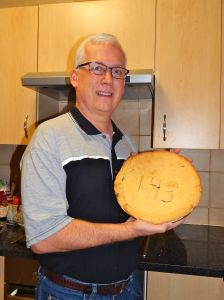
My wife says I make the best apple pies. I don’t know if that’s true. Our now grown sons didn’t seem to mind helping devour them (with some melting vanilla ice cream on top) on those rare occasions when I ventured into the kitchen and the aroma of a fresh baked pie soon filled the house. When it comes to baking apple pie, it’s really not preparing the apples that discourages me; that’s the simple part. And it’s a cinch to mix in the sugar and cinnamon. The part that’s tough, the part that keeps me from making apple pie more often, is the crust.

Crust either makes your pie, or breaks it. Where I usually get into trouble is not when adding the butter, or the small amounts of water. That’s easy; what’s tough is using the rolling pin. You have to roll it out to just the right thickness, just the right size to fit in the bottom of the pie plate. And the real trick is making sure you put enough flour on the rolling pin. Otherwise, the dough will stick to it. A time or two, when I was trying to roll out the dough to just the right thickness, it became so hopelessly stuck to the pin, that I had no choice. I gathered up the dough, shaped it back into a round dough ball, and started all over again. The second time around, I had enough flour. The dough cooperated this time, and I ended up with a nice, thin, tasty crust. What was the secret? I had to be willing to start over.

Lessons from Jeremiah 18:1-4

They didn’t have pie crust back in the prophet Jeremiah’s time, but God was about to teach Jeremiah a similar lesson. Sometimes, you just have to start over. In chapter 18, the Lord tells the prophet to go down to the potter’s house. In some ways, I think Jeremiah must have been relieved. At least God wasn’t asking him to do what he asked the prophet Isaiah to do once as a sign to Israel, to parade around stripped and naked! This assignment seems pretty simple. Jeremiah is to watch the potter as he works the clay on the wheel, making a pot.

I wish I could show you what the wheel looks like. I found a drawing in one of my books. Imagine a large stone wheel on bottom, then connected by an axle to a smaller stone wheel on top. The potter sits at the wheel, with the clay resting on the top, smaller wheel. Then, with his feet, he turns the bottom wheel, which makes the top wheel spin. And of course, that makes the clay spin, allowing the potter to form it with his hands.

So there sits Jeremiah, watching this craftsman working. And the more he watches, the more enthralled he becomes. Jeremiah was probably never a priest himself, but he came from a long line of priests. So while he might have seen a lot of sacrificing of animals by members of his family, it’s doubtful he knew much about pottery. And as he sits and watches the pot take shape, suddenly, something goes wrong. Look at verses 3 and 4 of Jeremiah 18: “But the pot he was shaping from the clay was marred in his hands; so the potter formed it into another pot, shaping it as seemed best to him” (NIV). Here’s how the New Living Translation reads: “But the jar he was making did not turn out as he had hoped, so the potter squashed the jar into a lump of clay and started again.”

There are lots of lessons that Jeremiah 18 has for us. Let’s take a few minutes and look at three of those lessons:

  1. God believes in second chances.
  2. New beginnings are usually painful.
  3. God wants to mold us into the image of Christ.

God believes in second chances.

Let’s take a look at that first lesson. God believes in second chances. There’s a word for that; it’s called grace. Theologians define grace as “the unmerited favor of God.” That means we don’t deserve it. In fact, because of our sin, our disobedience to God’s good law, the only thing we deserve is punishment.

Punishment is certainly what Israel, God’s chosen people, more than deserved. God had warned them long ago, when they were just starting out as a nation, that obedience would bring God’s blessing, but disobedience would result in divine curses. Deuteronomy 27-28 talks about those blessings and curses. Listen to the words of Deut. 28:1-6 (NIV):

If you fully obey the LORD your God and carefully follow all hiscommands I give you today, the LORD your God will set you high above all nations on earth. All these blessings will accompany you if you obey the LORD your God: You will be blessed in the city and blessed in the country. The fruit of your womb will be blessed, and the crops of your land and the young of your livestock – the calves of your herds and the lambs of your flock. Your basket and your kneading trough will be blessed. You will be blessed when you come in, and blessed when you go out.

But something had gone terribly wrong. Jeremiah 18:3 says that the clay pot was marred in the hands of the potter. God’s people, using their own God-given free will, had chosen poorly. They forgot that the same God who has promised blessings for obedience in Deut. 28 had warned of curses for disobedience just one chapter earlier. Deut. 27:15 says: “Cursed is the man who carves or casts an idol – a thing detestable to the LORD, the work of the craftsman’s hands – and sets it up in secret.” Yet we now that, with the exception of King Josiah, who had tried to turn the people to the worship of the one true God, most of the recent kings of Judah had set-up public worship to other gods. The true God, the God of Abraham, Isaac, and Jacob, had become just one more god worshipped alongside others.

But there’s the potter, working away on his wheel. The jar he was making didn’t turn out as he had hoped. Jeremiah doesn’t go into too much detail, he just says it was “marred.” In any case, there was no way in its present condition that it would be a useful jar. No one would pay good money for it at the marketplace. The potter could have said: “Forget it. This clay is no good.” He could have thrown it aside, sent out his apprentice for some fresh clay. But he does something else. The potter squashes the clay, and starts all over again. The potter doesn’t give up. Brothers and sisters, hear the Word of the Lord this morning: God is a God of grace. God believes in second chances.

I don’t know what you’ve done; I don’t know what your sin is. I’m pretty sure, though, that Satan has told you time and again: “Forget it. God can’t forgive that. You’re over the line. You’re beyond help.” But Jesus tells it like it is. Satan is the Father of lies; don’t listen to him. Jesus stands with his arms outstretched, ready to forgive you, ready to say to you, like he said to the woman caught in adultery: “Woman, where are your accusers? Has none condemned you? Then neither do I condemn you. Go now, and leave your life of sin” (John 8:10-11, NIV). Jesus believed in second chances. And even if you need a third chance or a fourth or maybe even more, there is a place of beginning again. Just like the potter squashed the clay, and started over again, you can have a fresh start. You can’t change yourself, but God can change you. Are you willing to be changed?
Continue reading “Apple pies, clay jars, and fresh starts”

Posted in ecclesiology & sacraments, reflections

Running toward evil

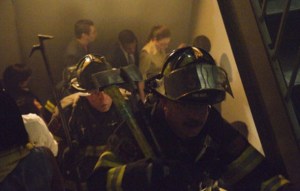
Firefighers ascend the World Trade Center on 9-11-01

We’re far enough away from the celebration of the 15th annivesary of the destruction of the Twin Towers to reflect on some of its lessons. There is one image that inspires me most: First responders ran toward the evil, not away from it. As people descended the stairs of the World Trade Center, firefighters ascended, not unlike police who run toward the sound of gunfire, not away from it.

This is a useful metaphor of how the church at her best should operate. When we see systemic evil, should we not run toward it, by our presence carrying the light of the Gospel into the darkest of places? Yesterday I listened to a paper presented by a pastor. His topic was corruption in society and how the church can respond in ways to weaken corruption’s grip. In the African nation where this pastor lives, raising his voice too loudly can have consequences, but he has decided it is better to run toward evil with Gospel light than run away and let the darkness deepen.

But it’s not just Africa that needs light. As Americans, have we romaticized rural areas as “God’s country” while avoiding large cities as if they are under the curse? Now as the drug epidemic impacts small villages and towns, it’s only reluctantly that we’ve admitted the problem is not geography but the human heart. If we invite believers to run toward cities it’s not that rural areas don’t count. It’s only that cities have more people whose hearts need the transforming work of God’s grace. Cities set the moral pace for a nation at-large, so it makes sense that we as Christ followers would want to live there, showing another way to live, a better way, a loving way, a Kingdom of God way.

Too often when I’ve known I should run towards evil, like Jonah, I’ve run in the opposite direction. Yet God’s question to the prophet still rings in my ears: “Should I not be concerned”? Let me be like those 9-11 first responders, going in when all the world is going out.


Posted in book reviews

A well-intentioned but misguided proposal

kennedy
Dr Philip Kennedy

Dr Philip Kennedy is a member of the Faculty of Theology and Religion at Mansfield College, University of Oxford. In A Modern Introduction to Theology: New Questions for Old Beliefs (London: I.B. Tauris, 2006, Amazon Kindle edition), he traces the rise of modernity from its beginnings and growth in the 17th/18th century  and continuing through Higher Criticism in biblical studies and the scientific revolution of the 20th century. By the end of the book, one may agree that Christian theology is in a 21st century wilderness of increasing societal irrelevance – at least in the West – but if you’re looking for Kennedy to lead the way out, you’ll be disappointed.

Let us first thank Dr Kennedy for what he gets right. As a Brit, he clearly sees the diminished influence of the church in the United Kingdom and throughout Europe, what he calls as the title of chapter 2 “Christianity’s current predicament.” Kennedy laments: “Untold numbers of contemporary human beings in the industrialized, commercialized and digitalized Occident now prefer to spend Sunday mornings in gymnasiums rather than churches. Why?” (chapter 2, Kindle location 655). There is no question that this is a problem of immense proportion in parts of the world. This is the context in which Kennedy asks the guiding question for his book:

Should conventional Christianity radically modify its doctrine and practices in the light of advanced knowledge generated in modern times? Or ought it to perpetuate itself in contemporary settings by recapitulating ancient wisdoms? (chapter 2, location 619).

By the end of the book, having rehearsed several centuries of challenges to Christian faith originating from diverse academic quarters – from Nietzsche, Feuerbach, Freud, Hick, Darwin, and a dozen others – it comes as no surprise at the book’s end when Kennedy concludes: “My answer to the book’s impelling question – as might have been guessed! – is that Christianity and its traditional theology need far-reaching revision” (From the Conclusion, Kindle location 5541).

So far, so good – there’s a problem that has developed over centuries, and a huge one at that. Yet there seems to be at the same time a certain prejudice just under the surface that shows up in subtle ways. Also in the Conclusion (location 5526), Kennedy observes regarding dismal church attendance in the U.K. –

The principle reason they stay at home is that they are educated enough to realize that the world and its inhabitants can no longer be described in terms unaware of the findings of modern science.

This seems like a backhanded way to affirm that the more you are aware of science, the less you will be a person of faith. Strangely, Kennedy offers no evidence to substantiate his implication. In fact, groups such as BioLogos are creating spaces where those who love God and biology can pursue both, confident that faith and scientific research are complementary, not contradictory. John Polkinghorne, formerly an astrophysicist, is now an Anglican Priest, another example of a person who has not felt compelled to choose between Christian faith or scientific pursuit. Kennedy would have done well to give some treatment to these promising conversations that are happening.

A second assumption that Kennedy makes is that “pre-modern” theology – by which he means that in the tradition of Aristotle, Augustine, and Thomas Aquinas – cannot flourish in the modernism of the 21st century. (One can question his reliance on the term “modern” as a way to describe the contemporary Western scene vs. the majority term “postmodern”). While he does doff his hat at several points to the growth of the church in the Global South – where contrary to his thesis, traditional theological constructs still rule the day – he seems to be unaware that the fastest growing Christian confessions in the United States are those promoting more ancient expressions of Christian faith, such as the Orthodox Church in America. (Note: Part of this growth can be attributed to immigration). American Millenials are increasingly leaving Evangelical churches, gravitating to communities of faith with a much deeper and historic form of worship, often more liturgical or “High Church.” This counter-evidence of attendance trends seemingly validating ancient faith is debatable, for sure, but it’s a debate Kennedy does not engage.

Finally, the tenor of Kennedy’s book is unduly anti-supernaturalistic. The assumption seems to be that since a scientific worldview now dominates, to survive, the church must abandon a conception of a God who performs miracles like those described in Scripture. But is this assumption based on a faulty binary thinking, i.e. that we either believe in naturalism or supernaturalism? Is it not possible to affirm both? For example, we go to the doctor for what ails us and are addicted to our cell phones, yet many in Western cultures are pushing out the edges of their technological worldview to encompass belief in the supernatural. J.K. Rowling’s Harry Potter series is exhibit A of the hunger of Brits and other Westerners for what is beyond the natural realm. When I was in France for language study in 1994, an edition of the Nouvel Observateur (a popular French magazine) noted that there were more practicing wizards in France than Protestant pastors. While the church was anemic, belief in the supernatural was robust. My children were enrolled in the French schools and it was surprising to see how much of French children’s literature spoke of witches and warlocks. This seemed to go beyond the realm of imagination to the realm of explanation, an attempt to add another interpretive framework to that of science alone, and this in the country that was at the forefront of the Enlightenment detailed at length by Kennedy — see chapter 4.

When we look at what variety of Christianity is growing best in the world – including in Kennedy’s United Kingdom – it is the Pentecostal strand of Christian faith, one that takes most seriously the reality of unseen forces. This growth arguably is happening because it takes into account the conceptual framework of Hollywood films that promote vampires, zombies, and other para-normal phenomena. Whereas a purely rationalistic type of Christianity denies miracles, Pentecostalism acknowledges evil forces and the many ways in which they can be manifested — see Ephesians 6:10-18. At the same time, it assures followers of Christ that Jesus is the Christus Victor, the one who has through his death and resurrection triumphed over it all! Ours is not to cower in fear but to push back the darkness, bringing in the Kingdom through the power of the Holy Spirit. In short, such a worldview need not deny the truths of science. However, it adds to its explanatory repertoire realities no less true for being invisible and transcending the natural realm, phenomena that the Bible describes as angels and demons and which may include the idea of systemic evil.

Philip Kennedy has written an introduction to theology that rehearses historic challenges to a Christian worldview. For that, he is to be commended; as theologians, ours is to engage challenges, not stick our head in the sand. I don’t doubt that his recommendation of radically revising Christian orthodoxy is well-intentioned. Notwithstanding, his proposal is misguided to the degree that it does not sufficiently factor in contrary evidence. Chief among this evidence is the striking advance of a type of Christianity particularly in the Global South (Latin America, Africa, and Asia) that is much closer to the plain reading of Scripture that he finds problematic. Indeed, the correct response to the decline of Christian influence is not to water down our wine, but to remember the One who turned water into wine.

Today, youth are more open than ever before to the supernatural as a reality and not just fantasy. At such a moment, it would be tragic if we heed the call of Dr Kennedy and jettison the very elements of Christian faith contained in Scripture that are most likely to connect with the youth of our post-modern world.

Posted in eschatology

Between the already and the not yet

dawnThe phone rang with the tragic news. My thirty-something pastor friend, Tim (name changed), was dead. He had tried to swerve, but the small sedan took the brunt of the oncoming eighteen-wheeler. The car overturned, coming to rest upside down. The emergency crew unbuckled Tim from the driver’s seat and raced him to the hospital. It was too late. His wife survived the crash, but Tim passed away.


Tim had pastored a radically charismatic storefront church. He had preached that God does miracles in our day, that He can even raise the dead. When some members of his church arrived at the hospital, they asked where their pastor’s body was being stored. Steven (name changed) – my friend and Tim’s and a fellow pastor from another charismatic church – was there to comfort the family. “We believe God is going to raise our pastor from the dead,” one of Tim’s church members announced to Steven. “Will you come and pray over Tim with us?” Steven refused; he even dissuaded them from doing what they planned. For days, one member told others that her pastor wasn’t dead, he was only “on vacation” and that he would soon return. A few days later, many attended his funeral and shed tears of sorrow. Tim had been well-loved. As best we could, we comforted his traumatized wife. Tim was buried; there was no miraculous resurrection.

This is an important dividing line between various church traditions. It is the eschatological question of the “already” vs. the “not yet.” All Christians believe that when Christ came to earth, he inaugurated the Kingdom of God. This is what Jesus meant when he said that the Kingdom of God was “in your midst” (Luke 17:21). Throughout Matthew’s Gospel – often dubbed the “Gospel of the Kingdom” – Jesus told parables of the Kingdom, but he did much more. He made the Kingdom concrete by healing the sick, opening the eyes of the blind, mulitplying loaves and fish to feed the hungry, and even making the winds and the waves obey his bidding. He brought the dead back to life. Already – it’s a word that unscores that Jesus got the ball rolling, that through his ministry – like rays of light penetrating the darkness at sunrise – the Kingdom had begun to dawn.

More than any group of believers, charismatics are the people of the already. Did not Jesus say that we would do even “greater things” than he did (John 14:12)? The spiritual gifts spoken of by Paul in 1 Corinthians 12-14 were not for the first centuries alone, as some claim. Charismatics more than any other Christian tradition emphasize that gifts are for the here-and-now, powerful endowments given by the Holy Spirit to the Church that allow her to carry out her ministry in a triumphant manner, opposing the forces of evil and advancing the Kingdom of God on earth.

Seen in this light, it’s less surprising that Tim’s church member would expect God to raise their pastor. Yet most Christian traditions have been reluctant to see everything through the single lens of the already. Long experience has taught us that we live in a world of suffering, that bad things happen to good people. Though we see the rays of a dawning Kingdom, the full light of day has not yet come. As long as we are caught in the parentheses between the already and the not yet – as long as Jesus has not yet returned to consummate the Kingdom – tractor trailers will slam into cars and good people will die, even good pastors. A thousand other heartaches will strike – the cruelty of cancer, the horrors of war, the madness of terrorism. Jesus tells us to pray “your kingdom come” (Matthew 6:10) precisely because we’re not yet there. Maranatha! Come, Lord Jesus.

I believe God can still work miracles, but I’m not counting on it. Even when we look at the Gospels, we don’t see everyone getting a miracle. Yes, a handful received their sight, but what of those who couldn’t make it to Jesus? Lepers were cleansed, no doubt about it, but surely many still went to their grave still suffering from the skin disease. As for resurrection? Jesus raised three from the dead, namely, the widow’s son at Nain, Jairus’s daughter, and Lazarus (Luke 7:11-17, Matthew 9:18-26, John 11:1-44). That is an infinitessimally small amount compared to the many who remained dead. Even the Acts of the Apostles record only one instance of Paul raising the dead (Acts 20:7-12). This is not to denigrate the signs and wonders that our Lord performed nor those performed by Peter, Paul, and others. Rather, it’s a caution to those who lean too heavily toward the already. Martha confessed her faith that Lazarus would be raised on the last day (John 11:24). Jesus had other plans for her brother, but Martha’s confession of faith is still the default one for believers today. The Apostles’ Creed places faith in the resurrection of the dead at the very end of the Creed, after our confession that Jesus will return to judge the “living and the dead.” Life everlasting follows the resurrection but after the return of Christ, not now. We’ll get there, but we have not yet arrived.

Where does that leave us? I believe our charismatic friends serve an important role. They are a corrective to churches that are lifeless, where the winds of the Holy Spirit have not blown in decades. By reminding us that Jesus has already inaugurated the Kingdom, they encourage us to push back the darkness, to live into the Kingdom. Yet we must be careful not to set up our people for a fall, to promise in the now what Jesus has only reserved for later. There is an already, but there is also a not yet. May God give us the courage to trust Him for what He longs to give us in the present and the patience to wait for what God has kept back for a future time.


Posted in reflections

On obscure Olympians and unsung disciples

olympicsAs the Olympics in Rio wind down, I’m struck by one main takeaway: We haven’t really seen much of the Olympics.

Sure, we saw some athletes celebrated, headliners like Michael Phelps, Simone Biles, and Usain Bolt. Yet the organizers of the 2016 summer Olympic Games report that more than 11,000 athletes are competing this year. Among those 11,000 are hundreds whose stories of discipline triumphant will never be publicly celebrated.

The level of commitment that it takes to even make it to the Olympic Games is staggering. I’ve managed to string together 2 weeks of early morning walks – not runs or swims or rowing, mind you, just brisk walks – and I’m proud of myself. Now imagine pushing yourself to your limits not for 2 weeks but nearly every day for years on end and we begin to catch just a glimpse of the commitment of athletes to their sport.

What is true in the sports world is true in the church. We have our Phelps-like “superstars,” leaders like Billy Graham and Rick Warren, Joyce Meyers, Tibi Joshua and Pope Francis. They are the headliners, the ones people know about. Yet there are many who never garner attention or praise, never capture the public spotlight who are nevertheless the journeywomen and journeymen whose quiet discipline and low-key faith in Christ make the church work. We won’t hear much about them, yet without them and their commitment to service under-girded by spiritual discipline, the Kingdom would stall.

Yet whether we are a headliner or one who is little known, Paul’s charge to us is the same:

Do you not know that in a race all the runners run, but only one gets the prize? Run in such a way as to get the prize. (1 Cor. 9:24, NIV).

While some will win a “crown that will not last” (v.25a), we all are focused on the “crown that will last forever” (v.25b). What is Paul saying? For most of us, the spiritual discipline that fuels our service in the Kingdom will go unrewarded on this earth. Yet we have a God who sees and who one day will recognize excellence. Discipline uncelebrated here and now will be rewarded there and then (Matthew 25:23).

Reward on the last day is extrinsic, yet there is an intrinsic motivation for spiritual discipline. Yes, God will one day reward faithfulness, but spiritual discipline has value in itself, and that value is participating in the life of God (2 Peter 1:4). God is our recompense.

Though she had won the gold medal, Olympic wrestler Helen Maroulis admitted: “Yesterday was about stepping on the mat and just wrestling to the best of my ability and really taking joy in what I do.” Yes, the gold medal was an honor, an extrinsic motivation, yet the greater motivation was intrinsic, “taking joy in what I do.” Such an internal motivation is primary, and – in her case – fortunate, since the media seemed more interested in reporting on the juvenile antics of male American swimmers outside the pool than her exploits on the mat.

One day, God will reward every unsung disciple for service often unnoticed and underappreciated this side of heaven. Meanwhile, let’s remain faithful, knowing that the greatest reward is here-and-now, and that reward is God himself. He is enough!

Image credit: publicdomainpictures.net


Posted in Bible

One Book, two approaches

chevalier_tuckerIn the film “Gigi,” Maurice Chevalier and Sophie Tucker sing the unforgettable “I remember it well.” (Click link to watch song). The aged couple reminisce about how they first met so many years ago. What’s strange – and comical – is that they agree on few of the details. On that day, was it raining or was it sunny? Did they meet at 9 a.m. or 8 a.m.? Was he on time to pick her up, or was he late? By the end of the song, there are many of these at-odds-with-each other memories. What is amazing about the song, however, is a simple realization: The details really don’t matter. What matters is that they met and fell in love. That fact no one can deny.

“I remember it well” has something to teach us when we come to Scripture. There are times when the Bible itself “remembers” it in two different ways:

  1. Were humans created on the sixth day or the fifth? Before re-reading Genesis, I would have confidently told you that humans – along with animals – were created on the sixth day. So says Genesis 1:24-26. Yet it’s not quite that simple. The Bible also says that humanity was created “on the day the LORD God made earth and sky” (see Gen. 2:4b and 7, CEB). Exactly when did God make earth and sky? Genesis 1:20-23 is clear: That happened on the fifth day. The details differ.
  2. Were there two angels at the empty tomb or one?  The resurrection of Jesus Christ is the crux of the Christian faith. That makes it all the more surprising to see that the Gospels themselves have different memories of one of the details from that morning. Matthew 28:2 recounts a single “angel of the Lord” who comes down from heaven and rolls away the stone. On the other hand, Luke 24:4 speaks of two “men” who were dressed in “gleaming bright clothing” (CEB). So which was it, one messenger from heaven or two? The details differ.
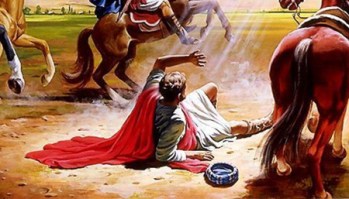
  3. What did Saul’s traveling companions on the road to Damascus experience? There is an intriguing variance in the details of the story of Saul’s conversion on the road to Damascus. While Saul was encircled with a light from heaven and fell to the ground – even as a voice from heaven spoke to him – his traveling companions “heard the voice but saw no one” (Acts 9:7, CEB). Later defending himself before a crowd in Jerusalem, Saul (now Paul) recounts: “My traveling companions saw the light, but they didn’t hear the voice of the one who spoke to me” (22:9, CEB). Did the companions hear the voice or didn’t they? The two possibilities are mutually exclusive.

saul

What is the takeaway from Genesis 1-2? We do not stake our faith on harmonizing two divergent creation stories in every detail. Rather, we understand the bottom line, that God is the creator, however he happened to create. That’s what matters.

And the resurrection? Whether there were two angels at the tomb or one in the last analysis is unimportant. What all four Gospels attest is that Jesus rose from the dead. That’s what matters.

What shall we say about Saul’s traveling companions? Whatever they saw or heard, one fact is undeniable: On the road to Damascus, Saul met the risen Christ and the man from Tarsus was never the same! We must not lose sight of that crucial takeaway, however the minor details in Paul’s recounting might vary.

Behind these three examples are two different ways of reading holy Scripture, one fundamentalist and one flexible. The first is uptight when seeming discrepancies arise; the second realizes that – while many discrepancies can be resolved – it’s vital not to neglect the main point by getting distracted by incidentals. Don’t overlook the forest for the sake of the trees.

As a child, I sang the words to a simple song:

The B-I-B-L-E

yes that’s the book for me!

I stand alone on the Word of God

The B-I-B-L-E.

If the Bible is the firm foundation on which I stand, then logically any apparent discrepancy must be explained. Much is at stake, after all, my very faith. Yet Wesleyans have taken an approach different than that of fundamentalists. We do not believe that the Bible itself is our foundation. Rather, it is Christ who is the firm place we have planted our feet. Scripture points us to him. While the Bible is imperfect, Christ is perfect. He is the One in whom “all the fullness of the Deity lives in bodily form” (Colossians 2:9, NIV). He is our place to stand.

Chevalier’s and Tucker’s charming song has something to teach us. Was it raining or fair weather when they met? Did their outing get a late start or did it begin on time? Was it 8 a.m. or 9 a.m.? When all was said and done, the affectionate old couple didn’t care. What counted was that they had met and that they had fallen in love; there was no denying that. As we come to Scripture, their attitude is worth emulating. There are details that Scripture itself remembers differently, but of one central reality we are sure. Here we solidly plant our feet: Christ died, Christ has risen, Christ is coming again. Maranatha!

—-

Image credits

Chevalier and Tucker: YouTube.com

Saul: Markmcmillion.com

Posted in sermons & addresses

What does love DO?

LOVEDOESNote to the reader: I preached this sermon at the Upstate New York District Family Camp, on Sunday, July 3. Scripture quotations are from the Common English Bible.

Text: Hebrews 13:1-16

Hebrews is an amazing book! It took a long time for the church to give it her stamp of approval, mainly because we’re not sure who wrote it. But one thing is certain: We sense in it the voice of the Lord.

Chapters 1-10 explain the high priestly ministry of Christ. We see how Jesus made atonement for our sins as God’s perfect sacrifice. Now chapters 11, 12, & 13 make some practical applications to life. In view of the great sacrifice for sin, the towering Cross of Christ, how shall we live?

Hebrews 13:1 sets the tone for the rest of the chapter:

Keep loving each other like family (CEB).

Love is one of the most overworked words in the English language. Still, it is the supporting beam that holds up the whole house of Christianity. Remove that beam, and the whole structure comes crashing down. Jesus in Mark 12 even summarized all the law and the prophets with two Great Commandments:

  1. Love God;
  2. Love others.

John Wesley with his brother, Charles, was the co-founder of the 18th century Methodist movement. If Phineas Bresee was our spiritual father, as Nazarenes, then Wesley was our spiritual grandfather. Here’s what he had to say about love:

How far is love…to be preferred before truth itself without love? We may die without the knowledge of many truths and yet be carried into Abraham’s bosom. But if we die without love, what will knowledge avail? Just as much as it avails the devil and his angels.

A few years ago, Bob Goff wrote a book entitled Love Does. It’s not enough to give an abstract definition of love. We understand what love is when we look at at what love does. Hebrews 13 may be understood as a long answer to a simple question:

What does love DO?

And to that question, I see in vv. 1-16 at least 4 answers:

  1. Love welcomes.
  2. Love remembers the forgotten and the mistreated.
  3. Love lives simply.
  4. Love sacrifices.

LOVE WELCOMES

First, love welcomes. Let’s read v. 2 again: “Don’t neglect to open your home to guests, because by doing this some have been hosts to angels without knowing it.”

When we first arrived in Kenya, one of the first words we learned in Swahili was the word for “welcome” – karibu, or (in the plural) karibuni.  It literally means “come close.” The writer to the Hebrews is saying: Love welcomes. He’s reminding us that the people of God are radically hospitable, that we are a “come close” people.

Verse 2 begins by saying that being a “come close” people includes being in each others’  homes. Back in 1986, Amy and I were in Kansas City while I attended seminary. Sunday night was an important service in the life of our church because we got to know each other more informally. Sue (not her real name) was one of our close friends. I remember when 30 minutes after the service people were still visiting and laughing. The janitor needed to lock up, so Sue announced lightheartedly: “Go home, people! You do have homes?” In fact, we did, and often after Sunday morning church, we invited others over for dinner, or they invited us. Sometimes it was Sunday evening, and we’d play a game or watch a movie together, in our homes.

Have we gotten out of the habit of home fellowship? Verse 2 reminds us: “Don’t neglect to open up your home to guests…” What will that look like as individuals, as churches, as a nation? What opportunities to reach people for Christ is God sending right to our doorstep, people from other countries, moving in right across the street?

I graduated from Eastern Nazarene College in 1985 but walked the neighborhood in Wollaston (Massachusetts) once again last Tuesday. Wollaston Church of the Nazarene does not need to send missionaries to China. God has already sent a bunch of Chinese to Wollaston! The “mission field” has come to us. They own restaurants, real estate agencies, and laundromats. They send their children to the public schools. I wonder: Are we saying to the Chinese in Wollaston or those of other nationalities “Karibuni” – come close – or are we saying “go away”? The first lesson from Hebrews 13 is: LOVE WELCOMES.

Continue reading “What does love DO?”

Posted in From soup to nuts

Blueberry pie time

Greg_pieSometimes, you just have to take a break from theology. Blueberry pie is as good (and delicious) an excuse as any!

Baking is relaxing and scratches my creativity itch. I used to be totally nervous that I would add a little bit too much of an ingredient and ruin the whole thing. Now, I’m much more go-with-the-flow. It’s tough to mess things up irretrievably.

Maybe there’s a spiritual application there…

We come to God all nervous, thinking we’ve totally messed things up, and God says: “It’s not so bad.” Then he adds the right proportion of ingredients we needed to balance things out. The end result? Delicious.

To my regular readers…

Sorry things have been a bit quiet here at “Theology in Overalls” lately. Amy and I are only one week away from the movers coming, boxing up our belongings and shipping them to Africa Nazarene University in Nairobi. We arrive there in early August to begin our new teaching (Greg) and editing (Amy) assignments. These have been chocked-full days, especially since we also have a region-wide conference for our Nazarene educators sandwiched in-between, plus two months in the U.S. on home assignment (deputation) during June and July…good but hectic times.

On the other hand, I have been writing. Just 2 weeks ago, I sent off a short manuscript to a publisher, and should know within a few weeks whether it will be green-lighted. Topic? Ecclesiology. We’ll see…

Thanks for reading TIO. May Father, Son, and Holy Spirit shower you and yours today with the divine presence.

Posted in sermons & addresses

An address to the graduates of NTC and NTCCA

Greg_grad_NTCI was honored to deliver this address to the graduates of Nazarene Theological College (South Africa) on April 23, 2016 and the graduates of Nazarene Theological College of Central Africa (Lilongwe, Malawi) on May 7, 2016.

———————————–

WE ARE GATHERED TODAY in this place for a celebration. During these moments together, we pause to thank the Triune God – Father, Son, and Holy Spirit – for his grace upon the lives of these graduates. In one way, today marks an ending, the finish line for a race that these women and men have been running, some for as long as the past 3 years. Graduates, as you cross that finish line this morning, I add my voice to the chorus of voices and say: “Congratulations! Well-done.”

Yet if today is an ending, in another more important way, it is also a beginning, or – to use the traditional word for a graduation ceremony – a commencement. It is the start of the rest of your life as those who seek to be ordained ministers, leading the flock of God in one capacity or another. At such a high and holy moment, what would our Lord Jesus, the great Shepherd of the sheep, be pleased for us to consider?

Because this is a graduation address and not a sermon, I will not take a single biblical text and expound it. That is an essential skill for a preacher and one that your teachers have taught you well. But like a preacher often does, allow me to give you a Trinity of ideas, 3 words of advice as you either launch out in ministry or else continue in that path:

1) Defend the flock fiercely;

2) Hold your position lightly;

3) Cling to Jesus tightly. Continue reading “An address to the graduates of NTC and NTCCA”

Posted in sermons & addresses

Work with the end in mind

By Petey21 (Own work) [Public domain], via Wikimedia Commons

“WORK WITH THE END IN MIND”

Rev. 2:18-29

I.  INTRODUCTION

Eric, a first year college student, moved into the dormitory. Once he had arranged his things inside his room, he cut a large golden letter “V” out of paper and posted it on his door. Others often would ask what the “V” meant, but Eric never would say. When his friends went out to party, he instead spent long hours in the library. He made friends for sure, but he kept his priorities straight. The four years passed quickly, and graduation day came. The Vice Chancellor of the school introduced him as the valedictorian. Eric came to the podium, then opened up his folder. Carefully, he took out what was inside. With a huge smile on his face, he held it up a large golden “V” as his classmates burst into applause.

Eric is a good example of what Steven Covey, the leadership guru, identified as one of the 7 Habits of Highly Effective People. Here it is: WORK WITH THE END IN MIND. And that’s exactly how our passage today is structured. Revelation 2:26-29 is a description of the golden letter “V,” a picture of the conqueror, the overcomer, the victor. God desires a wonderful outcome for each of us and in Jesus’ words to the church in Thyatira we find solid advice on how best to work with the end (or the goal) in mind. Allow me to paraphrase that advice as follows:

  1. Celebrate and keep doing what is working well.
  2. Avoid pitfalls.
  3. Persevere!

II. CELEBRATE AND KEEP DOING WHAT IS WORKING WELL

In Rev. 2:18, the Son of God, Christ himself – whose eyes are like blazing fire and whose feet like burnished bronze – congratulates the church in Thyatira.

That’s a lesson in and of itself. It seems like if you steal something or shoot somebody, you get mentioned in the news. How often, though, do we as a church celebrate the achievements of our own people? Maybe one of our children won a dance contest. Celebrate it! Or perhaps one of our brothers got a promotion at work. Can we celebrate that? There are dozens of good things, wholesome achievements that fly under the radar. Maybe we don’t know about them, or maybe we do, but do we praise God for what he is allowing us to achieve both as a church and as individuals in the church?

Jesus says in verse 19: “I know your deeds, your love and faith, your service and perseverance, and that you are now doing more than you did at first.” Those are high words of praise! Who at the end of their life when the believers gather for the funeral would not want that kind of praise?

“Sister so-and-so was loving and faithful.”

“Brother so-and-so served us well and didn’t quit.”

In the same way, take inventory of your life. What are you doing well? Are you a good provider, showing up at work on-time and giving your best to your employer? Then you need to tell your spouse: “Good job! Keep up the good work.” Maybe your children used to leave their toys lying around the house, to the point where they were a hazard. But now, they’re doing better. Or maybe last term they had a “D” on their report card but this time they raised it to be “B.” That’s worth celebrating. Perhaps someone at school said a very hurtful thing to your daughter, but instead of getting bitter, she prayed and God helped her forgive them. Parents, take a minute to celebrate your daughter’s forgiving heart. It will serve them well throughout life.

It’s important to identify what we’re doing well. Several times, I’ve taught a course on preaching. One student would preach and the others would have a handout where they could write comments. After the sermon, no matter how poor, we would always before suggesting improvements take time to affirm the things the preacher had done right. Perhaps they had lots of zeal when preaching. We affirmed that. Or maybe the volume was plenty high so that everyone could clearly hear what was being said. We affirmed that, too. It was important that we sincerely praised what was worthy of praise.

God looks at you, my brother, my sister, and God sees lots to praise. You are making spiritual progress! Celebrate that in yourself and celebrate that in others.

Celebrate and keep doing what is working well.

Continue reading “Work with the end in mind”