Posted in sermons & addresses

What’s love got to do with it?

crossHere’s the sermon I preached last Sunday at the Regents Park Church of the Nazarene (Johannesburg, RSA). In some ways, love is both the easiest topic to preach on and the most difficult. I’m preaching to myself as much as anyone else.


————

“What’s love got to do with it?”

Text: 1 John 4:16-21

Intro

The word “love” is one of the most powerful words in any language. When we think about music, there’s a whole category of songs that we call “love songs”. So many different lyrics from different songs could be recited, but for some reason what came to mind was Tina Turner’s 1984 hit, “What’s Love Got to Do with It?” The words ask:

What’s love got to do, got to do with it
What’s love but a second hand emotion
What’s love got to do, got to do with it
Who needs a heart when a heart can be broken

Now it would be quite a meeting if Tina Turner met the Apostle John, the disciple of Jesus who wrote our Scripture reading today. What would someone from the 1st century have to say to someone from the 21st? What would they talk about? What would they possibly have in common? Yet they have more in common than you might think at first glance. May I suggest that the entire book of 1 John is in fact an extended reply to the question: “What’s love got to do with it?” And the simple answer is: Love has everything to do with it when it comes to our Christian faith. Sure, it’s not the romantic love spoken about by Tina Turner, but it is a deeper love, a more lasting love, a love that brothers and sisters in Christ have for each other – or at least should have – because of our Lord.

Transition and sermon plan

Today, we’ve only read a few verses from the letter. I’d encourage you to take the time later today to read all of 1 John. It’s short, so it shouldn’t take you too long. If you read it all, you’ll see that a single theme is woven through the book like a golden strand. How can we summarize that theme? Here it is: “If you say you love God, then prove it by loving others.” It’s pretty simple, really. But since we don’t have time to see the whole forest, let’s sharpen our focus and at least examine a few of the trees in that forest. The three “trees” are really three short sentences:

  1. God is love.
  2. There is no fear in love.
  3. We love because he first loved us.

Continue reading “What’s love got to do with it?”

Posted in book reviews

Ray Bakke’s winsome theological vision for the city

bakkeThe world is moving to the city.

The tipping point came in 2010 when 52% of the world’s population lived in cities. Estimates are that by 2050, 2/3 of planet Earth’s human beings will be urban dwellers.

Ray Bakke is a prominent Chicago pastor and professor who has wrestled with the implications of rapid urbanization for the church. In A Theology as Big as the City (IVP, 1997) – a follow-up to his acclaimed The Urban Christian (IVP, 1988) – Bakke emphatically answers the mistaken notion that the Bible views cities uniformly in a negative light. Instead, he systematically surveys both Old and New Testaments, painting a picture of cities that are the object of divine love and concern. The implication is clear: If God loves cities and the people who live in them, can the church do any less?

While there are many themes raised in Theology as Big as the City, let’s take a look at three key ideas advanced by Bakke:

1) God’s hands are in the mud;

2) Jesus as an agent of personal and social transformation;

3) The role of an urban pastor.

God’s hands are in the mud

Ray Bakke begins his biblical survey of urban themes by looking at the creation narratives in Genesis 1-2. Genesis 2 depicts God as one down in the dirt, using his hands to form Adam from the “dust” of the earth (2:7).

Urban ministry is not aloof but engaged. It acknowledges hard realities yet works toward change. Bakke (p. 37) affirms:

We acknowledge that inner-city neighborhoods are often ugly, and the systems are broken. We all know a healthy person needs a healthy family, and a healthy family needs a healthy community…Yet there’s a sense that if Christ is with me in the midst of the slum, the neighborhood is a slum no longer. For Christ lives in me, and his kingdom agendas confront the neighborhood.

Our motive to work alongside God in “the mud” is not the need that exists. Rather, ministry in cities is fueled because “God has done a work of grace in my life that compels me to share. It overflows”(p. 36).

Continue reading “Ray Bakke’s winsome theological vision for the city”

Posted in pastoral care, reflections

Overeating in Christian perspective

forkIt’s the beginning of the new year and lots of people are making promises to lose weight. As Christians, how can we overcome the sin of gluttony (overeating)?

Disclaimer: This essay does not look at the medical side of obesity, only gluttony as a spiritual issue. It is always appropriate to consult with medical professionals and to learn to choose healthy foods.

Bear with me as we take what may seem like an unrelated detour. I promise to bring the plane in for a smooth landing.

Addressing the question of why we eat too much requires us as followers of Christ to ask another preliminary question:

Who am I?

As human beings, we are not accidents, a random conglomeration of atoms and cells. Rather, we are purposefully and lovingly molded by God, the One who creates and sustains all that is.

The Psalmist affirmed:

I praise you because I am fearfully and wonderfully made; your works are wonderful, I know that full well. (Psalm 139:14, NIV).

Who am I? I am the exquisite creation of God, so I have great value.

A second answer to the “Who am I?” question emerges from the story we find in Scripture. Not only did God fashion us as part of a wonderful creation. Importantly, we are created for relationship with God and others. This is beautifully symbolized in the first two chapters of Genesis. God placed Adam and Eve together in the garden and they had fellowship with each other and with God.

Third – and this one ties most directly with our topic of overeating – God created me as an embodied being. God fashioned Adam out of the dust of the earth (Gen. 2:7). The “dust” symbolizes substance or matter. At the end of each creation day, God stepped back and beheld various parts of creation, pronouncing them “good” (Gen. 1:3, 9, 24, to cite a few). Only when God at last had created Adam did he call creation “very good” (1:31).

Our bodies are excellent!

This has implications for how we view ourselves. For all of his merits, more than any other theologian, Augustine of Hippo (b. 354 AD) did much to make Christians feel guilty about sex. While Paul had advised that self-control must characterize all our behavior, including our sexuality (Galatians 5:23, 1 Cor. 6:18-20), Augustine posited that it was the sex act itself – even between spouses – that was sinful, the way that original sin was transmitted. Augustine’s influence has led in the West to a preoccupation with sins of a sexual nature, making them first order sins even as we ignore what a neutral observer might conclude we judge to be lesser sins (if sins at all), including eating too much.

To say we are embodied is not to imply that we are immortal souls living inside mortal bodies. That’s dualism, a Greek philosophical weed that (unfortunately) has blown into Christianity’s garden and taken root. The soil in which Christianity grew up is Hebrew soil, Old Testament teaching. Genesis 2:7 explains that human beings are matter (“dust”) into which God has breathed the breath of life. This is called holism; we are unities. I don’t have a body; I am a body animated by God.

Continue reading “Overeating in Christian perspective”

Posted in ecclesiology & sacraments, reflections

Karibuni: Coming close in 2016

West_Africa_22
God’s people worship in rural Benin (West Africa)

There’s a wonderful tradition I learned in Nairobi, Kenya. When visiting someone at home, instead of knocking on the door, the visitor calls out in Swahili: “Hodi.” If the host answers “Karibu!” (or to a group, “Karibuni”), then you are welcome to enter. In both singular and plural forms, the greeting means the same the thing: Come close.

God put on flesh; his name was Jesus, “the LORD saves.” We celebrate Advent as a Karibu moment, as the time when God in Christ came close.

It’s difficult to know someone at a distance. A Skype call can keep a relationship going, but it works best as an interlude between in-person encounters. Even in a world drawn closer together by technology, there’s no substitute for incarnation.

The well-known question is appropriate: If God seems far away from you, then who moved? (Hint: It wasn’t God). Following the Advent season – a time when we reflect upon Jesus coming close to us – I sense in return God’s call for me to individually draw closer. It’s God saying to me: Karibu. Yet we live in community and work out our faith corporately. So Jesus also says to us as a group, as the church: Karibuni.

One reason I advocate for frequent celebration of the Lord’s Supper is that it dramatizes the divine Karibuni. Communion symbolizes our Lord Jesus with strong arms outstretched in welcome to us. He says:

You are welcome! Come close.

In partaking of the bread and the wine, we experience the presence of the Holy Spirit, the drawing grace of God that woos us away from our sin toward something better, a life of holy love. At the Table, we are transformed, we are one and we are at home.

In Philippians 3:10a, Paul expresses his deepest desire in life: “I want to know Christ…” Only surface knowledge can be gained at a distance. Deeper understanding comes with close proximity. This year, I’m saying to God with all my heart: “Hodi.” I’m sensing his loving response: Karibu! Will you join me and together draw closer to Christ than we ever have before?

Posted in ecclesiology & sacraments

Connection: the fourth Nazarene core value

A frequent error message computers generate is: “Connection lost.” When wireless is working well, the world is at our fingertips. On the other hand, when connection to the internet is what my Brit friends call “dodgy,” frustration ensues.

What is true for IT is true for Christian churches. Connectivity counts; it always has. The Apostle Paul lived centuries before the internet, so he used the technology at his disposal. With ink, papyrus and messengers, the missionary from Tarsus kept scattered communities of faith connected, encouraging them, teaching them, mobilizing those who had more to share with those who had less. For the maintenance and advance of God’s Kingdom on earth, connection counts.

The Church of the Nazarene is a recent example of a far-flung community that has historically thrived through connection. During a question and answer session at the March 2015 Africa Regional Conference held in Johannesburg, South Africa, General Superintendent Eugenio Duarte wondered outloud whether – besides being Christian, holiness, and missional – “connection” shouldn’t be added as our fourth core value.

As I type these words, my wife and I are enjoying the company of our older son. He’s been here in Cheonan, South Korea teaching English through a program sponsored by Korea Nazarene University (KNU). It’s a wonderful example of the blessing of Nazarene connection since many of the teachers are graduates of other Nazarene universities. KNU is able to provide a service to its community while offering a chance for Nazarene-connected youth to gain exposure to the broader world. Connectivity still counts.

Yet in churches, connection is no accident. It’s intentional; it takes a lot of hard work to maintain. Local churches that are large and have means could go it alone and provide most of the programs their children and youth could ever need. But as a pastor of a small church in central Missouri, I was glad when the Kansas City District banded together to rent a camp. Our children and teens made friendships with others on the district that they never would have met otherwise. Most importantly, they made decisions for Christ that were life-changing. They grew in their spiritual and world outlook and our intentional commitment to connection was the reason.

If I’m a cheerleader for Nazarene connection, I have personal reasons. It was at a district junior quizzing meet held at the Schenectady church on the Upstate New York District where I first met the girl (Amy Bean) who years later said “yes” to my marriage proposal. At the quiz meet, my father was the photographer , and he had trouble getting us to stand close together for the photo. (Those of my generation will remember “coodies.”). Later at Eastern Nazarene College when Amy and I began dating, my dad joked that now he couldn’t keep us apart!

April 1975 at the Upstate NY District Junior Quiz - Amy and I finished second and first place
April 1975 at the Upstate NY District Junior Quiz – Amy and I finished second and first place

Recently, there’s been a discussion around the question of what divides Nazarenes and whether those divisions will lead us to split. In response, I wrote an essay warning about the dangers of schism. Judging by the number of views – it made my top 5 -as well as “likes” and positive comments on social media, the essay struck a chord with many. Others saw it as a “shushing” of those who who want to have conversations, a call to stick our head in the sand. One way to see an increase in conversation on a topic is to recommend not discussing it for reasons of unity! That seems to be what happened in this case.

I’ve no stomach to wade into discussions on the specific matters that are so divisive. The purpose of this post is merely to remind us all what is at-stake. Connection is a pearl of great value for which I might not be willing to sell everything I have, but I’d be willing to sell a lot (Matthew 13:45-46). And as an American, I realize that we Americans culturally have placed far less value on the interdependence that makes us strong, preferring to elevate the independence that we think makes us happy. Nearly 20 years of living in non-American settings has helped me realize our American blindspot. When talk of a split in the Church of the Nazarene originates in the U.S., it’s worth asking whether it’s the Lord that’s provoking the conversaton or whether the cultural blindspot is in-play.

Christian, holiness, missional – They’re our three core values. Perhaps it’s time to consider adding as our fourth value connection. Let’s not trade away this valuable pearl for a song.

Posted in ecclesiology & sacraments

The seductiveness of schism: a caution to fellow Nazarenes

gallant_lady_shipwreckAs Nazarenes, our core values are clear. We are Christian, we are holiness, and we are missional. Regarding the first value – “We are Christian” – we celebrate the remarkable times in which we live. For the broader Church of Jesus Christ, these are days of conciliation, of unity, of coming together for the sake of the Gospel and the advance of the Kingdom of God on earth. It’s a great moment to be alive and on the winning team!

The evidence of growing unity is all around us. In 1998, a joint declaration between Roman Catholics and Lutherans on the nature of justification was pronounced, a declaration ratified in 2006 by the World Methodist Council. Closer to home for those in the Wesleyan-Holiness orbit,  2011 saw the birth of the Global Wesleyan Alliance, with the 2013 meeting witnessing the participation of 11 denominations, including the Wesleyan Church, the Salvation Army, the Church of God (Anderson), the Church of the Nazarene, the Free Methoodist Church USA, and others. These are encouraging signs that the Holy Spirit is bringing us together in new ways, helping us advance in unity and with greater joint effectiveness.

As the only Nazarene missionaries living in the West African country of Benin (1999-2003), we reached out to missionaries of other denominations. Every Sunday night, twenty or so met together for Bible study, prayer and fellowship. On Wednesday, our missionary men’s group met for  breakfast. Despite differences, we were one in Christ. Friendships forged with brothers and sisters of different theological persuasions became our lifeline. While we didn’t agree on a handful of doctrinal issues, we knew this: We needed each other!

Against this larger backdrop of cooperation between churches of various traditions – a move to strengthen the ties that bind our hearts in Christian love, as the old hymn says – a dischordant note has been sounded this week by Nazarene pastor and blogger Josh Broward in his essay, “Will the Church of the Nazarene split?”

I don’t begrudge Pastor Broward his right to ask the question. Our denomination from the start at Pilot Point, Texas in 1908 has been founded upon a spirit of compromise to bring together diverse groups. Tensions have existed all along, and sometimes those tensions have resulted in schism, like when the Bible Missionary Church left the denomination in 1955 over the issue of television. Smaller splits happen in Africa, such as when a handful of Nazarene congregations in southeast Nigeria broke away from the denomination in the early 1990s. If Paul and Barnabas went their own ways over the issue of John Mark and his usefulness to the mission as a traveling companion (Acts 15:36-41), can we expect to always have unity in our time?

That being said, there are 4 reasons why expending energy talking about denominational schism is misguided:

1- Talk of a split ignores that the Holy Spirit is moving churches closer, not further apart. At the very moment when an interdenominational choir of Christians is learning to make beautiful music together, the “Shall we split?” dirge from some Nazarenes sounds strangely off-key. Instead, Paul advises:”So then we pursue the things that make for peace and the building up of one another” (Romans 14:19, NASB).

Continue reading “The seductiveness of schism: a caution to fellow Nazarenes”

Posted in pastoral care, reflections

Garbage can mad

clean-your-garbage-canNazarene preacher and publisher Bob Benson was the epitome of gentleness. In his winsome, softspoken way, he told the story of a time when he got angry, or “mad,” as he called it. What pushed him over the edge is unclear, but on that day, Benson stormed out of the house to bring in from the curb the empty family garbage can. With deadpan humor, he confessed:

I don’t even know how the garbage can lid got up on the roof!

After that, his children ranked his occasional moodiness. They’d whisper to each other: “Is he mad?” “Yes, he’s mad.” “But is he garbage can mad?”

The Advent season notwithstanding, a time of “peace on earth, good will toward men,” many are garbage can mad. Terrorist attacks in Paris and San Bernardino, California – like the flame of a Bunsen burner in a high school chemistry lab – are heating things up, stoking collective anger. Can explosive reactions be far behind?

The Apostle Paul knew how destructive unchecked anger could be. He was determined to throw water on the fire, not gasoline. What is unclear in English but apparent in the original Greek of Ephesians 4:26-27 is that Paul addresses not an individual but a group, the church:

“Be angry but do not sin; do not let the sun go down on your anger, and do not make room for the devil”(NRSV).

Anger is a perfectly human emotion. No state of grace exempts us from it. The only question is: How will we together channel it, negatively or positively? Will we as the followers of Jesus Christ allow evil events to heat us up so much that we explode in sinful actions? Here’s the disastrous formula:

Anger ——– >>> sin (v. 26)  = the devil wins (v. 27)

rudyOn September 11, 2001, jetliners became missiles. The Twin Towers in New York City plumetted to the ground. Nearly 3,000 individuals lost their lives, including Americans, Japanese, Brits and Dominicans. In his book Leadership (Little, Brown, 2002), NYC Mayor Rudolph (“Rudy”) Giuliani recounts the events of that day, but especially how he and his team in the aftermath swung into action. They did their best to channel their anger not destructively but productively, coordinating the rescue efforts of thousands of police officers and firefighters, setting up venues where families devastated by the loss of loved ones received a wide range of services from government agencies and private charities. Their mission was not to stoke the hot coals of anger but to help people cope and recover.

As Mayor, people looked to him to set the tone. Giuliani realized that many would be tempted to take out their anger on those who shared the same religious background as the handful of hijackers.  Part of his leadership responsibility  was to temper the flame of angry response. Guiliani writes (p. 360, italics added):

At the same time, I was trying to dampen the concept of group blame. Prejudice is largely about that. It’s about taking the perceived wrongdoing of one or a few people, which can be either real or imagined, then applying it to an entire group. I asked people on both sides not to do that. America is built on equal treatment.

That was 2001. Fast forward to 2015. We cannot control what politicians say, the fearmongering that passes for political discourse. Yet God calls us as followers of Christ to a higher path, to be different. Ours is to march to the beat of a better drummer. Shall we let our anger result in sin? Will we join in the misguided scapegoating, spreading via social media fears, half-truths and reactionary propaganda? Jesus taught us the Golden Rule:

Do to others as you would have them do to you (Luke 6:31, NRSV).

This is not an option for the one who bears the name of Jesus; it’s a directive. What will obedience to this command look like for us? What it doesn’t look should be obvious. It’s not about registering individuals who belong to minority religious groups or rounding up those who we perceive to be an internal threat, as the U.S. government wrongly did with 127,000 Americans of Japanese ancestry during the second World War. On the other hand, the Jesus kind of love – the kind that loves one’s neighbor as oneself (Mark 12:30-31) – may mean welcoming a religious minority family to the neighborhood, introducing yourself with a smile and a plate of homebaked cookies. It could be as simple as offering to help newcomers rake their leaves or tell them where the most affordable grocery store is located, the best family doctor or dentist. Would we want someone to do that for us?

There’s a lot of garbage can anger festering these days. Like for Bob Benson, so for the People of God, anger can quickly overcome us, leading us to impulsive actions that we’ll later regret. Those of other faith traditions are watching to see if Jesus really makes a positive difference. What will they see? In our anger, let us not sin. Let’s not give the devil a victory. Instead, this Advent season and always, let’s model a love that overcomes evil.

—–

Image credits

garbage can: Greatwhiteclean.com

cover of Giuliani book: Flapsblog.com


Posted in sermons & addresses

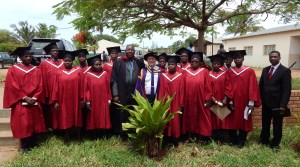
Remarks to the graduates of the Seminário Nazareno em Moçambique

DSCN4909On November 28, 2015, fourteen students graduated from the Seminário Nazareno em Moçambique, located in Maputo. These were my brief remarks to them on that joyous occasion.

—————

Rev. Aderito Ferreira, Field Strategy Coordinator, Rev. Adolfo Tembe, Principal of the Seminário, Rev José Moiane, Chair of the Board of Trustees, district superintendents, pastors, graduates, students, family members, honored guests, all protocols observed –

We gather here today because of God – Father, Son, and Holy Spirit. As the Apostle Paul said: “In God, we live, and move, and have our being.” No matter what else is said today, may this be clear: We honor and glorify the LORD. To God be the glory, great things He has done.

But we especially pause to thank God for you, the graduates of the Class of 2015. There are other places where you could have been today, other professional schools from which you could be graduating. However, you chose the Seminário Nazareno em Moçambique. Why? You came here in obedience to God, because God called you. You spent three years pursuing your diploma not because it was something you thought it would be nice to do. Rather, because of your calling from God, it was something that you knew you must do. Like Paul, you have said: “Woe is me if I preach not the Gospel!”

Earlier from Rev. Ferreira, we heard of the importance of preaching. Allow me to add to what he said so well. According to Scripture and according to the Manual of the Church of the Nazarene, another important task of the pastor besides preaching and loving the flock is to administer the sacraments. Some years ago, I was teaching a course in theology to Nazarene student pastors in West Africa. The Lord’s Supper was our topic. One student shared that in his country there were those who believed that every time a person who is “unworthy” receives the Lord’s Supper, the bread will stay lodged in the stomach until finally – when one has taken it “unworthily” too much – the stomach will be blocked and the person will die.

I’m glad that is not our belief or practice in the Church of the Nazarene. We don’t believe that taking communion should be a scary thing. Rather, it is a joyous celebration, a “means of grace,” an important way that we strengthen our faith. As pastors, I encourage you to celebrate the Lord’s Supper often with your people and also to frequently practice baptism.

Today is a day of joy. I believe that God wants to use you in amazing ways! Good things are before you. Times of fulfillment and joy in the service of the Lord await you. Think big; dream bold dreams, God-given visions, then, in the power of the Holy Spirit, make those dreams a reality. When we speak of entire sanctification, we often quote 1 Thessalonians 5:24 – “Faithful is he who called you, who also will do it.” May I suggest that this verse can also apply to your ministry in general? The one who called you is faithful and will empower you to minister.

Graduates, you made it! Well-done. Now go, preach the word, love the flock the Lord has entrusted to you, administer the sacraments, fulfill your God-given calling. We promise to encourage you as you remain faithful.

Posted in From soup to nuts

Jamaican banana bread

cookbookThis holiday season is strange. My travel schedule will take me away on Thanksgiving, then over Christmas we’ll be in South Korea. So, even though it breaks my rule of “No Christmas music until after the Thanksgiving meal,” I’m listening to Josh Groban’s “Noel” and the Carpenter’s “Christmas Portrait.” Now that I’m in holiday mood, time for some baking!

There’s a first for everything, and this is the first time I’ve attempted banana bread. With a bunch of overripe bananas on the counter, it’s the perfect time to try my hand.

The recipe comes from Extending the Table (Herald Press, 1991), an old Mennonite cookbook that we acquired when we lived in West Africa (see cover in photo).

———

bananabread2JAMAICAN BANANA BREAD

Makes 1 loaf

350 F / 180 C

55 min

Cream together: 1/2 c. margarine (125 ml), 1/2 c. sugar (125 ml), 1 t. vanilla (5 ml), and 1 egg, well beaten

Sift together: 2 c. flour (500 ml), 1 T. baking powder (15 ml), 1/2 t. ground nutmeg (2 ml), and a pinch of salt

Add to creamed mixture alternately, with: 3 ripe medium bananas, mashed (about 1 c./250 ml)

Add: 1/4 c. nuts, chopped (50 ml), and 1/4 c. raisins (ml)

Turn into greased 9 inch loaf pan (2 L). Bake 55 min. in preheated oven at 350 F (180 C) until golden brown.

ENJOY!

Posted in pastoral care, reflections

God’s four-step path to healing

DSCN4860Three words on a package of bananas – “Do not refrigerate” – instantly transported me back in time.

I was 16 and it was my first day on the job at the supermarket. My manager gave me simple instructions:

Take the skids off the truck, then stack the boxes of produce in the cooler.

The truck arrived, I did my work, then clocked out and went home.

The next day, my boss was furious. “Why did you put boxes of bananas in the cooler?” For the next several days, blackened bananas sold at deep discount on the sales floor. I’d messed up…majorly.

Most of us can recall times when we’ve missed the mark not just by a little but by a lot. However good our intentions, the end result was disastrous. We let someone down and may have even caused them deep pain. A shattered marriage, a bankruptcy, a broken trust – the consequences of our failure are plain to see and cut deep.

Thankfully, there’s a four-step path to healing.

First, let us resist the temptation to call sin by any other name. Instead, we have to admit we were wrong and be willing to change. Proverbs 28:13 reminds us: “People who conceal their sins will not prosper, but if they confess and turn from them, they will receive mercy” (NLT).

Secondly, let us accept God’s forgiveness. “As far as the east is from the west,” writes the Psalmist, “so far has he removed our transgressions from us” (Psalm 103:12, NIV).

Third, let us ask forgiveness from the person we wronged. James 5:16 promises healing, yet there is a prerequisite. We are to confess our sins to each other and pray for each other. Three of the most powerful words in any language are these: “I forgive you.” Reconciliation between people allows God’s healing to take root deep in our heart.

Finally, let us forgive ourselves. In Tramp for the Lord, Corrie Ten Boom talks about what God did with her sins once she confessed them: “When I confessed them to the Father, Jesus Christ washed them in his blood. They are now cast into the deepest sea and a sign put up that says, ‘NO FISHING ALLOWED.’ ” Like Paul, ours is to forget what is behind us and stretch toward what God has in-store for us (Phil. 3:13-14). God long ago forgave us. Are we willing to cut ourselves a break?

All of us have our own “bananas in the cooler” moment. There are times when there’s no way around it. We blundered, big time. Yet God doesn’t want us to stay mired in our guilt and shame. The Lord offers a path to healing. Are we ready to walk it, together?