When I was a hospital chaplain resident, some of the most harrowing experiences were Code Blues involving cardiac arrest. To stand with tearful families in the hallway, providing support and prayers, while their loved one received CPR and other emergency intervention is not something I’ll soon forget. Heart emergencies strike fear into the best of us.
My own family has been touched by heart disease. At 59, my late father had a heart attack; his father passed away from cardiac arrest at 55. A first cousin of mine keeled over at 60, his heart suddenly giving out.
Because of this family history, though I had no major symptoms, at my request, my primary care physician green-lighted a CT heart calcium scan (no contrast dyes). I had to pay $ 100.00 for the test, but am so glad I did. That test uncovered significant calcium build-up, leading to a referral to a cardiologist and further CT testing using contrast dyes, which revealed that I had extensive CAD (coronary artery disease). On December 26, a heart catheterization confirmed that two arteries were 100% blocked, and one was 85% occluded.
In the end, my surgical team decided on a hybrid treatment plan. On January 5, I had a four hour heart catheterization placing two stents in my RCA (artery at back of heart). Less than a week later, on January 10, I underwent a twelve hour double bypass surgery, using a robotic procedure that accessed the heart through the ribs, allowing for necessary repairs and easier recovery than a traditional open-heart surgery.
I’m now five weeks post-surgery, and gradually getting stronger. For this, I thank the Lord, my medical team, and all those who have prayed for me. I’ve been given a second chance at life and am profoundly grateful.
Are you hesitating about whether to have your heart checked? Hesitate no longer. By getting the heart calcium CT scan, I was able to defuse a ticking time bomb. Speak to your doctor about whether this inexpensive diagnostic is right for you.
__________________________________________
Image: No machine-readable author provided. Ekko assumed (based on copyright claims)., Public domain, via Wikimedia Commons
This sermon was preached at the Freedom Pine Run Church of the Nazarene in Freedom, PA on 12/31/23. All Scripture references are from the New International Version.
INTRODUCTION
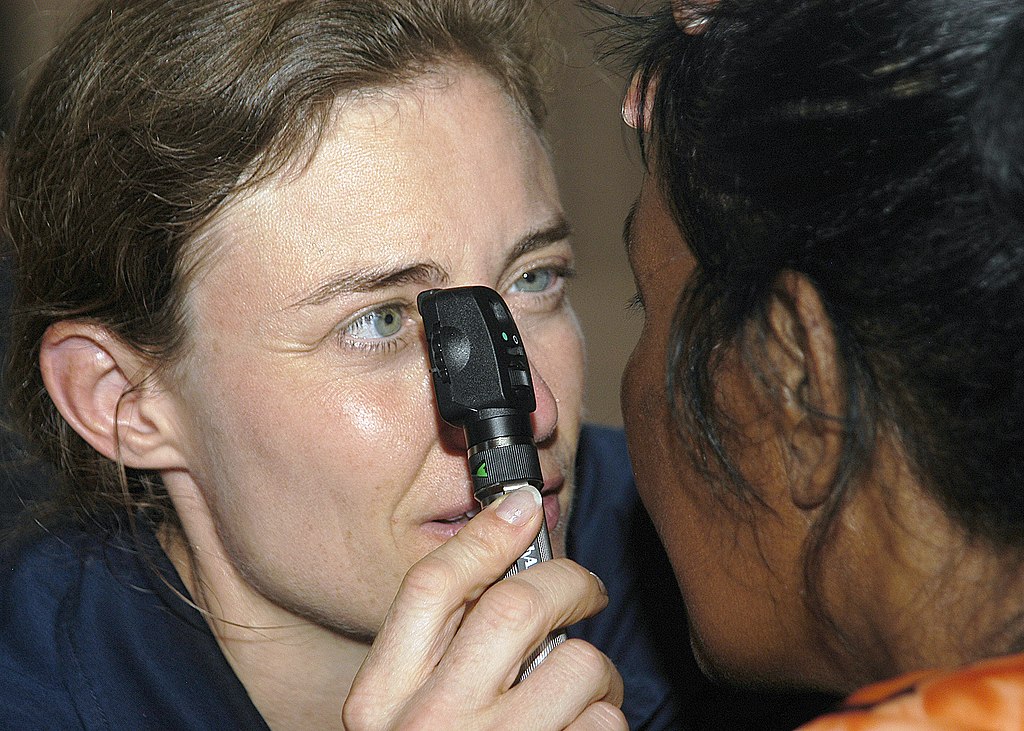
Last year, I had an eye exam. All the tests that the optometrist put me through to check my vision were high tech and impressive. I’m glad that my eyes are still strong and have no ailments that she could detect, other than my ongoing farsightedness, which requires me to wear glasses to read. The experience got me thinking about what ailments can affect our sight. One condition is glaucoma. According to my optometrist, glaucoma is tunnel vision. Little by little, and usually with a person not even noticing, peripheral vision – everything off to the left and right – begins to disappear. Soon, vision deteriorates until all a person can see is limited to a narrow band in front of them.
GOSPEL GLAUCOMA
In Luke 4, Jesus met a group of people who suffered from gospel glaucoma. They lived in the very town where Jesus grew up, the town of Nazareth. This was a tiny farming village, perched high on a hill, with probably only 200-400 people living there. It’s little wonder that when Philip told Nathanael about Jesus of Nazareth, Nathanael replied: “Can any good thing come of out of Nazareth?” (John 1:46). As descendants of Abraham, they were confident that God’s blessings were for them, but didn’t seem to realize that their spiritual outlook had become too narrow. Jesus was determined to help them understand that they were suffering from tunnel vision. To help focus our thoughts, let’s answer three questions raised by the story of our Lord’s rejection at Nazareth:
“In things essential, unity; in things non-essential, liberty; but in all things, love.”
Phineas F. Bresee
– Rupertus Meldenius (1626); quoted by Dr. Phineas F. Bresee, General Superintendent, Church of the Nazarene (1907-1915)
As a seminarian, I was comforted by this dictum, which was framed and hung on the hallway wall at Nazarene Theological Seminary in Kansas City. First on Dr. Bresee’s “essential” list was agreement upon preaching entire sanctification as the ongoing work of God’s grace in the heart and life of the believer, a grace experienced as both instantaneous and gradual. Preach that, Bresee believed, and you’re preaching what is essential. Other secondary concerns – such as divine healing – were relegated in the 1908 Manual to a section called “special advices.” With this understanding of “keeping the main thing the main thing,” union was reached. Delegates from three diverse groupings of holiness churches in the U.S. marched a victory lap around the tent in Pilot Point, Texas. The Pentecostal Church of the Nazarene was born. In 1919, we reverted to the shorter “Church of the Nazarene”, the original name for the West Coast grouping of churches.
Since 1908, we’ve always managed to find a way forward when it comes to issues secondary to our primary mission. Peruse the Manuals published roughly every 4 years since Pilot Point, and you’ll see that -as society changes- the issues we wrestled with also changed. We’re no longer concerned about whether Nazarenes should go to the circus, or participate in so-called “mixed bathing.” Attendance at the cinema was forbidden, but now we’re to honor God in all our media choices, the music we sing, and the kinds of dances we dance. Even divorce and remarriage, a very contentious issue with seemingly very clear biblical directives from Jesus himself (Mark 10:11, Matthew 19:3-12), we tackled because it touches many of our Nazarene families, people we dearly love. Our leaders tasked our best Bible scholars to research and publish their findings, then calmly help us work through the matter. Now, divorce alone is no longer a disqualifier for church membership or ordination. Yes, it took time to get there in unity, but get there we did. Retrospect has confirmed the wisdom of that process and subsequent course correction. The church is stronger for conserving laity and clergy who made it through the pain of divorce and still minister faithfully and effectively among us. Some of our local churches even host divorce care support groups. Surely God is pleased!
The discussions at General Assembly in June 2023 uncovered several social and theological issues that threaten our unity. These are difficult subjects that – like Nazarenes across the years- we long to sit down and discuss openly, without fear of being shushed or suffering professional consequences. With an open Bible and the love of Christ in our hearts, can we do what Dr. Bresee taught Nazarenes to do? Can we create designated spaces to listen to brothers and sisters from a wide variety of viewpoints? Can we once again task qualified individuals to present relevant research and help us reflect? Having prayed and done the hard work together, can we then move forward together in unity, our primary mission intact, to “make Christlike disciples in the nations”?
In Acts 15, after prayer and deliberation, the elders in Jerusalem decided to allow Gentiles to stay Gentiles and be folded into the church as they were. In verse 28, they wrote: “It seemed good to the Holy Spirit and to us…” The issues we face today are different, but the methodology is the same. Are we ready for a new season of study, reflection, and prayer? May God calm our fears and anxiety long enough so that we can hear God’s gentle voice and arrive at the place of unity Dr. Bresee desired for “the people called Nazarene.”
_______________________________
Rev. Dr. Gregory Crofford is a third generation Nazarene. He holds a B.A. in Religion (Eastern Nazarene College, 1985), an M.Div in Missiology (Nazarene Theological Seminary, 1989) and an M.A. and Ph.D. in Theology (Nazarene Theological College/University of Manchester, 2005, 2008). He was ordained a Nazarene elder in August, 1991 by Dr. John Allen Knight. Dr. Crofford has served as a music minister, pastor, and educational missionary. Currently, his ministry is hospice chaplaincy.
For Christians, experience has always been important. As a boy, I sang the hymn “He Lives” on many Sundays, but especially on Easter. One line concludes:
“You ask me how I know he lives? He lives within my heart.”
Experience is one factor that helps the church confirm calling. My first application for a District Minister’s License included questions about my religious experience, questions like:
When were you saved? When were you sanctified wholly? Why do you think God has called you to preach?
Recounting our life-changing experience with the Lord also encourages others, inviting them to participate in the things of God. In church jargon, these are called testimonies, and there’s biblical precedent for them. When Jesus cast demons out of the demoniac in the Gerasenes (Luke 8:26-39), the man was restored to health. The Lord commanded him:
“Go back to your family, and tell them everything God has done for you” (v. 39, NLT).
In the same way, the woman at the well in Samaria was so impressed by the words of Jesus to her, she went back to the village of Sychar and proclaimed: “Come and see a man who told me everything I every did! Could he possibly be the Messiah?” (John 4:29, NLT).
Experience confirms doctrine and practice. It can help establish the validity of divine calling, and it winsomely points other to Christ.
Experience informs our thinking
Let’s focus for the rest of this essay on the first point, that experience confirms doctrine and practice. John Wesley (1703-91) understood the role of experience as related to our faith and how we live it out. In the 1760s, some Methodists were testifying to having experienced entire sanctification (see 1 Thessalonians 5:23-24). He carefully interviewed many men and women about what had happened to them. Wesley knew that if the Methodists had interpreted Scripture correctly regarding the nature of sanctification, then they should expect validation of their viewpoint through on-the-ground testimonies. In the end, he was re-assured that the doctrine of Christian perfection as taught by himself, his brother, Charles, and the other Methodist preachers was indeed valid. It was confirmed through lived experience.
Whatever the Methodist understanding of Scripture arrived at through Bible study, Wesley knew that interpretations were always open to review. Interpretations are fallible because the Bible is always interpreted by human beings, with all their foibles and propensities toward error. If an interpretation is correct, then we can expect it to be confirmed “where the rubber hits the road.” The implication is simple: When there is a disconnect between a given understanding of the Bible and what Christians experience when applying it, then we must go back to the drawing board and – like a mathematician – check our work.
A musical illustration may help. There’s an old Sunday School chorus I learned to sing as a child. The lyrics say:
“I’m inright, outright, upright, downright happy all the time. Since Jesus Christ came in, and cleansed my heart from sin, I’m inright, outright, upright, downright happy all the time.”
For my young mind, the lesson was: “If I am saved and sanctified, then I’ll always be happy. Likewise, if I’m not always happy, then I can question whether I’ve really been saved and sanctified.”
My older self realizes that these lyrics — though sung by Sunday School children over decades – are nonetheless false. Christians may be saved and sanctified, but we are also human, with all the ups-and-downs that a full range of emotions bring. How did I come to this conclusion? It was because I found that far from being happy all the time, I sometimes was sad. My experience didn’t validate the theology of that children’s chorus. So, I went back to the drawing board, and checked my work. That’s when I realized that – however catchy the tune – that song’s lyrics were just plain wrong.
It’s important to note that experience isn’t just individual; groups also experience things. On the Day of Pentecost, the 120 who had gathered in the upper room experienced the Holy Spirit together. In our Western, individualistic outlook, we too often overlook this truth.
Let’s apply to a contemporary question the Wesleyan principal that experience validates (or calls into question) given interpretations of Scripture. Many churches believe that the role of pastor is reserved for males only. To make their point, they cite 1 Corinthians 14:34 – “Women must remain silent in the church.” Also highlighted is 1 Timothy 2:12, which seems to categorically forbid women to have authority over men. The question is:
Does the church’s experience validate this interpretation or call it into question?
John Wesley did not allow women to preach, until his mother, Susanna, insisted he come and listen to a woman who was leading a Methodist Society meeting in London. He couldn’t deny that the female leader was anointed by the Holy Spirit when she expounded the Scripture. He could have refused to even go with his mother to the meeting, considering the question of male only preaching a long-settled issue. Or having gone, he could have chosen to double down on his previous understanding of Scripture, telling the brave woman to sit down. For Wesley, this would have been to view what was happening in that Methodist meeting through the lens of his existing biblical interpretation. Instead, he went and listened with an open mind and heart. He let the new light he received inform his thinking. He did not jettison the Bible, but he adjusted his former interpretation to accommodate his new observation. The Church of the Nazarene follows in this understanding, believing that both men and women are called by God to preach, and can serve in any leadership capacity in the church.
John Wesley allowing experience to inform his doctrine was nothing new; he was following a well-worn New Testament path. For Peter, the question of clean and unclean animals was settled doctrine, having been addressed in the Old Testament purity laws. By extension, he understood that the children of Israel were the sole objects of God’s saving concern, the “clean” vs. the Gentiles, who were “unclean.” God was about to shake him up. On a rooftop in Joppa (Acts 10), Peter fell into a trance and had a vision. A sheet was let down from heaven, filled with all kinds of unclean animals, including reptiles and birds. Then, a voice commanded him: “Get up, Peter. Kill and eat them” (v. 13). Peter objected that he could not eat anything that Jewish law had declared unclean. The command came three times, then the sheet went back up to heaven.
The rest of the chapter recounts the arrival of messengers from Cornelius, a God-fearing centurion, a Gentile, and therefore (in Peter’s thinking) “unclean”. The Holy Spirit commands Peter to go with them to Cornelius, where Peter preaches the gospel and the Holy Spirit falls upon them, as evidenced by them speaking in languages they had never learned (vv. 44-46). Peter is astounded, and accepts Cornelius and his household as fellow Christians. Later, in Acts 15, he tells the story again, explaining how the experience of the Holy Spirit falling on Cornelius and his household had forced him to rethink what he thought he knew about Jews, Gentiles, and salvation.
Put yourself in the place of the elders in Jerusalem. Surely, Peter’s words must have seemed strange to them at first. After all, the understanding that salvation is limited to the Jews was a centuries-old interpretation of the Old Testament on the matter, yet they listened. They were willing to discuss together respectfully, allowing God to use the experience of Cornelius’ conversion to reshape their thinking. As for me, I’m glad Peter’s argument carried the day, or we would not as Gentiles be included in the church!
Coming into the 19th century, the principle of experience forcing a re-think of cherished biblical interpretations shows up again around the issue of slavery. Slave-owners in the United States viewed slaves as property, as sub-human. They could quote plenty of Bible passages that seemed to confirm that God held nothing against owning slaves. It was interaction with slaves and their undeniable humanity that led abolitionists to take up the cause of liberation: “Chains shall He break, for the slave is my brother, and in His name all oppression shall cease” (“O Holy Night,” 1855). Experience forced them to go back to the Bible and look again at longstanding, historic interpretations that had caused so much pain. They found better interpretations more in-line with love, a central tenet of the Christian faith.
Conclusion
I’m glad that the Church of the Nazarene historically has left a large place for experience in how we understand our faith and practice. I wonder: What other issues are we facing in the 21st century that need further study of Scripture, in-light of our individual and group experience? Will our fear prevent us from praying, studying, and talking together? Will anxiety lead us to sanction prophets among us who call us to this hard but holy work? May God grant us the grace and courage to re-evaluate interpretations of the Bible that – though longstanding – can cause harm, setting up stumbling blocks for those who otherwise might follow Christ.
It was the best buy ever. At a garage sale, my mother-in-law found several seasons of “Star Trek: The Next Generation” on VHS tapes. Total cost? $ 5.00. As Nazarene missionaries in West Africa, we wore the tapes out, watching episodes over-and-over.
One episode still haunts me. In “Remember Me” (Season 4, Episode 5), the ship’s Chief Medical Officer, Dr. Beverly Crusher, is caught in a warp bubble caused by her brilliant teenage son, Wesley, during an experiment gone awry. Gradually, all the people she knows inexplicably disappear, until in the climax scene, she’s sitting alone with Captain Jean-Luc Picard on the bridge. Of all people, surely he would understand what’s going on! “Haven’t you noticed the people disappearing?” she pleads. “What people?” he replies, a wan smile on his face. She names her crew mates one-by-one – Security Chief Mr. Wharf, Engineer Geordi Laforge, First Officer Will Riker, Counselor Deanna Troy. The captain sits there passively, finally offering unconvincing explanations why a tiny crew is sufficient. Determined to get to the bottom of things, she protests: “I suppose it makes sense to you that you and I are the only ones flying around in this huge star ship!” She then turns her back for a split second, and poof! Captain Picard himself is gone.
Something about that episode with the disappearing crew evokes how I feel at this moment in the history of the Church of the Nazarene (USA/Canada). I’ve been a Nazarene from birth, my parents presenting me for baby dedication at the Calvary Church of the Nazarene in Arlington, Virginia. When my mother handed me over to the pastor, he momentarily lost his grip. The congregation audibly gasped, but the pastor recovered quickly, catching me before my head hit the wooden altar rail. The sad part is, I can’t go back and see that altar. The Calvary Church of the Nazarene no longer exists. Like Dr. Crusher in the collapsing warp bubble, I sense its absence. A part of my story has vanished.
From December 1988 until July 1993, I pastored the First Church of the Nazarene in Sedalia, Missouri. We were never a large church; the high water mark was when we hit 107 on a Sunday morning. I told the people that if we broke 100, I’d let them smash a pie in my face. I was happy to taste lemon meringue that day! But like the Arlington Calvary church, I can’t go back. When the church closed its doors a few years ago, I grieved.
A few months ago, I visited the website of the district where I grew up. Clicking on the link labeled “churches,” I found new names for a handful of churches that had been planted since then, new growth for which I praised the Lord. However, I also searched in vain for a number of churches where I’d sung gospel concerts as a teenager with my family. They’re gone, closed and sold off.
It’s a story that’s repeating itself again and again across U.S. districts – churches closed, parsonages and buildings sold. Like the collapsing bubble on the U.S.S. Enterprise, little-by-little, things are disappearing. Have we noticed?
This collapse for me feels personal. Our lives are interconnected. It’s relationships lost, and with people vanishing, it’s demoralizing. It’s the bright young ministry student I taught at one of our Nazarene Universities – gone. It’s the veteran religion faculty member who’s an excellent preacher, who loves the Lord and loved his Nazarene ministry students – gone. It’s the family member who grew up in the Church of the Nazarene but cannot in good conscience stay any longer – gone. Little-by-little, bit-by-bit, I look around and think: “I haven’t seen _____ in a while.” Quietly, with no fanfare, they’re gone – like Captain Picard when Dr. Crusher turned her back for just a second – disappeared. Poof.
We’re having trouble finding pastors to fill churches. I wonder why that is? Are Nazarene youth being surveyed to find out what keeps them from ministry in our denomination? Are youth who have already left been asked why they left? If they are bold enough to answer honestly, what will we do with that information?
Let’s do better than Captain Picard who dismissed Dr. Crusher’s concerns, denying that any crew were missing. May God give us the grace to face reality and the courage to change what we must.
_______________________________
Image credit
Enterprise-D_crew_quarters.jpg: Derek Springer from Los Angeles, CA, USAPatrickStewart2004-08-03.jpg: Cdt. Patrick Caughey[1]derivative work: Loupeznik, CC BY-SA 3.0 https://creativecommons.org/licenses/by-sa/3.0, via Wikimedia Commons
Si vous avez déjà conduit sous la pluie sur une route boueuse, vous connaissez le danger. A gauche et à droite, il y a des fossés. Virez trop loin dans une direction et vous serez désolé, votre voiture ou votre camion sera endommagé et hors service.
Pour l’Église du Nazaréen, les conventions générales et l’Assemblée générale 2023 (du 9 au 16 juin) sont en cours à Indianapolis. Des délégués du monde entier se sont réunis pour examiner plusieurs résolutions. J’ai réfléchi à la façon dont les Nazaréens incarnent le juste milieu par rapport à un certain nombre de questions, et comment il y a de la sagesse à tracer et à maintenir un cap qui évite le péril dans les fossés. Examinons trois questions où cette position médiatrice favorise un ministère équilibré, efficace, et compatissant. Ces questions sont le baptême, le don des langues, et la sexualité humaine.
Baptême
Le baptême est le sacrement d’initiation à la famille de Dieu. Dans le livre des Actes, une maison entière (grec oikos) pouvait être baptisée en une seule fois. Dans Actes 10, Pierre a baptisé Corneille et sa maison, tandis que dans Actes 16, Paul et Silas ont baptisé dans la famille de Dieu le geôlier et son oikos. C’est un écho de l’Ancien Testament dans le Nouveau Testament, où Josué a proclamé : « Moi et à ma maison, nous servirons l’Eternel » (Josué 24:15, Genève). Les familles comprenaient probablement des individus jeunes et âgés. Pierre avait raison quand il a promis à la foule à Jérusalem le jour de la Pentecôte : « Car la promesse est pour vous et pour vos enfants… » (Actes 2 :39, Genève).
Le Manuel de l’Église du Nazaréen reflète à la fois dans son Article de Foi sur le baptême et ses rituels de baptême l’enseignement de la Bible selon lequel le baptême est un signe extérieur de la grâce intérieure de Dieu active dans la vie d’un individu, à toutes les étapes du parcours humain. Le baptême met l’accent sur Dieu et sa grâce et non sur nous. Que les parents présentent leurs bébés au baptême ou que des enfants plus âgés, des adolescents, ou des adultes se présentent, le sens est le même: l’Église les accueille dans le peuple de Dieu. Pour les bébés et jeunes enfants, ils recevront plus tard, à l’âge approprié, des instructions sur la signification de leur baptême, généralement vers l’âge de 12 ans, où ils pourront alors reconnaître publiquement leur foi en Christ. (N.B. : cette affirmation publique ne devrait pas être un soi-disant « rebaptême » puisque le baptême est un événement unique dans la vie. Voir Éphésiens 4:5). Pour les candidats au baptême plus âgés, un cours avant leur baptême est suffisant.
Cette position de permettre le baptême des enfants et le baptême des croyants est un exemple du juste milieu qui a bien servi les Nazaréens depuis notre naissance à Pilot Point, Texas en 1908. D’autre part, un domaine où l’Église du Nazaréen a été étrangement non-conforme à la communauté plus large de la foi chrétienne est la relation entre le baptême et la réception des membres. Il est possible actuellement d’être membre de l’Église du Nazaréen et de ne pas avoir été baptisé. Cela semble d’autant plus étrange lorsque nous enseignons aux nouveaux nazaréens les trois valeurs de « chrétien, sainteté, et mission ». La position chrétienne est claire, que le baptême est le sacrement d’initiation à l’Église. La séquence devrait être 1) le baptême, et 2) la réception en tant que membre nazaréen. L’Assemblée générale a l’opportunité de nous mettre en conformité avec la pratique chrétienne historique en votant pour approuver CA-701.
Baptême de l’Esprit et le don des langues
Un deuxième domaine sur lequel cette Assemblée générale pèsera est la question de l’évidence du baptême du Saint-Esprit. (Voir le paragraphe 925 du Manuel de 2017, qui est sujet à la ré-approbation ; voir également la résolution CA-711). L’Église du Nazaréen souligne que la preuve de la présence du Saint-Esprit dans la vie du croyant est le fruit de l’Esprit (Galates 5 :22-23). Cela inclut la liste des caractéristiques de Paul telles que l’amour, la joie, la paix, et la patience. L’histoire nazaréenne est instructive et peut nous guider. Bien que notre nom confessionnel pendant une décennie ait été «l’Église pentecôtiste du Nazaréen», l’Assemblée générale de 1919 a abandonné le mot «pentecôtiste» car il était devenu associé à la pratique des groupes engendrés par le Réveil de la rue Azuza (1906-1908). Ils croient que le parler en langues est la preuve du baptême de l’Esprit.
Ce sujet controversé reste d’actualité à ce jour, alors que l’Église du Nazaréen se développe dans le monde entier. Le programme d’études utilisé en Afrique par l’Institut Théologique Nazaréen (ITN) examine l’enseignement du Nouveau Testament sur le parler en langues (ou langages), en regardant non seulement les Actes des Apôtres, mais les écrits de Paul et Pierre (voir Romains 12 :3-8, 1 Corinthiens 12-14, 1 Pierre 4:10-11). En tant que directeur de l’ITN, j’ai été l’un de ceux et celles qui ont participé à la mise en place de ses différents cours, qui ont été rédigés par une équipe. Dans le cours « La Théologie Chrétienne 2 », une voie médiane a été soigneusement tracée entre deux extrêmes : 1) nier complètement le don des langues et d’autres dons spirituels (comme le font les cessationnistes), enseignant que les dons spirituels ont cessé après les premiers siècles de notre ère, et 2) Compréhensions pentecôtistes et charismatiques de la glossolalie, ou certains parlent dans une langue céleste qui doit être interprétée lors du culte de l’église.
Le cours ITN soutient que le don des langues est effectivement le don des langues humaines, comme illustré le jour de la Pentecôte. De véritables langues humaines étaient parlées, sous l’onction divine, et dans le but de communiquer l’Evangile. Suivant le principe herméneutique selon lequel des passages qui sont clairs peuvent éclairer à la lumière des passages qui le sont moins, Actes 2 devient la clé d’interprétation pour comprendre le don des langues tel qu’il est présenté dans Romains, 1 Corinthiens et 1 Pierre.
Certes, il s’agit d’un sujet complexe qui ne se prête guère à un résumé en quelques courts paragraphes. Notamment, l’Église wesleyenne, lors de sa récente Conférence générale, a ajouté un langage à sa Discipline qui permet la compréhension charismatique des langues en tant que don spirituel des langues célestes, nécessitant une interprétation lorsqu’elles sont utilisées publiquement. Il s’agit d’un développement important étant donné que l’Église wesleyenne est l’une de nos églises sœurs les plus proches sur le plan théologique.
Vu comment le don des langues a été enseigné dans le contexte nazaréen africain au cours des vingt-cinq dernières années, en particulier dans la formation théologique de nos ministres africains, nous espérons que l’Assemblée générale de 2023 procédera avec une grande prudence alors qu’elle examine à nouveau le renouvellement ou la modification du paragraphe 925. Le risque de confusion est important et tout changement dans notre position lors de l’examen de la résolution CA-711 ne devrait être fait qu’après une étude approfondie par des théologiens nazaréens qui représente la dénomination provenant de tous Régions du monde.
Sexualité humaine : Paragraphe 31
Enfin, la sexualité humaine est un sujet qui continue de susciter des débats tant à l’extérieur qu’à l’intérieur de l’Église du Nazaréen. Le Manuel de 2017 a pour la première fois réuni sous un même titre – le paragraphe 31 – une déclaration qui englobe un certain nombre de questions liées à la sexualité humaine. Parmi celles-ci figure la pratique de la polygamie, la prise de plusieurs conjoints. Bien qu’il existe de nombreux pays en Afrique où la polygamie (ou, plus précisément, la polygynie – le fait de prendre plusieurs épouses) est autorisée par la loi, les nazaréens africains ont été parmi ceux qui ont voté à une écrasante majorité lors de l’Assemblée générale de 2017 pour approuver la formulation interdisant la polygamie. Nos délégués africains étaient contre-culturels lorsqu’ils ont approuvé le paragraphe 31. C’était une décision audacieuse de leur part, surtout lorsque la polygamie est bien enracinée dans le contexte africain, en particulier dans les zones rurales.
Maintenant en 2023, c’est au tour des délégués américains et européens de vivre l’expérience de la tension croissante entre les vents culturels dominants et notre position nazaréenne en ce qui concerne les LGBTQ+ (lesbiennes, gays, bisexuels, transgenres, et queer). Récemment, un groupe de Nazaréens, comprenant des anciens ordonnés, a proposé que la dénomination adopte une position « affirmant pleinement » (ang. « fully affirming ») ce qui permettrait l’accueil en tant que membres les individus gais, lesbiennes, bisexuels pratiquants, et les transgenres. En plus, le clergé nazaréen aurait l’autorité de célébrer les mariages entre deux membres du même sexe. (Voir leur site Web à l’adresse http://www.lovingnazarenes.com). Cette position progressive peut être considérée comme une extrémité du spectre, car nous identifions les paramètres d’une voie médiane. Il est important de noter qu’aucune résolution en attente de l’Assemblée générale de juin 2023 n’a été proposée, visant à annuler le paragraphe 31, et ainsi à adopter la position « fully affirming ».
En revanche, le côté opposé du spectre, une approche très conservatrice, figure dans les résolutions en instance devant l’Assemblée générale. La résolution CA-705 supprimerait une grande partie du langage du paragraphe 31 qui est gracieux, insérant à plusieurs reprises des affirmations selon lesquelles l’intimité entre personnes de même sexe est un péché. Certes, le paragraphe 31 est déjà très clair sur le fait que toutes les pratiques qu’il mentionne sont interdites, mais curieusement, nulle déclaration similaire disant « c’est un péché » n’est recommandée pour aucun des autres comportements interdits par le paragraphe 31. L’effet du changement proposé est d’impliquer que d’autres types de transgressions sexuelles sont mauvaises, mais celle-ci en particulier est vraiment mauvaise. Il s’agit d’un pas en arrière, revenant à la teneur du langage antérieur du Manuel d’avant 2017 pour distinguer pour une correction spéciale ceux qui pratiquent l’homosexualité. L’une des raisons pour lesquelles une commission a été mise en place en 2013 était de rectifier ce traitement déséquilibré dans les déclarations du Manuel, en mettant en évidence une catégorie de délinquants – celle qui peut inclure un peu plus de 7% d’Américains qui s’identifient comme LGBT – tout en accordant moins d’attention à l’autre 93 %.
La déclaration révisée du Manuel, soigneusement élaborée par un groupe de travail international, a abouti à ce que nous connaissons maintenant sous le nom de paragraphe 31. Il oriente un juste milieu entre ce que le site « Loving Nazarenes » propose et ce que la résolution CA-705 du district du Kentucky accomplirait. Depuis son apparition en 2017, le paragraphe 31 a été bien accueilli par de nombreuses congrégations nazaréennes, et les pasteurs nazaréens ont déclaré publiquement via les médias sociaux que la déclaration est cohérente, aimante et mérite d’être maintenue. Certaines églises, telles que Trinity Midtown Church of the Nazarene à Kansas City, Missouri, dirigée par les pasteurs Andy et Sarah McGee, ont adopté la déclaration comme fournissant un contexte utile pour un ministère compatissant dans la communauté LGBTQ+. Notamment, une déclaration récente du Dr Jeren Rowell, président du Nazarene Theological Seminary, donne le conseil de ne pas toucher au paragraphe 31. Comme Rowell, je pense que nous devons faire preuve d’une grande prudence avant de décider de modifier une déclaration médiatrice qui – bien qu’elle ne puisse jamais satisfaire tout le monde – s’est déjà révélée utile pour maintenir l’Église du Nazaréen aussi unie que possible dans sa mission. En même temps, nous avons toujours cru que lorsque nous suivons la lumière que nous avons, Dieu nous donnera plus de lumière. Restons ouverts au Saint-Esprit et ouverts à de nouvelles recherches qui incorporent une étude attentive de l’Écriture, telle qu’illuminée par la raison, la tradition, et l’expérience.
Conclusion
L’Assemblée générale 2023 est là. Le baptême, le don des langues, et la sexualité humaine ne sont que trois des questions importantes dont discutent les délégués. En évitant les fossés à gauche et à droite, orientons plutôt une voie médiane, un juste milieu. Répondons à l’appel à la prière récemment diffusé par le Conseil des surintendants généraux, demandant au Saint-Esprit de visiter l’Assemblée générale d’une manière puissante. Que Dieu accorde à nos délégués et à nous tous la sagesse alors qu’ensemble, nous avançons avec unité et confiance vers un avenir plein d’espoir.
NOTE: I’ve re-posted this today (June 11) since some may not have seen it last month.
If you’ve ever driven in the rain on a muddy road, you know the danger. To the left and to the right are ditches. Veer too far in one direction and you’ll be sorry, your car or truck damaged and out of commission.
For the Church of the Nazarene, General Conventions and Assembly 2023 (June 9-16) are underway in Indianapolis. Delegates from across the globe have gathered to consider multiple resolutions. (All General Assembly resolutions are available at this link). I’ve been reflecting on how Nazarenes embody the Middle Way on a number of issues, and how – while challenging – there is wisdom in charting and maintaining a course that avoids peril in the ditches.
Let us examine three issues where this “down the middle” stance has allowed for balanced, effective, and compassionate ministry. These issues are baptism, the gift of languages, and human sexuality.
Baptism
Baptism is the sacrament of initiation into the family of God. In the book of Acts, an entire household (Greek oikos) could be baptized at once. In Acts 10, Peter baptized Cornelius and his household, whereas in Acts 16, Paul and Silas baptized into God’s family the jailer and his oikos. This is a New Testament echo of the Old Testament teaching, where Joshua proclaimed: “As for me and my household, we will serve the Lord” (Joshua 24:15, NIV). Households undoubtedly included individuals both young and old. Peter was correct when he promised the crowd in Jerusalem on the Day of Pentecost: “For the promise is for you and for your children…” (Acts 2:39b, ESV).
The Manual of the Church of the Nazarene reflects in both its Article of Faith on baptism and its baptism rituals the Bible’s teaching that baptism is an outward sign of God’s inward grace active in the life of an individual, at all stages of the human journey. Baptism places the spotlight on God and not on us. Whether parents present their babies for baptism or older children, teens, or adults present themselves, the meaning is the same: The Church welcomes them into the people of God. For babies, they will later at the appropriate age receive instruction on the meaning of their baptism, usually around age 12, where they can then publicly acknowledge their faith in Christ. (Note: This public affirmation should not be a so-called “rebaptism” since baptism is a single event in life. See Ephesians 4:5). For baptism candidates who are older, a class prior to their baptism is sufficient. This both/and position – of allowing for infant baptism and believer baptism – is an example of the Middle Way that has served Nazarenes well since our birth in Pilot Point, Texas in 1908.
On the other hand, one area where the Church of the Nazarene has been strangely out-of-step with the larger community of Christian faith is the relationship between baptism and membership. It is possible currently to be a member in the Church of the Nazarene and not have been baptized. This seems all the more odd when we teach new Nazarenes that we are Christian, Holiness, and Missional. The Christian position is clear, that baptism is the sacrament of initiation into the Church. The sequence should be 1) baptism, and 2) reception into Nazarene membership.The General Assembly has the opportunity to bring us in-line with historic Christian practice by voting to approve CA-701.
This sermon was preached on January 8, 2023 at Norwin Church of the Nazarene, Irwin, PA.
INTRODUCTION
Jay Withey, 27, got caught in a terrible snowstorm in Buffalo, NY the weekend of Christmas. According to a report on CBS Mornings, Jay knocked on the door of several houses where he saw lights, and even offered $ 500.00 if he could stay the night on the floor. Every time, he was turned away. He went back to his car, and picked up two strangers who huddled with him. They ran the engine for heat, until the gasoline was gone. Desperate, Jay noticed a light on in an elementary school, and broke a window to gain entry to the warm building. He then went out back out into the storm several times, inviting others into the building, including some elderly. They found food in the cafeteria and sheltered overnight until the storm subsided the next day. Jay left a note for the school principal, apologizing about the break-in and accounting for what they had eaten. School authorities released his note to the public, along with photos from school security cameras showing people wrapped up in blankets around cafeteria tables. It soon became clear: Jay was no burglar. He was a hero, and had bravely saved two dozen lives.
TRANSITION TO 1 JOHN 4
It’s a wonderful story because it has several angles. Why did Mr. Withey have to break into the school in the first place? Why wasn’t the school just open to begin with, as a storm shelter? That’s certainly a good discussion to have, maybe at the next meeting of the school board, or Buffalo city council. But today I’d like to look at this story with a happy ending through the lens of fear and love. Faced with a stranger at their door, people had to decide: Do I let him in, or do I turn him away? What emotions are at play in-the-moment that push us in one direction or the other? Today, let’s look at those two words – fear and love – in the light of 1 John 4:7-21, then we’ll finish with three recommendations that can help us both individually and as a church live out the Gospel.
FEAR
First, let’s talk about fear. There are types of fear that are healthy. For example, we know that there are evil adults who prey on children. It’s normal and necessary for parents to teach their children about “stranger danger.” A second healthy type of fear is reverence or respect. This is what we mean when saying we should “fear God.” It’s a good thing to be God-fearing, and when I look at our society today, we need to recapture our respect for God.
1 John 4:18, however, is about another kind of fear altogether, one that is unhealthy. The Greek word for “fear” in this verse is phobos. This is where we derive the English word “phobia.” Webster’s Online Dictionary defines “phobia” as an “exaggerated usually inexplicable and illogical fear of a particular object, class of objects, or situation.” An example of this might be the fear of heights (acrophobia) or the fear of tight spaces (claustrophobia). Notice that fear is illogical. It doesn’t make a lot of sense when you analyze it. Instead, it just wells up as an emotion in the moment. Fear can paralyze us. That’s why a lion roars first before it attacks a gazelle. It paralyzes its prey by instilling fear, giving the lion time to pounce. A second response to fear is withdrawal. It’s a defensive response, like a clam closing up or a crab scurrying behind a rock on the ocean floor. It’s the little West African boy who lived on the remote island who apparently had never seen a white missionary before. When he saw me and another missionary coming down the trail, he jumped into some reeds and peeked out at us, his eyes big.
John says in the same 18th verse that “fear has to do with punishment.” The believer need not fear the day of judgment. According to verse 17, on that day, we can have boldness. How so? If we have asked God to forgive us our sins – the wrong things we have done or the good things that we’ve refused to do – then we have been adopted into God’s family. We can have confidence because God has transformed us and sealed us with the Holy Spirit (see Ephesians 4:30).
John is never satisfied to stop with the human/divine aspect, the vertical dimension. Having looked ahead to Judgment Day, he returns to the present and considers the human/human dimension, the horizontal aspects. What does it look like in our relationships with each other when fear is allowed to dominate? Beginning in verse 20, John answers this question. He writes: “Those who say, ‘I love God’ and hate their brothers or sisters, are liars; for those who do not love a brother or sister whom they have seen, cannot love God whom they have not seen” (1 John 4:20, NRSV). Like a weed, when fear takes root, love is choked out.
LOVE
This brings us to the second major word in 1 John 4:7-21. That word is love. The stores have already marked down and sold all the leftover Christmas items. Have you seen what they put in their place? It’s all about Valentine’s Day! In fact, the first kind of love that usually comes to mind when we use that word is romantic love, from the Greek word eros, from which we derive the English word erotic. A second word for love is philia, or “brotherly love.” So we say “Philadelphia,” the city of brother love. But in our passage, the Greek noun for love is agape. The NRSV translates this noun and its various verbal forms as “love” and as such it appears 27 times in this passage. For this reason, John has been called the “apostle of love.” Agape is the kind of selfless love that originates in God but is exemplified in life-giving interactions between human beings who reflect God’s image. Agape is “love that seeks the welfare of all” (Vines, 1981; see “love”). Michael Curry describes agape as “love that looks outward” (Love is the Way: Holding on to Hope in Troubling Times [2020], 14).
John speaks not only of love, but “perfect love.” Perfect love is love that is complete, lacking nothing. If love were cheese, then perfect love would be cheddar cheese aged to sharp deliciousness. If love were chocolate, then perfect love would be a Hershey’s bar with almonds. If love were athletic ability, then perfect love would be Franco Harris’ “immaculate reception.” Perfect love is love that has reached its ultimate form and cannot be improved.
And so we come to 1 John 4:18 – “There is no fear in love, but perfect love casts out fear.” As a holiness preacher, I’ve always wondered why this verse doesn’t say “perfect love casts out sin.” John Wesley described God’s work of sanctification in our hearts as “love excluding sin.” Yet here we read that loves casts out fear. Rick Williamson notes that the term for “cast out” (exo ballei) is the same term used when describing Jesus who cast out devils (See Williamson, New Beacon Bible Commentary, 1, 2, 3 John: A Commentary in the Wesleyan Tradition [2010], 151).
What is John saying? Love and fear cannot co-exist in our hearts. If love takes the upper hand, fear will be banished. “Perfect love casts our fear.” But I wonder: Have we sometimes let perfect fear cast out love? Does the media we consume – the news channels we watch, the websites we read, the radio commentary that we listen to – stir-up in us fear of others, or does it encourage love and compassion for others? John teaches us in this passage that when we open our hearts to fear, hatred is never far behind. Likewise, when we open our hearts to love, then God abides within us, and we begin to look just like Jesus. In verse 17, John puts it this way: “Because as he is, so are we in this world.”
THREE RECOMMENDATIONS
So far we’ve looked at fear, and saw that stirring up fear can allow our love to wither and open the door to hatred. We also discovered that love is the antidote to fear and hatred, that “perfect love casts out fear.” Now let’s take a few minutes to consider three recommendations for living out 1 John 4:7-20 both individually and as a church family:
Lead with love. In Mark 10, the rich young ruler came to ask Jesus what he needed to do to inherit eternal life. Jesus didn’t beat around the bush. He told him to go and sell all that he had and give it to the poor, but sometimes we skip right over Mark’s aside about Jesus’s demeanor just before issuing that command. Mark 10:21a records: “Jesus looked at him and loved him.” Jesus always leads with love. In the same way, St. Francis instructed his monks: “Preach always. When necessary, use words.” The old adage is still true: “People won’t care how much you know until they know how much you care.” Sometimes I wonder how many opportunities to share our faith we’ve short-circuited because we got preachy before we even earned a hearing.
Avoid enlisting in the latest fear-driven crusade. Most Church historians agree that the low-point for Christianity came between the 11th and 13th centuries when Christian “crusaders” raised armies to take back Jerusalem and the Holy Land from Muslims. The atrocities done in the name of Christ will always be a black-eye for Christianity. I wonder if that same counterproductive crusading spirit lives on today in the various culture wars we’re asked to join? Sometimes it seems like we’re asking non-Christians in our country to behave in Christian ways, when that’s nothing they ever signed up for. Why should they be subject to a Book they’ve never agreed to as their guide, whatever the Bible might be for us as believers? It’s worth asking whether lurking beneath the surface of Christian action against x, y, or z is the fear factor, fear that we are being sidelined in a society that seems less-and-less interested in what we have to say or in supporting the church? I certainly don’t have all the answers; I’m not sure I have any answers about how to win back those who used to be with us but are long gone. What I do know is this: John is calling us away from fear, and calling us back to love. Madeleine L’Engle put it this way: “We do not draw people to Christ by loudly discrediting what they believe, by telling them how wrong they are and how right we are, but by showing them a light that is so lovely that they want with all their hearts to know the source of it.”
Trust in God’s prevenient grace. Prevenient grace is the action of the Holy Spirit that draws men, women, and children to God. It is God in love reaching out before we ever did, God taking the initiative. 1 John 4:10 teaches: “In this is love, not that we loved God but that he loved us and sent his Son to be the atoning sacrifice for our sins” (NRSV). If we believe that God has already been working in the heart of every human being at some level long before we encounter them, how can we possibly fear them? They may look different than we do, come from a different country, speak a different language, dress differently, like different music, or a dozen other factors, but this we have in common: God wants to draw them to Christ in the same way that God drew us! Which course of action will better allow us to become partners with God in their salvation – fear, or love?
CONCLUSION
On Christmas weekend, Jay Withey, 27, got caught in a Buffalo snowstorm and sought shelter. He knocked on doors, but everyone in fear turned him away. Norwin Church of the Nazarene: Who is knocking on our door? Will we turn them away? God forgive me when I have allowed my fear to banish my love. Instead, together, let us lead with love, avoid enlisting in fear-driven crusades, and trust in God’s prevenient grace. May perfect love cast out our fear, today and always.
Fresh off a gap year of honest but repetitive work in the produce department of a Rochester area supermarket, I drove 8 hours to Quincy, Massachusetts and waited in the freshman registration line at Eastern Nazarene College. “Principles of Biology” was the default choice for non-science majors. Chomping at the bit for an intellectual challenge, and even though I’d already declared my major as religion, I jauntily checked “Introduction to Zoology” instead, the entry course for biology and pre-med majors,
Little did I know what I’d let myself in for! Over the next semester, I painstakingly mastered the details of the Krebs cycle, encountered the Latin names of genera and species, and studied Prof. Glen Keyes’ carefully etched chalkboard drawings of cellular components and reproductive systems. Prof. came to class sporting a white lab coat, answering students’ questions, encouraging them as they diagrammed formulas or microscopic organisms in their lab books. Chapter 1 of the course textbook matter-of-factly presented Darwinian principles like natural selection and how life on earth had evolved and continued to do so. That chapter made me wonder about whether my Christian faith and evolution could be squared. I’ll always be thankful for a conversation with Dr. Alex Varughese in the religion department, an Old Testament specialist with an M.A. in Marine Biology. He sagely replied when I brought my quandary to him:
“Genesis 1-2 is not so much about how as it is about who.”
God is creator, and evolution is the mechanism God used and continues to use to create. The elegant solution of theistic evolution came clearly into view that day and has helpfully guided my thinking ever since.
After Christmas break, I registered for the new semester and headed to the bookstore to buy textbooks. Prof. Keyes walked in and spotted me, a look of concern on his face. “Greg, I just received the print-out for ‘Botany’ and your name was missing. That’s the next course for pre-med majors.” He looked surprised by my reply: “But Prof., I’m not a pre-med major. My major is religion.” He could have tried to convince me to drop religion and pursue pre-med, but he understood the value of both. His last words that day have lingered with me:
“I’m glad to know we’ll have another pastor behind the pulpit who understands that you can believe in both God and evolution.”
But back to 1981. Hard work in Zoology paid off. Going into the final exam, I stood near the top of the class of thirty plus students, down by around ten students who’d dropped the course along the way. When final grades were released, on my report card appeared a much-coveted “A.”
March 2022: Prof. Periodic Table
I drove to the memory care unit west of town. Things were going well with hospice Chaplaincy. Especially rewarding were patients’ stories, often told by their loved ones. Today would bring another story, by turns fascinating, frustrating, and tragic. This day, I would meet Prof. Periodic Table, or PT for short, a nickname the reader will soon understand.
PT was pushing a century old, but despite a faltering short-term memory, he recalled things that happened long ago. He could still recite many details related to science, especially biochemistry. On his wall he proudly displayed the Periodic Table of the Elements, a shout-out to his having taught biochemistry for nearly 4 decades at the collegiate level. At the end of each hospice visit, our tradition was for me to randomly choose one element on the chart. PT would take joy in telling me all about the chosen element and its uses in industry or space. One day, when I pointed on the chart to helium, he lamented that it’s now in short supply, and wondered how chemists would be able to do their work since it’s an element often used in the laboratory. Talking about the Periodic Table was a way to celebrate the hundreds of young scientific minds he had shaped through his expertise and fatherly guidance.
From the start, he was respectful to me, as he was to religion in general. Through his late wife, he maintained a nominal connection to a mainline Christian denomination, and sometimes donated to support their charitable causes. However, underneath the respect was a painful memory nearly 80 years old yet still fresh with emotion. PT grew up in a fundamentalist church, but he also loved chemistry. As a highschooler, his chemistry teacher let him stay after school and work in the laboratory, knowing he could trust the budding chemist not to blow it up with some ill-advised experiment. Soon, PT realized that science would be his life work. Unfortunately, his pastor took PT aside one Sunday at church and warned:
“You have to decide what it’s going to be, PT. You have to choose either science or God. You can’t believe in both.”
PT paused as he delivered the verdict: “I chose science.”
The next visit when PT told the story again, I found the right moment to tell my own story of Zoology, and the wise words of Prof. Keyes and Dr. Varughese to a young, eager college freshman. He listened carefully, and when I was done, he tearfully remarked: “You don’t know how much I wish I could have heard that many years ago.” That science and religion could be simultaneously affirmed was something that PT appears to have never heard clearly articulated. Instead, at a crucial moment, his pastor had tragically given him a false choice.
Later, taking an out-of-state job, I said goodbyes to PT and other hospice patients. Not long after moving, one day my phone pinged with a text message from a former coworker: “Mr. Periodic Table passed away today.” I grieved my friend’s passing and thanked the Lord that our paths had crossed. Whether PT adopted theistic evolution or rediscovered Christian faith, I’ll never know, but his openness to my prayers gives me hope that his earthly journey ended in a peaceful acceptance of God’s reality and gentle embrace.
False dilemmas
To the question, “Is it science or faith?” many answer YES. BioLogos.org exists to explore the nexus between scientific inquiry and faith, creating a space for scholars who understand that being forced to choose between the two is a false dilemma. From Gregor Mendel, the Catholic monk who bred peas and became the father of modern genetics, to John Polkinghorne, the British theoretical physicist turned theologian and Anglican minister, to Francis Collins, an American physician and geneticist who spear-headed the Human Genome Project and directed the U.S. National Institutes of Health, the history of science includes persons of faith who saw no conflict between science and religion.
When your Christian teenager comes to you and expresses their intent to pursue a career in ministry, I hope that you’ll find wise words like my Zoology professor did for me that day in the bookstore, words that encourage. Likewise, when your daughter or son excitedly tells you they want to pursue the sciences, I hope you’ll affirm them and not discourage them. Both are paths to God’s truth, and neither profession is an easy path. They’ll need all the support that they can get.
___________________
Image credits
test tubes and periodic table — Via Wikimedia, and the Creative Commons Licence, accessible here.
This sermon was preached at the Norwin Church of the Nazarene in Irwin, PA, on Sunday, 9/25/22. All Scripture references are from the New International Version, as accessed at BibleGateway.com.
INTRODUCTION
Yesterday, I had an eye exam. All the tests that the optometrist put me through to check my vision were high tech and impressive. I’m glad that my eyes are still strong and have no ailments that she could detect, other than my ongoing farsightedness, which requires me to wear glasses to read. The experience got me thinking about what ailments can affect our sight. One condition is glaucoma. According to my optometrist, glaucoma is tunnel vision. Little by little, and usually with a person not even noticing, peripheral vision – everything off to the left and right – begins to disappear. Soon, vision deteriorates until all a person can see is limited to a narrow band in front of them.
GOSPEL GLAUCOMA
In Luke 4, Jesus met a group of people who suffered from gospel glaucoma. They lived in the very town where Jesus grew up, the town of Nazareth. This was a tiny farming village, perched high on a hill, with probably only 200-400 people living there. It’s little wonder that when Philip told Nathanael about Jesus of Nazareth, Nathanael replied: “Can any good thing come of out of Nazareth?” (John 1:46). As descendants of Abraham, they were confident that God’s blessings were for them, but didn’t seem to realize that their spiritual outlook had become too narrow. Jesus was determined to help them understand that they were suffering from tunnel vision. To help focus our thoughts, let’s answer three questions raised by the story of our Lord’s rejection at Nazareth:








 Gregory Crofford