Posted in autobiographical

Progress report – Day 41

My Avalanche AX 175
My Avalanche AX 175

New Year’s resolutions – remember those?

In the spirit of accountability, indulge me this post today. Rewinding to the end of 2013, I resolved four things:

1) To love my wife even more;

2) To go deeper with God;

3) To keep my mind sharp;

4) To keep my body strong.

Loving my wife more than ever – I’ll have to let Amy grade me on how I’m doing. Lord knows I’m far from the perfect husband, but I can say this: I’m more convinced than ever that on 1 June 1985 when I took my marriage vows with Amy – other than the day when I was 7 and said “yes” to Jesus, deciding to follow Him – those vows that day in June were the best decision I’ve ever made. Can I say that 4 days before Valentine’s  Day?

On going deeper with God – My following a reading through the Bible in a year has made me hungrier to know my Lord (Phil. 3:10). But this year, I’m glad that others are coming along for the journey. If you read French, check out my “30 Minutes avec Dieu” journal.

As for keeping my mind sharp – Besides the theological reading that feeds this blog, I’ve found that reading things non-theological has been refreshing. I’m enjoying my daily dose of news sites, especially nbcnews.com, csmonitor.com, slate.com, and theatlantic.com. Right now, I’m reading Theodore Boone: The Accused by Grisham and A Team of Rivals: The Political Genius of Abraham Lincoln, by Doris Kearns Goodwin. The Kearns-Goodwin tome is a big one, and I’m on a slow read of 3-5 pages per day at bedtime. It’s a well-written book, and I love history.

The toughest one has been “keeping my body strong.” At 50 I’m in the AARP zone, but I refuse to be an old 50! When I’m at home, it hasn’t been a problem getting out on the bike and riding for 15-20 minutes in my hilly neighborhood, although the first few days were a killer. (Thanks go to Claude, my neighbor,  a biking aficionado and brother in Christ who rode with me twice and gave me some good tips, helping me avoid what he called the “heresy” of stopping and walking my bike. Did Claude know the right word to choose, or what?) Rainy days have called for some adjustment, and three times I’ve made a little indoor track of our living room and dining room, walking fast instead of biking. On those days, I’ve had to remember that the goal is not riding a bike. The goal is getting and staying fit. It sure is easy to confuse the means with the end! (Hmmm, there might be another blog post in there somewhere…)

Through these 6 weeks, a passage keeps coming to mind:

No, dear brothers and sisters, I have not achieved it, but I focus on this one thing: Forgetting the past and looking forward to what lies ahead, I press on to reach the end of the race and receive the heavenly prize for which God, through Christ Jesus, is calling us” (Philippians 3:13-14).

With all this striving, I’m glad that my acceptance with God does not depend upon my imperfect effort. Now more than ever, I’m glad for the grace of God, the unmerited favor that reminds me when I fall short, that’s O.K. God’s love and my acceptance with Him do not depend upon my performance. Still, I’m also glad for the other kind of grace, God’s power at work in me. I’m reminded of one of my favorite scenes from the movie, Hoosiers. Scott, the average basketball player who rarely is in the limelight, has a close walk with God and prays before games, kind of a precursor to Tim Tebow. His dad is the team chaplain who is also a local preacher. In the key part of the game, Scott comes off the bench and starts stringing together two pointers.”What has gotten into you?” the coach asks. “It’s the Lord,” Scott replies.  “I can feel his strength.”

I’m feeling a lot like Scott these days. It’s a good place to be, and all the credit goes to Jesus.

Next progress report: May 2014

Posted in African theology

Kwame Bediako reflects on Jesus as ancestor

Bediako-Kwame
Kwame Bediako

Kwame Bediako (1945-2008) was a Ghanian Christian theologian. With a PhD from Aberdeen, he was Director of the Akrofi-Christaller Memorial Centre for Mission Research and Applied Theology in Ghana. In the collection edited by William Dyrness, Emerging Voices in Global Theology (Zondervan, 1994), Kwame Bediako contributed the chapter, “Jesus in African Culture: A Ghanian Perspective.” In it, Bediako addressed a variety of Christological issues as seen through eyes of Akan culture. Of special interest is the way that he developed themes in the Book of Hebrews that resonate with Akan culture, particularly the function of the ancestors. Besides our Lord’s function as sacrifice and High Priest, Bediako framed Jesus in terms of the greatest ancestor (pp. 117-118):

Jesus Christ surpasses our natural ancestors also by virtue of who he is in himself. Ancestors, even described as ‘ancestral spirits,’ nonetheless remain essential human spirits; whatever benefit they may be said to bestow upon their communities is therefore effectively contained by the fact of their being human. Jesus Christ, on the other hand, took on human nature without loss to his divine nature. Belonging in the eternal realm – as the son of the Father  (Heb. 1:1, 48; 9:14) – he has nonetheless taken human nature into himself (Heb. 10:19) and so, as God-man, he ensures and infinitely more effective ministry to human beings (Heb. 7:25) than can ever be said of merely human ancestral spirits.

It is interesting to note that for Bediako, humans having spirits that survive the demise of the body is not questioned; it is an unexamined presupposition of his worldview and that of his people. [For a comparison of the two views, dualism and holism (monism), see my The Dark Side of Destiny: Hell Re-Examined (Wipf and Stock, 20013), chapter 5 – “What Are We, Anyways?,” available here). Beyond the first-order question of the existence of ancestral spirits, it may be asked:

Does calling Jesus the greatest ancestor in some way subordinate the Second Person of the Trinity to the First?

While we acknowledge the reality of the Incarnation, the “Word Becoming Flesh” (John 1:14), does not the use of the word “ancestor” as applied to Christ demote Him in substance and nature to a merely human order of being? In essence, in the Akan worldview, the Chief when enthroned takes on sacred character (p. 104) as intermediary. Yet the fact that there is a moment in time when  this status is conferred upon an ancestor is problematic when Jesus is then called “ancestor.” It seems to evoke the ancient heresy of adoptionism, where the merely human Jesus of Nazareth supposedly became the Son of God at the moment of is baptism by John. In any case, Bediako wrote widely, and this is my first exposure to his writings. It is possible that he has answered this objection elsewhere, so I will keep an eye open to this concern as I dig deeper.

A critique of the “Christ our ancestor” idea offered by Rodney Reed and Gift Mtukwa of Africa Nazarene University (Nairobi) may be accessed here.

Kwame Bediako believed strongly in the importance of Christology done from an African perspective. Contextualization means speaking to listeners in ways that meet them where they are. According to Bediako, this is part of the cultural adaptability that has made Christianity “culturally translatable” and the “most universal” of world religions (p. 119). As in any culture around the world, it will take wisdom from the Holy Spirit to do so in a way that remains true to Scripture and orthodoxy.

———–

Photo credit: Dictionary of African Christian Biography

Posted in ecclesiology & sacraments, reflections

Idols in the Church, Part 2: The cult of the beautiful body

Narcissus sees his reflection

The story of the handsome young Narcissus is cautionary. One day he came upon a pool and bent down to get a drink. There, he saw an image in the water, but did not recognize it as his own reflection. Enamored by the vision and instantly in love, he repeatedly reached into the water to touch the alluring face, only to have it dissolve each time in ripples. Narcissus stayed transfixed for the rest of his life, kneeling by the pool, withering away to nothing, frustrated by desire unfulfilled.

From the story of  Narcissus derives the word “narcissism,” whose first definition in Merrian-Webster’s Online Dictionary is “egotism” or “egocentrism.” The second definition is “love or sexual desire for one’s own body.”

In his influential 1979 The Culture of Narcissism: American Life in an Age of Diminishing Expectations, cultural historian Christopher Lasch observed (p. 5):

“To live for the moment is the prevailing passion — to live for yourself, not for your predecessors or posterity.”

While there are many manifestations of narcissism that infect American culture, let’s look at just one, the cult of the beautiful body. We should ask: How as the People of God can we smash this idol that has been set-up among us?

The everyday media message that shapes how we perceive ourselves is insidious. While we admire the talent of the sculptor, it is dangerous and unrealistic to take the statuesque proportions of a Venus de Milo or Michelangelo’s David and expect everyone to conform.

Venus_de_Milo_Louvre_Ma399_n4
Venus de Milo, at the Louvre (Paris, France) See page for author [Public domain], via Wikimedia Commons
A 50-ish mother past child bearing years was on nursery duty at church. One of the toddlers came up to her, put her hand on the woman’s tummy and said: “Are you going to have a baby?” Laughing, the woman replied: “No, dear, some of us are just shaped this way.”

The proverb reminds us that “beauty is only skin deep.” Yet every time we check out at the store, the magazines shout: “You should look like this!” There we behold the twenty-something belles and beaus who are the cultural icons of physical perfection. Those who are older are more resistant to the physical beauty drumbeat, but not so the young. While many think of anorexia nervosa as confined to females, one in ten males in the United States suffer from this disease of self-perception. The National Association of Anorexia Nervosa and Associated Disorders attributes this to “social norms for males, which emphasize strength and athleticism.”

Does our careless use of language contribute to our society’s fixation with physical beauty? In the ’70s, we complimented each other for being “cool.” Now, among the most overused word in the English language is “hot.” “Wow, she’s HOT!” Or, “He’s a hottie!” Seriously? Do we really want to reduce people to a one-word description carrying sexual overtones? Surely that’s beneath the dignity of a follower of Christ.

Continue reading “Idols in the Church, Part 2: The cult of the beautiful body”

Posted in African theology, book reviews

Bishop Okorocha on the meaning of “salvation”

Rev Dr Cyril Okorocha, Anglican Bishop of Owerri (Ima State, Nigeria)
Left: Rev Dr Cyril Okorocha, Anglican Bishop of Owerri (Ima State, Nigeria)

Like people, churches have a lifespan. They will eventually die. That doesn’t make it any easier for me to see buildings that used to house vibrant Christian communities of faith turned into houses or bookstores.

Yet the Gloria Gaither “Church Triumphant” lyric aptly states, “God always has a people.” In these days of declining church attendance in North America and Great Britain, it’s easy to lose sight of Gaither’s profound insight, that the “Church triumphant is alive and well.”

Exhibit A of that “aliveness” and “wellness” is Nigeria. In a West African nation brimming with the vitality of youth amidst a population of nearly 170 million, there are enough brands of Christianity to make your head spin. Many are independent churches, mixing up a strange brew of African Traditional Religion (ATR) and imported prosperity messages. Yet even long established Christian groupings – such as Anglicanism – are thriving.

An Anglican, Rev Dr Cyril Okorocha is the Bishop of Owerri in Imo State, Nigeria, and holds a PhD in missiology from the University of Aberdeen. Below is my review of an important chapter he contributed to a collection.

———————-

emergingvoicesSome words I’ve always taken for granted. They seemed to need no definition. Salvation was one of them. For one brought up in the North American evangelical milieu, “salvation” for me as a child meant “going to heaven when I die” or “asking Jesus into my heart.” There were “wordless” books or Roman Roads, the “Four Spiritual Laws” or other “evangelism plans” that if followed meant that my “name is written in the Lamb’s book of life.” Or, to use the vernacular, “I’m saved!”

The more I study, the more I realize that – while an encounter with Jesus Christ is still vital – Scripture talks about salvation in a much broader sense. But what Cyril Okorocha does in his chapter entitled “The Meaning of Salvation: An African Perspective” (in William A. Dyrness, ed., Emerging Voices in Global Theology [Zondervan, 1998]) is to pull back the curtain on the worldview of the Igbo, a large people group in southern Nigeria. Specifically, he teases out how the Igbo understand the word “salvation.” In short, salvation is intertwined with well being (Ezi Ndu) in the here-and-now, which explains in-part the popularity of prosperity teachers in Nigeria. Okorocha observes (p. 83):

African primal peoples have no disinterested love for their gods. Worship is given only in return for protection and life-enhancing benefits. This pragmatic and almost utilitarian attitude to religion is the key to Igbo conversion to Christianity. But it is also the explanation for the rise of new religious movements, including the African Independent Churches.

A strength of the chapter is its presentation of prayers traditionally offered by Igbo who are not Christian. Besides prayers for health and well-being, there are prayers for peaceful community, prayers that accompany sacrifices to appease the spirits, and prayers for women to bear many children: “Marriage is primarily for, and in order, to have children. When a marriage fails to provide children, traditional steps are taken to rectify the situation” (p. 84).

In Western settings, “sin” is usually conceived individualistically. When Paul says that “all have sinned and fall short of God’s glory” (Romans 3:23), the individual is taught to think of this as “I have sinned.” Arguably, perhaps due to the influence of the Puritans in early American life, many Americans think of “major offenses” in terms of sexual sins. (Nathaniel Hawthorne’s 1850 The Scarlet Letter is the epitome of this approach). But for the Igbo, “sin” is considered “any conduct or occurrence which may incur the wrath of the gods and therefore lead to the vitiation of life” (p. 87). Further, sin is dealt with communally. In a passage reminiscent of the Old Testament practice of Yom Kippur (see Leviticus 16.8-10), Okorocha (pp. 86-87) tells of the Yoruba practice of the télé (osu):

The télé is the Yoruba osu, or ‘human (usually male) scapegoat’: The people symbolically bind their sins on him on the day of the final ritual cleansing and warding off (after the cleansing sacrifice of the animal has been offered). The sins are tied on the back of the télé in the form of a heavy load (made up of all kinds of rubbish, often including human waste) which he bears to the sacred grove, the evil forest. The people throw the télé into the forest and chant: Take sins away! Take misfortunes away! Take disease away! Take death away!

Bishop Okorocha does a good job of describing the Igbo worldview but is less effective when offering a critique. While he speaks of the “anthropocentrism” (human centeredness) of African religion, unfortunately, he prescribes nothing to remedy the situation. (Such a remedy would certainly be helpful in North America, too). Instead, he lays out the importance of “power” without exposing the dangers of an outsized emphasis upon this one aspect of Christian faith. After all, can a Christian ethic be built upon “power” alone? As a missionary educator living in Benin (Nigeria’s smaller neighbor to the West), I encouraged our pastors to avoid speaking of power in isolation of other qualifying terms. Instead, our message should be the “power of a holy life.”  In this way, we can make sure that two elements often presented in tandem in the New Testament stay coupled.

This criticism aside, Cyril Okorocha does an admirable job of acquainting the reader with how many Africans view salvation, a vital topic not only to Christianity in general but to Wesleyanism particularly. I look forward to reading other writings by the Anglican Bishop.

———————————————

Photo credits:

1) Bishop Okorocha: Christian Voice News Online

2) Emerging Global Voices: Barnes and Noble

Posted in African theology, book reviews, The Wesleys and Wesleyan theology

South African Tony Balcom on “faith in the boiling pot”

emergingvoicesIn 2014, I am committed to plunge into the massive literature on African theology, or what I prefer to call “Christian theology written by Africans.” After all, we don’t usually speak of “European theology,” “Australian theology,” or “North American theology,” so why should we insist on the term “African theology”? By speaking of Christian theology, it is an acknowledgment that the broad, Scriptural themes that unite us – wherever on this planet we happen to have been born and raised – are the priority.  On the other hand, speaking of “Christian theology written by Africans” admits that each of us unwittingly brings cultural “glasses” to the reading of Scripture that cannot be removed. These glasses affect the way we go about building our theology, including the choice of which themes from Holy Writ to emphasize and which to soft-pedal or even (unconsciously) which we ignore. Teaching only theology developed in Western settings means neglecting themes that are dear to the heart of Africans while emphasizing some that for them may hold less interest.

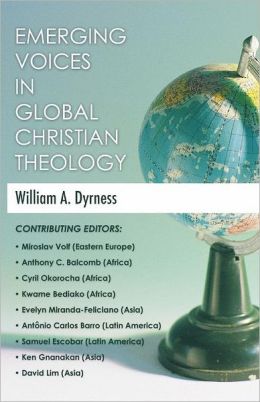
To begin this plunge, I took down from the shelf a book that – to my embarrassment – has sat unread for years, even if it has traveled with me as I’ve made my home and served as a missionary in Côte d’Ivoire, Benin, Haiti, Kenya, and now South Africa. William Dyrness helped edit Emerging Voices in Global Christian Theology (Zondervan, 1994). The compendium contains three essays penned by Christian theologians from Africa, as follows:

Anthony Balcom, “South Africa: Terrifying Stories of Faith from the Political Boiling Pot of the World”

Cyril Okorocha, “The Meaning of Salvation: An African Perspective”

Kwame Bediako, “Jesus in African Culture: A Ghanaian Perspective”

Today, we will look at the first.

Tony Balcom was born in South Africa but raised in Northern Rhodesia (now Zimbabwe). His essay was published the same year when South Africa elected Nelson Mandela as President. This means that Balcom would have been writing some time in 1993, when many South Africans feared that their country was teetering on the brink of civil war. In this context of seemingly intractable mistrust between citizens of differing backgrounds, Balcom poignantly observed (pp. 47-48):

For almost four centuries in South Africa, we fought and killed each other. When we tired of this we shouted abuse at each other across great divides of race, culture, and ethnicity. When we tired of this we slammed the door on each other, each pretending the other was not there, each hoping the other would go away. But when we squatted at the keyhole and squinted through to the other side, we saw each other there, as large as life, waiting. And we knew that one day we would have to do it. One day we would have to talk…it is the conversation of those who have begrudgingly come to realize that conversation is the only way out, because those who do not talk, fight. It is therefore conversation steeped in suspicion, resentment, fear, and hate. But it is nevertheless conversation.

Balcom tells three stories to illustrate his contention: “Not a single issue of life can escape the fact of our faith. Our faith demands of us that we ask the questions to do with our lives” (p. 47). The best story is that of Nonqawuse. A prophetess from the Xhosa people group, in 1856, she revealed that the ancestors had spoken to her and had instructed that all the cattle must be slaughtered. Once they were dead, not only the cattle but all the ancestors would come back to life in spontaneous resurrection, chasing away the white oppressors (p. 50). The paramount chief of the Xhosa, Sarhili, accepted the prophecy, and he ordered the slaughter, believing – according to the prophecy – that the resurrection would happen on 11 August 1856. The date came and went, with no resurrection. Balcom concludes: “The Xhosa people were effectively decimated” (p. 50).

The story of Nonqawuse is a tragic narrative that makes one appreciate the desperate lengths that the oppressed will go to in search of liberation. Further, it encourages today’s messengers of the Gospel to make sure that we are preaching Good News. This Good News is of a Christ who not only liberates us from our sins. More than that, regardless of our cultural heritage – in the words of our Nazarene communion ritual – Christ unites us as believers who are “one, at one table with the Lord.” Barriers of ethnicity must crumble around the Table.

It has been 19 years since Tony Balcom’s essay. Just over one month ago, former President Nelson Mandela passed away, heralded by one and all in the country as a Great Uniter. Debate continues regarding whether Madiba was a follower of Christ. Certainly God knows the heart, and we rest in that truth. However one answers the question, one thing is certain: Of all peoples, Christians should be at the forefront of promoting harmony among peoples of all backgrounds. This is the primary take-away from Balcom’s chapter, a timeless lesson in a troubled and divided world.

————————-

Photo credit: Barnes and Noble

Posted in reflections, The Wesleys and Wesleyan theology

Work with the end in mind

Steven Covey, author of The 7 Habits of Highly Effective People

Steven Covey penned one of the most influential leadership books of the late 20th century, The 7 Habits of Highly Effective People. Covey passed away in 2012, but his principles live on. Here is one of them:

Work with the end in mind.

Those words would have resonated well with 18th century Methodists in England. One of their characteristics that commended Methodism to the people of their day was the peaceful, even heroic way that Methodists faced their own end. Long before the time of drugging people in their final hours, those who approached death were often quite lucid. The 88 year old Rev John Wesley, laying on his death bed in 1791, murmured to those gathered around him: “And best of all, God is with us.”

Here are last words from some others:

“See in what peace a Christian can die.” – Joseph Addison, English politician and writer

“Am I dying, or is this my birthday?” – Lady Astor

“Now comes the mystery.” – Rev Henry Ward  Beecher, 19th century American abolitonist

“I regret that I have but one life to give for my country.” – Nathan Hale

“I’m going over the valley.” – Babe Ruth, 20th century American baseball player

“Bring down the curtain, the farce is played out.” – Rabelais

“They couldn’t hit an elephant at this dist-” – John Sedgwick, Union General, to his men when they advised him to take cover

“Let us cross over the river and sit under the shade of the trees.” – Confederate General Thomas “Stonewall” Jackson

“Leave the shower curtain on the inside of the tub.” – Conrad Hilton, hotel magnate

“So little done, so much to do.” – Cecil John Rhodes, South African gold and diamond miner

“Strike the tent.” – Confederate General Robert E. Lee

“Hold the cross high, so I may see it through the flames.” – Joan of Arc

“I have seen heaven open, and Jesus on the right hand of God.” – Rev Thomas Cranmer, Archbishop of Canterbury

Samuel Clemens, better known under his pen name, “Mark Twain,” had some “work with the end in mind” words of his own. I chose them for the “senior quotes” section of the 1985 Nautilus, the yearbook of Eastern Nazarene College:

Let us so live that – when we come to die – even the undertaker will be sorry.

Have a God-blessed and pivotal year in 2014.

————

Photo credit: NPR.org

Posted in reflections

Idols in the Church, part 1: when food displaces God

cheeseburgerIdolatry is not a new problem for the people of God. It’s as old as the impatient Israelities – restless when Moses was delayed on Mt Sinai – forging a golden calf and bowing down in worship before it (see Exodus 32). Repeatedly in the Old Testament, the prophets called upon Israel and Judah to return to Yahweh. Righteous kings like Hezekiah broke down the “high places” dedicated to Baal and the poles erected to the worship of his partner, Asherah (2 Kings 18:1-4). The willingness to confront idolatry – no matter how ingrained it had become – was the hallmark of the righteous leader.

The times have changed, but our tendency as the people of God to set up idols has not. One idol that the Church needs to topple in its midst is not Baal or Asherah, but it is an idol nonetheless. I’m talking about the false god of food.

Paul described those who lived as “enemies of the cross” (Phil. 3:19). Among the characteristics of such individuals whose minds were “set on earthly things” was that they made of their stomach a god:

Their destiny is destruction, their god is their stomach, and their glory is their shame. Their mind is set on earthly things. But our citizenship is in heaven (3:19-20a, NIV).

The apostle was calling the church to be radically different than the world in which she lived. In Eating to Excess: The Meaning of Gluttony and the Fat Body in the Ancient World (Praeger, 2011; available here on Google books), Susan Hill (p. 103) includes a warning from Clement of Alexandria (AD 150-211/215):

There is no limit to the gluttony these men practice. Truly, in inventing a multitude of new sweets and ever seeking recipes of every description, they are shipwrecked on honey-cakes and desserts.

Likewise, John Chrysostom (AD 347-407) compared a gluttonous person to a wild animal. He or she is “a wild beast rather than a human being; for to devour much food is proper to panther, and lion, and bear.  No wonder (that they do so) for those creatures have not a reasonable soul. Yet even they, if they be gorged with food more than they need, and beyond the measure appointed them by nature, get their whole body ruined by it; how much more we?” (Hill, p. 117).

Paul, Clement, and Chrysostom echoed cautions sounded in the Old Testament. Proverbs 23:1-3 (CEB) advises:

When you sit down to dine with a ruler, carefully consider what is in front of you. Place a knife at your throat to control your appetite. Don’t long for the ruler’s delicacies; the food misleads.

So inadvisable was gluttony to the Jew that to befriend a glutton was to shame one’s parents (Proverbs 28:7). Gluttony (along with drunkenness) led to impoverishment (Prov. 23:21).

Continue reading “Idols in the Church, part 1: when food displaces God”

Posted in Bible

Jesus and the argument from silence

800px-Empty_bookThe headline caught my eye: “Here’s what Jesus had to say about (topic x).”  Underneath was an open book, with blank pages.

Clever, right? But is it a valid argument?

Let’s take the issue of cutting down trees. I might say:

Here’s what Jesus said about deforestation: ”          “

If felling trees and planting nothing in their place were wrong, one might assume that the Son of God would have uttered words against such an evil practice. In fact, we search Matthew, Mark, Luke, and John in vain for a single word from Jesus on the subject. Accordingly, are we justified in clear-cutting the Amazon forest?

Another “hot-button” topic is abortion. Did Jesus have anything precise to say about it? No. Some might ask: “If it were so wrong, wouldn’t Jesus have spoken against it?”

The argument from silence makes conclusions based not on what Jesus said, but on what he didn’t say. But is it right to isolate Jesus’ teachings from the larger message of God’s revelation as contained in the 66 books of the Old and New Testaments? The Lord responded to the pressing issues of his day, not all the pressing issues of our day. Still,  we can find principles about caring for the earth in the same Old Testament that Jesus recognized as God’s revelation. Psalm 104 praises the Creator and the beauty and splendor of creation. To mar that creation through deforestation is like taking a masterpiece by Rembrandt and slicing the canvas with scissors. In the same way, human beings – born and unborn – are God’s masterpiece. David affirms that we are “fearfully and wonderfully made” (Psalm 139:14, NIV). Deforestation and abortion alike are sins against both creation and Creator.

Apart from the Old Testament kings and prophets – the giants on whose shoulders Jesus stood – the Apostle Paul and other New Testament writers fill in some of the gaps. A good example is slavery. Jesus is mute about it, yet Paul radically affirmed:

“There is neither Jew nor Gentile, neither slave nor free, nor is there male and female, for you are all one in Christ Jesus.” – Galatians 3:28, NIV

If one were intent on accepting only Jesus’ words (or lack thereof) as our guide, one could say:

Here’s what Jesus had to say about slavery: ”             “

Yet we don’t accept that argument, because we understand that God’s view of the issue must be more broadly considered, taking into account not just the words of Christ in the Gospels, but all of the Bible. And when we do that, we see that God had lots to say about it. Yes, we can argue over the meaning of verses addressing slavery – and slave owners and abolitionists in 19th century America did so in spades! –  but at least we’d be debating the significance of words and not the verbal vacuum of the argumentum ex silencio.

The next time someone references Jesus’ silence on an issue, don’t let it be the close of the discussion. Instead, let it spur you to dig deeper in the broader mine of Scripture, to unearth closely related principles from God that can guide us. The Church and our world deserve nothing less.

————–

Image credit: Wikkipedia commons

Posted in reflections

Top 5 Christlike acts in 2013

crossSome want to go back to the “good ‘ole days.” Count me out. These are exciting times to be alive and to see what God is up to right now. Here are my “Top 5 Christlike acts of 2013”-

5. Nine-year-old swimmer gives trophy to hospitalized rival – Josh Zuchowski and Reese Branzell are rivals, with Reese usually coming out first, and Josh a close second. When Reese was hospitalized with a bone infection, Josh won the Florida swim meet, then sent his trophy to the hospital, a gift for Reese. The attached note?  “I won this trophy for you today,” said Josh, “and I hope to see you back in the pool.” What parent wouldn’t be proud of such a son?

4. Wrongfully imprisoned man has kind words for friend whose testimony put him behind bars – Ryan Ferguson, 29, spent more than 9 years in a Missouri prison for a crime he did not commit. When he gave a news conference the day of his release – cleared of all charges – he promised to do what he could to work for the release of Chuck Erickson, whose police-coerced testimony had put Ryan behind bars. Ferguson’s humble spirit and refusal to walk down the path of bitterness have gained him more than 90,000 followers on FaceBook, the “army” that – in addition to the efforts of his family and lawyer, Kathleen Zellner – he credits with having produced the judicial review that ultimately resulted in his release. Thanks, Mr Ferguson, for your positive model to everyone.

3.  Teammates create an unforgettable moment for fellow player with special needs – In a story worthy of Chicken Soup for the Soul, Keith Orr – a young man with a learning disability – scored a touchdown for his team, the Olivet Middle School. His teammates left their coach in the dark, working for weeks in secret to devise a play that would allow Keith to score from within the 5 yard line. When the play worked, they carried Keith off the field in triumph. Looks a lot like Jesus to me.

2. Freed prisoner walks the way of peace – O.K., this one happened before 2013, but the movie – “Long Walk to Freedom” – came out this year, so I’m counting it. Nelson Mandela had every reason to strike back after having spent 27 years in prison. Even his wife, Winnie – who had suffered 16 months of solitary confinement – was ready for battle. Yet in a broadcast that many credit with averting civil war, Mandela committed himself to reconciliation between long-term enemies in South Africa. The rest, as they say, is history.

1. Pope Francis sets new tone for the Roman Catholic Church – With his emphasis upon reaching the hurting and marginalized, Pope Francis is leading the way, not with law but with grace. Even those not usually inclined to applaud Christianity have noticed, including Time, which named him Man of the Year.

How about you? What would be your vote for the top 5 Christlike acts of 2013?