Posted in Bible, ecclesiology & sacraments

Ephesians 3:19 – God cannot fill what is not empty

This year, my wife and I swore off soda.

Maybe you call it “pop” or – if you’re a Southerner – it’s a “Coke.” But it’s all the same thing, those highly sugared, carbonated drinks to which so many of us seem to be addicted.

We’re learning a lesson: When what is unhealthy gets jettisoned, what is healthy can take its place. So instead of soda, we’re drinking more water, milk, and juice, and feeling better for it.

To make room for good food, get rid of the junk.

As in the realm of the body, so it is in the realm of the spirit. Ephesians 3:19b is part of a larger prayer for holiness. In that verse, Paul prays for the Ephesians, that they will be “filled to the measure of all the fullness of God” (NIV). In context, it’s clear that the sign of that fullness is the love of God “that surpasses knowledge” (v. 19a).

And yet…

How many of us are so filled up with the junk of this world that there is little room for God?

Television? Internet? Smart phones? Songs praising what we once considered shameful?

189795_glass_2_filling_with_waterThe media themselves are neutral. Each can be used to glorify God, yet is that their practical effect in our daily lives?  Does what we consume make us more sensitive to the voice of God or do our media choices make God seem more distant, more irrelevant?
The revival that broke out in 1970 on the campus of Asbury College in Wilmore, Kentucky was characterized above all by a deep sense of sin. When the holy presence of God fell upon the chapel service that February 3, students began with deep repentance confessing sins. Only then did they come to a joyous sense of both the forgiveness and fullness of God.

We say we want revival, that we hunger for the fullness of God in our hearts and lives. Yet how can God fill what is already cluttered with junk? Before we can know filling we must know emptying. We confess and God cleanses away!

God cannot fill what is not empty.

Many things that fill our lives we should not discard. They are wholesome and honor God. Yet harmful practices that distance us from the Lord must go if the Lord’s holy, loving presence would take their place.

These days, it takes courage to call sinful and damaging what the world labels fun and harmless. Yet that’s exactly the  kind of people God desires, one that – as necessary – will head north when all the world seems to be flocking south.

Are you filled with so much, yet strangely unsatisfied? It’s time to take inventory. God is calling each of us to confession and emptying so that God can fill us with Himself, the only one who can satisfy.

————-

Image: sxc.hu

Posted in book reviews

The mystery of divine healing

faith_cureOf all the non-Nazarene churches where my family gave gospel concerts, the Tom’s River Assembly of God was among the most memorable.

My mom’s parents had long attended a staid, independent Baptist church. But some from the AOG befriended them, and for the next 10 years, they were faithful members.

We gave our concert at the same time that a faith healing evangelist was conducting a protracted meeting at the church. After having laid hands upon the sick and praying for them, he invited others to come forward to represent people who needed healing but were not present at the service. I went forward and prayed for Friend Stafford, an elderly mostly deaf man in my home church back in Rochester for whom I had learned sign language so I could be his interpreter during church services. We went back home, and I couldn’t wait to see what Friend would be like as a hearing man. Much to my disappointment, he was as hard of hearing as ever.

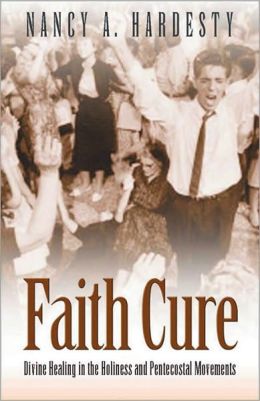
With my own background as a Nazarene and my contact with Pentecostal groups like the AOG, Nancy A. Hardesty’s Faith Cure: Divine Healing in the Holiness and Pentecostal Movements (Peabody, MA: Hendrickson, 2003) caught my attention. It is a handsome volume that packs a lot of solid historical research into a mere 152 pages.

Where Nancy Hardesty excels is in her making various heroes (and heroines) of the late 19th and early 20th century divine healing movement in America come alive. Aimee Semple-McPherson, Alexander Dowie, A.B. Simpson and a colorful cast of of others who emphasized God’s healing touch receive sympathetic treatment from Hardesty, though she does not hesitate to show their flaws.

In a chapter entitled “No doctors, no drugs,” the author delves into the quackery that passed as medical science at the end of the 19th century. This does much to establish the historical context that makes it understandable why Simpson and others insisted that believers seeking physical healing put their sole trust in Jesus, the Great Physician. As modern medicine has improved, this categorical insistence upon forsaking all other means toward healing except God’s direct touch has likewise faded.

Not all is well with Faith Cure. The chapter entitled “theology” is too short to do justice to various Bible passages often cited in defense of divine healing. Further, there is no attempt on the part of the author to research the authenticity of healings that the so-called “healing evangelists” performed in the mid-20th century.

Despite these shortcomings, Nancy Hardesty provides a good introduction to a vast topic. She acknowledges that there is an ongoing place for the doctrine and practice of  divine healing (and anointing with oil – James 5) in the life of local congregations within the Holiness and Pentecostal traditions. If her book stirs up a desire to return to balanced teaching on the topic, then it will have served a useful purpose beyond mere academic interest in a fascinating topic.

——–

Photo credit: Barnes and Noble

Posted in book reviews

Making a difference in West Africa

Responding_to_the_Call-thCan one little girl from an obscure village in Côte d’Ivoire make a difference? Read Responding to the Call: The Story of Jacqueline Dje Dje (Nazarene Publishing House, 2013) and you will answer with a resounding “yes.”

Amy Crofford* has written 6 missionary books for NPH, and in some ways, this is the best of the lot. Where other books have centered around the lives and experiences of Western missionaries, this biography revolves around the first ordained French-speaking  female pastor in the Church of the Nazarene in West Africa.

The reader is quickly caught up in young Jacqueline’s quest to fulfill her call from God, setting out in search of a denomination that will allow her to preach and shepherd God’s flock. Obstacles are not easily overcome, but with a patient spirit and a quiet determination, Jacqueline first conquers academic disadvantages to graduate from the Bible Institute. Later, she overcomes longstanding cultural biases, planting a new church and eventually receiving Nazarene ordination as an elder. To discover the moving ending to her story, the reader can find the book here or ask to borrow it from the NMI President at a local Church of the Nazarene near you.

While strong overall, the book has its weaknesses. It’s not clear what connection two profiles of other female African Nazarene pastors have to the main narrative. Also, some missing details will leave the reader in suspense, like the name of a “life changing book” that someone gave Jacqueline. More information, please!

Whatever the book’s flaws, Rev. Jacqueline Dje Dje’s courage shines through. She became a pioneer for other Nazarene women called by God to pastoral ministry. (A French translation of the book is planned). One serendipity is that by presenting the story of a female pastor overseas, perhaps the American Nazarene reader will be more open to considering some of his or her own biases about what gender a Nazarene pastor in the United States should be.

*Full disclosure: The author is married to the owner of this blog.

———-

Image credit: Nazarene Missions International

Posted in sermons & addresses

Hate sin and love God by loving others – 1 John 3:7-18

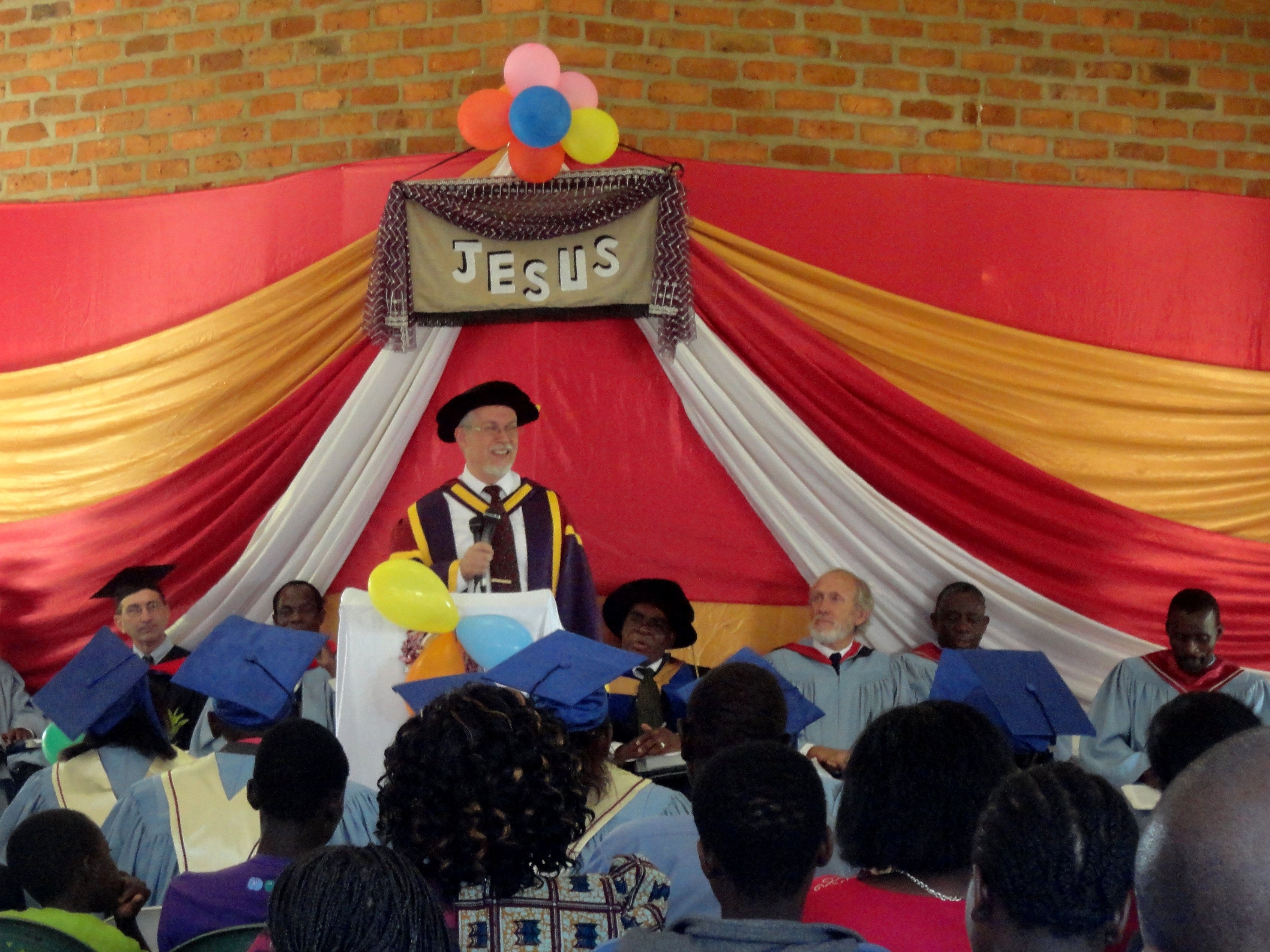
The chapel of NTCCA was full as Greg addressed graduates, their families, and friends
The chapel of NTCCA was full as Dr. Crofford addressed graduates, their families, and friends

Note: This is the graduation address I presented at the commencement exercises of Nazarene Theological College of Central Africa (Lilongwe, Malawi) on 4 May 2013.

Scripture reading: 1 John 3:7-18

Text: 1 John 3:8b – “God Son appeared for this purpose, to destroy the works of the devil” (Common English Bible).

——————————-

“Hate sin and love God (by loving others)”

I.  INTRODUCTION

(salutation and all protocols observed)

We are gathered together today to honor the achievement of the graduates of Nazarene Theological College of Central Africa, both campus and extension students. You have persisted through many hours, days, and months of study, and all for one reason: To better equip yourself for the ministry to which our Lord Jesus Christ has called you in his church. Today, we pause on this auspicious occasion to say two words: Well done!

Many of you have already been involved in ministry in the local church. Some of you will be taking the role of pastor for the first time. At such a moment, what words of wisdom does the Bible have for you?

We have heard the Scripture reading from 1 John 3:7-18. In the passage, two commands repeat themselves:

1) hate sin;

2) love God, by loving others.

Continue reading “Hate sin and love God by loving others – 1 John 3:7-18”

Posted in Christian ethics, reflections

A mini U.N. in my closet – but at what price?

One of two shirts I often wear, made in Bangladesh
one of two shirts I often wear, made in Bangladesh

A factory in Savar, Bangladesh collapsed Wednesday. More than 3,000 workers were inside, making clothes to fill orders placed by stores like Walmart, working at monthly wages equivalent to only $ 38.00 U.S.  When the building began to shake, chaos ensued as people ran for the doors. At last count, more than 350 were killed, crushed under the weight of a building shoddily constructed but only days ago certified as safe by engineers.

The commercial asks: “What’s in your wallet?” But the tragic news from Savar begs a different question: “What’s in your closet?” Looking at shirts only, I discovered in my wardrobe “made in” tags from:

Bangladesh

Vietnam

Hong Kong

Macau (administered by the Chinese)

Lesotho

Nicaragua

Kenya

Guatemala

Pakistan

India

Bottom line? I have a mini U.N. in my closet, but at what price?

The “Do unto others as you would have them do unto you” (Matt. 7:12) ethic of the Christian faith teaches us that sin is not just an affair between us and God. Sin always has collateral damage, affecting others. Sometimes, sin insidiously weaves its way into the economic structures of our world, producing what theologians call systemic evil.

The factory in Bangladesh paying its workers little more than $ 1.00 per day is there in part because of the shirt hanging in my closet. If I and countless other consumers had chosen to buy shirts only from stores who outsource to safe manufacturers that pay fair wages, then Wednesday’s tragedy may have been avoided.

But let’s face it: We want cheap shirts and pants and running shoes and power tools, and the list goes on.

I have seen the face of evil, and it is me.

James 4:17 teaches that if we know to do good yet refuse, then we have sinned. So let’s get practical. Solving all systemic evil is overwhelming, on that we can agree. Yet surely we can light a candle and not just curse the darkness. Short of becoming Amish and spinning my own clothes, how should I react to the systemic evil in this instance?

1) As a regular customer of Walmart, I can tell them that I am sorry for having participated in this tragedy by buying their clothes from Bangladesh. Further, I can invite them to join me in demanding changes.

2) Until those changes take place, I can find a store that guarantees its products were produced responsibly in safe factories that pay a fair wage. Will I pay more? Most likely I will, but here the Golden Rule applies again. If I were working in Pakistan, Kenya, or anywhere else, would I want to receive a fair wage?

3) Finally, I can buy local products on purpose. When I buy things made close-by, I can be more sure that those who made them were fairly compensated. Also, by helping a local company grow its local market, they will spend less on transporting the goods far away. This in-turn will reduce the energy used and therefore the greenhouse gases produced to transport it to far away customers.

Systemic evil includes all of us, yet we can loosen its clutch if we are intentional. Like Jesus, let’s remember that loving “the least of these” (Matt. 25:31-46) means loving those who make the things that I use every day.

————

UPDATE: Since this story broke, I noticed that clothing from Bangladesh at the Atlanta airport was marked down by 75%. Time will tell whether this distaste on the part of the buying public will endure.

Posted in From soup to nuts

Theologian’s apple crumb cake

Maybe the first word of this blog’s title is a bit of a stretch to make it fit the “Theology in Overalls” theme. Truth be told, there’s nothing original (or sinful) about my cake. You can find the recipe over at Amateur Gourmet.

On second thought, there is something a tad original about it.

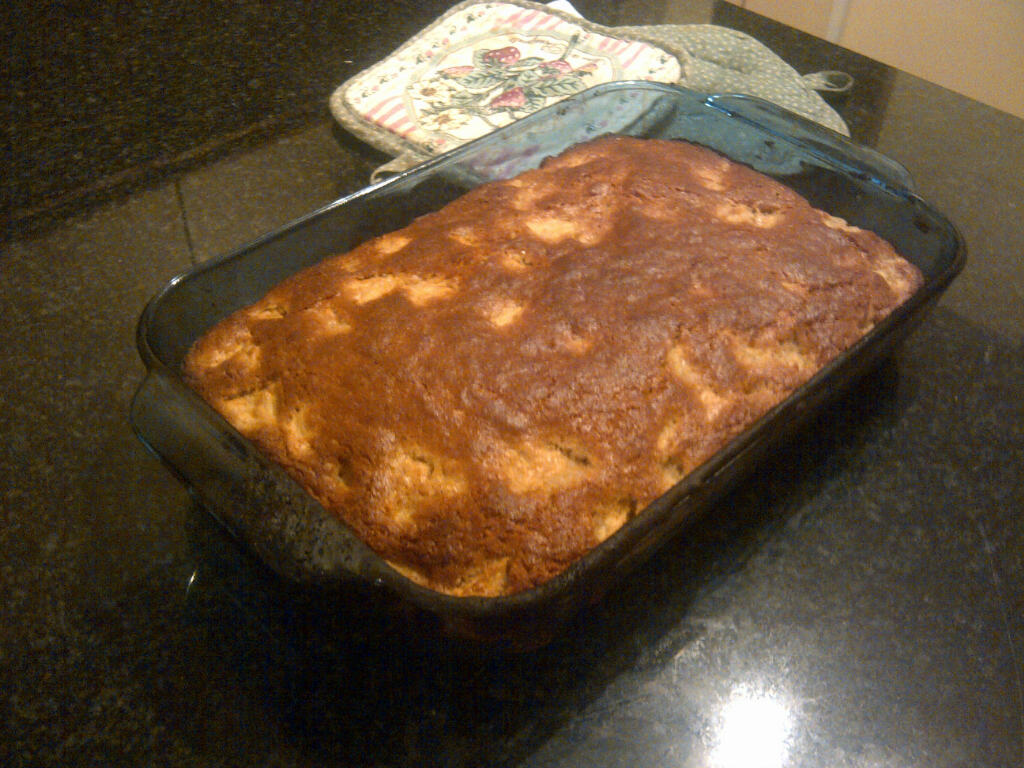
I had just put it in the oven to bake for the prescribed 30-35 minutes when (horror of horrors) I realized a small detail: I had forgotten to add the 2 1/2 teaspoons of baking powder. Amy informed me in no uncertain terms that cake needs baking powder to rise. Time to get creative!

Turns out this white stuff is pretty important when baking. Who would have thunk it?
Turns out this white stuff is pretty important when baking. Who wooda thunk it?

Out of the oven came the pan, and I dumped the whole thing (wondrous crumbly/buttery topping and all) into a large mixing bowl. Into the mix went the forgotten white magic from Royal, then back into the fiery furnace.

Thirty minutes later, tuh-dah! Here’s the result:

Crumb cake, sans topping (it's hiding inside)
Crumb cake, sans topping (it’s hiding inside)

Serve with Five Roses tea (milk and sugar, please) and other than the missing topping, not bad, if I say so myself.

Posted in reflections

Seeing God from the lookout…and the street

Columbia Center, Seattle

When it comes to skyscrapers, I might as well admit it: I’m a soft touch.

Maybe it’s because of my NYC experience as a four-year-old. My Dad, Mom, my brothers and I headed north from Flemington, New Jersey to Manhattan. From the 80-something floor of the Empire State building, we looked out over the sprawling metropolis. My head poking through the railing, I looked at the vehicles so far below, then exclaimed: “Daddy, look at all those Matchbox cars down there!”

As a student on Boston’s South Shore, I trekked more than once to the Prudential building, in search of the same perched-above-it-all thrill. Then just last week, Seattle’s Columbia Center beckoned. From the 73rd floor of the 76 floor titan – the tallest in the West Coast region of North America – I spied the comings-and-goings of harbor boats in Elliott Bay, elevated highways snaking south toward Normandy Park, and Mt. Rainier foggy through the mist. Even on a cloudy day, it was worth the admission price.

Yet most of our life is lived down on the street. In Seattle, it’s down in Pike Place Market where they throw you the catch of the day…and you drop it. Or back in Boston, when you leave the Prudential building, the same subway that deposited you near tony Beacon Hill takes you back to Eastern Nazarene College winding through hardscrabble neighborhoods like Roxbury. Even the storied Empire State Building that summer day in ’67 sheltered in a stairwell a derelict man, sleeping away his hangover.

There are days when I see God from the lookout. Through prayer, Scripture reading or the well-crafted phrase of a praise song or sermon, I momentarily rise and glimpse the majesty of the vista. Perched above it all, the rays of the sun seem warmer, clearer, more pristine. There, the sweep of God’s plans fit together in unity, a well-choreographed dance scene from a Rodgers and Hammerstein musical.

Most days, though, I’m at street level. Instead of pondering the greatness of God, I’m frantically looking for my car keys or fretting about whether the money is going to run out before the month does.

Yet the amazing thing about the God we serve is that God is not confined! At the top of the skyscraper? God is there. Down on the street level where we suffer? God is there, too — Jesus, Immanuel, God with us.

Continue reading “Seeing God from the lookout…and the street”

Posted in Christian ethics, reflections

Let’s talk about the “s” word

When did sin become the “s” word that we dare not speak?

This was not always so. There was a time when most believed that sin – disobedience to God’s law, whether through rebellion or neglect (1 John 3:4, James 4:17) – was a big deal. Sinning was stigmatized, a warning to others of its danger, like a sign on a power box: “Danger: High Voltage.” We believed it was the cryptonite that could bring any Superman to his knees. Do we still believe that?voltage

There are at least two devastating consequences of sin’s denial:

1. The denial of sin precludes the possibility of healing, leading to death.

In his sermon Original Sin, John Wesley urged: “Know your sickness, know your cure.” Salvation in Scripture is a solution to a problem. But if we think there is no problem, then we won’t seek a solution.

One of the most painful reality T.V. shows to watch is Intervention. In one episode, a young woman addicted to methamphetamine takes the drug regularly, admitting no downside to her habit. Yet she is blind to the way it is controlling her life, putting her job in jeopardy and straining her relationship with those who love her most. Recovery only came when her family staged an intervention and she was willing to admit: “I’m an addict, and I need help.”

Likewise, the Good News of Jesus’ death only makes sense if we first acknowledge the bad news of our sinful predicament. Each of us must come to the place where we acknowledge that we are the worst of sinners (1 Tim. 1:15, NIV). Only when the illness is diagnosed and we accept Scripture’s dismal diagnosis will we be ready to seek the Great Physician for a remedy.

Sometimes death is presented only as what happens when we breathe our last. Yet sin is so poisonous that it begins to diminish the present vitality of those who deny its presence. In John 10:10, Jesus warns about the “thief” that has come to “steal, kill and destroy” (CEB). Sin gives us death on the installment plan, a progressive choking off of our life here-and-now. The end result is utter darkness, devoid of hope and without God (Matt. 25:30, Galatians 6:8). Conversely, to confess our sin is the first step toward the full recovery God wishes for each of us (1 John 1:9), a clean heart and a fresh start.

2. The denial of sin destroys community.

One of the devil’s biggest lies is often repeated: “No one else is getting hurt.” But is this true? Before the cheating spouse is unmasked, he or she may be convinced that an extramarital dalliance is harmless, not a sin but an innocent pleasure. Yet when the affair is exposed, the fallout is no less devastating. Like a priceless vase shattered into a hundred pieces, trust can only be painstakingly glued back together. Even then, the fissures are obvious, the beauty marred.

The epitome of beauty marred is Fantine, Victor Hugo’s pitiful character in Les Misérables. Her own indiscretion of conceiving a child out of wedlock is compounded by the sin of others who move beyond stigmatizing to self-righteous victimizing, chasing her from her factory job, forcing her to resort to prostitution to support her daughter, Cosette. In the 2012 film adaptation of the novel, Anne Hathaway sings “I dreamed a dream,” dripping with pathos:

“I had a dream my life would be
So different from this hell I’m living,
So different now from what it seemed…
Now life has killed the dream I dreamed…”

Fantine is alone and broken. Her own sin could have been forgiven and overcome if she had experienced the power of grace demonstrated through others. Instead, the blindness of her fellow employees to the sinfulness of their gossip and their subsequent shunning of one they judge to be disgraced dramatically fractures community. Whether it is the denial of sin by an individual or the tolerance of corporate sin by the community at-large, it is the community itself that is destroyed.

Only in this light does the radical action of Peter toward Ananias and Sapphira in Acts 5 make any sense. When they sold their land and secretly kept back part of the money for themselves, Peter confronted them. Since the couple had lied about what they had done, Peter became the mouthpiece of the Holy Spirit, pronouncing judgment: “You have not lied to people, but to God” (Acts 5:4, CEB). For the Christian community to sweep sin under the carpet would have guaranteed the church’s demise. Peter knew that the denial of sin destroys community.

Conclusion

In the 21st century, the Church faces many challenges. The culture in North America particularly seems to be growing intolerant of the “s” word. Yet Scripture and experience both remind us that only when we acknowledge our sin can God’s forgiveness flow. Isn’t it time we talk about the “s” word?

———–

Photo credit: Creative Safety Supply

Posted in autobiographical

A good turn in the Big Woods

winter-maine-300x225Québec beckoned, and I could not resist. When had I fallen in love? Perhaps it was the first time that summer when I’d gazed out over Montréal from the lookout point. Or maybe it was listening to strains of “La vie est belle à Place Royale” sung with heart to the accompaniment of a concertina on the cobblestone streets of the OldCity. But whenever it was didn’t really matter. What mattered was the letter I held in my hand, an invitation to return. Sixteen months later, I was going back to this little piece of France in Canada, and I couldn’t be more delighted.

The three days in Québec flew by, as I took in its winter wonders. Having said my goodbyes to friends, I turned the nose of my Plymouth Horizon southeast, heading back to Boston’s south shore and my last semester at college. Thoughts of my fiancée back on campus were on my mind even as music from my latest tape filled the tiny car. My wipers kept time, brushing away the snow flakes that began to fall. The miles crawled past as I crossed through the customs checkpoint and continued down the lonely highway, passing through the Big Woods of Maine on that that cold New Years’ Eve.

“Is it my imagination,” I thought, “or is the music getting slower?” There was no mistaking it now. The tape was slowing down, but the snow fell harder, turning into an icy storm, as the wind began to howl. The dashboard glowed more dimly, then not at all. I struggled through the blinding white to make out the road ahead of me even as my headlights quit. An eighteen-wheeler slammed on its brakes behind me, the driver angrily blaring his horn as he passed. My tail lights out, I was an accident waiting to happen.

My first thought was to pull over to the shoulder and pop the hood. Surely someone would give me a hand? But cars were sparse on Route 201 that night, most folks having the sense to stay in on a frigid New Year’s Eve. Besides, what guarantee did I have that once I turned the key off it would start again? Foolishly, I had forgotten to put gloves or a ski cap in the car, and my winter jacket was getting colder by the minute.

The headline in tomorrow’s paper was only too clear: “Frozen motorist discovered in snow.” No, there had to be another way, as I said a quick prayer.

That’s when I remembered Ken’s directory. Ken, a retiree, worked part-time on campus in the print shop. Years before the internet was born, he’d taken on the huge project of compiling a telephone directory of churches in our denomination. Before break, he’d wished me a Merry Christmas and handed me a directory. “What am I possibly going to do with this?” I secretly thought, but took his gift and thanked him. Before my trip, I’d tossed it into my bag and forgotten about it, until now. Little did Ken know that his book was about to save my life.

By now my Horizon limped along at a mere 30 mph. Somehow, I’d managed to stay on the road long enough for a passing vehicle’s headlights to illuminate an overhead road sign: Waterville, ½ mile. Taking the ramp, I groped towards town, as the car sputtered and died by a public phone in a deserted parking lot.

“Maine,” I thought. “Who do I know in Maine who could possibly be in this book?” Scanning through the pages, Skowhegan rang a bell. Quickly dialing the number as I shivered in the metallic phone booth, the voice of a middle-aged man came on the line. “Is this Pastor Gary?” I asked. He remembered me from the choir concert our college had performed at his church the previous spring. Aware of my predicament, he took my number and asked me to wait while he made arrangements. A blustery ten minutes later, the phone rang and my numbed fingers lifted the receiver from its cradle. “Greg,” he said, reassurance in his voice, “I just spoke with my Aunt Gertrude. She lives just a quarter of a mile up the road from where you’re standing. It’s an old school that they’ve converted to senior citizen apartments. Just ring her buzzer, and she’ll let you in. She has an extra bedroom and you can spend the night.” Thanking Gary profusely, I locked up my car, then set out to meet my new friend.

“What will Gertrude be like?” I wondered. Pushing the button, I heard the buzzer ring, then her voice came over the intercom. A few minutes later, standing in the hallway, I gently knocked on her door. “Come in, Greg,” she said, as she opened the door and invited me in. “You must be freezing! Would you like some hot chocolate?” I sat down on her couch and took off snowy shoes, my nearly frost-bitten toes grateful for the comfort of a warm carpet. While Gertrude busied herself in the kitchen with our hot chocolate, I looked around her simple apartment. The clock on the wall registered 11:55 p.m. as it quietly ticked away the last moments of 1984. Gertrude came back into the living room and handed me a piping hot cup of cocoa. We sipped together in silence and watched the television as a luminous apple dropped down the huge pole in Times Square.

The next morning, Gertrude made me a hearty breakfast of eggs, toast, and oatmeal. She let me use her phone to call mechanics, but I frankly wasn’t optimistic. Who in their right mind would be working on New Year’s Day? And even if I did find someone, I had no credit card. Would they agree to fix my car for what little I had in my wallet? After reaching answering machines at a half dozen shops, finally on the seventh call a real person answered. He said he was just working half a day, but when I explained my situation, he agreed to take a look at the car. A few hours later, I had a new alternator belt, and the big-hearted mechanic had $ 25.00. Waving goodbye and thanking him again, I turned one more time toward Boston, my tape deck booming and my mind thinking again of a special someone back on campus.

Québec still beckons to me. My special someone – now my wife – and our two sons visited the Old City together a few years back. They, too, appreciate its charms, but I have to admit it. It’s hard for me to think about Québec without being grateful to a retired printer, a kindly preacher, a hospitable old lady and a generous mechanic who in wintry Maine did a foolish college boy a good turn.

————-

Photo credit: Bill Dodge Auto Group

Posted in sermons & addresses

Well-done, good and faithful servant!

Grace Ncube, Chair, Board of Trustees, awards Diploma in Theology to graduate Lindley April
Mrs. Grace Ncube, Chair, Board of Trustees, awards Diploma in Theology to graduate Lindley April as I look on.

Today was a tremendous day at Nazarene Theological College as 7 received their Diploma in Theology and 12 were awarded the Bachelor of Theology. Here is the address that I delivered to the graduates.

– Greg

“Well-done, good and faithful servant”

An address on the occasion of the 22nd Annual Commencement Exercises

Nazarene Theological College

Muldersdrift, South Africa

Gregory Crofford, Ph.D. — Regional Education Coordinator

March 16, 2013

Dr. Filimao Chambo (in absentia), Rev. Collin Elliott (in absentia), Rev. Mashangu Maluleka, Members of the Board of Trustees, District Superintendents, Pastors, Graduates of the class of 2013, students of NTC, parents, friends, honored guests, all protocols observed –

Jesus, teller of parables

Our Lord Jesus Christ was a man of the people. He knew their hopes and fears, their dreams and their disappointments. For 33 years, he walked among them as one of them, showing them both the dangers of self-love and the joy of loving God and others.

The Parable of the Talents retold

Jesus had a way of speaking to the people in their own language, and they loved him for it. His parables connected with people right where they lived. One such story is recounted in the 25th chapter of Matthew’s Gospel. The master was going on a journey, but before leaving, he called to him three of his servants. To the first he gave 5 “bags of gold” (as the TNIV puts it), to the second 2 bags of gold, and to the last servant, 1 bag. Some translations use the word “talent,” which was equivalent to 20 years of a day laborer’s wages.

Some time later, the master returned and called his servants in to give an account of the money that he had entrusted to them. “Look,” said the first servant. “You gave me 5 talents. I have gained five more!”  The master was delighted, and replied: ‘Well-done, good and faithful servant! You have been faithful with a few things; I will put you in charge of many things. Come and share your master’s happiness!’ Likewise, the man who had been entrusted with two talents came before his master, carry an additional two talents. He, too, received the blessing of his master. But the third man came before the master with a single bag of gold. “Here is the talent you entrusted to me,” he said. ‘I knew that you are a hard man, harvesting where you have not sown and gathering where you have not scattered seed.  So I was afraid and went out and hid your gold in the ground.”

The master was furious. “So you knew I was a hard man?” he demanded. “Then at very least you could have put the bag of gold on deposit at the bank so I would have it back with interest.” The master confiscated the bag of gold and gave it to the servant who already had 10 bags. He concluded: “For whoever has will be given more, and they will have an abundance. Whoever does not have, even what they have will be taken from them”(Matt. 25:29).  The story has a very sad ending. The master orders that the servant be thrown outside into the darkness, where there was weeping and gnashing of teeth.

Traditionally, preachers have three points to their message, but today, let’s look at four lessons gleaned from the parable of the talents.

Continue reading “Well-done, good and faithful servant!”