Posted in book reviews, reflections, The Wesleys and Wesleyan theology

When is simple too simple? Relational theology and love

relational_theologyThe word “relationship” is part-and-parcel of evangelical jargon. A tract left on a public bench may ask in bold letters:

Do you have a personal relationship with Jesus Christ?

And it is through the prism of relationship that some Christian theologians are formulating their views. A recent example is Brint Montgomery, Thomas Jay Oord, and Karen Winslow, eds., Relational Theology: A Contemporary Introduction (Point Loma Press, 2012), a collection of essays written by 31 authors contributing insights from the relational paradigm to a spectrum of theological and philosophical issues.

Structure and target audience

Relational Theology is structured around four categories:

1. Doctrines of theology in relational perspective;

2. Biblical witness in relational perspective;

3. The Christian life in relational perspective;

4. Ethics and justice in relational perspective.

Nested under these headings are intriguing subjects, including (among others) sin, free will and determinism, the means of grace, how humans relate to the creation, social justice, and feminist theology. True to its sub-title, “A Contemporary Introduction,” each of the essays is short, presenting a fly-over view at 30,000 feet of the ground beneath. Footnoting is very limited, which frees the text of heavy documentation, making the read more user friendly, especially for the novice. On the the other hand, since the book is geared toward the non-specialist, it is puzzling why the editors chose not to include questions for group discussion at the end of each chapter. This would have made for better learning as well as improved marketing of the book to small church groups, Sunday School classes or other venues.

Those who clicked on the Amazon.com link above will notice that the book is listed as “out of print.” Strangely, Point Loma Press (the publisher) also does not list the book on its website. It is hoped that these glitches can soon be corrected so that Relational Theology will be easily available to readers.

Continue reading “When is simple too simple? Relational theology and love”

Posted in book reviews, missions & evangelism

Jonny Steinberg’s Tale of Two Liberias

little-liberia-an-african-odyssey-in-new-york-cityIf you’re looking for a whimsical read, then steer clear of Jonny Steinberg’s Little Liberia: An African Odyssey in New York City (London: Vintage Books, 2012). But if you crave a journalistic style that ably presents riveting episodes from Liberia’s two civil wars (1989-96, 1999-2003) along with their ripple effect upon “Little Liberia” (Liberians refugees exiled on Staten Island in New York City), then Steinberg’s account is for you.

Full disclosure: I cannot read Little Liberia without seeing it through the eyes of my own visits to that country. It was during a lull in the fighting in the Spring of ’95  that I first touched-down in Monrovia, to teach a theology class to twenty pastors. Subsequent visits have confirmed for me the resiliency of this people, a determination to stick together through tough times. To visit Liberia is to love Liberians, a gregarious and hard-scrabble people.

This same enduring spirit imbues Steinberg’s book, narrated through the eyes of two Liberian refugees living in New York City. Rufus Arkoi was a soccer coach and organizer who left Liberia in 1986. His path later crossed with Jacob Massaquoi, whose foot had been badly mangled in a shooting in Monrovia during an outbreak of fighting. Through their childhood stories, we catch a glimpse of the historical dynamics that laid the tragic groundwork for the gathering storm.

What is it that made Liberia prone to such brutal civil wars? Part of it – according to Rufus Arkoi – is the “suspicion and jealousy” that permeates society. When asked where that comes from, his answer is polygamy (p. 149-50):

I always say it is because of how our families are structured: one man, four wives, four sets of children, four sets of goals, not one set of family goals. Jealousy among the four sets of children. This mother is only looking at the interests of her children and is wishing that those children from the other mothers do badly in life. That’s the family structure. That’s the society.

And yet the amazing thing about both Rufus Arkoi and Jacob Massaquoi is that – whatever the cause of suspicion – they both are most of the time able to rise above it, contributing to the good of their fellow Liberians in important ways. Theirs is an optimism that sees not only what is but what can be, both working to help Liberian youth on Staten island get the education that will keep them out of gangs, enabling them to build for a brighter future.

In connection with economic development back in their homeland, one assumption that that author never challenges is that salvation must come from outside of Liberia. It is Liberians working in New York City who – much like Haitians – send a significant portion of their salary back to their country of origin. On the one hand, this is admirable, a sign of solidarity that should be applauded. On the other hand, it perpetuates a cycle of dependency, blinding citizens to local resources. Of course, this is the dilemma of all foreign aid. How can legitimate human need be met without creating in those helped a sense of entitlement? To use the words of the late Jack Kemp, how can assistance be a “hand up” and not merely a “hand out”?

In the last chapter of the book, Rufus Arkoi returns to Liberia and makes promises that he will go back and raise money from American donors, that he will send American soccer scouts to Monrovia to recruit Liberian players for foreign teams (p. 241). One more time, he works from an old paradigm, that someone else from somewhere else will solve our problems. What is lacking is a strategy for developing local resources for long-term sustainability. To borrow a political slogan, how can Liberia move from “Yes, they can” to “Yes, we can”?

For those who have never traveled outside of North America, Little Liberia it is an excellent introduction to dynamics that operate not only in Liberia but across sub-Saharan Africa.  Truly, this is a continent with huge potential and where most of the solutions to most of the problems lie close by, not far away. A pastor from South Africa put it well: “We are a rich people with a poverty mentality.” Yet it is more than outlook; it is also values. Solutions are short-circuited by individual greed, through misappropriating for oneself funds that were intended for the common good. (And lest we Americans get too self-righteous on this score, Google “Bernie Madoff.” Pot, meet kettle.)

As Christian educators, our task remains to inculcate in the young the integrity that will prevent the corruption that has tainted the past. Economic poverty is closely tied to moral poverty, no matter where in the world one is working, Africa included. It is righteousness that “exalts a nation” (Proverbs 14:34). Truly, holiness is Africa’s hope; indeed, it is the world’s hope!

Whether describing the depressing ravages of civil war or the optimism of re-directing youth through sports and education, Jonny Steinberg is a gifted writer well worth the reader’s time. I highly recommend Little Liberia.

———–

Photo credit: Angus Robertson

Posted in reflections

A genoux, petits enfants – thoughts on worship at Christmas

“On your knees, little children.” (A genoux, petits enfants)

This line from “Petit Papa Noël” sung by Josh Groban reminds us that – like many things in life – worship is something we teach our children. At Christmas time, adults supervise children in pageants at church. The little shepherds and wisemen arrive in their ill-fitting but colorfully cute outfits, and parent snap pictures, pride welling up inside. What are we teaching? From this activity, we teach our young that the Divine demands our allegiance, is worthy of our adoration.

Ideally, it is only to God that we teach our children to bow, in deference to the First of the Ten Commandments: “No other gods; only me” (Exodus 20:3, The Message). This is crucial, because to bow our knees to anyone or anything but God is idolatry, the setting up of false gods in our lives. But sometimes I wonder: When the Christmas pageant is done, the cookies are eaten, the fellowship hall vacuumed and we’ve locked the church door behind us, what are we modeling to our young the rest of the year? Even if we never verbalize “On your knees, little children” through our daily actions and reactions, to what other gods are we encouraging our children to give their devotion?

Merriam Webster’s fourth definition of worship is “extravagant respect or admiration for or devotion to an object of esteem.” As I look around our world, I see a number of things that – while wholesome within limits – can morph into something else altogether, usurping the place in our lives that belongs only to God. You probably have your own list, but here are three from mine:

Exhibit A – Media

ImageThis is a huge influence in our daily lives, and encompasses so many “gadgets.” Television is only the most obvious. By the time an English child has reached the age of 7, he or she will have already spent 1/7 of their lives – one full year – in front of the television screen. Is your living room set-up with furniture all centered around a big-screen T.V. or is it set-up in a way that encourages conversation among those in the room? Positioning of objects speaks of priorities.

Sometimes the advantage of living overseas is coming back to the United States with fresh eyes on my own country. Walking onto the platform of the Washington D.C. subway, I was amazed to see at least 80% of those waiting for the subway to arrive glued to their “smart phone.” We were all physically together, yet in spirit, we were inhabiting hundreds of different virtual worlds. Is it any wonder that Democrats and Republicans have trouble talking about anything big when in our nation’s capital we don’t even converse with each other about small things while standing side-by-side? Has our devotion to our gadgets become extravagant, edging out the rich, in-the-flesh relationships that otherwise might flourish? (This may be an ironic question on a web-based blog, so you have permission to stop reading and to spend some time with your twelve-year-old).

Continue reading “A genoux, petits enfants – thoughts on worship at Christmas”

Posted in sermons & addresses

What difference does Christmas make?

cross-and-manger“What difference does Christmas make?”

Galatians 4:1-7

Preached at African Nazarene University Church

Nairobi, Kenya

Sunday, December 16, 2012

– Read passage in the NLT, followed by opening prayer –

I.          INTRODUCTION

What difference does Christmas make?

Is it just about eating chicken, going up-country to visit with relatives? Or, in my native country, drawing on German customs, is it just about making cookies and putting up a fir trees with lights and decorations?

What difference does Christmas make?

To answer the question, first we must change the question.

The word “Christmas” never appears in the Bible. It comes from Middle English prior to the 12th century, and refers to the mass devoted to Christ celebrating Christ’s birth.

So really, we instead should ask:

What difference does the incarnation make?

Now, I’m not suggesting that we change our greeting from “Merry Christmas” to “Merry incarnation.” That would take some getting used to! But it would be a more accurate description of what we’re actually celebrating. It is the feast of Christ’s coming to earth to save us.

John 1:14 (KJV) tells us: And the Word was made flesh, and dwelt among us, (and we beheld his glory, the glory as of the only begotten of the Father,) full of grace and truth.”

In the same way, the Apostle Paul thought long and hard about what difference Christ’s coming to earth made. As a Jewish man, his first concern was to relate the old thing that God had done through His covenant people with the new thing God had done through Christ. That’s really what Galatians is all about.

So in Galatians 4:1-7, we find at least three answers to the question, “What difference does the incarnation make?” The answers to that question can be summarized in three words:

1) freedom

2) adoption

3) inheritance

Continue reading “What difference does Christmas make?”

Posted in ecclesiology & sacraments, reflections

When more is less: Dubious words attached to “Christian”

Learning French, I came across the word aimer. It means “to like or to love.” I assumed that to place the word beaucoup (very much) after aimer would be an intensifier, i.e. “I love you very much.” That’s not so,” said my French teacher. “The verb for love is so strong, that to add any adverb afterwards is only to weaken its meaning.”

In the same way, some adjectives attached to the front of the word “Christian” just weaken the term. Like barnacles on a ship’s hull, is it time to scrape them off?  Here’s a quick list of some candidates for scrubbing:

Evangelical Christian” – From the Greek for Good News, “evangelical” emphasizes the act of evangelism, of telling others the Good News of Jesus. This is the Gospel, that God sent Jesus to save the world — that Jesus was born, died, rose again and will one day return. Yet truth be told, all communities that bear the name of Christ preach the Gospel as they understand it, so why the back-handed slight on others by claiming the word “Good News” (evangelical) in an exclusive way? Some of the readers over at Rachel Held Evans’ blog seem to agree, and are ready to jettison this word that divides.

Born again Christian”- Jesus told Nicodemus: “You must be born again” (John 3:7). Yet “born again” attached to “Christan” is arguably redundant. According to the theology of some, the New Birth happens for a baby at the moment of its baptism. Others see it happening when a adult makes a decision to follow Christ. Still others believe the New Birth happens at the moment of adult baptism. All three agree upon one thing: The New Birth is the gateway to Christian faith. So, the only kind of Christian is the born again kind! To ask a Christian – “Have you been born again?” – is a simple question. There is only one answer: “I’m a Christian; therefore, I have been born again.” Let’s drop “born again” as an adjective in front of “Christian.” It’s a needless piling up of words, and only causes confusion. Say: “I’m born again” or say “I am a Christian.” Labeling yourself a “born again Christian” is like saying: “I’m a bison buffalo” – two different names, same animal.

Bible believing Christian”- This one is a bit trickier. I understand what people mean by it. They mean that the Bible is God’s Word, and should be our guide for our salvation and how we live. Some go further, saying that the Bible is without error in the original autographs (now lost, we are told). I think that there are other ways of getting this message across, without the kind of self-righteousness that the term “Bible believing Christian” exudes. Why not just say: “I’m a Christian, and the Bible is very important to me. I love how practical it is, and try to live by its guidelines.” You’ve made the same point in a non-combative way.

Spirit-filled Christian” – By definition, all Christians are temples where the Holy Spirit resides (Romans 8:9, 1 Cor. 6:19). Yes, we are to be open to the constant outpouring and renewing of the Holy Spirit in our lives (Eph. 5:18). However, using the term “Spirit-filled Christian” seems to imply that there are Christians who do not have the Holy Spirit. It would be better to say: “Are you a Christian who overflows with the presence of God?” Such a way of putting it makes the Christian hungry for the fullness of God without implying that they are bereft of the Holy Spirit.

Some today want to avoid the term “Christian” altogether, thinking it carries too much baggage. Interestingly, the word “Christian” only appears three times in the New Testament (Acts 11:26, 26:28; 1 Peter 4:16). In all three cases, it appears as a noun. It is never used as an adjective, i.e. “That’s not very Christian of you!” This sparse use in the Bible should give us pause when we insist too much on the word. On the other hand, the terms “disciple” (follower) and “believer” are replete throughout the New Testament. The former is the term of choice in the Gospels, while the latter is common in the book of Acts. Both words place emphasis upon action, i.e. to follow and to believe. When it comes to Christ, to do one is to do the other.

—————–

Photo credit: Catholic Encyclopedia

Posted in reflections

Time for some righteous rebellion?

Rebels often get smacked down. Jesus was a rebel, and he knew if we followed his example, we could expect the same treatment:

“Blessed are you when people insult you, persecute you and falsely say all kinds of evil against you because of me. Rejoice and be glad, because great is your reward in heaven, for in the same way they persecuted the prophets who were before you.” – Matthew 5:11-12 (NIV)

In the United States, Christians throw around the term “persecution” far too lightly. It is a sacred word, dripping with the blood of the martyrs, and when we toss the term out nonchalantly, we cheapen it. This is why the Beatitude is clear: the blessing is only for those who are mistreated “because of me.” We’re not talking about a negative reaction from others that we’ve merited because of our own silly behavior in the name of Christ, such as the Florida pastor who in April 2012 threatened to burn the Koran. He should have been censored.  That’s not persecution; that’s public accountability.

But let’s not be naive. The drift of Western culture on multiple fronts is such that those who resist the tide, however quietly, will necessarily stand out. As a preacher rightly pointed out: “We’re upstream Christians in a downstream world.”

There are dangers in group psychology when those who before were culturally dominant become a cultural minority. This seems to be the moment we’re living in, both in the United Kingdom and the United States. The knee-jerk reaction for the believer can be to withdraw from broader society, like a turtle who – when you poke his head with a stick – draws back into his shell. But how can we be salt and light if we remove our loving influence at the very time when it’s most needed?

A second reaction is anger, a temptation to lash out at those we perceive as marginalizing us. This may show up on FaceBook as angry status updates or bitter criticisms of politicians. Time to add a new verse to the children’s song: “Oh, be careful little fingers what you type!”

A superior path is the path of righteousness. Want to rebel? Be holy! By doggedly modeling the values of love and integrity, no matter what, we can make a difference. Rather than disengaging, our commitment – in obedience to the Great Commandments to love God and neighbor- must be to re-engage our culture. Because the stereotype is that Christians are brittle and hateful, we must go the second mile to show that the stereotype is just plain wrong.

A good example of this was Sandra Bullock, the actor who played the mom in the 2009 film, The Blind Side. She turned down the role three times, fearing it was just another example of Christians grandstanding about good deeds, while on-the-side living low-down like too many others. But after she met the real-life Christian family behind the film and spent extended time with them, she concluded: “I finally met people who walk the walk.”

When “everyone else is doing it,” when Christianity has been compromised, it’s time we put a little rebellion in the mix. Follower of Jesus, are you ready for some righteous rebellion?

“Don’t let the world around you squeeze you into its own mold, but let God remold your minds from within, so that you may prove in practice that the plan of God for you is good, meets all his demands and moves towards the goal of true maturity.” – Romans 12:2,  J.B. Phililips paraphrase

Let’s rebel against the low road, whether it’s the low road of non-believers or Christians who don’t act like it. It’s time to take our faith to the next level. It’s time for some holy rebellion. Are you ready to be a righteous rebel?

———–

Photo credit: Blue Cheddar

Posted in reflections

Eugénio Duarte on Last Things

Dr. Eugénio R. Duarte
37th General Superintendent
Church of the Nazarene

Dr. Eugénio R. Duarte (pronounced DEW ART) is one of six General Superintendents in the Church of the Nazarene. His meditation (below) is part of the “We Believe” series on Nazarene beliefs, widely distributed via e-mail by the Board of General Superintendents.

———————————————–

We believe … that our Lord will return,
the dead will be raised,
and the final judgment will take place.

Growing up in a community greatly affected by emigration, I observed early on the struggle some experienced between wanting to stay home with loved ones and their need to leave. In fact those who were able to depart in search of a better life were considered brave; emigration became a mark of prestige. My older brother left the day before he would have been recruited to serve in the army. Many ran away out of fear of dying in battle.

My brother promised that he would return home. We waited for many years. Then one day we learned that he had passed away, and our hope of seeing him again vanished. We could never be certain about his real desire to return or even his ability to fulfill his promise. This is an oft-repeated human tragedy.

Unlike humans, Jesus is always able and willing to fulfill His promises. The promise of His return was made with unswerving confidence. “Do not let your hearts be troubled. Trust in God; trust also in me. In my Father’s house are many rooms; if it were not so, I would have told you. I am going there to prepare a place for you. And if I go and prepare a place for you, I will come back and take you to be with me that you also may be where I am” (John 14:1–3, NIV).

Theologians do not agree on details surrounding the second coming of Jesus; they have differing views about the order of eschatological events. But there is unequivocal agreement that Jesus is coming again because in His own words and in other parts of the Scriptures it is clear that He will return. In fact the Bible ends with Jesus’ words, “I am coming soon,” followed by the Church’s “Amen. Come, Lord Jesus” (Revelation 22:20, NIV).

Our belief in the second coming of Jesus is also firmly supported by God’s promise of His victory over all sin, death, pain, afflictions, and injustice. To see the Lord Jesus when He comes—whether we are raised from the dead or found alive in Him—will be cause for great celebration.

The spirit of hope and celebration with which 1 Thessalonians 4:15–17 proclaims His return must be accompanied by the declaration in Romans 2:1–16 that Jesus will judge the world. Those who refuse to know and confess Him as Lord will miss not only this moment of celebration at His coming, but also the eternal joy of being with the Lord forever. The reality of unbelievers having to face the unbiased Judge should prompt the Church to share the good news with everyone and to disciple all who come to know and love Jesus.

Let the Church say AMEN to the announced return of the Lord!

—————————————

“On the third day he rose again from the dead; he ascended into heaven, and is seated at the right hand of God the Father Almighty; from there he will come to judge the living and the dead.” (The Apostles’ Creed)

————————————–

Photo Credit: Wesleyan Anglican

Posted in Bible, missions & evangelism, sermons & addresses

Three lessons on the lost – Luke 15

The Return of the Prodigal Son (1773), by Pompei Batoni

Here’s a sermon I recently wrote, based on Luke 15’s lost sheep, lost coin, and lost sons.

Some speak of Jesus’ “preferential option for the poor.” But I wonder if that isn’t too narrow a reading of Scripture? I would argue that Jesus had a “preferential option for the lost,” regardless of their socio-economic status; for him, that was irrelevant. Jesus sought out lost people from all walks of life.

In gratefulness for God’s grace toward us, do we do the same?

——————————————————–

SCRIPTURE READING:  Luke 19:9-10

“Jesus responded: ‘Salvation has come to this home today, for this man has shown himself to be a son of Abraham. And I, the Son of Man, have come to seek and save those like him who are lost.’ “

– re-tell briefly the stories of the lost sheep, lost coin, and lost sons (Luke 15)

PRAYER

I. INTRODUCTION

It’s hard to admit you’re lost. More than once, I’ve said to my wife when driving:

We’re not really lost. I just don’t know where we are.

Jesus, on the other hand, was not afraid to speak the truth. He cared enough about the lost to label them as such. That wasn’t hateful; that was loving. He understood that only when we acknowledge that people are lost will we do whatever it takes to rescue them.

Do we really believe that people without Jesus are hopelessly and finally lost?

I believe it because Jesus believed it.

When Zaccheus the tax collector repented of his sin, paying back up to four times as much as he had cheated from his victims, Jesus declared:

“Salvation has come to this home today, for this man has shown himself to be a son of Abraham. And I, the Son of Man, have come to seek and to save those like him who are lost.” – Luke 19:9-10 (NLT)

Four chapters earlier, in Luke 15, Jesus spoke to a crowd of tax collectors and “sinners,” plus some Pharisees and teachers of the law. In that context, in no uncertain terms, Jesus spoke of the lost. From the stories of the lost sheep, the lost coin, and the lost sons, we can learn three lessons about the lost:

1. The lost matter greatly to God;

2. The lost can be found;

3. God calls us to join in searching for the lost.

Continue reading “Three lessons on the lost – Luke 15”

Posted in missions & evangelism

A classic: Shoemaker’s “I Stand By the Door”

Sam Shoemaker (1893-1963) served as a pastor in New York City and Pittsburgh. He was instrumental in establishing the spiritual foundation for Alcoholics Anonymous, particularly the need to turn to God as a way of coming out of alcoholism.

Rev. Shoemaker, toward the end of his life, wrote “I Stand by the Door” (aka “I Stay Near the Door”) as an apology for his ministry. I first heard the poem in 1983 during a devotional time at the beginning of Church History class at Eastern Nazarene College, taught by Joseph Seaborn. The poem struck me that day and ever since by its simplicity and vision; what’s more, I’ve found it crosses cultures.

The version of the poem below is from an online tract. The only change that I have made is to update the language, making it gender inclusive.

———————–

I stand by the door.
I neither go too far in, nor stay too far out,
The door is the most important door in the world—
It is the door through which people walk when they find God.
There’s no use my going way inside, and staying there,
When so many are still outside, and they, as much as I,
Crave to know where the door is.
And all that so many ever find
Is only the wall where a door ought to be.
They creep along the wall like those who are blind.
With outstretched, groping hands,
Feeling for a door, knowing there must be a door,
Yet they never find it . . .
So I stand by the door.

The most tremendous thing in the world
Is for people to find that door—the door to God.
The most important thing any one can do
Is to take hold of one of those blind, groping hands,
And put it on the latch—the latch that only clicks
And opens to one’s own touch.
People die outside that door, as starving beggars die
On cold nights in cruel cities in the dead of winter—
Die for want of what is within their grasp.
They live, on the other side of it—live because they have found it.
Nothing else matters compared to helping them find it,
And open it, and walk in, and find Him . . .
So I stand by the door.

Go in, great saints, go all the way in—
Go way down into the cavernous cellars,
And way up into the spacious attics—
In a vast, roomy house, this house where God is.
Go into the deepest of hidden casements,
Of withdrawal, of silence, of sainthood.
Some must inhabit those inner rooms,
And know the depths and heights of God,
And call outside to the rest of us how wonderful it is.
Sometimes I take a deeper look in,
Sometimes venture a little farther;
But my place seems closer to the opening . . .
So I stand by the door.

The people too far in do not see how near these are
To leaving—preoccupied with the wonder of it all.
Somebody must watch for those who have entered the door,
But would like to run away. So for them, too,
I stand by the door.

I admire the people who go way in.
But I wish they would not forget how it was
Before they got in. Then they would be able to help
The people who have not even found the door,
Or the people who want to run away again from God.
You can go in too deeply, and stay in too long,
And forget the people outside the door.
As for me, I shall take my old accustomed place,
Near enough to God to hear Him, and know He is there,
But not so far from people as not to hear them,
And remember they are there too.
Where? Outside the door—
Thousands of them, millions of them.
But—more important for me—
One of them, two of them, ten of them,
Whose hands I am intended to put on the latch,
So I shall stand by the door and wait
For those who seek it.
‘I had rather be a door-keeper . . .’
So I stand by the door.

—————


Posted in book reviews

A Year of Biblical Womanhood: Evans stirs the pot

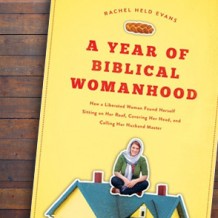
This book’s yellow cover evokes Curious George, except the Man with the Yellow Hat never shows up. But rather than judging a book by its cover – or by the negative reviews of some  – I read for myself Rachel Held Evans’ A Year of Biblical Womanhood: How a Liberated Woman Found Herself Sitting on Her Roof, Covering Her Head, and Calling Her Husband Master (Tyndale, 2012, Kindle edition).  What I discovered was a story that is funny and thought-provoking, though neglecting one important principle of interpreting the Christian Scriptures.

Who is Rachel Held Evans, and why this book?

Rachel Held Evans grew up in a fundamentalist Christian tradition. More recently, she has moved away from the narrow tenets of her upbringing and developed a huge following on her weblog. She has pulled this off largely through championing the cause of women, especially in the context of the dominant patriarchal ethos of American evangelical Christianity. It was in conversation with her blog readers (and apparently as a follow-up volume to A.J. Jacobs’ earlier book on living a year as a biblical man) that Evans decided to attempt living out for a year the major commands of the Bible directed toward women.  Her purpose in writing becomes clear in the introduction (p. xix):

Now, we evangelicals have a nasty habit of throwing the word biblical around like it’s Martin Luther’s middle name. We especially like to stick it in front of other loaded words, like economics, sexuality, politics, and marriage to create the impression that God has definite opinions about such things, opinions that just so happen to correspond with our own. Despite insistent claims that we don’t ‘pick and choose’ what parts of the Bible we take seriously, using the word biblical almost always involves selectivity.

Her activities included letting her hair grow longer without cutting it, sitting in a tent alone in the front yard during her monthly “impurity” (period), calling her husband, Dan, her “master,” covering her head, remaining silent in church, taking care of a computer baby for three days, and “praising her husband at the city gate” by holding up a sign at the outskirts of Dayton declaring: “Dan is awesome!”

Continue reading “A Year of Biblical Womanhood: Evans stirs the pot”