Posted in book reviews

Appreciation for a bridge builder

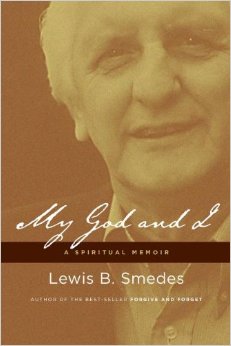
SmedesLewis B. Smedes, the late professor of Christian Ethics at Fuller Theological Seminary, wrote fourteen books in his lifetime. I’ve read only one, his last, My God and I : A Spiritual Memoir (Eerdmans, 2003), which is a rather backwards way of doing things. Still, if this book is a good indicator of the quality of his prior work, I’ve got some more reading to do!
Professor Smedes sums up his outlook on life in a succinct paragraph (p. 64):

I was, from the start, a Christian of the bridge. I liked bridges that I could cross over to drink from unbelievers’ goblets, to feast on their wisdom, and to admire their good works. I also liked bridges that I could cross over and, with God’s blessing, be a blessing to the people on the other side.

Though he joined the Christian Reformed Church as a young man, it is apparent that Smedes over time grew increasingly uncomfortable with parts of the Calvinistic creed, particularly the doctrine of absolute sovereignty, that “God is in control” of the most minute details of what transpires on earth. In response to this idea, he pens one of the most moving chapters in the book. Recounting the death of his newborn son, only a day old, Smedes observes (p. 121):

On the day that our baby boy died, I knew that I could never again believe that God had arranged for our tiny child to die before he had hardly begun to live, any more than I could believe that we would, one fine day when he would make it all plain, praise God that it had happened.

Smedes’ honest remarks resonate with me. We concur when later he applies the same logic to the events of 9/11/2001, seeing in the terrorist attacks not the hand of God but the pure face of evil. He concludes: “God, we hope, will one day emerge triumphant over evil, though, on the way to that glad day, he sometimes takes a beating” (p. 125). I am happy to affirm that God is far more powerful than anyone, but cannot ascribe evil committed by others to a good God, an inescapable conclusion if one believes that God has ordained all that happens.

On the negative side of the ledger, My God and I does not read evenly. The earlier chapters are slow, so the reader should be persistent since the second half of the book moves at a quicker pace.

My God and I is a good snapshot of one who combined the life of the mind with a warm heart for people. It’s a rare combination. In our polarized world, one can pray that the Lord will raise up more conciliators like Lewis Smedes.

Posted in book reviews

One man who changed the world

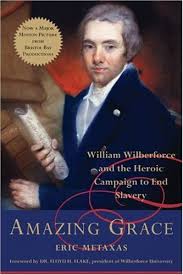
WilbeforceOne of my favorite movies is “Amazing Grace,” the 2006 film recounting the life of William Wilberforce, the late 18th/early 19th century crusader against the slave trade. When buying Eric Metaxas’ Amazing Grace: William Wilberforce and the Heroic Campaign to End Slavery (Monarch Books, 2007), I wondered if it would be as good as the cinematic production. The answer is: It’s not as good. It’s better.

Metaxas brings the sure hand of a veteran storyteller to his subject matter. Though he did much research for the book, he avoids footnoting, preferring instead to move the narrative along at a brisk clip, unburdened by any academic apparatus. (At the back of the book, he points interested readers to more scholarly books on Wilberforce). With wit and an engaging style, the author transports the reader back to the time when the slave trade every year saw 50,000 Africans kidnapped (mostly from the West African coast) and transported in horrific conditions across the Atlantic to the West Indies and the American colonies. Those who survived – sometimes as few as half on-board – lived short and brutal lives on sugar plantations on Caribbean islands like Jamaica, Barbados and St. Kitt.

Through the pages of Amazing Grace, one key lesson emerges: If you know your cause is just, never give up. It took twenty years of sweat and toil as a team of abolitionists led by Wilberforce for Parliament to finally outlaw the slave trade in the British Empire. Though tempted at times to give up, the MP from Yorkshire – a mere 5 foot 3 inches and sickly – proved to be small but mighty.

Yet Metaxas tempered this heroic portrayal in important ways, humanizing the protagonist. Wilberforce’s cause took him away from his family, so much that one time his young son didn’t recognize his own father when Wilberforce took him screaming from the house maid’s arms! Metaxas also noted Wilberforce’s tendency to jump from one topic to another, finding it hard to discipline himself and stay focused on one subject. Wilberforce himself attributed this to the raucous lifestyle that he lived at Cambridge as a young man, where he never learned to focus sufficiently on study. To what degree this was influenced as well by his decades-long dependence upon opium to treat his colitis is also not clear.

Metaxas’ biography makes at least two major contributions that go beyond the film. First, he delves much deeper into Wilberforce’s Christian faith, talking about his conversion (the “Great Change”) and how he was influenced by Methodism, the stricter form of belief promulgated in the 18th century by George Whitefield and John Wesley. In contrast to those giants of faith, the author does a commendable job showing how Wilberforce lived a much sunnier form of evangelical faith including a ready wit and positive celebration of life’s wholesome joys. Secondly, Metaxas explains how Wilberforce’s Christian faith informed his concern for the numerous other social causes he promoted. These included prison reform, successfully passing a bill through Parliament to open up India for missionary work (which included abolition of the ritual burning of widows on the funeral pyres of their deceased husbands) and founding the SPCA, the Society for the Prevention of Cruelty to Animals.

All-in-all, Amazing Grace: William Wilberforce and the Heroic Campaign to End Slavery does an excellent job of providing further details necessarily cut-out of a 2 hour movie. I read the book in about 12 hours over two days and found myself pulled along by the story, impressed by the skill of the author. Other than two very small errors in the text, the editing was excellent and the still color photos from the movie welcome. Christians who marry personal piety with social action informed by faith will appreciate this well-drawn portrait of a great man.

———-

Image credit: Amazon.com

Posted in book reviews

The Cross and the Lynching Tree: A Review

james-cone
Professor James H. Cone

WARNING: This essay contains graphic language and images.

James Cone’s The Cross and the Lynching Tree (Orbis, 2011; Kindle edition) was a difficult read, at times excruciating for an American child of upper-middle class white privilege like myself. Yet if healing is ever to come – if we are ever to live as one race, the human race, for whom skin color is no more important than a dozen other interesting but secondary characteristics – then we must return to the scene of the crime. Reconciliation begins there.

For Americans, the crime scene spanned at least sixty years, from 1880-1940. Over that period, nearly 5,000 black Americans died at the hands of white lynch mobs (Cone, 3). The victims included a handful of women but were mostly men strung up on trees, castrated, pulled behind automobiles, flayed into unconsciousness and burned alive.

Lynching on 9 August 1930, in Marion, Indiana

No due process of law was given to these black men often accused of raping white women. In many instances, white anger was provoked by consensual sexual intercourse between a black man and a white female (Cone, 127).

The Marion, Indiana lynching (pictured above) inspired Abel Meeropol (aka Lewis Allen) to pen the poem, “Strange Fruit,” later recorded by blues singer, Billy Holiday (cited by Cone, 120):

Southern trees bear strange fruit

Blood on the leaves and blood at the root

Black body swinging in the Southern breeze

Strange fruit hanging from the poplar tree.

Continue reading “The Cross and the Lynching Tree: A Review”

Posted in book reviews, From soup to nuts

An engaging tale in search of a broader audience

51TQQwFVyBL._AA160_Every good writer should write about what they know. As one born and raised in the vicinity of Elbridge, New York, where A Rifle for Reed (Amazon Kindle, 2013) takes place, author Amy Crofford is well-suited to craft this young reader’s tale. Well-researched and fast-paced, the story follows the 1851 adventures of twelve-year-old Reed Porter. It is a time of ferment in the country as people take sides in the great debate over slavery. Reed’s family is caught-up in the drama surrounding the Fugitive Slave Act and must decide where their loyalties lie.

Crofford is a newcomer to the genre and offers a wholesome alternative to much of the darker themes that dominate youth literature. The main drawback to the book – and the reason for my four star rating – is its limited marketing as a self-published work of fiction. One can only hope that a publisher will latch onto this engaging story and give it the wider audience it deserves.

Posted in book reviews, From soup to nuts

An inspiration for all achievers

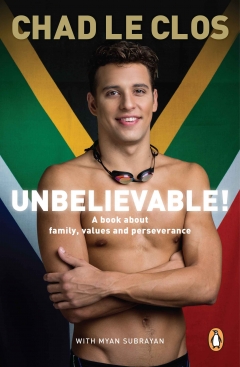
Myan Subrayan -Unbelievable! - HRYou may not be a swimmer, but if you’re an achiever in any area of life, you’ll enjoy Unbelievable: A Book About Family, Values, and Perseverance (Penguin, 2014; Amazon Kindle edition). Author Myan Subrayan had done an excellent job introducing us to one of South Africa’s sports heroes, 2012 Olympic swimming gold medalist, Chad le Clos.

Mr le Clos surprised many when he bested the legendary Michael Phelps in the men’s 200 m butterfly in London. What has been equally impressive since that high moment is Chad’s down-to-earth way of handling success. Thanks largely to his strong family, he has stayed grounded, including throwing himself into a handful of worthy causes. These include the fight against breast cancer, following his mother’s battle with the disease, as well as the campaign to save Africa’s rhinos from extinction.

Unfortunately, on some topics, the book stays in the shallow end of the pool. As a person of faith, I would have appreciated more about Chad’s religion. From time-to-time there was a hint, such as this line : “God has given me talent and opportunities, and I want to use these to make a positive difference wherever I go” (location 1736, Kindle). Hopefully, future bios will confidently swim into deeper waters.

All-in-all, Unbelievable accomplishes what it sets out to do. At a time when some other South African sports heroes have spectacularly imploded, it’s refreshing to see a young man who has already accomplished much yet kept a positive and balanced outlook. Keep up the good work, sir.

————

Photo credit: Penguin Books (South Africa)

Posted in book reviews

Magesa on African Spirituality

51nfH883olL._UY250_In What is not Sacred? African Spirituality (Orbis, 2013, Kindle edition), Laurenti Magesa, a Jesuit from Tanzania (East Africa), opens up a new world to Westerners unconsciously fashioned by an individualistic frame-of-reference, a different way of being where the primary category is not “I” but “we.” This communal worldview takes into account not only the present but reserves a large place for the past, ancestors who have gone before, those who though dead, still live.

Magesa acknowledges that arguably there are many African cultures; however, he maintains that there is a unified way of viewing the world and life together that unites all sub-Saharan peoples, what he calls a “sameness of spirit and intention” (location 147). What is not Sacred? addresses a variety of topics related to this worldview. He argues that a truly African Christianity must allow Africans to preserve from their pre-Christian religious heritage elements that are not in conflict with the Gospel.

This essay shall limit itself to three topics that Magesa addresses, namely: 1) the role of vital power; 2) sex and community, and 3) reconciliation.

The role of “vital power”

What is “vital power”? Magesa observes (location 620):

Vital power requires and demands the active ‘skill’ inherent in created order so as to negotiate relationships between the visible and invisible elements of the universe. Vital power implies that nothing is what is seems to be on the surface. To realize this is to begin to know the meaning of life and to start living it well and fully.

The author calls this vital energy “primordial,” a force that helps the “universe to exist harmoniously and with all its constituent components” (location 633). Importantly, the ancestors are a “fundamental link in the force of life” and the “dispensers of morality and (the) venerated patriarchs of the community” (location 645).

While what Magesa observes is undoubtedly correct, he seems incapable of stepping outside his own frame-of-reference to offer meaningful critique. He passes by without comment the term “venerated patriarchs.” Can females have no place among what John Mbiti calls the “living dead,” those who take an active interest beyond the grave in the earthly vitality of the people group? According to Rev Gift Mutkwa of Africa Nazarene University, the Shona of Zimbabwe do acknowledge Mbuya Nehanda as an ancestor, but primarily for her status as the wife of Sekuru Kaguvi. In any case, if women are almost never acknowledged as ancestors, this has ramifications for the here-and-now role of women in societal leadership. If women will not be venerated later, why should we consider their point-of-view now? Magesa’s own faith confession (Roman Catholic) does not allow for the ordination of women, but for Christian traditions that do, one may ask: Is an element of prejudice based upon gender hard-wired into the African religious worldview?

Laurenti Magesa
Laurenti Magesa

A second area where Magesa offers no corrective is the question of spirit possession and libations. Speaking of herbalists who heal, he portrays them as “guided by other powers such as that of the ancestors through dreams of possession” (location 697). Likewise, he speaks of “ancestral spirits” who are capable of “bi-location,” dwelling in the “sky” but also able to “possess any creature for a certain purpose” (location 774). Later, Magesa explains: “Broadly speaking, spirit possession can be benevolent or malevolent, depending upon whether the possessing spirit fulfills positive or negative expectations” (location 1551). Because (on Magesa’s reading) the spirit can guide a family regarding the seemingly recalcitrant but justified behavior of some of its members, this type of spirit possession can have a “pedagogical value for the larger society to reform unjust systems” (location 1564). In no instance does Magesa critique the practice of spirit possession. Instead, he appears to ascribe to it positive value. For the reader reliant upon Scripture as the rule of Christian faith and practice, this is no small offense. Followers of Christ are called upon to “test the spirits, to see whether they are from God” (1 John 4:1a, NIV). One must wonder whether some have unwittingly invited demon possession in the name of so-called ancestral possession. Could this explain why the frequency of demon possession seems greater in Africa than in the Western world where the cult of ancestors is largely absent?

Further, Magesa describes “daily veneration of ancestors through prayer, or frequent pouring of libations to them” as “acts of piety” and as “necessary for the good ordering of the life of the community” (location 1306). Does Magesa’s language of piety as related to ancestors introduce an element foreign to Christian faith? Pouring out libations to the ancestors treads dangerously close to a similar practice that Paul declared out-of-bounds. In 1 Corinthians 10:14-22, he warned the Corinthians to avoid participating in both the table of the Lord and the “table of demons,” of drinking the cup of the Lord and drinking the “cup of demons.” To do so is to practice idolatry (v. 14) and to risk arousing the Lord’s anger  (v. 22). The error was split religious loyalties. God will brook no competition. Would this not include competition with the mini-deities called ancestors?

Continue reading “Magesa on African Spirituality”

Posted in book reviews

Phineas Bresee: Pastor to the People

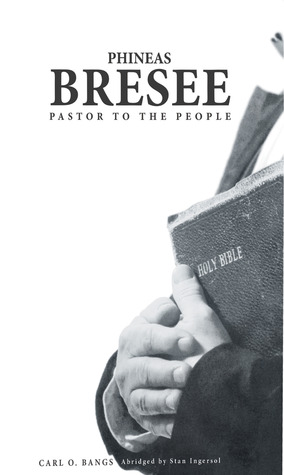
18126212It’s a courageous act to put a hero under the microscope, but Carl Bangs does just that in Phineas Bresee: Pastor to the People (Beacon Hill Press, 2013). In this abridgment by Stan Ingersol of a more scholarly, larger work by Bangs, the portrait that emerges of Church of the Nazarene founder Bresee  is one of a powerful preacher, capable administrator and principled social activist. Though not without weaknesses and acquainted with failure, Bresee’s legacy is of an ordinary servant of the Lord set on fire by God’s perfect love.

As one who grew up in Upstate, New York, I found Bresee’s little known origins in Franklin, New York to be of special interest. Bresee as a teenager clerked in a store and one day was invited by the local Methodist pastor to come to church. Following the service, he attended a class meeting and there prayed through to faith in Christ. Knowing the importance of the class meeting to how early Methodism carried out discipleship, I was surprised to have never known this important tidbit about Bresee’s spiritual awakening. Throughout his ministry in both Methodism and later in the Church of the Nazarene, Bresee maintained this small groups emphasis as an important part of a larger constellation of prayer meetings and evangelistic services. It is only in the past two decades that Nazarenes have rediscovered this lost part of our heritage.

For readers unfamiliar with Bresee’s story, it will be surprising to see the twin emphasis he placed upon holiness and temperance, the latter indicating unremitting opposition to the production and consumption of alcohol (p. 115). Some of the most impassioned pleas on the floor of Nazarene General Assemblies in the later part of the twentieth century were on the subject of alcohol, especially against proposals to soften the total abstinence stance of the denomination. The denomination maintains its tee-totaling stance in solidarity with those who have been damaged by alcohol’s excesses. Pastor to the People is a reminder of the long pedigree that this stance has among the people called Nazarenes.

Phineas Bresee’s way with words shines through at various points in Bangs’ biography. In a 1903 sermon on Isaiah 4:2-6, he cautioned the church against moral compromise (p. 175):

Without holiness and the presence of him who dwells only in holy hearts, the church is soon a conquered church driveling for show; a beggar holding out a dirty hand for the world’s pittance; or a ballet girl dancing and singing for the world’s amusement and pay; or a blind old Samson grinding at the mill — brought out occasionally for the amusement of the Philistines. God’s holy people are neither players for the world’s amusements, nor caterers to the world’s taste.

This is a message as timely at the beginning of the 21st century as it was at the rise of the 20th.

His formidable skills notwithstanding, I was glad to see Bangs humanize Bresee by including not only stories of success but also accounts of failure, including the closing of the Methodist Simpson Tabernacle (pp. 124-27) and his short tenure at the independent Penial Mission (p. 136) where as one of the pastors he was unceremoniously asked to leave. Even the inclusion of an side remark that Bresee was a poor singer who would start songs in the wrong key and expect instrumentalists to fix the problem (p. 175) helps the biography steer clear of hero worship.

Phineas Bresee: Pastor to the People at just over 200 pages is an accessible introduction to the man and ministry that helped set the Church of the Nazarene on its course for the next 100 years. It is a helpful read for anyone who wants to understand the theological and practical worldview of Nazarenes, especially those in North America.

Posted in book reviews

Preston Sprinkle on scandalous grace

charisWhy do we need one more book on grace? It’s a fair question. In Charis: God’s Scandalous Grace for Us (David C. Cook, 2014), author Preston Sprinkle gives a convincing though incomplete answer.

Preston Sprinkle is best known for co-authoring with Francis Chan Erasing Hell (2011). This time around, Sprinkle goes solo, painting a handful of biblical portraits mostly from the Old Testament, each one an example of the relentless pursuit of God’s grace (Gk. charis). It is through these pictures of grace that Sprinkle targets his objective:

Rich, poor, successful, homeless, healthy, disabled, black, white, brown, young, old, famous, abused, pervert, or priest – whoever you are and whatever you have done or have not accomplished – if you are human, then you are cherished and prized and honored and enjoyed as the pinnacle of creation by a Creator who breeds charis (p. 38).

Too often, we don’t take the time to plumb the height and depth of grace. Too quickly – Sprinkle maintains – we move on to other aspects of salvation without marveling in this, God’s “gift” to all of us, the undeserving. His observation is a fair one. Dwelling upon grace can be an important remedy for those who have grown up in a legalistic setting where “working out our own salvation” (Phil. 2:12) leaves believers with the nagging feeling that they’ll never quite measure up.

Sprinkle – though a PhD in Bible from the University of Aberdeen – wears his learning lightly. With language that is picturesque but not ornate,  gritty yet not vulgar, he refuses to PhotoShop the blemishes of OT characters like Samson, Rahab, Abraham, and David. His point is that God’s grace reaches us as we really are and not as we pretend to be. We cannot earn grace. Rather, “God loves you because of who He is and because of what Christ has done” (p. 108).

What shall be our response to God’s scandalous grace?

The author purposely leaves this to the Epilogue, in order to allow the reader to bask sufficiently in God’s grace. Yet one wonders: Will the reader who only makes it halfway through the book end up with a balanced, biblical picture? For though God comes to us where we are with all His grace, it is never his intention to leave us in our mess. The angel announced that Jesus would “save his people from their sins” (Matt. 1:21), not save his people in their sins. It is the concept of transformation following repentance that rounds out the Good News. Though in the Epilogue Sprinkle addresses the vital role of obedience, repentance (a change of mind regarding sin) is never mentioned, making the book incomplete. Neglecting to tease out the relationship between grace and repentance is an omission that –  from the perspective of Wesleyan theology with its deep concern to avoid antinomianism (lawlessness)  – is nothing short of glaring.

Yet on balance, Charis is a welcome book. The old Methodist hymn said it well:  “It’s not my brother, not my sister, but it’s me, O Lord, standing it the need of prayer.” The gift of God’s grace is not for those who think they are healthy but for those who are convinced that they are sick and powerless to make themselves well. And that, truth be told, includes us all.

———-

Image credit: Amazon.com

Posted in book reviews

Brian Zahnd and the peace of Christ that opposes Empire

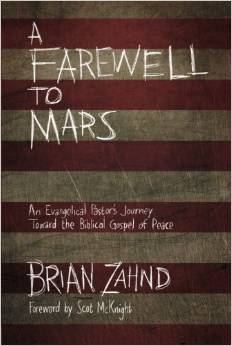
indexIt’s all the rage, this little anti-war tome, A Farewell to Mars: An Evangelical Pastor’s Journey Toward the Biblical Gospel of Peace (David C. Cook, 2014; Kindle edition). Pastor Brian Zahnd has written an insightful and controversial book that will push many followers of Christ to re-evaluate what Jesus would do not just in our lives as individuals but as nations sharing one planet.

Pastor Zahnd – like many Americans at the time of the invasion of Iraq in 2003 – was solidly behind the foray into the country ruled by Saddam Hussein. Zahnd had led in public prayers for the troops, bellicose war prayers for which God later gently nudged the pastor toward repentance. Gradually, Zahnd re-examined his position and is now as staunch a proponent of peace as he is an opponent of Empire, no matter what country is behind it. In place of Empire, Zahnd espouses a different more durable kind of arrangement:

“The resurrection is not only God’s vindication of his Son; it is the vindication of all Jesus taught. Easter Sunday is nothing less than the triumph of the peaceable kingdom of Christ.”- location 231

Herein lies an attractive feature of Zahnd’s work: It’s mostly about Jesus. It’s hard to argue with that methodology if we are going to be Christians, little Christs. Yet ironically, have we as followers of the good and gentle shepherd who “lays down his life for the sheep” (John 10:11, NIV) justified wars in his name? Zahnd argues convincingly that we have. Citing the disastrous medieval military campaigns to take back Jerusalem from Muslims, he concludes: “The crusades are perhaps the most egregious example of how distorted Christianity can become when we separate Christ from his ideas. Yet we continue to do this – we worship Jesus as Savior while dismissing his ideas about peace” (location 160).

Pastor Zahnd rightfully protests the melding of Christian and militaristic symbolism, recounting a visit to the chapel at the U.S. Air Force Academy where the “cross” at the front of the sanctuary was made up of swords. Zahnd concludes that this becomes a strange composite, a tribute more fitting to the Roman god of war (Mars) than Jesus, the Prince of Peace. The danger is that the church – which should be promoting the kingdom of God – unwittingly becomes a mere chaplain to the state. He explains:

“Our responsibility is not to chaplain the state but to call the state to repentance and to surrender to the King who is Lord. Our responsibility is to be an alternative to the state. Christians would do far more good for our country by learning not to look to DC for solutions but to the glorious Son of God, who loves us and gave himself for us and, in doing so, gave us a whole new way of life – one not shaped by the power of force but the force of the gospel ” (location 35).

Yet Zahnd’s argument suffers from off-putting elements for the otherwise open-minded reader. Rejecting the label of “pacifist,” he concludes: “But I am not a political pacifist. What I am is a Christian” (location 1354).Does this imply that those who have reached different conclusions on war and peace are not Christian? My experience is that Mennonites – who are unashamedly part of the peace church tradition – avoid statements like Zahnd’s that appear to demonize Christian brothers and sisters outside their circle. Further, Zahnd’s two caustic poems in the book may leave readers with the same bad taste in their mouths.

Beyond the question of the sometimes acerbic tone is that of biblical interpretation. It only makes sense that the “peaceable kingdom” of Isaiah 2:2-4 would figure prominently in Zahnd’s thinking, the famous vision of swords beaten into plowshares. What he neglects to mention is the prophet Joel’s contrary admonition: “Hammer your plowshares into swords and your pruning hooks into spears. Train even your weaklings to be warriors” (Joel 3:10). Joel’s is an end times vision of the armies of the earth gathering together for battle. So this prophecy is all the more important for Zahnd to address since war talk among 21st century American Evangelicals is often wrapped-up with apocalyptic scenarios.

At times Zahnd’s arguments are not sufficiently developed. While it is clear he opposes the offensive use of military force that Empires require, he leaves unaddressed the defense of nations or loved ones under attack that is the arena for Just War Theory.

Weaknesses aside, Brian Zahnd’s A Farewell to Mars makes an important and timely contribution. Zahnd’s writing style is engaging. He succeeds in presenting from Scripture an historic and peaceful alternative to the well-worn path of war that for America and the world has too often yielded little but bitter fruit.

———–

Image credit: Amazon.com

Posted in book reviews

When soteriology and ecology embrace: Howard Snyder’s expansive vision

Howard Snyder
Howard Snyder

“Ecology” is one of those musty words crowded out by more trendy fare, terms like “environmentalism” and “Creation Care.” But if theologian Howard Snyder has his way, ecology will soon be on everyone’s lips.

In Salvation Means Creation Healed: The Ecology of Sin and Grace: Overcoming the Divorce Between Earth and Heaven (Eugene, Oregon: Cascade Books, 2011; Kindle edition), Snyder – a theologian of mission and John Wesley scholar –  boldly challenges the Church to broaden its narrow conception of salvation to encompass the full panorama of God’s loving concern, as presented in Scripture. If the ideas championed in his book were to take hold, the mission of the Church in the world would look radically different than it has for much of the past 100 years.

John Wesley often structured his sermons in terms of “sickness/cure,” and Howard Snyder adopts a similar methodology. Following Chapter 1, a treatment of the “divorce of heaven and earth” due to a dominant neo-Platonism that prioritizes the value of spirit over matter, Snyder details a “fourfold alienation”  under the heading of the “ecology of sin” (see pp. 68-78):

1) alienation with God;

2) alienation from one another;

3) alienation from ourselves (internal division), and

4) alienation from the land.

Following a time-honored Wesleyan paradigm, Snyder treats sin as a moral disease. Because sin is fourfold in nature , the Gospel as cure must address each aspect of the condition or be incomplete. Snyder argues that evangelical soteriology (the doctrine of salvation) has indeed been grossly inadequate. While we have effectively addressed the first point (alienation from God) – preaching tirelessly about justification and sanctification – we’ve had less to say about points 2 and 3 and until recently were wholly silent on point 4. (Note: Snyder correctly points out that John Wesley himself later in life had much more to say about God’s concern for all creation, not just human beings).

For Snyder, the one biblical concept that covers all four alienations is that of healing. This healing is not a far-off, wholly spiritual prospect reserved for an ethereal “heaven.” Rather, healing is for the here-and-now, an expansive, cosmic restoration of all creation in which the Church – empowered and gifted by the Holy Spirit – actively participates. Snyder argues (p. 38):

But an agenda remains. The church spread throughout the earth but often doesn’t see the earth. The church is still far from realizing its potential to renew and heal the land. Millions of people have been reconciled to God. Yet the full promise of salvation as creation healed is yet to become real and visible worldwide.

Turning from sickness to cure, the book capably unpacks the meaning of the covenant with Noah (Genesis 9:8-15). This first covenant is both everlasting and for the “preservation of creation” (Snyder, p. 55). Importantly, it is a three-way covenant, i.e. between God, humans, and creatures. Snyder observes that it “has never been revoked, and largely defines stewardship on earth” (p. 90). In Chapter 6, “The Groans of Creation,” the reader uncovers what such stewardship means in relation to climate change, the overstressed oceans, and deforestation. At its core, taking care of the earth is a human question since it is poor people who are first and most affected by human practices that throw the earth’s systems out of kilter. Synder rightly observes: “Creation care is pro-life” (p. 83). Later, he concludes: “If we are passionate about people, we will be passionate about their world” (p. 152).

Salvation Means Creation Healed is an ambitious book, perhaps too ambitious. Chapter 11 delves into the nature of the Church, introducing material on worship styles that – while interesting – is tangential to the  main thrust of the book. That central concern is relating soteriology to ecology. Thankfully, Snyder finds his footing once again at the end of Chapter 12, speaking of how the “stigmata” ( the marks of the Church) should be practiced through four principles as related to Creation (pp. 198-200):

1) the earthkeeping principle;

2) the Sabbath principle;

3) the fruitfulness principle;

4) the fulfillment and limits principle.

These four principles provide a positive agenda for how the Church can rectify the fourth alienation, our distance from and poor stewardship of God’s good earth.

Howard Snyder adds his voice to a rising chorus of those who have concluded that the Church’s mission – particularly the modus operandi of its Evangelical branch – has been too other-worldly. His is a clarion call to rediscover the biblical Gospel, the full scope of God’s concern for all creation and our duty under God to care for the land. Since Evangelicals – including the descendants of John Wesley – have placed soteriology at the center, Snyder’s re-casting of ecology in soteriological terms is very welcome. May both his tribe and readership increase.

————

Image credit: Greenville College