Posted in book reviews

Bonhoeffer: a new portrait for a new generation

bonhoeffer_featureI’ve always enjoyed a good biography, but have to tell you: Eric Metaxas’ Bonhoeffer: Pastor, Martyr, Prophet, Spy (Thomas Nelson, 2010; Kindle edition) is not good. It is very good.

Dietrich Bonhoeffer (1906-45) was a world-class theologian who opposed the regime of Adolf Hitler and ultimately was jailed and hanged for his involvement in the plot on the Führer’s life. That episode is the best-known part of the German martyr’s story. What Metexas adds is a vivid description of Bonhoeffer’s life prior to that chapter, painting with a clear and readable style a sympathetic portrait of the man celebrated for The Cost of Discipleship and Life Together.

Much in Metaxas’ portrayal was new to me, including the extent to which Karl Barth’s theology influenced Bonhoeffer and the latter’s distaste for the liberal theology prominent at New York’s Union Theological Seminary where he studied  in 1930-31. Also endearing was Bonhoeffer’s love of music – he was an accomplished pianist – and the details of his engagement and letter writing to his fiancée, Maria von Wedemeyer.

The book is replete with excerpts from Bonhoeffer’s books, addresses, and letters. These reveal how important he thought practical and recurrent experience in pastoring was. In this way, theology never becomes distant or detached. Instead, it was to be hammered out in the life of the community of faith. He pastored churches in Barcelona and London, and always sensed tension between his hunger to pursue both the life of theological academia and the work of a parish minister.

Here’s a sample of some of the sections I highlighted as I was reading:

“For many Germans, their national identify had become so melted together with whatever Lutheran Christian faith they had that it was impossible to see either clearly. After four hundred years of taking for granted that all Germans were Lutheran Christians, no one really knew what Christianity was any more.” – Metaxas, p. 174

“The question is really: Christianity of Germanism? And the sooner the conflict is revealed in the clear light of day, the better.” – D. Bonhoeffer, cited by Metaxas, p. 183

“He was convinced that a church that was not willing to stand up for the Jews in its midst was not the real church of Jesus Christ. On that, he was quite decided.” – Metaxas, p. 186

“First they came fo the Socialists, and I did not speak out – because I was not Socialist. Then they came for the Trade Unionists, and I did not speak out – because I was not a Trade Unionist. Then they came for the Jews, and I did not speak out – because I was not a Jew. And then they came for me – and there was no one left to speak for me.” – Martin Niemöller, cited by Metaxas, p. 192

“Bonhoeffer was constantly joking, whether verbally or in other ways.” – Metaxas, p. 201

“Battles are won, not with weapons, but with God. They are won when the way leads to the cross.” – D. Bonhoeffer, cited by Metaxas, p. 241

“Bonhoeffer advocated a Christianity that seemed too worldly for traditional Lutheran conservatives and too pietistic for theological liberals. He was too much something for everyone, so both sides misunderstood and criticized him.” – Metaxas, p. 248

“Things do exist that are worth standing up for without compromise. To me it seems that peace and social justice are such things, as is Christ himself.” – D. Bonhoeffer, cited by Metaxas, p. 260

Dietrich Bonhoeffer has become a Protestant saint. For this reason, it is frowned upon to criticize him. To his credit, Metaxas does not present him as a perfect man. Bonhoeffer’s doubts and fears emerged particularly in his conversations with Eberhard Bethge, who was a close friend and became a confessor to him. In Metaxas’ estimation, Bonhoeffer could also come across as an elitist, stand-offish to the point of seeming arrogant. These are darker shades that add texture to the canvas.

One weakness in the book is the tone of the discussion questions at the end. They are written in a time and culture-bound way, from an American, right-wing Republican perspective. This is unfortunate for the international reader, introducing a parochial and ephemeral element to a book that otherwise deals with universal, lasting themes.

The book’s and Bonhoeffer’s weaknesses aside, there is much to admire about the young German man who was not content to rest in the realm of theory. Instead, he moved to action at a time when action and not merely discussion was most needed. Eric Metaxas is to be commended for winsomely introducing a new generation to an exceptional leader.

——–

Image credit: Baylor Institute

Posted in book reviews

Square Peg: “Wesleyan” fundamentalists?

Dr Morris Weigelt taught my “Hermeneutics” course at Nazarene Theological Seminary. One day he advised: “When reading anyone’s work, ask yourself this question: What are they reacting to?”

Weigelt’s advice has served me well across the years, and his question is relevant when considering the book edited by Al Truesdale, Square Peg: Why Wesleyans Aren’t Fundamentalists, Amazon Kindle edition (Beacon Hill Press, 2012). Eight writers take up diverse topics including the historic meaning of Fundamentalism, Christian faith and science, unity/diversity in the Church, and the authority of Scripture. In-turn, formal responses give the book the feel of a dialogue. Square Peg responds to what Paul Bassett called the “Fundamentalist leavening of the Holiness Movement” [see Wesleyan Theological Journal 13 (Spring 1978):65-91], which has manifested itself most recently in the activities of groups like the “Concerned Nazarenes.” [See also my essay, “Nazarene or Baptarene? When Traditions Collide,” available here].

In the introduction (p. 8), Al Truesdale lays out the book’s thesis:

“We shall see that differences between fundamentalism and Wesleyan theology are so important that denominations in the Wesleyan tradition cannot adopt fundamentalism without forfeiting essential parts of what it means to be Wesleyan.”

The volume’s strengths are several. Fred Cawthorne’s chapter, “The Harmony of Science and the Christian Faith,” is alone worth the book’s price, as he ably takes the reader through cosmology (including the “Big Bang”) and evolutionary biology from a theistic perspective, making a convincing case for the compatibility of Christian faith and scientific inquiry. I especially appreciated how he validated the role of the Creator God as both “upholding and sustaining,” affirming that God not only began the creative evolutionary process but actively oversees and shepherds the emerging universe. Cawthorne (pp. 104-105) contends:

“If we say that God cannot create through a gradual, progressive process such as evolution, then we limit God’s transcendence and immanence…his full participation in nature and his gracious empowerment of nature…Consideration of evolution should deepen our affirmation that God works above, in, and through creation; it should strengthen, not threaten, our faith.”

Also particularly helpful is Joel Green’s contribution, “A Wesleyan Understanding of Biblical Authority: The Formation of Holy Lives.” It is one thing to mentally assent to God’s Word as “authoritative,” but what does that mean if we rarely crack open a Bible or meditate upon Scripture? Green laments (p. 128): “…there is no necessary path from claims about the trustworthiness of the Bible to living lives oriented toward the Scriptures.” Yet John Wesley taught that the “written word of God” is the “sufficient rule of both Christian faith and practice” [see Wesley’s “The Character of a Methodist,” cited by Green, p. 131). Practically speaking, this means adopting “habits of reading and prayer that lead to the conformity of our thoughts, feelings, beliefs, and behaviors to God’s will revealed in Scripture” (Green, p. 134). In short, it is the life-transforming nature of our engagement with Scripture that validates Holy Writ as inspired by God. In the wording of the old saying : “The proof is in the pudding.”

Square Peg, though valuable, could have been better. The introduction gives no explanation of the “Why it Matters” responses to each chapter nor how they work. Some responders mention the focus group format, even naming the participants. Others write as if they alone are responding, making no mention of having processed the material with others. This is confusing, and makes for a disjointed format. Also, there are no discussion questions included, diminishing the value of the book as a tool for Bible studies, adult Sunday School, or small groups.

Though not perfect, Square Peg opens up a conversation that is long overdue among us. Wesleyan-Holiness pastors would do well to put it in the hands of every new member, particularly those coming from other ecclesiastical backgrounds. To remain true to our Wesleyan theological heritage, we will need to be more intentional than we have been. To that end, Al Truesdale and company have rendered all denominations in the Wesleyan-Holiness orbit a service.

——————

Image credit: Amazon.com

Posted in book reviews, ecclesiology & sacraments

Belonging and believing: Baptism and the People of God

978-1-426-71137-4Helen came 15 minutes early to Sunday night service. “Pastor,” she said, “I have to get saved!”

What was up with Helen?

This seventy-something Missourian certainly hadn’t stopped by my office on the spur of the moment. Her coming to Christ was like a pot on slow boil, and the “flame” had been two years of friendship from others in the women’s ministry group. In short, women in our church loved Helen to Jesus.

I thought about Helen when reading George Hunter III’s The Celtic Way of Evangelism: How Christianity Can Reach the West Again (Kindle edition; Nashville, Tennessee: Abingdon Press, 2000, 2010). Hunter reports on John Finney’s 1992 study, examining how people come to faith in Christ. Finney discovered that most people today come to faith gradually, as they are folded into the life of the Christian community. Hunter calls this the “ongoing contagious life of the congregation” (location 795) in contrast to “special event preaching.” Summing up this philosophy, Finney uses just four words:

Belonging comes before believing.

Yet Finney’s and Hunter’s insight has implications not just for adult conversion but for how we bring up our children in Christian faith. The Anabaptist view dominates in North America, reversing the “belonging/believing” order to “believing/belonging.”  It reserves the waters of baptism (the sign of belonging) for children old enough to make a conscious decision about their faith. Practically, this means most children aren’t baptized until at least ten or older. It is an essentially individualistic view, where the person is seen as prior and superior to the group. (Contrast this with the dominant African ethos, which says: “I am because we are.”) Whether intentionally or not, does this give the message to our children: “You don’t really belong to the church until you believe”?

Surprisingly, many Nazarenes coming from a Baptist background do not realize that our DNA includes a strong strand of the Finney/Hunter “belonging before believing” idea. This is passed down to us from our Methodist heritage and the covenant theology espoused by John Wesley. A newborn child (as symbolized by infant baptism) is early folded into the loving community of faith. Later in childhood, he or she through careful Christian education, including catechism, comes to a personal understanding of saving faith. Just like circumcision “marked off ” the Jewish male as part of the faith community, so baptism “marks off” the male and female infant of Christian parents as belonging to the covenant New Testament People of God (Colossians 2:11-12). It announces to one and all:  “This child, through prevenient grace, belongs to the church, even before he or she believes.”

Hunter and Finney (location 797) contend that the postmodern mindset is much more receptive to the belonging/believing pattern than the dominant evangelical opposite. As Wesleyan people, are we not well-positioned to appropriate the best from both Evangelical and covenant traditions? We must continue to invite unbelieving adults to a place of personal conversion followed by baptism. Likewise, we encourage those bringing up their children in the Nazarene community of faith to present their infants for baptism. Baptism (like circumcision) is a one-time sign of initiation. Whether later as an adult or earlier as a little child, it’s an amazing thing to belong to the People of God. Let’s joyfully celebrate it!

UPDATE: There has been some excellent feedback to this piece over on Naznet.com. The “nub” of the debate is this: Does a Baptist -like ecclesiology really reverse the order from belonging/believing to believing/belonging? Not everyone accepts this premise.  Is it simplistic for me to call this ecclesiology “individualistic” and that represented by baptizing young children “corporate”? What do you think?

———–

Image credit: The Good Book Stall

Posted in book reviews

So many books, so little time

booksI’m in the final stages of correcting assignments for an online missions course that I monitored for Mount Vernon Nazarene University. Once that’s done, I’ll put up a review of the two Kindle version course text books, both of which were new to me:

Hunter, George G., III. The Celtic Way of Evangelism: How Christianity Can Reach the West…AGAIN. 10th anniversary edition, revised and expanded. Nashville, Tennessee: Abingdon Press, 2000, 2010.

Pierson, Paul E. The Dynamics of Christian Mission: History Through a Missiological Perspective. Pasadena, CA: William Carey International Press, 2009.

Other e-books that I haven’t started, but that are beckoning to me from my iPad Kindle reader:

1) Allen, J. Bennett. The Skeptical Juror and the Trial of Byron Case. Long Beach, CA: Allen & Allen Semiotics, 2010.

This reflects my budding interest in innocence projects, which came out of following the story of Ryan Ferguson, exonerated after being wrongly imprisoned for nearly 10 years in a Missouri penitentiary for a murder he did not commit. Ferguson’s grace under fire amazed me, and his tireless advocacy for the innocent post-release is inspiring.

2) Barrett, Matthew, and Caneday, Ardel, gen. eds. Four Views on the Historical Adam. Grand Rapids, Michigan: Zondervan, 2013.

-I’ve seen very little dedicated to this topic, so hope to expand my thinking about possibilities.

3) Burden, Suzzanne, Carla Sunberg, and Jamie Wright. Reclaiming Eve: The Identity and Calling of Women in the Kingdom of God. Kansas City, Missouri: Beacon Hill Press, 2014.

-Carla Sunberg recently spoke at the Africa Nazarene Women’s Clergy conference, and referenced this new book. It’s designed for the average lay reader.

4) Carson, D.A.  Christ and Culture Revisited. Grand Rapids, Michigan, and Cambridge, U.K.: Wm. B. Eerdmans, 2008.

– I appreciate the original 5 points from H. Richard Niebuhr, and look forward to Carson’s take on it.

5) Fudge, Edward William. The Divine Rescue: The gripping drama of a lost world and of the Creator who will not let it go. Abilene, Texas: Leafwood Publishers, 2010.

– This Church of Christ biblical scholar is best known for his excellent work on hell and conditional immortality. You can read my short book on the same subject by clicking here. You may also be interested in my podcast interview with Christopher Date at the Rethinkinghell.com website, dedicated to evangelical conditionalism (aka annihilationism). Grab a cup of coffee…the interview is 90 minutes long.

6) Heurtz, Christopher L. Simple Spirituality: How to See God in a Broken World. Downer’s Grove, Illinois: IVP, 2008.

– Anything on Christian simplicity attracts my attention.

7) Keller, Timothy. Walking with God through Pain and Suffering. New York: Dutton (Penguin), 2013.

-Rev. Brent L. White, a UMC pastor with a growing blog, highly recommends this book. Timothy Keller is pastor of the 5,000 member Redeemer Presbyterian Church in New York City.

8) McClung, Grant, ed. Azusa Street and BeyondC: Missional Commentary on the Global Pentecostal/Charismatic Movement. Revised edition. Alachua, Florida: Bridge-Logos, 2006.

– I’ve read little about Pentecostalism from an insider’s point-of-view. This was mentioned by Pierson, and should be enlightening.

9) Merrick, Britt, with Trowbridge, Allison.  Godspeed: Making Christ’s Mission Your Own. Ontario, Canada: David C. Cook, 2012.

– Honestly, I don’t remember who recommended this, but it looks like it would be a good book for an intro to missions course.

10) Metaxas, Eric. Bonhoeffer: Pastor, Martyr, Prophet, Spy. Nashville, Dallas, Mexico City, and Rio de Janeiro: Thomas Nelson, 2010.

– My friend and advocate for those living in poverty, James Copple, is a big Bonhoeffer fan. This one’s for you, Jim!

11) Noble, T.A.  Holy Trinity: Holy People (The Historic Doctrine of Christian Perfecting). Eugene, OR: Cascade Books, 2013.

– Dr Thomas Noble was the internal examiner for my PhD viva through the University of Manchester. He is considered one of the foremost Wesleyan theologians of our time, with an accent upon Christology.

12) Olson, Roger E. Questions To All Your Answers. Grand Rapids, Michigan: Zondervan, 2007.Sanneh, Lamin. Disciples of All Nations: Pillars of World Christianity. Oxford, England: Oxford University Press, 2008.

– The more I read of Roger Olsen’s blog, the more I like how he thinks. Dr Matt Price of MVNU put me on to this book.

13) Snyder, Howard A., with Scandrett, Joel. Salvation Means Creation Healed: The Ecology of Sin and Grace (Overcoming the Divorce between Earth and Heaven). Eugene, OR: Cascade Books, 2011.

– Snyder is one of my John Wesley heroes. I’m about 10 pages in on this one, and liking how he frames ecology from a soteriological perspective. This (so far) reminds me of Michael Lodahl’s God of Nature and Of Grace.

14) Truesdale, Al, ed.  Square Peg: Why Wesleyans Aren’t Fundamentalists. Kansas City, Missouri: Beacon Hill Press, 2012.

– Truesdale has been a gatekeeper for me in my academic career, including inviting me to write several articles for the 2013 Global Dictionary of Wesleyan Theology. I’m anxious to see what he and others have to say about what Paul Bassett has called the “fundamentalist leavening of the holiness movement.”

15) Walton, John H. The Lost World of Genesis: Ancient Cosmology and the Origins Debate. Madison, Wisconsin: IVP Academic, 2010.

– I’m an unapologetic theistic evolutionist. My Presybterian pastor friend, Chris Wiley, had good things to say about Walton’s work.

16) Wright, N.T. Scripture and the Authority of God: How to Read the Bible Today. SPCK, 2011.

– I’m about 1/2 way done with this. It’s not as revolutionary to my own thinking as Surprised by Hope: Rethinking Heaven, the Resurrection, and the Mission of the Church, but it’s making some good points.

———

Photo credit: Readcwbooks.com

Posted in African theology, book reviews

Bishop Okorocha on the meaning of “salvation”

Rev Dr Cyril Okorocha, Anglican Bishop of Owerri (Ima State, Nigeria)
Left: Rev Dr Cyril Okorocha, Anglican Bishop of Owerri (Ima State, Nigeria)

Like people, churches have a lifespan. They will eventually die. That doesn’t make it any easier for me to see buildings that used to house vibrant Christian communities of faith turned into houses or bookstores.

Yet the Gloria Gaither “Church Triumphant” lyric aptly states, “God always has a people.” In these days of declining church attendance in North America and Great Britain, it’s easy to lose sight of Gaither’s profound insight, that the “Church triumphant is alive and well.”

Exhibit A of that “aliveness” and “wellness” is Nigeria. In a West African nation brimming with the vitality of youth amidst a population of nearly 170 million, there are enough brands of Christianity to make your head spin. Many are independent churches, mixing up a strange brew of African Traditional Religion (ATR) and imported prosperity messages. Yet even long established Christian groupings – such as Anglicanism – are thriving.

An Anglican, Rev Dr Cyril Okorocha is the Bishop of Owerri in Imo State, Nigeria, and holds a PhD in missiology from the University of Aberdeen. Below is my review of an important chapter he contributed to a collection.

———————-

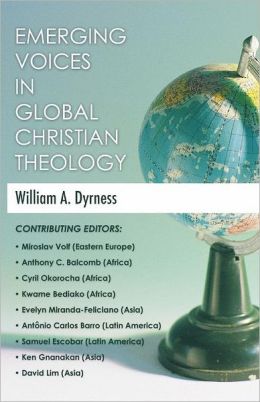
emergingvoicesSome words I’ve always taken for granted. They seemed to need no definition. Salvation was one of them. For one brought up in the North American evangelical milieu, “salvation” for me as a child meant “going to heaven when I die” or “asking Jesus into my heart.” There were “wordless” books or Roman Roads, the “Four Spiritual Laws” or other “evangelism plans” that if followed meant that my “name is written in the Lamb’s book of life.” Or, to use the vernacular, “I’m saved!”

The more I study, the more I realize that – while an encounter with Jesus Christ is still vital – Scripture talks about salvation in a much broader sense. But what Cyril Okorocha does in his chapter entitled “The Meaning of Salvation: An African Perspective” (in William A. Dyrness, ed., Emerging Voices in Global Theology [Zondervan, 1998]) is to pull back the curtain on the worldview of the Igbo, a large people group in southern Nigeria. Specifically, he teases out how the Igbo understand the word “salvation.” In short, salvation is intertwined with well being (Ezi Ndu) in the here-and-now, which explains in-part the popularity of prosperity teachers in Nigeria. Okorocha observes (p. 83):

African primal peoples have no disinterested love for their gods. Worship is given only in return for protection and life-enhancing benefits. This pragmatic and almost utilitarian attitude to religion is the key to Igbo conversion to Christianity. But it is also the explanation for the rise of new religious movements, including the African Independent Churches.

A strength of the chapter is its presentation of prayers traditionally offered by Igbo who are not Christian. Besides prayers for health and well-being, there are prayers for peaceful community, prayers that accompany sacrifices to appease the spirits, and prayers for women to bear many children: “Marriage is primarily for, and in order, to have children. When a marriage fails to provide children, traditional steps are taken to rectify the situation” (p. 84).

In Western settings, “sin” is usually conceived individualistically. When Paul says that “all have sinned and fall short of God’s glory” (Romans 3:23), the individual is taught to think of this as “I have sinned.” Arguably, perhaps due to the influence of the Puritans in early American life, many Americans think of “major offenses” in terms of sexual sins. (Nathaniel Hawthorne’s 1850 The Scarlet Letter is the epitome of this approach). But for the Igbo, “sin” is considered “any conduct or occurrence which may incur the wrath of the gods and therefore lead to the vitiation of life” (p. 87). Further, sin is dealt with communally. In a passage reminiscent of the Old Testament practice of Yom Kippur (see Leviticus 16.8-10), Okorocha (pp. 86-87) tells of the Yoruba practice of the télé (osu):

The télé is the Yoruba osu, or ‘human (usually male) scapegoat’: The people symbolically bind their sins on him on the day of the final ritual cleansing and warding off (after the cleansing sacrifice of the animal has been offered). The sins are tied on the back of the télé in the form of a heavy load (made up of all kinds of rubbish, often including human waste) which he bears to the sacred grove, the evil forest. The people throw the télé into the forest and chant: Take sins away! Take misfortunes away! Take disease away! Take death away!

Bishop Okorocha does a good job of describing the Igbo worldview but is less effective when offering a critique. While he speaks of the “anthropocentrism” (human centeredness) of African religion, unfortunately, he prescribes nothing to remedy the situation. (Such a remedy would certainly be helpful in North America, too). Instead, he lays out the importance of “power” without exposing the dangers of an outsized emphasis upon this one aspect of Christian faith. After all, can a Christian ethic be built upon “power” alone? As a missionary educator living in Benin (Nigeria’s smaller neighbor to the West), I encouraged our pastors to avoid speaking of power in isolation of other qualifying terms. Instead, our message should be the “power of a holy life.”  In this way, we can make sure that two elements often presented in tandem in the New Testament stay coupled.

This criticism aside, Cyril Okorocha does an admirable job of acquainting the reader with how many Africans view salvation, a vital topic not only to Christianity in general but to Wesleyanism particularly. I look forward to reading other writings by the Anglican Bishop.

———————————————

Photo credits:

1) Bishop Okorocha: Christian Voice News Online

2) Emerging Global Voices: Barnes and Noble

Posted in African theology, book reviews, The Wesleys and Wesleyan theology

South African Tony Balcom on “faith in the boiling pot”

emergingvoicesIn 2014, I am committed to plunge into the massive literature on African theology, or what I prefer to call “Christian theology written by Africans.” After all, we don’t usually speak of “European theology,” “Australian theology,” or “North American theology,” so why should we insist on the term “African theology”? By speaking of Christian theology, it is an acknowledgment that the broad, Scriptural themes that unite us – wherever on this planet we happen to have been born and raised – are the priority.  On the other hand, speaking of “Christian theology written by Africans” admits that each of us unwittingly brings cultural “glasses” to the reading of Scripture that cannot be removed. These glasses affect the way we go about building our theology, including the choice of which themes from Holy Writ to emphasize and which to soft-pedal or even (unconsciously) which we ignore. Teaching only theology developed in Western settings means neglecting themes that are dear to the heart of Africans while emphasizing some that for them may hold less interest.

To begin this plunge, I took down from the shelf a book that – to my embarrassment – has sat unread for years, even if it has traveled with me as I’ve made my home and served as a missionary in Côte d’Ivoire, Benin, Haiti, Kenya, and now South Africa. William Dyrness helped edit Emerging Voices in Global Christian Theology (Zondervan, 1994). The compendium contains three essays penned by Christian theologians from Africa, as follows:

Anthony Balcom, “South Africa: Terrifying Stories of Faith from the Political Boiling Pot of the World”

Cyril Okorocha, “The Meaning of Salvation: An African Perspective”

Kwame Bediako, “Jesus in African Culture: A Ghanaian Perspective”

Today, we will look at the first.

Tony Balcom was born in South Africa but raised in Northern Rhodesia (now Zimbabwe). His essay was published the same year when South Africa elected Nelson Mandela as President. This means that Balcom would have been writing some time in 1993, when many South Africans feared that their country was teetering on the brink of civil war. In this context of seemingly intractable mistrust between citizens of differing backgrounds, Balcom poignantly observed (pp. 47-48):

For almost four centuries in South Africa, we fought and killed each other. When we tired of this we shouted abuse at each other across great divides of race, culture, and ethnicity. When we tired of this we slammed the door on each other, each pretending the other was not there, each hoping the other would go away. But when we squatted at the keyhole and squinted through to the other side, we saw each other there, as large as life, waiting. And we knew that one day we would have to do it. One day we would have to talk…it is the conversation of those who have begrudgingly come to realize that conversation is the only way out, because those who do not talk, fight. It is therefore conversation steeped in suspicion, resentment, fear, and hate. But it is nevertheless conversation.

Balcom tells three stories to illustrate his contention: “Not a single issue of life can escape the fact of our faith. Our faith demands of us that we ask the questions to do with our lives” (p. 47). The best story is that of Nonqawuse. A prophetess from the Xhosa people group, in 1856, she revealed that the ancestors had spoken to her and had instructed that all the cattle must be slaughtered. Once they were dead, not only the cattle but all the ancestors would come back to life in spontaneous resurrection, chasing away the white oppressors (p. 50). The paramount chief of the Xhosa, Sarhili, accepted the prophecy, and he ordered the slaughter, believing – according to the prophecy – that the resurrection would happen on 11 August 1856. The date came and went, with no resurrection. Balcom concludes: “The Xhosa people were effectively decimated” (p. 50).

The story of Nonqawuse is a tragic narrative that makes one appreciate the desperate lengths that the oppressed will go to in search of liberation. Further, it encourages today’s messengers of the Gospel to make sure that we are preaching Good News. This Good News is of a Christ who not only liberates us from our sins. More than that, regardless of our cultural heritage – in the words of our Nazarene communion ritual – Christ unites us as believers who are “one, at one table with the Lord.” Barriers of ethnicity must crumble around the Table.

It has been 19 years since Tony Balcom’s essay. Just over one month ago, former President Nelson Mandela passed away, heralded by one and all in the country as a Great Uniter. Debate continues regarding whether Madiba was a follower of Christ. Certainly God knows the heart, and we rest in that truth. However one answers the question, one thing is certain: Of all peoples, Christians should be at the forefront of promoting harmony among peoples of all backgrounds. This is the primary take-away from Balcom’s chapter, a timeless lesson in a troubled and divided world.

————————-

Photo credit: Barnes and Noble

Posted in book reviews

Amiel’s Journal Intime – a slow read amply rewarded

Henri Frédéric Amiel

When Amy started reading Amiel’s Journal Intime, I had my doubts. What could a 19th century Swiss philosopher have to say to a 21st century reader? Plenty, as it turns out.

Henri Frédéric Amiel (1821-81) taught aesthetics and philosophy at the University of Geneva. He never married, and his not having found a wife remained a lifelong regret. Still, he found happiness in communing with nature, in an unquenchable thirst for learning, and a faith in God strong enough to ask tough questions.

The Journal Intime was a multi-volume work originally penned in French and compiled over several decades. Thankfully, it didn’t take several decades for me to read it, but it did take several months! Unlike a John Grisham page-turner that you can devour in a few hours, Amiel’s writing is like a savoury meal best digested slowly and in small portions. Here are a few quotes that I hope will whet your appetite to download this free book on your own Kindle.

—————

The power of example

“Like alone acts upon like. Therefore do not amend by reasoning, but by example; approach feeling by feeling; do not hope to excite love except by love. Be what you wish others to become. Let yourself and not your words preach for you.” – April 7, 1851

“Be careful of your reputation, not through vanity, but that you may not harm your life’s work, and out of love for truth.” – March 3, 1852

“Every life is a profession of faith, and exercises an inevitable and silent propaganda. As far as lies in its power, it tends to transform the universe and humanity into its own image. Thus we all have a cure of souls.” – May 2, 1852

“An evil example is a spiritual poison: it is the proclamation of a sacrilegious faith, of an impure God. Sin would be only an evil for him who commits it, were it not a crime toward the weak brethren, whom it corrupts.” – May 2, 1852

The danger of materialism

“Materialism is the auxiliary doctrine of every tyranny, whether of the one or of the masses. To crush what is spiritual, moral, human so to speak, in man, by specializing him; to form more wheels of the great social machine, instead of perfect individuals; to make society and not conscience the center of life, to enslave the soul to things, to de-personalize man, this is the dominant drift of our epoch.” – June 17, 1852

A proper view of God

“To believe in a good and fatherly God, who educates us, who tempers the wind to the shorn lamb, who punishes only when he must, and takes away only with regret; this thought, or rather this conviction, gives courage and security.” – September 27, 1852

Continue reading “Amiel’s Journal Intime – a slow read amply rewarded”

Posted in book reviews, reflections

Dark Side of Destiny now available in print!

WIPFSTOCK_Template
The Dark Side of Destiny: Hell Re-Examined (Wipf & Stock, 2013) by J. Gregory Crofford

I didn’t set out to write this book, but it was the book that had to be written.

A story might help. During my sophomore year at Eastern Nazarene College, I worked as a teller at a Boston Savings & Loan. Joel was my fellow-teller, and during slow times, I’d break out a book. One day, I was reading one of Hal Lindsay’s best-sellers about the end times. Joel flipped through the book, then asked a piercing question:

Do you believe all that stuff?

Joel was a non-believer, and his question got me thinking. What if Hal Lindsay was wrong? What if his kind of writing – while seemingly truthful – was making Christianity unattractive to those we are called to reach? So I went back to Scripture and did a re-study. What I found led me away from that kind of sensational view to post-millenialism, a more historic and balanced view that fits better with the whole tenor of what God’s mission is in this world, especially as related to the work of the Church and the Kingdom of God.

That same process happened for me when it comes to the traditional doctrine of Hell.

This time it was many Joels whose voices came across in the threaded comments of websites. They questioned what kind of God would make individuals suffer forever in the flames of Hell. It was a character question, and that got my attention. I took down from my shelf Four Views of Hell (Zondervan, 1992) and re-read the excellent essay by Clark Pinnock. It was a good summary of an alternate view, but I wanted to go deeper. The magisterial The Fire That Consumes: A Biblical and Historical Study of the Doctrine of Final Punishment (3rd ed.; Wipf and Stock, 2011) by Edward Fudge made a convincing case from Scripture and answered some of the nagging exegetical questions that I’d had over the years.

Yet for all their merits, these kinds of works won’t be studied by the average layperson. So on this blog, bit by bit, I hammered out what later would become chapters to my new book, The Dark Side of Destiny: Hell Re-Examined (Wipf & Stock, 2013). Here’s what the back cover says:

Discussion of Hell is hotter than ever. Yet for all the attention the topic has drawn, few are the resources that provide an overview of the major points in dispute without bogging down in detail.

The Dark Side of Destiny: Hell Re-examined is an excellent primer, yet goes beyond a mere description of options. Dr. Crofford weighs various views of Hell in the light of Scripture and finds them wanting. In the end, he champions a neglected view of last things that both responds better to the preponderance of biblical evidence and safeguards the character of God as equitable, holy, and loving.

With probing discussion questions at the end of short chapters, The Dark Side of Destiny is ideal for Bible studies, Sunday school classes, or small groups.

The book has only 90 pages. It’s short on purpose. I hope to develop a C.S. Lewis side to me, to bring theology into the streets.

ORDER INFORMATION

You can order the book for just over $ 10.00 directly through the Wipf & Stock website (click on the link). Or, if you prefer, it’s also available here on Amazon.com for $ 13.00. Within 3 months, it will be available as a Kindle e-book.

Some of you may have downloaded the book in its original self-published Kindle e-book format. In a minor revision, this version tightens up some of the arguments and corrects some typos. It also includes a new foreword by Edward William Fudge.

Let me know what you think, and spread the news!

—————

Image credit: Wipf & Stock

Posted in book reviews

James Copple on saving the children

Voices_from_the_night_3D-v4James Copple’s Voices from the Night (Amazon Kindle, 2013) takes you from  drug-infested crack houses in the Midwestern United States to the slums of Nairobi. In words that paint memorable pictures, Copple shares stories of children and youth who face impossible odds and somehow come out on top.

Key to Copple’s method is what he calls “coming alongside”:

My career path is about coming alongside the dispossessed, the impoverished, the broken, and the wounded. To be in journey along side of the oppressed is to recognize that you bring skills, gifts, and capacity that can strengthen or contribute to the welfare of those you engage. Further, to come along side suggests that you have as much to learn from the other as the other has to learn from you. It is a bridge bound by love, grace, and empathy (location 122).

For the author, child victims of war, drug abuse, and poverty must not be mere abstractions or projects at whom we throw money to ease our conscience. Rather, they are a living, breathing reality, youth with hopes, dreams, and incredible potential. Copple laments that governmental budgets find millions for wars and leave social agencies to fight each other over the remaining scraps. Surely we can do better than this! But more than money, children and youth need us, our time, our love, our attention. That’s what community is all about.

Voices from the Night includes heart-wrenching stories, so be prepared to be haunted by what Jesus called “the least of these.” Whether it’s little Omar in Somalia who divulges to soldiers where his mother is hiding, resulting in her rape, all so that his empty, growling stomach can have a couple of biscuits, to a little girl in a filthy crack house who pleads with Jim, “Mister, can you get me out of here?,” there’s no taking your eyes off the sad specter of children suffering.

A positive aspect of the book is that the author doesn’t just present the problem. He offers practical solutions, but be warned: They come at a personal price. Community change can only transpire when we are in-the-flesh involved with those who need rescuing. The final chapter offers ways to roll up your sleeves and make a difference.

The wide-ranging nature of Voices from the Night is also its weakness. Really there are two books here, one dealing with anti-drug crusading in the United States and a second telling more recent stories from the hardscrabble areas of East Africa. While the children and their stories are compelling, the long interludes of moralizing are less so.

Despite this weakness, Voices from the Night is a clarion call to advocate for those who are most often shunted aside as insignificant. Copple never promises that change will be easy, but he guarantees that looking back one day, you’ll be glad you spent yourself in a cause bigger than yourself.

————————–

Photo credit: James Copple the Seeker

Posted in book reviews

African Voices II

African Voices II , by Mark and Nancy Pitts (Nazarene Publishing House, 2012)

They did it again! Mark and Nancy Pitts served up a second portion of inspiring profiles of African Nazarene leaders. An hour later when I finished the book, not only did I know these leaders better, but I was grateful to God for the privilege of serving as a missionary alongside some of the Lord’s best.

African Voices II is divided into eight chapters, each telling the story of a different leader. From Senegal to Kenya, from Southern Sudan to Mozambique, from Malawi to South Africa, each leader’s story is different, yet the thread that ties them together is an unwavering commitment to Christ and the expansion of the Church.

Here are some of my favorite quotes:

“Individualism is considered witchcraft in most African societies, so the concept of holiness as love finds fertile ground in Africa.” – Benson Phiri, Malawi

“Christians and church leaders in Africa must not only live holy lives but must also be brave enough to speak prophetically against evil wherever they find it, just as Amos did when he spoke against the actions of the king.” – Enoch Litswele, South Africa

“One thing I learned from my parents is to stand by the truth, no matter what.” – Filimao Chambo, Mozambique

“People should be able to see in us the holiness that we are telling them about. If we only present holiness as a concept, then others will see it as an idea, not as a way of life that is lived out before them.” – Emmanuel Wafula

“When planting a church, it is not qualified leaders that are needed; just ask for people who are willing to serve God. The Holy Spirit helps us know that this one is real and genuine and another one is not serious. The Holy Spirit gives discernment.” – John Yual, Southern Sudan

African Voices II also includes some amazing stories of former Muslims who are living out their faith in Christ in dangerous places. Be warned: You may feel like you’ve suffered nothing major yet for the Cause of the Gospel. On the positive side, you’ll be drawn to surround these leaders of God with your prayers.

——————

Photo credit: Barnes and Noble