Posted in missions & evangelism, reflections

Is Evangelicalism Platonic and Gnostic?

blakecrIt’s a classic entry from The Sacred Diary of Adrian Plass, Aged 37 3/4:

Sunday December 22nd

Guest speaker at church today, dressed in a monk’s habit. He said that God is nice and he likes us. Everyone looked at Edwin to see if we agreed. Difficult to tell as he was grinning like a happy little boy. Speaker kept quoting Mother Teresa of Calcutta, who is, of course, a Roman Catholic!

Afterwards, Richard Cook whispered to us, ‘Ah yes, but is she saved?’

Gerald whispered back, ‘Ah yes, but how many filthy beggars have you washed this week, Richard?’

Get the book. Read it all — it’s a hoot, and has kept our family laughing at times we’d rather cry.

Like all good comedians, Plass knows how to have us laughing and thinking at the same time. For lying just under the surface of a farcical scene is an important point: What is the relationship of things spiritual and things bodily? Is our job just to get people “saved” (ready to meet God) or does this whole Christianity business also involve rolling up our sleeves and pitching in?

It’s funny how our view of reality may have an unintended effect upon how we answer that question. It’s an old discussion, one that came up in the earliest centuries of the Church. The term Gnosticism comes from the Greek word gnosis, meaning “knowledge.” Some claimed that salvation was attained through special knowledge. It was an esoteric system that included a pure God far removed from Creation, with “eons” (or emanations) radiating from Him, and only the “demi-urge” (a far removed from God, intermediate being) indirectly bringing the universe into existence. God was spirit and pure, whereas matter was evil.

Importantly, Gnosticism contained a strong element of escapism. The Catholic Encyclopedia explained:

“This utter pessimism, bemoaning the existence of the whole universe as a corruption and a calamity, with a feverish craving to be freed from the body of this death and a mad hope that, if only we knew, we could by some mystic words undo the cursed spell of this existence — this is the foundation of all Gnostic thought.”

Gnosticism was shaped by many religions, so It is debated how much Gnosticsm was influenced by Plato’s thought, but some influence is accepted. Plato had taught that the soul is immortal and would outlive the temporal body. In this sense, priority was placed upon what was eternal (“Ideas” or “Forms”) vs. what was only an earthly shadow.

Whatever the degree of Plato’s influence upon Gnostic belief, Gnosticism has had an influence upon Christian theology and practice. Monasticism grew up in early centuries of the Church, some forms of which treated the body harshly. Others reacted differently to the mix of Platonism and Gnosticism, believing that the soul (being pure) could not be negatively affected by bodily behavior. Hedonism was the result.

Past ideas can echo down to the present. Evangelicalism is the brand of Christianity that became prominent in North America (and to some extent, in the United Kingdom) in the mid twentieth century. Billy Graham was its most notable leader, emphasizing people “making a decision for Christ.” The most important thing in life was to be “born again,” to be “saved.” (Thank the Lord for the many thousands who found hope in Christ through Dr Graham!)

Much broader than Graham himself, in most Evangelical preaching, the emphasis was placed upon heaven as the place where our “never dying soul” would go to be at death, but only if we had “accepted Christ.” Those who presented the Gospel (Good News) in this way were called “soul winners.” In my own denomination, there was the mid-20th century “Crusade for Souls.” Long-time Nazarene Theological Seminary Professor of Evangelism Charles (Chic) Shaver taught a modified form of the “Kennedy Plan,” which begins with the question:

Have you reached the place in your life where you know for sure that if you died tonight you would go to heaven?

Note where the emphasis lies. The concern is for the next life, not this one. Underneath the little word “you” is the dualistic assumption, that the real “you” is the one that leaves when you die. The word “soul” is not explicit, but it’s there nonetheless.

We must ask: For all of its positive fruit, to what degree was this understanding of the Gospel influenced by Plato, or perhaps Gnostic-like ideas? By 1987 when I took “Personal Evangelism,”  some students at NTS had begun questioning Dr Shaver. It was difficult, after all, to be learning about Gnosticism from Dr Paul Bassett in Church History I and not see shades of Gnosticism in the “soul winning” language used down the hall. To his credit, Shaver recognized the problem, but kept the language, explaining that he could “spend the next 50 years on that cause” and be distracted from the task God had given him, which was introducing people to Christ — fair enough. To this day, I appreciate Dr Shaver and the way he made us concerned not just about “souls,” but about people. Still, the “soul” language can be problematic.

A second question relates to the moral ramifications of Gnostic teaching. Earlier, we saw that one possible reaction to the “soul matters more than body” idea was monasticism. Twentieth century Evangelicalism built no monasteries, but I wonder if a monastic spirit isn’t behind some of the more legalistic expressions of the movement? If what matters is eternal souls being one day in heaven with God, then necessarily everything else that is “earthly” pales in comparison, especially if what is earthly is by definition corrupt. And what’s more, if there’s any question whatsoever that such pursuits could keep the soul “missing heaven” (as evangelists used to say), then those things must be eschewed as “worldly.”

Finally, Gnostic pessimism shines through in some versions of the End Times. The Left Behind series of books and films encourages disengagement from the world, presenting a dystopic vision. Only the “rapture” (and later, the Second Coming of Jesus) will bring bliss for those who escape the Great Tribulation and the claws of the Anti-Christ to go to be with Jesus in a better place. This is the default view of most Evangelicals, yet the escapism it shares with Gnosticism is real.

So what do you think? Realizing the overall good that has been done by emphasizing evangelism, have we sometimes been Platonic or even Gnostic in how we speak about our Christian faith?

———————-

Photo credit: Sullivan County
Posted in reflections

Confessions of a Protestant lost in a sea of Catholicism

giotto_crucifixMy friend, Jim, pastored in small-town Missouri. “Greg,” he once confided, “you can’t swing a dead cat in my town without hitting a Baptist.” Apart from whether dead-cat swinging is advisable, I understood what he meant. What is true in Missouri is even more pronounced in Oklahoma (my adopted state), where there are not just Baptists but as many choices of church “flavors” as ice cream flavors at Coldstone Creamery.

Yet my roots are in the Northeast, where most of my growing up years were in Rochester, New York. While Syracuse is dominated by the Irish, Rochester and Buffalo were more heavily settled by Italian immigrants. In my high school, there were wonderful Italian last names like Dallasandro, Cervone, and Arcuri, to name a few. With a strange, decidedly un-Italian name like Crofford, at times it seemed like I was one of the few whose last name didn’t end with an “i,” “o,” or “e.”

Italian ancestry brought with it Roman Catholicism. In elementary school, the cafeteria never served hamburgers on Fridays, only fish sticks, a concession to old-school Catholicism and its fasting practices that endured in the early 70s, Vatican II notwithstanding. On the bus, students talked about their Saturday “religion” classes and later about taking “first communion” or “confirmation.” In 10th grade chemistry, I chatted with my friend, Greg, who asked me what I wanted to do with my life. “I’m going to be a pastor,” I answered. Shocked, he asked: “But don’t you want to get married and have children?” Since Roman Catholic priests (pastors) are celibate, he couldn’t comprehend that as a Protestant I could purse the ministry and  have a family.

As I look back on my public school experience, I realize that in many ways I was a Protestant lost in a sea of Catholicism.

As incredible as it now seems, as a child I believed that Catholics were all bound for hell. Maybe it was the Chick Tract that said the Pope was the Anti-Christ. Perhaps it was a stray comment here-and-there from adults, asking prayer for good Catholic church attending individuals, that they would be “saved.” Whoever it was that wrote on the wet cement of my young mind, the etching soon hardened.  We were “in” and they were “out.” Others told me that we should “have a burden for the lost,” that we should pray and “witness” to them. Throughout 3rd grade, I was determined to tell my friends at school about  Jesus, but at the end of the day, always felt guilty that I hadn’t had the courage to do so.

High school ended, and I’ve never gone back. College at one of the liberal arts institutions sponsored by my denomination meant I was no longer religiously isolated. Rather, I was one of the “birds of a feather who flock together,” surrounded by individuals of like faith. Later years brought marriage, family, and work as a pastor and missionary in my denomination.

As I’ve grown older, I’m able to reflect more objectively on my experience as a lonely Protestant. Here are some of the things I’ve concluded:

1. I needlessly distanced myself from my peers. I wonder how many friendships never blossomed because I was convinced in some way that I couldn’t articulate at the time that association = religious compromise? When Catholic girls flirted with me, I didn’t flirt back, but how could I tell them it wasn’t because they weren’t pretty but because they were Catholic? In retrospect, my aloofness was overkill.

2. Some of my prejudices are inherited. As one in the Anglican/Methodist tradition, I was surprised to find anti-Catholic sentiments in the writings of two of my heroes, John and Charles Wesley. They speak of “Papism” as shorthand for their distaste of all things Roman. Some of that bigotry has been passed down to their ecclesiastical descendants, myself included, and we would do well to challenge it.

3. Roman Catholics love the Church. Whereas my own tradition does well speaking of the importance of being born again, being “saved,” and having a relationship with Jesus Christ, too many of the “saved” don’t have a good grasp of how church fits into the scheme. Sadly, faith then becomes an individualistic endeavor. On the other hand, Roman Catholics by-and-large respect the importance of the Church as the community of faith. Sure, they can be openly critical of it and sometimes will only attend a few times a year (as do some Protestants), but when outsiders attack the Church, watch out! They circle the wagons. Church is not a “tack on” for the Catholic; it is at the center of their faith, and there is something alluring about that. When former Catholics join Protestant churches, I’ve noticed that they often conserve their high view of the Church. What Protestant pastor isn’t thrilled to have loyal members like that?

4. The liturgy and architecture point us Godward. Does the bread and wine literally become the body and blood of Jesus during Eucharist? That’s a hard one for me to swallow, yet there is a majesty to the old rituals of Catholic worship that make the evangelical fad of “seeker sensitive” worship seem shallow by comparison. Protestant church buildings – at least lately – look more like office complexes. There is something worshipful, on the other hand, about a vaulted ceiling, stained glass windows, and pews that are bolted down. Cathlolic architecture says: “Do you need a place for dinners? That’s in the adjoining building. This space is for worship, and that’s enough.”

5. Socially, Roman Catholics care about many of the things I care about. Family is vital, and abortion is to be avoided. These two conservative tenets overlap with the thinking of many Protestant evangelicals.

6. I like Pope Francis. His tenure has started off with him garnering respect from a wide spectrum of Christian leaders as he lives a simple life and radiates love to all with whom he comes in contact.

Purposely, this essay has not dwelt upon where Roman Catholicism and Protestantism part ways. That list includes the place of Mary and the saints, but I have learned that non-adherence to the overall beliefs/practices of a particular religious group does not mean that we must paint with a broad brush, calling what is good, bad. We can celebrate the ways that God is working in other groups, and hope that they will in-turn celebrate the ways that God is working among us, warts and all.

Jesus said to Peter in John 21 not to worry about the so-called “Beloved Disciple,” that he was not Peter’s concern. Instead, he simply said to Peter: “You must follow me.” As Christians, let us affirm one another where we can, but most importantly, keep our eyes upon the One whom we are following. Doing that, how can we go wrong?

—————-

Image credit: Artchive.com

Posted in Bible, reflections

Fasting, justice, and Sabbath rest: reflections on Isaiah 58:6-14

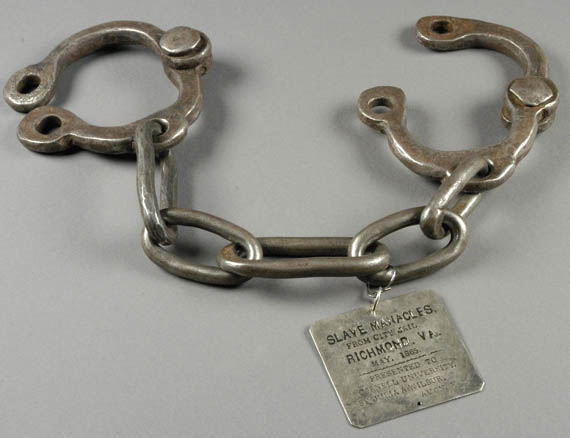
manaclesLet’s play a word association game. When you hear the word “fasting,” what is the first thing that comes to your mind?

Since I can’t read your mind, I’ll have to be content to let you know what images came to me. I envisioned a desert monk, someone like John the Baptist, austere, skinny, and prophetic. Another image is Ash Wednesday, a sober time when we give up something for Lent.

I must confess that upon hearing the word “fasting,” the first thing that popped into my thoughts was definitely not “justice.” Yet the prophet Isaiah insisted that the two concepts are intertwined. If fasting is abstaining, then there are practices from which we must refrain. Isaiah explains:

Isn’t this the fast I choose: releasing wicked restraints, untying the ropes of a yoke, setting free the mistreated, and breaking every yoke? Isn’t it sharing your bread with the hungry and bringing the homeless poor into your house, covering the naked when you see them, and not hiding from your own family? (Isaiah 58:6-7, CEB)

Isaiah calls us to “fast” (abstain) from any enterprise that enslaves people, “untying the ropes of a yoke” (v.6).  For example, millions around the world are enslaved to cigarette smoking. If we are involved in the production of tobacco, are we not implicated in that bondage? Likewise, to “set free the mistreated,” using Isaiah’s colorful phrase, will mean abstaining from our own involvement, however indirect, in the mistreatment of others. Perhaps this will mean that we think twice about spending our dollars at businesses that could pay their workers a livable wage but stubbornly refuse to do so.

At the end of the chapter, Isaiah speaks of keeping the Sabbath (58:13-14). When God first spoke of the Sabbath (Exodus 20:8-11), he clearly underscored the principle of rest. This is a fast from all work. When serving as a missionary in Haiti, often we had no power from the local municipality. Our solution was to install a large generator that could give light to all the buildings on campus. I was assigned to maintain the generator, changing the oil and the filters as needed. Most importantly, however, was the instruction regarding how many hours uninterrupted the generator could run. It was important not to run it for too long without having several hours idle or else the generator would wear out.

If we understand that about a machine, why do we miss the lesson when it comes to ourselves? God made us and understands that sometimes we must fast from work in order to rest. Recreation – what as children we called “play” – is not just for children. We literally must be “re-created” by finding time free from toil, to unstring the tightly strung bow, to kick back and do nothing useful. Yet in our 24/7 world, even the people of God grossly neglect the Sabbath principle. Have we sacrificed our health on the altar of corporate profits?

Holiness is not just personal; holiness is social. Profession of saving and sanctifying faith can be easily undermined by our wicked practices. Fasting from food is not sufficient if at the same time we refuse to abstain from practices that undercut our witness.

But if we feed the poor and clothe the naked (v. 7, 10), then Isaiah affirms that what we say with our words will be seconded by our actions. And guess what? People will notice!

Then your light will break out like the dawn, and you will be healed quickly. Your own righteousness will walk before you, and the LORD’s glory will be our rear guard. Then you will call and the LORD will answer; you will cry for help, and God will say, ‘I am here (8-9a).

When reading Isaiah 58, I’m forced to reflect on my own life first of all. Renewal always begins with the person in the mirror. Will you join me in this prayer?

“Help me, LORD, in this sin-sick world, to be part of the solution and not part of the problem. Show me where my words and actions do not match up, that what I do might open doors for sharing the love of Christ with others and not impede the advance of Your Kingdom. In Jesus’ name I pray, AMEN.”

——————-

Image credit: Cornell Library Guides


Posted in Christian ethics, reflections

Thank you, Dr King

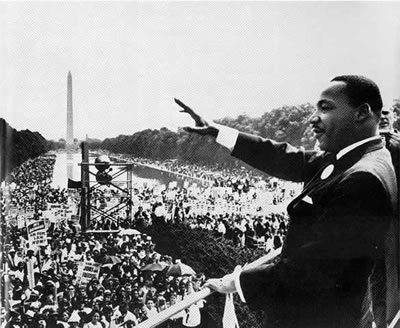
kingOn August 28, 1963, the Rev. Dr. Martin Luther King, Jr. gave a speech on the steps of the Lincoln Memorial that galvanized a nation, with echoes heard around the world. Coming from the airport in Johannesburg yesterday, the taxi driver who transported me listened to a radio discussion on to what degree King’s ideals have been realized in South African society. I’m proud that a fellow American like Dr King left a positive legacy that is still referenced 50 years later.

The story of Jackie Robinson is brilliantly portrayed in the film, 42. As a baseball player post-WW II, he faced blatant prejudices as he broke the color barrier in professional sports. There can be little doubt that we have come a long ways since the time when “Whites Only” signs were painted on the doors of public bathrooms or over water fountains. Yet much remains to be accomplished.

But let us narrow the focus from society in general to our own personal, daily choices. Here are a few small ways that in recent years I’ve tried to narrow the gap at least a little bit:

1. There is only one race, the human race. Dr Charles Gailey, Professor Emeritus of Missions at Nazarene Theological Seminary, spoke eloquently that there are not “races,” but only one, the human race. Within that race, there are certainly variations and diversity, yet there is so much more that unites us than what divides us! When a political pollster called one evening, at the end he needed to check off the boxes on his questionnaire. “What race are you?” he asked. “Human,” I replied. There was a long silence, then the pollster responded:  “You are correct. I never thought of it that way before.” Thank you, Dr Gailey, for reminding us that what we share far outweighs what differentiates us.

2. Take a bus. You can have some amazing conversations on buses. Everyone is on a journey somewhere, and buses are among the best multicultural crossroads in our nation. (If I had more than one life, I would travel buses between cities and in cities for a year, just so I could write a book about my experiences). They say that love’s first duty is to listen, and on buses you get the chance to hear each other out. I spoke for 45 minutes with several African-American men headed to California, breaking into celebrity in the world of rap music. In that one hour, I learned more about that topic than I had learned before. I also learned that a few of my comments were perceived as racist, even though I had no idea they were coming across that way. They in-turn were interested in my experiences in Africa. We shook hands at the end, and wished each other well. My world expanded in a way that it likely would not have except for riding the bus together.

3. Gently correct. In a rural church, the greeter met me at the door and introduced himself. Within 5 minutes, he had asked me questions that were pejorative toward those who skin is of a darker color. I’ve learned that the best way to correct discordant notes in someone’s narrative is to give them a new narrative. After he had listened to our missionary presentation, you could see the wheels turning in his head as his conclusions about entire groups of people were challenged by new information. Now he knew names and details, a new narrative. At the end of my presentation, I closed in prayer, thanking the Lord that one day we would all gather in worship around God’s throne, black and white, men and women and children of all nations, to worship God eternally.

4. Go out of your way to welcome those different than yourselves. At a recent church gathering, I noticed that there were only two African-American women present. Understandably, they were sitting together. From what I could tell, no one engaged them in conversation. They looked uncomfortable, so I shook their hand and exchanged names, asked them where they were from, and welcomed them to the meeting. You could see them visibly relax as a smile replaced what had been a frown.

5. Grow beyond your biases. A friend recently talked about “Jewing someone down.” When I asked why she would use such an expression, she apologized. “My mother used to say that,” she said. “But you’re right. I’ll do better.” And so must I! You can’t help but breathe some biases growing up in an all-white neighborhood, attending a high school where perhaps only 1% of the student body was black. And I suspect that many Americans are in the same boat as myself. Limited experience with those of a different color or cultural background allows negative stereotypes to thrive since there is little first-hand experience to contradict it. But my world is growing, and as it does, I’m seeing it with new eyes.

6. Accommodate as much as possible the wishes of others. The other day I made a new friend. When I called him “Ed,” he gently corrected me. “Please call me Edward” he said. What would my new friend think if I had insisted on calling him “Ed” even though he had requested otherwise? Would that have harmed or hurt our budding friendship? Likewise, there are minority groups who are sensitive about how they are called. Out of love, we now say “little people” instead of “midget” or “dwarf.” The handicapped more positively are known as the physically challenged. When we accommodate others as much as possible, we are fulfilling the command of the Lord to do unto others as we would have them do unto us (Matthew 7:12).

Dr Martin Luther King held up a mirror to our collective face, and allowed us to gaze into it. He reminded us in his “I Have a Dream Speech” on that warm day in August 1963 that what matters is not the color of our skin, but the content of our character. Thank you, Dr King, for showing us the better path that – by the grace of God – we all can follow.

Posted in autobiographical, reflections

Last-place finish

cross_countryThis essay, based upon a cross-country meet in the autumn of my first year in high school, appeared in the Standard for August 9, 1992. I have no photo from the event, but this pic from a recent Pennsylvania meet evokes my own experience as a young man in Spencerport, New York.

————————————

Dark clouds loomed overhead, threatening to turn the high school cross-country meet into an impromptu swimming competition. At last, skittish officials called runners to the starting line. A shot from the starting gun cracked the misty air. The race was on.

While we jostled for early position, my mind hurried back in time, even as my body advanced with smooth strides. Academically, the year was off to a good start. I ranked near the top of my freshman class, but my longstanding awkwardness in things athletic grated on my self-esteem like a coarse wool sweater. The previous summer, I determined to scratch the itch or die trying. An early day in September, I boldly laced on my factory-fresh blue Nike trainers and made for the locker room.

Friends had warned me of the rigors of racing, and their advice proved accurate. The first athletic “Everest” consisted of eight consecutive timed miles. Our drill-sergeant coach barked out impatient orders as he pushed our bodies to the edge of endurance. Hard work in practice paid off; my race times improved from meet to meet. Soon there were some on the team I managed to outrun. Still, I envied those runners who placed high in the standings and could cheer others as they entered the chute and crossed the finish line. Improvement notwithstanding, I usually got no more than a bird’s-eye view from the other end of things!

A sharp elbow from a teammate snapped me out of my daydream, and I set myself squarely to the task at hand. Two and one quarter miles later, the verdict was in. Unfortunately, the puddles turned out to be the only unique aspect to this latest effort. I crossed the finish line about two-thirds back in the pack.

Most runners quickly donned their sweat suits and headed for the buses, anxious to get warm and dry. Spectators became fewer, so no one seemed to notice one mother who stood at the mouth of the finish chute. Scanning the distant field with a hand over her eyes, her facial expression betrayed the worry she felt. Could there be someone still out on the course? I thought. For several minutes she kept up the vigil, starting at the slightest movement upon the horizon.

Moments later I spotted the object of her concern. In the distance, a bobbing figure was approaching. It became obvious from his halting stride that this youngster was in a great deal of pain. As he drew closer, the strained expression on his face bore eloquent testimony to the difficult run it had been. Drawing on all the strength he could muster, the boy’s determination was outdone only by the encouragement of his devoted mother. Tears streamed down her cheeks as she yelled through cupped hands: “Come on, Johnny! You can make it! You’re almost here!” Exhausted, he stumbled the final few yards, then fell headlong into the warm embrace of his mother’s arms. I overheard the tender words: “You made it, Johnny! I knew you would. I love you, son.”

Slowly, I walked toward the team bus and took my seat among my companions. The miles swept by while I replayed the scene in my mind’s eye. Soon I pondered a different type of race, but a race nonetheless. The apostle Paul speaks in 1 Corinthians 9:24 of the Christian race: “Do you not know that in a race all the runners run, but only one gets the prize? Run in such a way as to get the prize” (NIV).

Children of God have a clear course marked out before them. For sure it is not all roses; the narrow way never is. There are swirling streams to be forded, jagged roots that must be sidestepped, and sharp inclines to mount. At the times the Christian runner even falls flat on his face, mocked by the elements around him. When you face lands in the mud, there is but one thing to do: Get back on your feet, and in God’s power, press on. The finish line is still up ahead.

By most people’s standards, Johnny was a lousy runner. No crowds lined the chute to cheer his last-place finish. No blue ribbons or “great job!” pats on the back awaited him. Yet somehow I sensed that for mother and son at that moment, nothing could be more of a reward than the unfeigned love between them.

The cross-country season ended, and with it my fleeting dreams of running stardom. But the lesson for life learned that rainy Saturday in October lives on. From the view of many I meet, I’m so far back in this world’s race you could even count me out. There will be no great accolades from dignitaries, no medals of commendation for a hasty “rise to the top,” no Nobel peace prize or prime-time television interviews. Last-place finishers don’t guest host “The Tonight Show.” However, with sheer confidence I can say I’m “running to win the prize.” And when I finally get to the finish chute, I suspect everyone will have already boarded the buses and gone home. Everyone except One, that is. His name is Jesus, and when I fall exhausted into his outstretched arms, he’ll put the first-place crown on this last-place finisher. That will be worth it all.

————————————–

Photo credit: The Patriot News

Posted in From soup to nuts, reflections

Thoughts on the eve of Nazarene General Assembly 2013

I was only 12 years old when I attended my first General Assembly of the Church of the Nazarene in 1976, held in Dallas, Texas. We attended because my older brother, Mark, made the Easter (ENC) regional team representing us at the teen Bible Quiz. On the trip there, we discovered a wonderful up-and-coming hamburger restaurant around Lousiville, Kentucky. You may have heard of them.  They were called Wendy’s.

The other memory from that Assembly involved my two littlest brothers, Jay and Chad, only 6 and 5 years old. Somehow, they slipped away from their mom in the big Saturday crowd milling about the exhibits. Like Mary and Joseph frantically searching for the boy Jesus, we scoured every venue. No, they didn’t turn up in the Temple talking with the teachers of the Law, nor were they chatting with the General Superintendents. But a friend found them gleefully riding the elevator of the famed 18 story Baker Hotel where we were staying.

Now the General Assembly is in Indianapolis. For my brothers’ sake (and for my own enjoyment), Amy and I already rode the glorious glass elevator of the Hyatt Regency all the way to the top. Willie Wonka was nowhere in sight, and the elevator didn’t pop through the roof, but it was still lots of fun. I can’t wait to initiate some of our African delegates to this breathtaking experience.

Who says General Assembly has to be all so serious?

But on the other hand…

I do hunger for a movement of God’s Holy Spirit upon our church! If we can just set aside for a moment all the little things and get a glimpse of His perspective and His plans for us, then this time in Indianapolis will have been worth all the effort.

“Come, Holy Spirit, I need thee!

Come, sweet Spirit, I pray.

Come, in Thy strength and Thy power,

Come, in Thy own gentle way.”

Posted in Christian ethics, reflections

A mini U.N. in my closet – but at what price?

One of two shirts I often wear, made in Bangladesh
one of two shirts I often wear, made in Bangladesh

A factory in Savar, Bangladesh collapsed Wednesday. More than 3,000 workers were inside, making clothes to fill orders placed by stores like Walmart, working at monthly wages equivalent to only $ 38.00 U.S.  When the building began to shake, chaos ensued as people ran for the doors. At last count, more than 350 were killed, crushed under the weight of a building shoddily constructed but only days ago certified as safe by engineers.

The commercial asks: “What’s in your wallet?” But the tragic news from Savar begs a different question: “What’s in your closet?” Looking at shirts only, I discovered in my wardrobe “made in” tags from:

Bangladesh

Vietnam

Hong Kong

Macau (administered by the Chinese)

Lesotho

Nicaragua

Kenya

Guatemala

Pakistan

India

Bottom line? I have a mini U.N. in my closet, but at what price?

The “Do unto others as you would have them do unto you” (Matt. 7:12) ethic of the Christian faith teaches us that sin is not just an affair between us and God. Sin always has collateral damage, affecting others. Sometimes, sin insidiously weaves its way into the economic structures of our world, producing what theologians call systemic evil.

The factory in Bangladesh paying its workers little more than $ 1.00 per day is there in part because of the shirt hanging in my closet. If I and countless other consumers had chosen to buy shirts only from stores who outsource to safe manufacturers that pay fair wages, then Wednesday’s tragedy may have been avoided.

But let’s face it: We want cheap shirts and pants and running shoes and power tools, and the list goes on.

I have seen the face of evil, and it is me.

James 4:17 teaches that if we know to do good yet refuse, then we have sinned. So let’s get practical. Solving all systemic evil is overwhelming, on that we can agree. Yet surely we can light a candle and not just curse the darkness. Short of becoming Amish and spinning my own clothes, how should I react to the systemic evil in this instance?

1) As a regular customer of Walmart, I can tell them that I am sorry for having participated in this tragedy by buying their clothes from Bangladesh. Further, I can invite them to join me in demanding changes.

2) Until those changes take place, I can find a store that guarantees its products were produced responsibly in safe factories that pay a fair wage. Will I pay more? Most likely I will, but here the Golden Rule applies again. If I were working in Pakistan, Kenya, or anywhere else, would I want to receive a fair wage?

3) Finally, I can buy local products on purpose. When I buy things made close-by, I can be more sure that those who made them were fairly compensated. Also, by helping a local company grow its local market, they will spend less on transporting the goods far away. This in-turn will reduce the energy used and therefore the greenhouse gases produced to transport it to far away customers.

Systemic evil includes all of us, yet we can loosen its clutch if we are intentional. Like Jesus, let’s remember that loving “the least of these” (Matt. 25:31-46) means loving those who make the things that I use every day.

————

UPDATE: Since this story broke, I noticed that clothing from Bangladesh at the Atlanta airport was marked down by 75%. Time will tell whether this distaste on the part of the buying public will endure.

Posted in reflections

Seeing God from the lookout…and the street

Columbia Center, Seattle

When it comes to skyscrapers, I might as well admit it: I’m a soft touch.

Maybe it’s because of my NYC experience as a four-year-old. My Dad, Mom, my brothers and I headed north from Flemington, New Jersey to Manhattan. From the 80-something floor of the Empire State building, we looked out over the sprawling metropolis. My head poking through the railing, I looked at the vehicles so far below, then exclaimed: “Daddy, look at all those Matchbox cars down there!”

As a student on Boston’s South Shore, I trekked more than once to the Prudential building, in search of the same perched-above-it-all thrill. Then just last week, Seattle’s Columbia Center beckoned. From the 73rd floor of the 76 floor titan – the tallest in the West Coast region of North America – I spied the comings-and-goings of harbor boats in Elliott Bay, elevated highways snaking south toward Normandy Park, and Mt. Rainier foggy through the mist. Even on a cloudy day, it was worth the admission price.

Yet most of our life is lived down on the street. In Seattle, it’s down in Pike Place Market where they throw you the catch of the day…and you drop it. Or back in Boston, when you leave the Prudential building, the same subway that deposited you near tony Beacon Hill takes you back to Eastern Nazarene College winding through hardscrabble neighborhoods like Roxbury. Even the storied Empire State Building that summer day in ’67 sheltered in a stairwell a derelict man, sleeping away his hangover.

There are days when I see God from the lookout. Through prayer, Scripture reading or the well-crafted phrase of a praise song or sermon, I momentarily rise and glimpse the majesty of the vista. Perched above it all, the rays of the sun seem warmer, clearer, more pristine. There, the sweep of God’s plans fit together in unity, a well-choreographed dance scene from a Rodgers and Hammerstein musical.

Most days, though, I’m at street level. Instead of pondering the greatness of God, I’m frantically looking for my car keys or fretting about whether the money is going to run out before the month does.

Yet the amazing thing about the God we serve is that God is not confined! At the top of the skyscraper? God is there. Down on the street level where we suffer? God is there, too — Jesus, Immanuel, God with us.

Continue reading “Seeing God from the lookout…and the street”

Posted in Christian ethics, reflections

Let’s talk about the “s” word

When did sin become the “s” word that we dare not speak?

This was not always so. There was a time when most believed that sin – disobedience to God’s law, whether through rebellion or neglect (1 John 3:4, James 4:17) – was a big deal. Sinning was stigmatized, a warning to others of its danger, like a sign on a power box: “Danger: High Voltage.” We believed it was the cryptonite that could bring any Superman to his knees. Do we still believe that?voltage

There are at least two devastating consequences of sin’s denial:

1. The denial of sin precludes the possibility of healing, leading to death.

In his sermon Original Sin, John Wesley urged: “Know your sickness, know your cure.” Salvation in Scripture is a solution to a problem. But if we think there is no problem, then we won’t seek a solution.

One of the most painful reality T.V. shows to watch is Intervention. In one episode, a young woman addicted to methamphetamine takes the drug regularly, admitting no downside to her habit. Yet she is blind to the way it is controlling her life, putting her job in jeopardy and straining her relationship with those who love her most. Recovery only came when her family staged an intervention and she was willing to admit: “I’m an addict, and I need help.”

Likewise, the Good News of Jesus’ death only makes sense if we first acknowledge the bad news of our sinful predicament. Each of us must come to the place where we acknowledge that we are the worst of sinners (1 Tim. 1:15, NIV). Only when the illness is diagnosed and we accept Scripture’s dismal diagnosis will we be ready to seek the Great Physician for a remedy.

Sometimes death is presented only as what happens when we breathe our last. Yet sin is so poisonous that it begins to diminish the present vitality of those who deny its presence. In John 10:10, Jesus warns about the “thief” that has come to “steal, kill and destroy” (CEB). Sin gives us death on the installment plan, a progressive choking off of our life here-and-now. The end result is utter darkness, devoid of hope and without God (Matt. 25:30, Galatians 6:8). Conversely, to confess our sin is the first step toward the full recovery God wishes for each of us (1 John 1:9), a clean heart and a fresh start.

2. The denial of sin destroys community.

One of the devil’s biggest lies is often repeated: “No one else is getting hurt.” But is this true? Before the cheating spouse is unmasked, he or she may be convinced that an extramarital dalliance is harmless, not a sin but an innocent pleasure. Yet when the affair is exposed, the fallout is no less devastating. Like a priceless vase shattered into a hundred pieces, trust can only be painstakingly glued back together. Even then, the fissures are obvious, the beauty marred.

The epitome of beauty marred is Fantine, Victor Hugo’s pitiful character in Les Misérables. Her own indiscretion of conceiving a child out of wedlock is compounded by the sin of others who move beyond stigmatizing to self-righteous victimizing, chasing her from her factory job, forcing her to resort to prostitution to support her daughter, Cosette. In the 2012 film adaptation of the novel, Anne Hathaway sings “I dreamed a dream,” dripping with pathos:

“I had a dream my life would be
So different from this hell I’m living,
So different now from what it seemed…
Now life has killed the dream I dreamed…”

Fantine is alone and broken. Her own sin could have been forgiven and overcome if she had experienced the power of grace demonstrated through others. Instead, the blindness of her fellow employees to the sinfulness of their gossip and their subsequent shunning of one they judge to be disgraced dramatically fractures community. Whether it is the denial of sin by an individual or the tolerance of corporate sin by the community at-large, it is the community itself that is destroyed.

Only in this light does the radical action of Peter toward Ananias and Sapphira in Acts 5 make any sense. When they sold their land and secretly kept back part of the money for themselves, Peter confronted them. Since the couple had lied about what they had done, Peter became the mouthpiece of the Holy Spirit, pronouncing judgment: “You have not lied to people, but to God” (Acts 5:4, CEB). For the Christian community to sweep sin under the carpet would have guaranteed the church’s demise. Peter knew that the denial of sin destroys community.

Conclusion

In the 21st century, the Church faces many challenges. The culture in North America particularly seems to be growing intolerant of the “s” word. Yet Scripture and experience both remind us that only when we acknowledge our sin can God’s forgiveness flow. Isn’t it time we talk about the “s” word?

———–

Photo credit: Creative Safety Supply

Posted in ecclesiology & sacraments, reflections

Doing church God’s way

A Sunday morning drive in our '63 Chevy Impala meant we'd soon be at church.
A Sunday morning drive in our ’63 Chevy Impala meant we’d soon be at church.

I was just a boy of three. It was Sunday, and time to go to church.

We lived near Clinton, New Jersey, but because there was no Nazarene church nearby, my parents loaded me and my two older brothers into our ’63 Chevy Impala. We drove 45 minutes down the highway to the Edison Church of the Nazarene.

When I would see the turn-off ramp, I would know that we were close to church. Excitedly, I’d say to my father: “Church, Dad!” I’d keep repeating the phrase until Dad would give-in and respond: “Yes, church, Greg.” I’d then make the rounds: “Church, Mom!” Finally, I’d insist on the same “Yes, church, Greg” response from my older brothers, David and Mark. It was a fun game…at least the first thirteen times.

My brothers grew tired of it. As we climbed into the Chevy the next Sunday morning, they made their case. “Dad,” they pleaded, “Tell Greg he can’t say that anymore. It’s annoying.” One parental lecture later, I’d learned my lesson. As we got to the turn-off this time, I solemnly intoned: “I’m not going to say ‘church, Dad.” When there was no response, I repeated: “I’m not going to say ‘church, Dad.”

What was true for me as a young boy is still true today: Being excited about going to church depends upon understanding what church is all about.

Continue reading “Doing church God’s way”