Posted in missions & evangelism, reflections, The Wesleys and Wesleyan theology

Heaven isn’t enough

heavenWhy did Jesus die on the cross?

The tendency over the past 50 years in some Christian circles has been to say:

Jesus died on the cross so we could go to heaven.

The epitome of this approach was an evangelism strategy developed by the Reverend D. James Kennedy, pastor of the Coral Ridge Presbyterian Church in Fort Lauderdale, Florida. In home visits, church members would ask prospects: “Do you know for sure that if you died tonight you would go to heaven?”

At Seminary, we learned this method in a slightly modified form. However, it has always seemed incomplete to those coming from a Wesleyan-Holiness perspective. In Matthew 28:16-20, the passage commonly called the “Great Commission,” Jesus outlined our mission not as helping people make sure their ticket is punched for the heavenly bus ride. Rather, it is a call for people to follow Jesus in the here-and-now:

Go therefore and make disciples of all nations, baptizing them in the name of the Father and of the Son and of the Holy Spirit, and teaching them to obey everything that I have commanded you. And remember, I am with you always, to the end of the age (Matthew 28:19-20, NRSV).

Common Evangelical parlance says that we must “get saved.” Strangely, there is often little mention of this in relationship to following Jesus. An experience of praying a “sinner’s prayer” becomes the be-all and end-all of our interaction with individuals. Discipleship – the act of following Jesus and growing in holiness – seems to be relegated to an optional activity. To this, Gregory Boyd responds:

To place faith in Jesus Christ for salvation, therefore, is inseparable from the pledge to live faithfully as a disciple of Christ.

Even this needs more clarity, for a decision to “be saved” is a decision to turn our backs on wrongdoing and to follow Jesus together. The Great Commission is explicit at this point since disciples are to be baptized, a sign of our abandonment of evil ways and our initiation into the church. In meeting together we find strength and mutual encouragement. An ember separated from the fire soon grows cold,  but when left piled up with other embers keeps glowing and producing warmth. It is together that we can learn to obey all that Christ commanded, in love holding each other accountable.

But let’s return to the original question: Why did Jesus die on the cross?

We’ve seen so far that the answer “so that we could go to heaven” is inadequate in that is skips over the crucial notion of discipleship. It neglects to mention that our one day being with Jesus in heaven will be because we’ve followed him there first.

A better answer to the question would be:

Jesus died on the cross to save us from our sins.

houston

In the film, Apollo 13, the astronaut character played by Tom Hanks radios back to earth: “Houston, we have a problem.” In the same way, the Bible teaches that each of us has a problem, and that problem is sin. Sins are the evil actions we commit that estrange us from God. These acts of disobedience to God’s law (1 John 3:4) set us on a path that ultimately leads to our destruction (Romans 6:23). To follow the path of sin is to follow what Jesus called the “broad path” (Matthew 7:13). On the other hand, God gives us the power to choose to follow Christ. A decision to follow him is a decision – by God’s help – to turn away from the path of destruction and take another path, a narrow path that leads to life (Matthew 7:14).

When the angel appeared to Mary and told her that she was pregnant by the Holy Spirit and would bear a child, the angel told Mary what name to give the newborn. He was to be called Jesus, derived from the Hebrew word Yeshua (salvation). And what would Jesus’ mission on earth be? He would “save his people from their sins” (Matthew 1:21, KJV).

These days some want to rewrite Matthew 1:21 to say that Jesus will save his people not from their sins but in their sins. It is like we believe that since Jesus saves me, it doesn’t matter how I live. John Wesley (1703-91) called this false doctrine antinomianism, or lawlessness. He saw it as the most widespread and deadly error of his day. Yet the writer to the Hebrews makes it clear that Jesus died in order for us to live transformed lives:

Therefore Jesus also suffered outside the city gate in order to sanctify the people by his own blood (Hebrews 13:12, NRSV).

In this verse, to sanctify is to purify. God longs to make us like Jesus, to clean us up! Nina Gunter insists: “Grace does not leave us where it found us.” This is exactly the opposite of the slogans we hear, such as “I’m only human” or “I’m just a sinner saved by grace.” You may have been a sinner, but that was then, this is now (1 Corinthians 6:11).  Now, we are followers of Jesus Christ, reconciled to God, adopted into God’s family! Jesus can change us; he can save us from our sin, or he is no Savior at all.

Church leaders are wringing their hands, wondering what they can do to make the church grow again. May I suggest sinning Christianity is the problem? Until we get to the place where we are sick of our sin and desperate for God’s holy love to fill us, we will have nothing of value to offer to people who look on and see only the same filth and absence of love that they can find 24/7 elsewhere.  If the church has a PR problem, it’s only because it has a sin problem. How can we offer deliverance if we ourselves are still enchained?

Heaven isn’t enough. Jesus died for more than to take us to heaven. He died so that as his true followers we can live new lives, transformed lives, lives characterized by the power of the Holy Spirit, spilling over with God’s holy love right here on earth. May the Lord renew His church both individually and corporately!

—————

Image credits

Staircase to heaven: picturesofheaven.net

Houston: wingclips.com


Posted in autobiographical, reflections

The power of modeling

DatsunThe stick shift stood tall, like a bully daring me (the punk) to step over a chalk line. Sure, I had my driver’s license, but I had passed my road test with our family car, an automatic. This was different. At 17, this was my first car, a 1973 Datsun 610, and this was no automatic. This was a four-on-the-floor. The price had been reasonable and the decision to buy the economical two-door sedan seemed wise at the time, but now I wondered: What had I done?

It was Sunday night. Early Monday morning, I was to report to the grocery store across town for my first day on the job. Thankfully, all is not lost when you have an amazing Dad. With me riding shotgun, he drove my Datsun to the empty parking lot of a nearby department store. He could have immediately switched spots and told me how to drive a standard, but for now, he had a better plan. “Watch me, Greg” he advised. Then patiently he modeled how left leg and right hand work together to clutch and shift. First he showed me, and then later – behind the wheel myself – I imitated his actions. A punk no more, an hour later, I drove us back home. The bully had been defeated.

Driving stick shift isn’t the only area in life where modeling is powerful. It is just as important when it comes to Christian faith. The Apostle Paul, writing to the Corinthians, was direct: “Follow my example, as I follow the example of Christ” (1 Cor. 11:1, NIV). Youth are meant to observe those who are older. The sobering question is:

What are we modeling?

Foul language, harmful habits, and infidelity play out on the family stage. The saying is true: “Little pitchers have big ears,” but children also have open eyes. When they see us modeling negative things, they will pattern their own lives accordingly. The apple rarely falls far from the tree.

Thankfully, the power of modeling can be turned in a positive direction. Riding along with his parents, a six-year-old boy piped up from the back seat. “Daddy,” he said, “I’m going to be just like you. I’m going to be a Christian, and I’m going to be a pastor.” A smile came across the young father’s face. I felt honored to witness a sacred moment.

Singing about a father’s influence on his son, Philips, Craig and Dean pray:

Lord, I want to be just like you, ‘cuz he wants to be just like me.

Mothers also model confident living for their daughters. Providing a pattern of egalitarian marriage is a godly heritage that young girls can admire. They in turn will seek out men who understand and practice the mutually beneficial synergy of teamwork.

As for families, so for faith. St. Francis of Assisi reminded us: “Preach always. When necessary, use words.” We learned in first grade during “show and tell” that showing beats telling every time.

Who’s watching you? What are you modeling? May God give us grace to lead lives that others will want to imitate.

Posted in reflections

Supernatural Jesus…and why it matters

stormDoes it matter whether Jesus is “supernatural”?

I ask because of the following anonymous words, reportedly taken from a social media conversation between a member of the clergy and an unidentified correspondent:

You are having difficulty accepting that I don’t see Scripture as a bunch of threats, rules and facts. I find the truth in the book, but not necessarily factual accounts. It’s hard for me to embrace a ‘magical’ God or even a supernatural Jesus.

See NazNet.com for the fuller context.

But back to the question:

Does it matter whether Jesus is supernatural?

Absolutely. It matters. If Jesus is not supernatural – but more than that, if Jesus is not fully God and fully human, as orthodox Christology teaches — then Christians are nothing more than idolaters, worshiping the creature rather than the Creator, a breaking of the First of the Ten Commandments (Exodus 20:3).

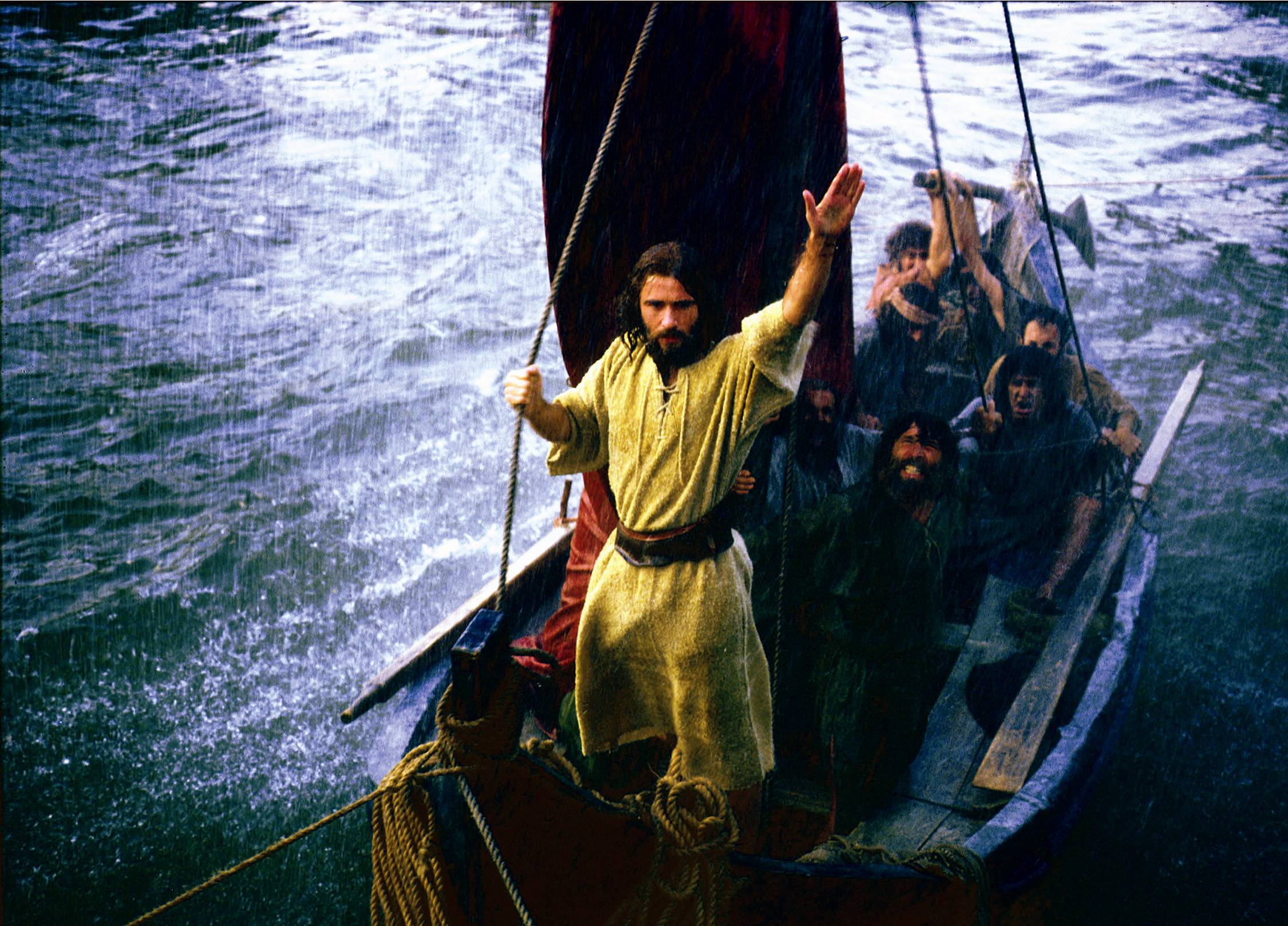
Yet there is ample evidence that Jesus is God. On one occasion, Jesus is portrayed as calming a storm, stretching out his hand over the troubled waters. “Peace, be still,” he said. “Who is this man?” his disciples asked in amazement. “Even the wind and the sea obey him” (Mark 4:41, NASB). A storm was a natural enough phenomenon, but what Jesus did wasn’t. What he did was supernatural, a word defined by the online Merriam-Webster Dictionary as “departing from what is usual or normal especially so as to appear to transcend the laws of nature.”

This is only one miraculous incident among dozens peppered throughout the New Testament Gospels of Matthew, Mark, Luke, and John. Jesus of Nazareth is presented as one who taught, forgave sin, who healed the lame, the deaf and the blind, who cast demons out of people, and who bent the laws of how things work in the universe, changing water into wine and multiplying fishes and loaves of bread to feed hungry people.

For the sake of argument, we could concur with our aforementioned anonymous member of the clergy that it is “hard to embrace” a  “supernatural Jesus” or a “magical God.” But if we were to concur, let us be clear that we would be parting company with the first Christian eyewitnesses. In fact, miracles played a key role in persuading them that Jesus was the long-awaited Anointed One of God, the Messiah, the Christ.

On the Day of Pentecost, Peter – a fisherman who had traveled with Jesus for three years – gave the first Christian sermon ever recorded. Here’s what he concluded in Acts 2:22 (NIV):

Fellow Israelites, listen to this: Jesus of Nazareth was a man accredited by God to you by miracles, wonders and signs, which God did among you through him, as you yourselves know.

Later, in v. 36, he adds: “Therefore let all Israel be assured of this: God has made this Jesus, whom you crucified, both Lord and Messiah” (NIV).

For Peter and the early Christians, miracles were spiritual credentials, a solid proof of divinity. For more on this, see also Hebrews 1, esp. the “powerful word” by which the Son of God “sustains all things” (v.3).

As the one who desires only our good, Jesus loves us unconditionally. Yet this love is not a weak love, a mere sentimentality. It is a robust love backed up by the ability to fend off those who would do his beloved harm. The love of Jesus is not only a holy love but a powerful love, and so we pray in the strong name of Jesus.

Jesus does not have a corner on the market when it comes to power. There are many powerful individuals in our world. Likewise, angels, the devil and demons occupy – to use the term of missionary anthropologist Paul Hiebert – an “excluded middle” or forgotten realm of beings created by God as part of the natural world, spiritual beings more powerful than humans but inferior to God. Though they are sometimes referred to as “supernatural,” it’s an unfortunate designation, dignifying them with a word that should be reserved only for God. (If the devil is called “supernatural,” then at least we must say that Jesus Christ is Supernatural, to designate his surpassing greatness). As the Second Person of the uncreated Triune God, there is no equivalence between his power and that of created beings. He is the ultimate authority before which all petty authorities must bow.

A memory from my youth illustrates the ultimate nature of this power. As a 13-year-old boy, I got caught up in the Citizen’s Band (CB) radio craze that swept the United States in the mid to late 70s. Saving up my money from the lawn mowing business my brothers and I ran, I finally had enough to buy the high powered “walkie talkie” I’d wanted. The problem was, the company that made it sold me a lemon. It was defective, so I took it back to the store and asked the salesman to trade it for a new one. He refused, but I didn’t give up. I asked to speak with the store manager, but he also refused. Frustrated, I talked with my dad about the problem. He suggested that I write to the President of the company, which I did. Two weeks letter, I received a typed letter from him, containing instructions for me to take the letter and to show it to the store manager. The letter – signed and sealed by the President – gave clear instructions for the store manager to replace my defective walkie talkie with a new, fully functioning unit. His power was ultimate, exceeding that of the store manager. An hour later, I had a new CB!

Imagine that the letter instead had said something like this: “Dear Mr Crofford, I’m very sorry for your problem, but there’s really nothing that I can do about it. I may be the President of this company, but each store manager can do what they want. My hands are tied.” How impressed would I have been with such a so-called “President” of that technology firm? Not at all! Instead, I would have probably called him a PINO – President-in-name-only, a fake President, a puny President, or something of the sort.

A Jesus who is only a natural Jesus and not a Supernatural Jesus wouldn’t be worthy of me addressing to him my prayers, any more than a powerless President of a company would be worthy of me addressing to him or her my letter of complaint. Why bother? This is the logic behind the observation from the author of the Epistle to the Hebrews:

And without faith it is impossible to please God, because anyone who comes to him must believe that he exists and that he rewards those who earnestly seek him (Hebrews 11:6, NIV).

Someone who “rewards” those who seek him is one who has the power to reward. When Jesus bade his disciples farewell before ascending to heaven, he made a sweeping claim:

All authority in heaven and on earth has been given to me. Therefore, God and make disciples of all nations… (Matthew 28:18-19, NIV).

Living as a missionary in Africa is a huge privilege. The faith of the church in Africa by-and-large is not philosophical or speculative. The hardscrabble nature of life in many parts of the continent makes Christian faith here very  practical. With that in mind, here’s what I responded on a forum to the paragraph from the anonymous member of the clergy quoted above, with his (apparently) non-supernatural Jesus:

His comment would be largely incomprehensible to 95% of our African Nazarenes. If Christianity is not supernatural, then what’s the point? Jesus is Christus Victor, the One who – in power unmatched by any other Being – has overcome sin, death, and the devil. Hebrews 2:14-15 is amazing, and strangely neglected:

“Therefore, since the children share in flesh and blood, he also shared the same things in the same way. He did this to destroy the one who has the power over death – the devil – by dying. He set free those who were held in slavery their entire lives by their fear of death.” – Common English Bible

Philip Jenkins has written about the “New Christendom” that has emerged in the Global South. While I definitely see some theological inaccuracy as well as excesses in the neo-Pentecostalism that is growing quickly in Africa and elsewhere – esp. the nature of tongues and the so-called prosperity gospel – the reason neo-Pentecostalism is so attractive is because it approximates the very nature of Christ’s powerful ministry on earth as displayed in the Gospels, addressing the full gamut of human need, including both physical and spiritual deliverance.

Any denomination that overtly or even quietly adopts an anti-supernatural way of thinking is a denomination that has written its own obituary. It has relegated itself to irrelevancy. As the French proverb puts it: “Le chien aboie, la caravane passe” – “The dog barks while the parade passes it by.”

Say what you might about our doctrine of entire sanctification, it reflects a supernaturalist worldview, for we believe that only an all-powerful, Triune God -as revealed in the Old and New Testaments – is capable of the greatest miracle of all, namely, transforming the human heart. Give me that kind of faith, and – as John Wesley said when he wished for 100 godly and fully-committed Methodists – we’ll storm the gates of Hell.

May God spare us from an anemic strain of faith. Give me a muscular, robust, Supernatural Jesus and not the watered-down soup being dished out in too many quarters these days.

———-

Image credit: simchaztv.com

Posted in reflections

When sin grows wings and claws

This leopard stopped long enough for me to take his picture at the Nairobi (Kenya) safari walk.

It’s a moving scene from the film, “Amazing Grace.” William Wilberforce is desperate to make the horror of the slave trade concrete for those who have the power to abolish it but remain unconvinced. So he hosts an outing for selected members of the aristocracy, a short boat tour up the river Thames. What they don’t know is his real motive. As violins play, the boat steers alongside the Madagascar, a filthy slave ship just returned from the West Indies. Dramatically, Wilberforce calls out from the deck of the putrid vessel, inviting the aristocrats to breathe in deeply, to take in the stench that is slavery. Instinctively, women cover their noses with their handkerchief, shielding themselves. “Take away that handkerchief!” Wilberforce commands. “Breathe in the foul smell of slavery.”

In recent days, there have been two moments when we – like those aristocratic women – were tempted to shield ourselves from the foul smell of twin evils. The first was the hidden-camera videos of Planned Parenthood officials discussing the sale of body parts harvested from abortions. Instinctively, media put up the “handkerchief” of diversion, focusing on other health services the group provides for the poor. “Don’t look at that, look over here instead!” was their plea. But it was too late. The public knows a putrid smell when it accosts our collective olfactory sense, and the damage was already done and will continue as more videos are released in coming weeks. Estimates are that 55 million unborn have been aborted since 1973, the year that Roe v. Wade legalized abortion in all 50 states. Some stenches are not easily covered up.

The second story that smelled foul was the baiting and slaying of Cecil, a majestic 13-year-old lion in Zimbabwe. Reports are that he was lured outside of the wildlife reserve where he lived by the use of a dead animal. Subsequently, he was skinned and his head severed. Whether laws were broken is still being determined, but the public is seething. Uproar continues as the media focuses on the story, and the American dentist who has admitted his involvement in the trophy hunt has gone into hiding.

As I look at the two stories, I’m reminded of a quote from Walter Rauschenbush in his 1917 A Theology for the Social Gospel:

When fed with money, sin grows wings and claws.

In both cases – the Planned Parenthood trading in body parts of aborted babies and the slaying of Cecil the lion – money has played a role. In a video featured at Breitbart.com, Dr. Mary Gatter, President of Planned Parenthood’s Medical Director’s Council, discusses the price of fetal parts. She later jokes about “wanting a Lamborghini” in exchange for body parts. Some have argued that the videos have been cleverly edited for effect, but this has not stopped promises by members of Congress to investigate. Likewise, reports are that the American dentist who shot Cecil with his bow and arrow paid $ 55,000.00 to local hunters to assist him in the hunt, this despite the fact that there are now only 34,000 lions left in the wild in Africa.

The Apostle Paul appears to be on the same page with Walter Rauschenbusch. Writing to his young protégé, Timothy, he observed:

For the love of money is a root of all kinds of evil. Some people, eager for money, have wandered from the faith and pierced themselves with many griefs (1 Timothy 6:19, NIV).

Admittedly, it’s hard to get past hand-wringing to workable solutions. As long as there is a financial incentive for selling parts of aborted babies, trafficking of this sort will continue. If convicted of having broken existing laws, Planned Parenthood should be fined massively so that any past profit will be mitigated. Closer regulation and monitoring should be put in place. Likewise, trophy hunting – to be curtailed – must take away the bragging rights of such hunters. The simplest way would be to deprive them of their trophy, and already Emirates Airlines has announced it will no longer transport trophy carcasses, with pressure mounting on other airlines to do the same.

The Psalmist affirms:

The LORD is good to all. He has compassion on all he has made (Psalm 145:9, NIV).

The love of money always has the tendency to undercut our compassion, whether toward human beings in utero or the rest of God’s good creation. We don’t need Lamborghinis and we don’t need animal trophies. Like Paul, let us be content if we have food and clothing (1 Timothy 6:8). In the end, the only answer to greed and the vices it spawns is not more laws but a willingness to celebrate what God has already given us, the daily bread for which Jesus taught us to pray (Matthew 6:11). Only contentment – as individuals and as peoples – can prevent our sin from growing wings and claws.

———

UPDATE: This article from Factcheck.org does a decent job of answering some of Planned Parenthood’s critics. It seems to me that any money given in exchange for fetal parts is too much. And – of course – it begs the question of what other abortion providers make profit from the trade, even if whether Planned Parenthood profits from this is still to be determined.

Posted in missions & evangelism, reflections

Trading in our goodbyes for hellos

goodbyeIt was December 5, 2005. Political storm clouds had been gathering for months, but on that day, the storm let loose. Word came from our superior that – due to insecurity in the country – we were to evacuate Haiti within 48 hours. Just one day before, we’d decorated the Christmas tree. Now, we quickly removed the ornaments, collapsing the tree and storing it in a closet. Hurriedly, we did laundry, packed our clothes, swept the house and headed to the airport.

So began an odyssey that took the four of us to Bethany, Oklahoma. Since that time, Bethany has been our psychological anchor, even if after three years there Amy and I physically returned to Africa, the continent of our earlier missionary service. One son already lives overseas, and the other will soon move to another state. Like a hot air balloon tethered to the ground, one-by-one, the slender ropes have once again been severed. The balloon is slowing rising again, this time to a new base back East with a sibling, a new driver’s license and address, a new touch-back point when we return from Africa briefly to the U.S. each year. Nine years after first coming to Oklahoma, it’s time for another goodbye.

Goodbyes were the stuff of life for Paul. In Acts 20:13-38, Paul was passing near Ephesus, his old pastorate where he’d spent three years pouring his life into new disciples. He was on his way to Jerusalem, so from Miletus he sent word to the elders in Ephesus to come to see him. After encouraging them to remain firm in the faith and warning them about dangers to the flock, Luke recounts the emotional scene:

When Paul had finished speaking, he knelt down with all of them and prayed. They all wept as they embraced him and kissed him. What grieved them most was his statement that they would never see his face again. Then they accompanied him to the ship (20:36-38, NIV).

As Paul lamented that he would be absent from the Ephesians, so today we lament absence. Despite gadgets that connect us across the miles in real time via the Internet, there’s no substitute for sitting in the same room with friends and loved ones. Through the prophets, God had sent revelation to his people – a kind of virtual contact – yet it was inferior to the incarnation, Jesus coming in the flesh. It is only in the flesh that we can place a reassuring hand on a shoulder, wipe a tear, or give someone a hug. When distance separates us, like Paul, we grieve the loss.

The French language is rich when it comes to saying goodbye. In the musical, “The Sound of Music,” the children perform a goodnight song for the gathered party goers. In a clever bi-lingual play on words, Lisel chants: “Adieu, adieu, to yuh and yuh and yuh.” The word “adieu” (literally, “to God”) is well-chosen since her family would soon be secretly crossing the Alps from Austria to the safety of war time neutral Switzerland. She had no expectation to see them again, so she commended them into God’s hands. Yet the more common way to say goodbye is “au revoir,” meaning “until the re-sighting,” or more informally, “see you later.” The Scottish tune “Auld Lang Syne” – commonly sung at New Year’s Eve parties – is a celebration of times gone by. The French keep the tune, but substitute words with another meaning: “Ce n’est qu’un au revoir, mes frères” (“This is only a ‘see you later,’ my brothers. “) It looks forward, not backward.

Christian faith also looks forward. However sad goodbyes might be, hope changes the equation. The same gloomy Paul of Acts 19 is cheerier elsewhere, reminding the Corinthians that we are resurrection people:

If only for this life we have hope in Christ, we are of all people most to be pitied (1 Corinthians 15:9, NIV).

To the Thessalonians, he paints a picture of Christ’s return when we shall be raised to new life (1 Thessalonians 4:13-18). We are to “comfort each other with these words” (v. 18), the promise that we shall “be with the Lord forever” (v. 17).

Former missionary Linda Seaman has said:

Heaven is where we’ll trade in all our goodbyes for hellos.

I’ve gotten better at saying goodbyes. When moving, it’s healthy to visit one last time places that hold good memories and to wish farewell to friends. I spent a lot of time this week doing just that. Some friends I won’t see again during this life, but we despair not. The Christian hope sustains us.

Saying goodbye to Bethany, Oklahoma – a safe harbor after a storm – won’t be my last goodbye. There will be other goodbyes made to other people and places on this earthly journey. I’m glad that – for the Jesus follower – the journey ends with  heavenly hellos. Don’t miss the reunion!

———-

Image credit: Luna Starla blog

Posted in reflections

A means of grace: a tribute to Dr Rob Staples

rob staples“Take a course from Dr Staples.”

Those six words jumped off the page, words penned by my former Eastern Nazarene College professor when I was a first-year student at Nazarene Theological Seminary. It was part of a thoughtful and pastoral reply to my anguished letter, wondering whether I should continue in my journey toward ordained Nazarene ministry.

First semester at Seminary had been brutal, capped off by a note scrawled on my research paper by a different well-intentioned but theologically brittle professor:

“Mr Crofford, if this is your continuing position, do not seek ordination in the Church of the Nazarene.”

The Lord must have known that such “hardening of the categories” called for an antidote. I enrolled in some of Staples’ courses and the good Doctor became part of God’s medicine.

NTS chapel services were always better attended on the days when Dr Staples preached. We could count on his lively sense of humor to add a light moment to our day. When a colleague took longer than usual to introduce him, piling up the plaudits, Staples at last made his way to the pulpit:

“With a introduction like that,” he quipped, “even I can’t wait to hear what I’m going to say.”

It will be shame if no one preserved his many limericks, humorously delivered before his sermon with a comic’s keen sense of timing.

Other funny moments were more spontaneous. Once in class, Dr Staples lost his train of thought, his brain stubbornly refusing to recall the name of the theological term that eluded him. “Oh no,” he lamented. “I think I might have what’s his name’s disease!”

Staples’ course, “Wesley’s Theology,” opened up a new world. My understanding of the doctrine of holiness to that time was based solely upon the American Holiness Movement interpretation with its strong accent upon a second, definite crisis experience. Dr Staples masterfully guided us through large swaths of Wesley’s writings; the takeaway for me was love. John Wesley taught that – as Jesus affirms in Mark 12:30-31 – holiness boils down to love for God and love for neighbor. Holiness suddenly was immensely practical and others-focused, a refreshing change from the self-centered nature of my prior understanding. Later when I pursued doctoral studies, it’s not surprising that I dug deeper into the theology of John and Charles Wesley. After all, it was Dr Staples who had sowed the seed years before.

All was not roses for the professor students loved. In class one day, he alluded to an episode from a few years earlier where powerful critics in the church questioned aspects of his theology, seeking his removal. Without tearing off the scab, he observed with just a hint of pain:

“I stood at the edge of my ecclesiastical grave and looked down into it.”

After a formal inquiry, he was vindicated, but the episode is a reminder that even professors of theology who are well-loved and loyal to the denomination risk becoming casualties when an unchecked “hardening of the categories” sets in. It was a vigorous defense of Staples by colleagues that saved him for the church. Happily, it meant that he was still there at NTS to teach me when my own time of theological fragility arrived, when I desperately craved not heavy-handed law but lighthearted grace. Indeed, Dr Staples’ wit and wisdom became for me a means of grace.

Dr Staples, thank you for staying the course. Well-done, good and faithful servant.

———

Photo credit: Greenlynn blog

Posted in reflections

Missing small

Medium2I’m missing small.

I first noticed it at a doughnut shop at the Ronald Reagan airport in D.C. then here at a mini-mart in Oklahoma. In both places, if you want coffee, you have two choices, medium or large.

Now, I’m no expert in logic, but doesn’t the word “medium” by definition mean in the middle? So, how can you have medium-sized unless you also have large and small?

Jesus had a soft spot in his heart for small. His disciples wanted to chase away little children, but Jesus scolded: “Let the little children come to me, and do not hinder them, for the kingdom of God belongs to such as these” (Matthew 19:14, NIV). That verse alone provides a pretty good argument for why the church baptizes people of all ages and sizes.

Sometimes small refers not to age but to the “vertically challenged.” Zaccheus climbed a sycamore tree to try to see Jesus, but the irony of the story is that the Lord ended up seeing him. When he did, he perceived not a reviled tax collector but a small man with big promise. When Zaccheus promised to make restitution for all he had stolen, Christ responded: “Today salvation has come to this house, because this man, too, is a son of Abraham” (Luke 19:9, NIV).

The most famous example of small in Christ’s teaching is the humble mustard seed. Just a speck of grain, yet it grows into a large tree, big enough so that birds can lodge in its branches (Matthew 13:31-32). Jesus used this as a parable of the Kingdom of God. Something may seem insignificant, unimportant, yet God can use it to make major, positive changes. Bi-vocational pastors of churches with just a handful of members should take heart. You don’t have to be a big church to count. Little churches – whether they meet in a church building or a home – can have an impact all out-of-proportion to their size. What counts is that they are filled with love for God and others, yet always inviting new people into the life-changing circle.

When it comes to coffee, I can deal with only medium or large, but when it comes to the Kingdom, let’s not forget small. No one is insignificant to God, and no service rendered is unimportant in the Lord’s sight.

Posted in reflections

Resurrection: Putting all our eggs in one basket

eggs-in-a-basketThe old proverb warns: “Don’t put all your eggs in one basket.” Mark Twain retorted: “Put all your eggs in one basket, then watch that basket.”

There’s no question that for followers of Christ, the basket has a label: RESURRECTION. But have we been watching that basket, keeping it strong, or allowing speculative, fanciful views about “Heaven” to weaken it?

Ancient Jewish views on life after death and resurrection

The first followers of Christ staked their lives on the claim that God had raised Jesus of Nazareth to life. But what was the context of that claim and what made it so extraordinary? As Jews, they had been brought up learning swaths of what Christians now call the Old Testament. Importantly, this part of our Bible gives little hope for life after death, wavering between death as either non-existence or (at most) a shadowy and undefined abode.

Job 14:1-14 (NIV) is a good summary of the non-existence view. In v. 14a, Job asked:

If someone dies, will they live again?

That the answer to Job’s question is “no” may be concluded from the preceding verses. There we read phrases like these:

“Mortals, born of woman, are of few days and full of trouble. They spring up like flowers and wither away; like fleeting shadows, they do not endure” (vv. 1-2).

“A man dies and is laid low; he breathes his last and is no more” (v. 10).

“As the water of a lake dries up or a riverbed becomes parched and dry, so he lies down and does not rise;
 till the heavens are no more, people will not awake or be roused from their sleep” (vv. 11-12).

King David models this hopelessness. In 2 Samuel 12:14, Nathan the prophet had announced that the child born of David’s illicit affair with Bathsheba would die. However, David attempted to change God’s mind by fasting and showing his repentance, lying on sackcloth for several nights. Seven days later, the child died. When David heard the news, he got up, washed and ate food. When asked about his sudden return to normal behavior, the King replied (vv. 22-23):

While the baby was alive, I fasted and wept because I thought, ‘Who knows? The LORD may be gracious to me and let him live.’ But now that he is dead, why should I fast? Can I bring him back again? I’ll go to him, but he will never return to me (HCSB).

When David said “I will go to him,” what did he mean? It is a simple acknowledgment that he, too, would one day die. As Ecclesiastes 3:2 teaches, there is a “time to be born, and a time to die.” The location where the dead reside is sheol, the grave, a place that the Psalmist – in a parallel phrase – compares to destruction:

“The cords of death encompassed me; the torrents of destruction assailed me;
the cords of Sheol entangled me; the snares of death confronted me” (Psalm 18:4-5, ESV).

At best, sheol is a place of shadowy existence. Isaiah 14:9-10 pictures the kings of the earth: “Sheol beneath is stirred up to meet you when you come; it rouses the shades to greet you, all who were leaders of the earth; it raises from their thrones all who were kings of the nations. All of them will answer and say to you:
‘You too have become as weak as we! You have become like us!’ (ESV).

While the majority report in the OT gives no promise of meaningful life after death, there is a minority report. One might think that the minority report would speak of disembodied souls surviving death, yet this is not the case. The Hebrew worldview can conceive of no meaningful life apart from the body. It is no surprise, then, that the minority report – Daniel 12:1-4 – frames hope in terms of renewed bodily existence:

At that time Michael, the great prince who protects your people, will arise. There will be a time of distress such as has not happened from the beginning of nations until then. But at that time your people—everyone whose name is found written in the book—will be delivered. Multitudes who sleep in the dust of the earth will awake: some to everlasting life, others to shame and everlasting contempt.  Those who are wise will shine like the brightness of the heavens, and those who lead many to righteousness, like the stars for ever and ever.  But you, Daniel, roll up and seal the words of the scroll until the time of the end. Many will go here and there to increase knowledge (NIV).

Jesus and Paul on resurrection

Fast forward several hundred years. In the time between the writing of the Old and New Testaments, the doctrine of the resurrection gained ground, so much so that we see the doctrine believed by some ordinary Jews in the Gospels. For example, when Jesus told the grieving Mary that her brother, Lazarus, will rise again, she replied: “I know he will rise again in the resurrection at the last day” (John 11:24, NIV). To this, Jesus answered (vv. 25-26):

I am the resurrection and the life. Whoever believes in me, though he die, yet shall he live, and everyone who lives and believes in me shall never die. Do you believe this? (ESV)

Note where Jesus lodged Mary’s hope. It was not in disembodied existence as a soul, but renewed bodily existence possible only through the resurrection power of God in Christ. He brought comfort not by saying: “Mary, don’t you know that Lazarus is in a better place right now?” Rather, he anchored Christian hope solidly in the resurrection.

Jesus was not alone in this approach. Paul taught the same thing in multiple passages, but the strongest is found in 1 Corinthians 15:12-14. To those who denied Christ’s resurrection, he replied:

Now if Christ is proclaimed as raised from the dead, how can some of you say that there is no resurrection of the dead? But if there is no resurrection of the dead, then not even Christ has been raised. And if Christ has not been raised, then our preaching is in vain and your faith is in vain (ESV).

The communion ritual has it right when the people respond: “Christ has died, Christ is risen, Christ will come again.” In that response, we direct people back to one of the main themes of the New Testament, the place where our hope for the next life is found, namely, the resurrection (John 5:28-29, 1 Thess. 4:13-18).

Challenges raised by the notion of disembodied existence after death

There are a few passages in the New Testament that suggest believers who have died have conscious existence now, awaiting the resurrection at the return of Christ. In Philippians 1:23, Paul talked of his desire to “depart and be with Christ”(NIV). Likewise, to be “away from the body” was for Paul to be “at-home with the Lord” (2 Corinthians 5:8, NIV). The problem with dwelling on these passages – and taking them to the next level by speculating, as books like Todd Burpo’s Heaven is for Real have done- is that they provoke a set of parallel questions about unbelievers. These include:

1) If believers are with Jesus, then where are unbelievers?

2) Do rewards and punishments begin immediately at death? If so, then what purpose does the final judgment (2 Corinthians 5:10, Revelation 11:15) serve if God at death has already passed out rewards and punishments?

3) If unbelievers are now in “torment” (as some interpret Luke 16:19-31 to teach), then in what sense can a disembodied, non-physical spirit suffer physical torture? How could flames harm a soul that has no more substance to it than steam that rises from a tea kettle?

Anyone who emphasizes what happens immediately after we die (continued existence of a soul) and not what happens when Jesus returns (bodily resurrection) will be forced to answer these questions in more detail.

Whispering and Shouting: Getting it backwards

The Old Testament writers were careful not to speculate unduly about the abode of the dead. In the same way, the New Testament gives very little information on where the righteous are prior to the resurrection at Christ’s return (1 Thess. 4:13-18) and less still about the current location of the wicked. Put in other terms, regarding the intermediate state – “life after death” – the New Testament only whispers, yet regarding the resurrection – what N.T. Wright calls “life AFTER life after death” – Scripture SHOUTS!

megaphoneBut what do we find today?

The problem with most current popular books about the next life is that writers have gotten it backwards, shouting where Scripture only whispers. What we end up with are books about Heaven based mostly upon individuals who claim to have left their body and gone to Heaven. How can such claims be verified? We’ve seen some unscrupulous individuals ready to sell their fabricated story to people anxious to know more than Scripture itself teaches, books like The Boy Who Came Back from Heaven, co-written by Kevin Melarky and his son, Alex. A decade later, Alex admitted that he had never gone to Heaven, that it was all made up. LifeWay books has since pulled all books from its stores that recount such stories.

Instead of speculating harmfully about where Scripture only whispers, isn’t it time that we get back to where Scripture shouts?

Pastoral practice at the time of grieving

Theory meets practice most directly at the funeral. Here, our theology must put its overalls on, ministering to families when they are grieving the loss of a loved one. Sometimes, people will ask: “Where is my loved one now?” Here are a few guidelines for those confronted with this heartfelt query:

1. If a deceased individual was a unbeliever, refuse to speculate on their current state. That is truly only known to God. Instead, we should emphasize that God is loving, merciful, and just. We can simply say what is true for everyone:

“They are in God’s hands, awaiting the resurrection.”

2. On the other hand, there are some who lived a righteous life and had a clear Christian testimony. Even there, let us not embellish what Scripture affirms. Do not speculate about activities in Heaven that require a body by saying things like “Uncle Harry is teeing off on Heaven’s 18th hole” or “I’m sure Grandma is having a good time baking cookies with Aunt Sally.” Such comments cheapen the resurrection, weakening the “basket” in which Christianity has confidently put all of its “eggs.” Also, avoid speaking of the resurrection in present terms. The resurrection is still future, happening at the return of Christ, so to attribute bodily activities now to those who have not yet received a resurrected body is confusing. Even if human beings have souls that outlive bodies – and some Christians teach otherwise – at very least, we should not go beyond what the New Testament allows us to say, simply affirming instead:

“They are now with Jesus.”

Thoughts upon a massacre

Last week in Garissa, Kenya, 150 university students were slaughtered by terrorists, many of the victims Christians, some who were in the chapel praying when the shooting broke out. The resurrection of Christ, on the third day after Jesus was unjustly stripped, whipped, and nailed to a shameful cross, tells us:

Evil will not have the last word.

Followers of Christ who died that day in Kenya are now with their Master, but most importantly, the One who made them will one day re-create them! Jesus has risen, and so we shall rise at his return when the Lord inaugurates his kingdom, a new heaven and a new earth.

In the face of unthinkable actions by evildoers, this is not the time to soft-pedal the resurrection. It is the basket where we have placed every last egg. Instead, let us keep the basket strong, affirming once again the timeless words of the Apostles’ Creed: “I believe in the resurrection of the body and the life everlasting. AMEN.”

———————————-

FOR FURTHER STUDY: See Pastor Matt O’Reilly’s video at Seed Bed, sponsored by Asbury Theological Seminary. Also, I highly recommend N.T. Wright’s Surprised by Hope: Rethinking Heaven, the Resurrection, and the Mission of the Church (HarperCollins, 2008).

———————————

Image credits:

Eggs and basket – Pengjoon.com

Megaphone – Wattpad.com

Posted in reflections

Barnabas, the man with the yellow cap

yellow_capEdward de Bono has written about six thinking hats. In Bono’s analysis, for efficient and productive meetings, the leader (the “blue hat”) must encourage a mix of contributions from the others:

white hat: seeks facts, data

red hat: senses the emotion involved

green hat: contributes new ideas and perspectives; creative

black hat: sees the potential pitfalls and dangers of a idea; pessimistic

yellow hat: highlights the possibilities in proposals and people; optimistic

My adulthood has been a quest to toss away my black cap and doff a yellow one.

People who wear yellow hats are sunny, bright, optimistic. Those words hardly described me in high school, where my black cap was firmly in-place, so much that my 10th grade American History teacher – word-playing on my name, Gregory – called me “drudgery.” In retrospect, he did me a favor, sowing a seed that later produced a desire to change, to let God’s grace change me.

Emphatically, I reject the determinism of our day. Are temperaments immutable, “once a black hat, always a black hat”? Followers of Christ committed to a Wesleyan-Arminian theology should know better. We believe like John Wesley (1703-91) that God graciously enables individuals to choose. Therefore, whatever my innate inclinations or childhood conditioning toward pessimism, I have a choice. For my part, I’ve consciously decided to belt out Annie’s “The sun will come out tomorrow” ten times for every one time I (might) listen to Gary Jules’  “Mad World.” Black cap? Been there, done that. With the Holy Spirit’s help, every day, I’ll choose the yellow one instead.

Barnabas, the son of encouragement

Part of wearing a yellow cap is a firm resolve to encourage rather than discourage others, and no Bible character modeled yellow-hat-living better than Barnabas, the “son of encouragement” (Acts 4:36). When the believers in Jerusalem were rightfully wary of Christian-persecuting Saul’s “conversion,” it was Barnabas who convinced the church to accept him as a genuine brother – Paul, no longer Saul – transformed by the grace of God (Acts 9:27). Later, when John Mark disappointed Paul and Barnabas by abandoning them on the first missionary journey, Barnabas stood staunchly by the youthful John Mark, setting out with him as a new duo. Why? Paul – once burned, twice shy – refused to allow John Mark to journey with them the second time around (Acts 15:37-41). It was providential that yellow-hatted Barnabas was there for John Mark at a very fragile moment. Today, many consider Barnabas’ protegé the author of the Gospel of Mark. Even Paul eventually had a change of heart, asking Timothy to bring John Mark with him, because “he is helpful to me in my ministry” (2 Timothy 4:11).

Encouragers do not live in denial, as if evil and suffering don’t exist. Rather, because they know all too well that these results of the Fall are rampant, yellow-capped disciples of Christ purposefully lean into optimism, underscoring the possibilities of the grace of God to redeem both individuals and communities.

It wasn’t just the church of the first century that needed encouragers.  The people of God in every age must have a healthy number of them for its own equilibrium and flourishing. But I wonder:

When it comes to the church and her prospects today, where have all the yellow hats gone? Like honey bees, are they mysteriously dying off?

Judging by what I read on the internet, there must have been a sale on black caps. Lots of people – especially bloggers – are busy lamenting the church’s decline, writing her obituary, as if the church can do nothing right. You’ve seen the posts: “10 blunders that…” and “5 mistakes that…”  As one who has worn the black cap too often myself, I realize the danger of that kind of unchecked pessimism. Black-hatters, I challenge you:

Come with me on my quest for the yellow hat.

There is a place for caution. The church cannot do without some black hats, but does she now have too many? More than ever, the church needs upbeat people like Barnabas, sons and daughters of encouragement. You know you want to sport that yellow cap! It’s stylish and comfortable. Enough already with the over-the-top negativity. Together, let’s make the choice – by God’s grace – to be possibility thinkers.

———-

Image credits:

yellow cap: Augustcaps.com

Barnabas: The Faith Pal

Posted in reflections

Heaven: Starting the song all over again

trumpetMr. Taylor was my first band conductor.

Conducting a 4th grade band takes a special kind of patience. Every child is new at his or her instrument, be it the flute, clarinet, trumpet, trombone, drums, or a dozen other things that make noise. And let’s face it, for 4th graders, about all we could was make noise. Like my brothers before me, I played the trumpet, or at least I tried.

Our first concert came at Christmas time. By then, all of us had a grand total of 3 months of experience, practicing twice per week in the band room. Parents and siblings gathered in the cafeteria and waited for us to file in. At last, all of us were in our seats and Mr. Taylor stepped up to the small platform, took his conductor’s baton, and raised his arms. We all snapped to attention and raised our instruments, ready to play.

I’m not sure what happened, but only about half of us began playing when his arms came down, signalling the start of the song. Were some still trying to spot where their families sat in the audience? Maybe others were still adjusting their music on the stand or simply daydreaming, but whatever the reason, it was a poor start.

Mr. Taylor then did something that surprised us. He suddenly stopped directing the song, tapping his baton several times on the music stand. We all ground to a halt, not knowing what to make of it all. Slowly, he turned around and addressed the audience:

“Ladies and gentlemen, we’ve had a very poor start to the song. Please forgive us. We can do better. Now, we are going to start all over again.”

And that is exactly what we did. I’m glad to report that the second time went much better, and when we were done, the audience applauded with gusto.

That’s what Heaven will be like. Heaven is New Creation. Heaven is God starting the song all over again.

The first time through, the song has been marred by sin, off-key. God knows we all can do better. One day, he will tap his baton on the music stand and we will all begin again.

John described it this way: :

Then I saw “a new heaven and a new earth,” for the first heaven and the first earth had passed away, and there was no longer any sea. I saw the Holy City, the new Jerusalem, coming down out of heaven from God, prepared as a bride beautifully dressed for her husband. And I heard a loud voice from the throne saying, “Look! God’s dwelling place is now among the people, and he will dwell with them. They will be his people, and God himself will be with them and be their God. ‘He will wipe every tear from their eyes. There will be no more death’ or mourning or crying or pain, for the old order of things has passed away” (Revelation 21:1-4).

More and more of those who have played their instruments with me in the band are now silent, awaiting that second chance to perform. On that day, the band will once again assemble. All who have played before us will be present, gloriously resurrected by the Lord in new, durable bodies. What a grand reunion that will be as Jesus raises the baton and we start the song all over again!

How about you? Will you be in the band? This life is only the poor beginning to the song, but a new, better beginning is coming. Don’t miss out on it. Keep your instrument in-tune. What a performance that will be!