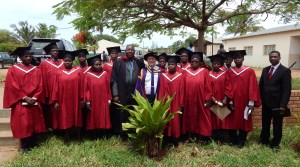
I was honored to deliver this address to the graduates of Nazarene Theological College (South Africa) on April 23, 2016 and the graduates of Nazarene Theological College of Central Africa (Lilongwe, Malawi) on May 7, 2016.
———————————–
WE ARE GATHERED TODAY in this place for a celebration. During these moments together, we pause to thank the Triune God – Father, Son, and Holy Spirit – for his grace upon the lives of these graduates. In one way, today marks an ending, the finish line for a race that these women and men have been running, some for as long as the past 3 years. Graduates, as you cross that finish line this morning, I add my voice to the chorus of voices and say: “Congratulations! Well-done.”
Yet if today is an ending, in another more important way, it is also a beginning, or – to use the traditional word for a graduation ceremony – a commencement. It is the start of the rest of your life as those who seek to be ordained ministers, leading the flock of God in one capacity or another. At such a high and holy moment, what would our Lord Jesus, the great Shepherd of the sheep, be pleased for us to consider?
Because this is a graduation address and not a sermon, I will not take a single biblical text and expound it. That is an essential skill for a preacher and one that your teachers have taught you well. But like a preacher often does, allow me to give you a Trinity of ideas, 3 words of advice as you either launch out in ministry or else continue in that path:
By Petey21 (Own work) [Public domain], via Wikimedia Commons
“WORK WITH THE END IN MIND”
Rev. 2:18-29
I. INTRODUCTION
Eric, a first year college student, moved into the dormitory. Once he had arranged his things inside his room, he cut a large golden letter “V” out of paper and posted it on his door. Others often would ask what the “V” meant, but Eric never would say. When his friends went out to party, he instead spent long hours in the library. He made friends for sure, but he kept his priorities straight. The four years passed quickly, and graduation day came. The Vice Chancellor of the school introduced him as the valedictorian. Eric came to the podium, then opened up his folder. Carefully, he took out what was inside. With a huge smile on his face, he held it up a large golden “V” as his classmates burst into applause.
Eric is a good example of what Steven Covey, the leadership guru, identified as one of the 7 Habits of Highly Effective People. Here it is: WORK WITH THE END IN MIND. And that’s exactly how our passage today is structured. Revelation 2:26-29 is a description of the golden letter “V,” a picture of the conqueror, the overcomer, the victor. God desires a wonderful outcome for each of us and in Jesus’ words to the church in Thyatira we find solid advice on how best to work with the end (or the goal) in mind. Allow me to paraphrase that advice as follows:
Celebrate and keep doing what is working well.
Avoid pitfalls.
Persevere!
II. CELEBRATE AND KEEP DOING WHAT IS WORKING WELL
In Rev. 2:18, the Son of God, Christ himself – whose eyes are like blazing fire and whose feet like burnished bronze – congratulates the church in Thyatira.
That’s a lesson in and of itself. It seems like if you steal something or shoot somebody, you get mentioned in the news. How often, though, do we as a church celebrate the achievements of our own people? Maybe one of our children won a dance contest. Celebrate it! Or perhaps one of our brothers got a promotion at work. Can we celebrate that? There are dozens of good things, wholesome achievements that fly under the radar. Maybe we don’t know about them, or maybe we do, but do we praise God for what he is allowing us to achieve both as a church and as individuals in the church?
Jesus says in verse 19: “I know your deeds, your love and faith, your service and perseverance, and that you are now doing more than you did at first.” Those are high words of praise! Who at the end of their life when the believers gather for the funeral would not want that kind of praise?
“Sister so-and-so was loving and faithful.”
“Brother so-and-so served us well and didn’t quit.”
In the same way, take inventory of your life. What are you doing well? Are you a good provider, showing up at work on-time and giving your best to your employer? Then you need to tell your spouse: “Good job! Keep up the good work.” Maybe your children used to leave their toys lying around the house, to the point where they were a hazard. But now, they’re doing better. Or maybe last term they had a “D” on their report card but this time they raised it to be “B.” That’s worth celebrating. Perhaps someone at school said a very hurtful thing to your daughter, but instead of getting bitter, she prayed and God helped her forgive them. Parents, take a minute to celebrate your daughter’s forgiving heart. It will serve them well throughout life.
It’s important to identify what we’re doing well. Several times, I’ve taught a course on preaching. One student would preach and the others would have a handout where they could write comments. After the sermon, no matter how poor, we would always before suggesting improvements take time to affirm the things the preacher had done right. Perhaps they had lots of zeal when preaching. We affirmed that. Or maybe the volume was plenty high so that everyone could clearly hear what was being said. We affirmed that, too. It was important that we sincerely praised what was worthy of praise.
God looks at you, my brother, my sister, and God sees lots to praise. You are making spiritual progress! Celebrate that in yourself and celebrate that in others.
Here’s a graduation address that I gave on October 21, 2012 to Liberian pastors receiving their Diploma in Theology from Nazarene Theological Institute.
————-
“Running Well” (1 Cor. 9:24-27)
Introduction
To the graduates of the NTI-Liberia class of 2012, families, friends, honored guests:
The Bible talks about the Christian life using several images. It speaks of birth and growth. At other times, it says we are buildings under construction. But the image that has always fired my imagination is running.
From one race to another
The Apostle Paul in 1 Cor. 9:24-27 (NIV) likewise draws lessons from sports. He encourages us:
Do you not know that in a race all the runners run, but only one gets the prize? Run in such a way as to get the prize. Everyone who competes in the games goes into strict training. They do it to get a crown that will not last, but we do it to get a crown that will last forever. Therefore I do not run like someone running aimlessly; I do not fight like a boxer beating the air. No, I strike a blow to my body and make it my slave so that after I have preached to others, I myself will not be disqualified for the prize.
Today, the day of your graduation from the Nazarene Theological Institute of Liberia, marks the end of a race. You have completed an academic race, a race that when you began you thought would be a 5k but it turned out to be much longer! You have crossed the finish line, and everyone here today pauses with you to reflect on your achievement. To you we say with sincerity and good cheer: WELL DONE!
Yet we are here today for another reason. We, your family, friends, colleagues, and members of the larger Liberian community, have gathered not only to congratulate you, but to cheer you on. For we know that while one race has finished, another race continues, and that is the race we are all running, the race of Christian faith. And for you, those called to full-time Christian ministry, there is the race of vocational service to Christ, his church, and the world.
In that race, you as graduates of NTI are pacesetters. You are leaders to whom not only the church but the nation looks for inspiration. To you, in both your relationship with Christ and in ministry, I say this afternoon: RUN WELL.
Let us look together in more detail at 1 Corinthians 9. Thankfully, not only does it say “run well” but it gives concrete advice on how to do so.
Give the race your very best, together.
Avoid disqualification.
Remember the crown.
Give the race your very best, together.
Paul commands: “Run in such a way as to get the prize.” The Greek plural imperative indicates that Paul is not talking to one person, but to a group. He’s saying: “Run this race together.”
I was never an accomplished runner, but two years of high school cross-country taught me many things. My second year of running, we got a new coach. He didn’t just tell us to run; he strapped on his running shoes and led the way!
One day, he taught us what he called “Indian running.” All ten of us ran in single file. Each hundred meters or so, coach would yell “next runner!” The runner at the back of the line would have to speed up and pass all the others, taking his place at the front. Coach would refuse to let anyone else slow down so that the new runner could more easily get to the front of the line. Instead, he’d yell: “Come on, Crofford, you can do it!” And when I made it, he’d yell: “Good job!” Soon, we all understood and yelled out encouragement to each other, just like the coach had yelled out encouragement to us.
And so I ask our graduates: Are you running alone in ministry? If so, it’s time we did some Indian running. It’s time we encouraged each other.
John Wesley, our spiritual grandfather, understood this well. He grouped Methodists together in classes and bands. He knew that for us to give the race our best, we need each other. And so the movement that he and his brother, Charles, started eventually came to be called the Methodist connexion.
Own work, CC BY-SA 4.0, https://commons.wikimedia.org/w/index.php?curid=44533966We are connected. In this connection we call the Church of the Nazarene, we strive to run the race the very best we can, and to do so, we stay connected. We run together.
Graduates, turn to the graduate on your left. Say these words:
“Brother, I promise to stay connected.”
Now, turn to the graduate on your right. Say these words:
“Brother, I promise to stay connected.”
As a young pastor, I was brand new in ministry. I had so much to learn! Thankfully, I wasn’t alone. Once per month, I met the four other pastors on the zone and we ate lunch together. Those were times when we could share our victories and our struggles. What precious times those were!
Connection can even happen on the Internet. On FaceBook, a former student of mine invited me to join a closed ministry support group. One of the members posted this the other day: “Please pray for me. I’m struggling. This is a season of temptation for me.” Within 10 minutes, two other brothers in ministry had responded. “Here’s my phone number,” one of them wrote. “Call me, brother, and we can talk. I’m here to help you through your struggle.”
However you do it, don’t run alone. Give the race your very best, together.
Avoid disqualification
His name was Taoufik Makloufi. On August 6, 2012, at the London Olympic games, a race referee disqualified him during the first lap of the 800m race. What was his offense? Makloufi had already qualified for another event in which he was better, the 1500m, an event in which he was expected to win a medal. By not trying in the 800, event, Makloufi hoped to save his energy for the 1500m. The end result was that officials kicked him out of the Olympics and he never got to run his preferred event.
It’s a tragedy when someone is disqualified. Paul himself – though a great Apostle – guarded against this possibility. In verse 27, he says that he “beat his body” to “make it my slave.” Why did he do this? The verse continues: “…so that after I have preached to others, I myself might not be disqualified for the prize.”
A Chinese proverb says: “You can’t stop the birds from flying around your head but you can stop them from nesting in your hair.” There is not a person in this room who is exempt from weakness. The devil knows your weakness. The question is: Do you?
What is your plan of action when your day of temptation comes? And it will come. The saying is still true: “Those who fail to plan, plan to fail.”
Paul says to us today:
Give the race your very best, together.
Avoid disqualification.
Finally, he exhorts us:
Remember the crown.
Verse 25 of our text reminds us: “Everyone who competes in the games goes into strict training. They do it to get a crown that will not last, but we do it to get a crown that will last forever.”
Stephen Covey was best known for his book, The 7 Habits of Highly Effective People. The second habit is this: “Begin with the end in mind.”
The Apostle Paul said the same thing: Remember the end; remember the objective. Remember the crown.
It seems like those who run shorter distances get more attention. We hear about Jamaica’s Usain Bolt, champion of the 100m and 200m distance. Many even know about Kenya’s David Rudisha, gold medalist in the 800m run in London. Fewer know the names of champion marathoners, names like Tiki Gelana, the female gold medal winner from Ethiopia.
Yet ministry in the church is more like a marathon than a 100m dash. To make it through this race, women and men of God, we have to remember the finish line. We have to remember the crown.
Chris shows off his medal received for finishing the Marine Corps marathon, October 2014My nephew, Chris, this year successfully completed all 26+ miles of his third Chicago marathon. Here’s what he wrote about the experience:
While running my 3rd Chicago marathon today, I started thinking about the psyche of the ‘casual’ marathon runner such as myself…1) Starting line: Ecstatic! 2) 13.1 miles: confident. 3) 16 miles: Worried – ‘Really, I have 10 more miles!’4) 20 miles: Self pity – ‘This is painfully horrible! Why did I sign up for this thing again!’and 5) 26.2 miles – Ecstatic! ‘I can’t believe I made it through!’
Best time yet. Looking forward to next year.
Though my nephew didn’t say anything about it, I also know that his wife, Erin, and his two young daughters were waiting for him at the finish line with a warm embrace. I know because Erin posted up a photo of Chris and the whole family after he had finished. Chris didn’t set any records, but he finished, and for him that day, his wife and daughters were his “crown.”
I suspect that there will be moments in your ministry – if you haven’t had them already – when you will have the same self-pity Chris did after 20 miles. After a sermon that you thought was excellent flops, when criticism from someone in the church stings, when you see your family on the edge of poverty and the devil mocks you by saying how stupid you are and how much richer you could be if only you’d do something else rather than pastor –
Like Chris at mile 20, you may think:
This is horrible! Why did I sign up for this again?
When that moment comes, as it surely will, I say to you this afternoon:
Keep running! Remember the finish line. Remember the crown.
You’ll probably never receive here on earth the recognition that you deserve. But Paul says: There is a different crown, a crown that lasts forever. Recognition in this life is fleeting; the reward of heaven is eternal.
CONCLUSION
And so graduates of the NTI-Liberia, you have come at last to the end of a race, an academic race, a Diploma in Theology. As Director of the NTI, I wish you my hearty congratulations for a job well-done. We honor you today on the occasion of this tremendous achievement. Yet if one race is over, other races continue. For each of us here today, there is the race of the Christian life, but for you, the graduates, there is the ongoing race of full-time ministry in service to Christ, his church, and your world. In that race, give it your very best, not alone, but together. In that race, at all costs, avoid disqualification, and in that race, remember the crown.
Here’s the sermon I preached last Sunday at the Regents Park Church of the Nazarene (Johannesburg, RSA). In some ways, love is both the easiest topic to preach on and the most difficult. I’m preaching to myself as much as anyone else.
————
“What’s love got to do with it?”
Text: 1 John 4:16-21
Intro
The word “love” is one of the most powerful words in any language. When we think about music, there’s a whole category of songs that we call “love songs”. So many different lyrics from different songs could be recited, but for some reason what came to mind was Tina Turner’s 1984 hit, “What’s Love Got to Do with It?” The words ask:
What’s love got to do, got to do with it
What’s love but a second hand emotion
What’s love got to do, got to do with it
Who needs a heart when a heart can be broken
Now it would be quite a meeting if Tina Turner met the Apostle John, the disciple of Jesus who wrote our Scripture reading today. What would someone from the 1st century have to say to someone from the 21st? What would they talk about? What would they possibly have in common? Yet they have more in common than you might think at first glance. May I suggest that the entire book of 1 John is in fact an extended reply to the question: “What’s love got to do with it?” And the simple answer is: Love has everything to do with it when it comes to our Christian faith. Sure, it’s not the romantic love spoken about by Tina Turner, but it is a deeper love, a more lasting love, a love that brothers and sisters in Christ have for each other – or at least should have – because of our Lord.
Transition and sermon plan
Today, we’ve only read a few verses from the letter. I’d encourage you to take the time later today to read all of 1 John. It’s short, so it shouldn’t take you too long. If you read it all, you’ll see that a single theme is woven through the book like a golden strand. How can we summarize that theme? Here it is: “If you say you love God, then prove it by loving others.” It’s pretty simple, really. But since we don’t have time to see the whole forest, let’s sharpen our focus and at least examine a few of the trees in that forest. The three “trees” are really three short sentences:
On November 28, 2015, fourteen students graduated from the Seminário Nazareno em Moçambique, located in Maputo. These were my brief remarks to them on that joyous occasion.
—————
Rev. Aderito Ferreira, Field Strategy Coordinator, Rev. Adolfo Tembe, Principal of the Seminário, Rev José Moiane, Chair of the Board of Trustees, district superintendents, pastors, graduates, students, family members, honored guests, all protocols observed –
We gather here today because of God – Father, Son, and Holy Spirit. As the Apostle Paul said: “In God, we live, and move, and have our being.” No matter what else is said today, may this be clear: We honor and glorify the LORD. To God be the glory, great things He has done.
But we especially pause to thank God for you, the graduates of the Class of 2015. There are other places where you could have been today, other professional schools from which you could be graduating. However, you chose the Seminário Nazareno em Moçambique. Why? You came here in obedience to God, because God called you. You spent three years pursuing your diploma not because it was something you thought it would be nice to do. Rather, because of your calling from God, it was something that you knew you must do. Like Paul, you have said: “Woe is me if I preach not the Gospel!”
Earlier from Rev. Ferreira, we heard of the importance of preaching. Allow me to add to what he said so well. According to Scripture and according to the Manual of the Church of the Nazarene, another important task of the pastor besides preaching and loving the flock is to administer the sacraments. Some years ago, I was teaching a course in theology to Nazarene student pastors in West Africa. The Lord’s Supper was our topic. One student shared that in his country there were those who believed that every time a person who is “unworthy” receives the Lord’s Supper, the bread will stay lodged in the stomach until finally – when one has taken it “unworthily” too much – the stomach will be blocked and the person will die.
I’m glad that is not our belief or practice in the Church of the Nazarene. We don’t believe that taking communion should be a scary thing. Rather, it is a joyous celebration, a “means of grace,” an important way that we strengthen our faith. As pastors, I encourage you to celebrate the Lord’s Supper often with your people and also to frequently practice baptism.
Today is a day of joy. I believe that God wants to use you in amazing ways! Good things are before you. Times of fulfillment and joy in the service of the Lord await you. Think big; dream bold dreams, God-given visions, then, in the power of the Holy Spirit, make those dreams a reality. When we speak of entire sanctification, we often quote 1 Thessalonians 5:24 – “Faithful is he who called you, who also will do it.” May I suggest that this verse can also apply to your ministry in general? The one who called you is faithful and will empower you to minister.
Graduates, you made it! Well-done. Now go, preach the word, love the flock the Lord has entrusted to you, administer the sacraments, fulfill your God-given calling. We promise to encourage you as you remain faithful.
On Saturday September 26, 2015, I was honored to preach at the Bridge Church of the Nazarene in Lubumbashi, Democratic Republic of the Congo (DRC). It capped off a week of teaching. Here is a rough transcript of the sermon, which was well-received by all.
—————
“Calming the Storm”
Mark 4:35-41
INTRODUCTION
Some years ago when serving as a missionary in Haiti, I visited the island of La Gonave with Sadrack Nelson, my assistant. For a week, we taught a course, much like the course we’ve enjoyed together this week. When the course was finished, we said our goodbyes and – early in the morning – headed to the dock to catch a boat back across the water to Port-au-Prince. We paid our passage on one of the speedboats, and sat on board waiting for the other passengers to arrive. On the side of the boat, a small metal plaque read: “15 passengers maximum.” I counted as more and more passengers paid their fare and climbed aboard…12, 13, 17, 21, 24…Counting the captain, we numbered 26. I began to pray.
That morning, the water was very rough. This didn’t slow down the captain, who opened the throttle to maximum. The waves tossed the boat back and forth as all of us were deluged with the spray. At more than one point, I wondered – like the disciples crossing the sea of Galilee in the storm – whether we would capsize. Finally, I called out to the captain: “With the rough seas, shouldn’t we go slower?” To this he replied, “God is with us.” I couldn’t help but respond with the words of Jesus in Matthew 4: “You shall not test the Lord your God!”
I. LET’S CROSS TO THE OTHER SIDE (v. 35)
In Mark 4, we find the story of another time when waters were rough and people feared they would drown. But before we get to that part of the story, let’s back up just a bit. Earlier in the chapter, Jesus had been teaching the people about the Kingdom of God, telling them various parables. But now in v. 35, when the evening had come, he said to his disciples: “Let us go over to the other side.”
Why would Jesus say this? Were there not many people already where they were who needed to know about Jesus? Did they also not need more teaching? Surely, they did, yet the Lord realized that on the other side of the lake, others waited who needed his help, in this case, a man from the Gerasenes who was demon possessed (Mark 5:1-20). Jesus is always lifting our eyes to those who have not yet heard.
I can identify with Jesus’ words, “Let us go over to the other side.” It reminds us of how God lead me and my family from Côte d’Ivoire to Benin. I had been serving for more than 3 years as Director of the Nazarene Bible Institute in Abidjan. Amy had her ministry, and our sons were doing well in their primary school. Little did we know that God was about to send us somewhere else.
One day at the office, I heard the fax machine begin churning out a fax. It was sent by our missionary in Ghana, and was a copy of an article. Beninese President Matthew Kérékou has spoken to a conference of missionaries held in Johannesburg. At the end of his speech, he made a plea:
Come to Benin. Help me lay a Christian foundation for my nation.
It was an amazing story, and I wondered aloud: “I wonder who God will send? ” Later at home, I showed my wife, Amy, a copy of the fax. She reminded me of a conversation from two weeks earlier, when our field director had mentioned Benin as one of the countries that we still needed to enter. The Lord had spoken to Amy’s heart that night, but now the fax seemed like a confirmation. “Could it be that God is calling us to go to Benin?” she asked. I ruled it out, but she encouraged me to join her in prayer on the matter.
A few days later, I was listening to a song in my car, on the way to the office. It was Philips, Craig and Dean’s “I am crucified with Christ.” The lyrics follow the words of Galatians 2:20:
I am crucified with Christ, and yet I live
Not I, but Christ who lives within me.
The cross will never ask for more than I can give
For it’s by his strength I live.
There’s no greater sacrifice…
I am crucified with Christ, and yet I live.
After listening to the song, it seemed that the Lord spoke to my heart:
And what about you, Greg? Are you crucified with me? Are you still on the cross? Will you do what I’m asking you to do? Will you go to Benin?
Arriving at the office, I parked the car and climbed the stairs. I was the first one on team to arrive that morning, and I locked the door behind me. Down on my knees, I told the Lord all the reasons why we weren’t the ones to go. “I”m a theological educator,” I said, “not a church planter.” When all my excuses were done, I pleaded: “God, I can’t do this.” The Lord answered: “You’re right. You can’t, but I can, and I’ll go with you.”
That day I gave in to the Lord. Nearly 1 year later, God had put all the pieces together for us to move to Benin. It’s amazing to see how that time of just 4 1/2 years in Benin, of laying a foundation, has lead to things that surpass what we could have imagined, good things, God things. Through the sacrifice of many Beninese and the moving of the Holy Spirit, we now have more than 100 churches and more than 15,000 Nazarenes in Benin. To God be the glory!
And what of you? The Church of the Nazarene in the DRC is mostly in three cities, namely, Goma, Lubumbashi and Kinshasa. Could it be that Jesus is also saying to the Church of the Nazarene in the DRC: “Let us go over to the other side”? Church, so many more need the message of holiness! Are we willing to do what God is calling the church to do, to go to those who have not heard? I can promise you: God will reward our obedience to Him.
II. THE WAVES BROKE OVER THE BOAT (v. 37)
When we respond to Jesus’ call to cross over to the other side, we shouldn’t be naive. He has not promised that things will be easy. They climbed into the boat, and before long, v. 37 tells us that a furious squall came up. The result? The “waves broke over the boat.”
In December 1999, just 11 months after arrival, it seemed like our boat would sink. One after another, we fell ill with malaria. First was me, then Amy, followed by John. Only Brad was spared that month. While in the clinic receiving treatment, they discovered a mass in Amy’s lower abdomen. The doctor recommended that she fly back to the U.S. where she could receive further testing. So, Amy headed to her parents in New York State while I stayed behind and did the single dad routine. The night before her surgery, Amy called to say that the test that is 98% accurate showed cancer. We prayed over the phone, then I called others to pray. The next day, the surgery went well, and – praise the Lord – the mass was benign!
My brother and sisters, my story is hardly unique. So many of you have known such times of trial. God has never promised that things will be easy. In fact, when we are obedient to the Lord and launch out in new ways, rest assured that things will get tough. Expect it. I Peter 4:12-13 (NIV) advises:
Dear friends, do not be surprised at the painful trial you are suffering, as though something strange were happening to you. But rejoice that you participate in the sufferings of Christ, so that you may be overjoyed when his glory is revealed.
Yet despite the difficult times, I’m glad to know the story doesn’t end there.
III. JESUS IS STILL IN THE BOAT
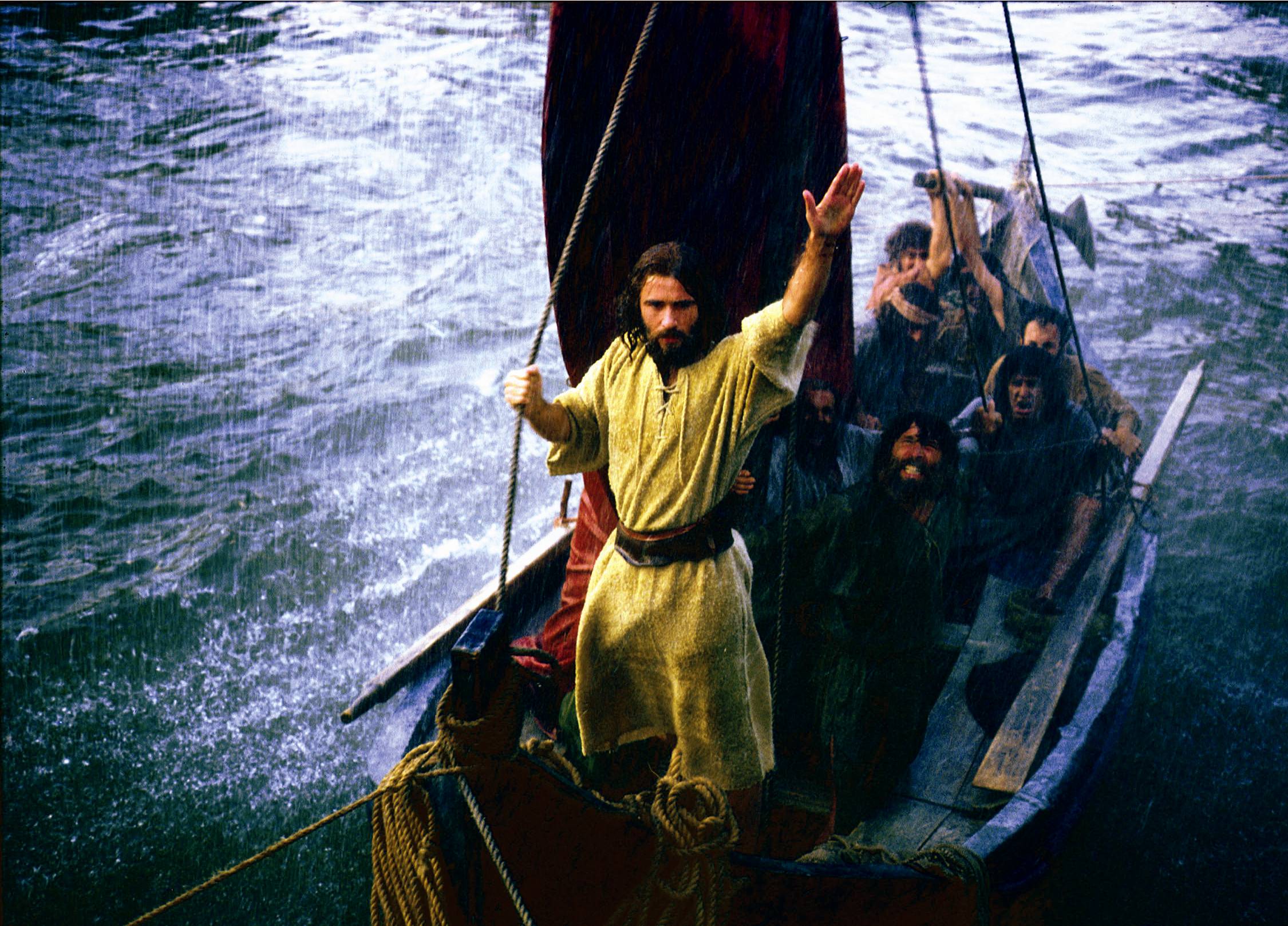
The disciples were afraid they would drown. But one thing reassured them: Jesus was still in the boat! They woke him up, and cried out: “Teacher, don’t you care if we drown?” (v. 38). Then Jesus stood up and told the wind to be quiet. Verse 39 tells us: “Then the wind died down and it was completely calm.” Turning to his disciples, he asked: “Why are you so afraid? Do you still have no faith?” (v. 40).
I don’t know where you are living right now. Maybe you wonder how you will pay your children’s school fees, or perhaps you’ve been looking for work for a long time, yet nothing materializes. Or it may be a health matter, or you wonder how you will get the rent for this month. There are times when we say to the Lord: “Don’t you care if we drown?” At times like this, let us not forget: Jesus is still in the boat! He cares, and he will help us.
In John 16:33, on the night of his arrest, Jesus comforted his disciples: “In this world you will have trouble.” Aren’t you glad the verse doesn’t end there? It continues: “But take heart! For I have overcome the world.”
What waves are crashing over the side of your boat? Call out to Jesus! He loves you, and he will calm the storm.
IV. CONCLUSION
The story of Jesus and his disciples on the sea of Galilee holds many lessons for us. He told his disciples: “Let’s cross to the other side.” How about you? In what ways does God want to stretch you, to use you to reach those who still don’t know about Jesus or the message of holiness? Will we be obedient to the call? Be assured, it won’t be easy. In fact, it will be very difficult to obey, and you may even fear for your life as the waves comes crashing in over the sides. But take courage! Jesus will never leave you. He will never forsake you. Jesus is still in the boat, and he will see you through.
I preached this sermon Sunday morning December 28 (2014) at the Maraisburg (South Africa) Church of the Nazarene.
———
TEXT: Luke 2:1-20 (Common English Bible)
I. INTRODUCTION
Have you heard the expression “familiarity breeds contempt”? The saying means that we no longer value what we think we know very well. Luke 2:1-20 may be one of those passages where we think we’ve “been there, done that.” As a boy, I recall on Christmas morning seeing the presents under the tree and wanting to open them up right away. But first we had to eat breakfast (so Mom insisted), then our tradition dictated that my Dad read Luke 2:1-20, the Christmas story, and that we pray before any gifts were exchanged.
And so even now as an adult, I must concentrate on what God is trying to say in this passage. It’s not “Let’s hurry up and get this over so we can get to the good stuff, the presents.” Rather, I understand that the best gift is hidden right here in the Bible passage. So let’s talk this morning about three lessons from the story of Jesus’ birth.
II. FIRST LESSON: GOD DELIGHTS IN SIMPLE PEOPLE WHO LOVE HIM.
The first lesson is this: God delights in simple people who love Him.
Remember Mary? She was a simple maiden living in Nazareth, an out-of-the-way town in an out-of-the-way corner of the Roman Empire. Most experts think she was only 14 or 15 years old, too young to have had sexual contact within her strict Jewish setting. Yet in Luke 1:38, once she has heard the news from the angel telling her that she had been chosen to carry the Christ child, her simple love for God shines through in her response:
I am the Lord’s servant. Let it be with me just as you have said.
Or how about Joseph? Matthew 1:18-24 shows a man ready to break off his engagement with Mary. Why? Because she is pregnant and Joseph knows the child is not his. How many of us men would be willing to accept the angel’s explanation in a dream, that the child was conceived by the Holy Spirit? We have no recorded verbal response from Joseph, but the simplicity of his faith is proven by his actions. Matthew 1:24 says: “When Joseph woke up, he did just as an angel from God commanded and took Mary as his wife.”
Mary and Joseph, Joseph and Mary – together, they teach us a lesson: God delights in simple people who love Him. And what about us? Loving God does not exclude the educated or the wealthy, but it also embraces simple folks from humble circumstances. If God could use two humble individuals like Mary and Joseph, surely he can use people like you and people like me. The only question is: Are we available?
III. SECOND LESSON: BIG THINGS OFTEN START SMALL.
Yet not only do we learn that God delights in simple people that love Him. There is a second lesson tucked away in this story: Big things often start small.
Sometimes we see this in the corporate world. Steve Jobs began a company in 1976 out of the garage of his parents’ home in Los Altos, California. You may recognize the name of the company he founded: Apple Computers. In 2013, the value of Apple’s outstanding shares was $ 460 billion USD.
But if big things often start small in the business world, this is equally true when it comes to the Story of God. When Joseph and Mary laid the baby Jesus in an animal feed trough in the tiny village of Bethlehem, little could they fathom what a difference this child would make. In 2,000 years, the message preached by Jesus now echoes around the world, with as of 2010 more than 2 billion Christians living in virtually every country on Earth. Big things often start small.
I wonder: In 2015, is there something small but important that God wants you to do? Perhaps this is the year that you will discover your purpose. Don’t say: “No, it can’t be that. That’s unimportant.” God has a way of taking seemingly small things and using them in big ways. Just make sure it’s for God’s glory and not yours.
IV. THIRD LESSON: WHEN GOD SAYS OBEY, DO IT QUICKLY.
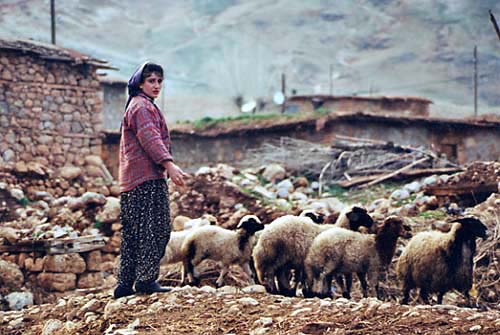
A Turkish shepherdess
There’s a third lesson for us today from the story of Jesus’ birth. This lesson comes from the shepherds, that group of men (possible even some women included) who were watching their sheep at night. Luke tells us that the angels gave an impromptu concert of praise, announcing the birth of Jesus. I love the shepherds’ response once the angels were gone: Verse 15 – “Let’s go right now to Bethlehem and see what’s happened.” Lesson? When God says obey, do it quickly. The command was implied in the words of the angel, in v. 12:
“This is a sign for you: you will find a newborn baby wrapped snugly and lying in a manger…”
It’s fun to think about the excuses the shepherds could have used. They could have said:
– “We can’t leave these sheep here. Someone else will have to find the Christ child.”
– “Don’t those angels know that Bethlehem is quite a walk from here? It’s the middle of the night. Let’s get some shut-eye.”
– “They said we’d find the baby, but they didn’t specify tonight. We can always go tomorrow.”
But the shepherds didn’t find ways to wiggle out of their duty. They went right away, so right away they found Joseph and Mary and the baby lying in the manger. Because they obeyed God’s instructions right away, they received the blessing of their obedience right away. Verse 20:
“The shepherds returned home, glorifying and praising God for all they had heard and seen. Everything happened just as they had been told.”
And what about you and me? What has God been telling us to do but we have been stalling? Obedience delayed has another name: disobedience. Let us not miss out on God’s blessing. When God says obey, let’s do it quickly.
V. CONCLUSION
Every Christmas present has been unwrapped. The Christmas tree and decorations will soon be stored away, yet three lessons remain from the story of Jesus’ birth. First, God delights in simple people who love Him. Secondly, big things often start small. Thirdly, when God says obey, do it quickly.
Benediction – Jude 24
“To the one who is able to protect you from falling, and to present you blameless and rejoicing before his glorious presence, to the only God our savior, through Jesus Christ our Lord, belong glory, majesty, power and authority, before all time, now and forever. AMEN.”
SANU Chancellor Dr Loren Gresham was with us for the 5th graduation ceremony.
I was honored to offer this prayer of dedication for the graduating class:
Triune God, Father, Son, and Holy Spirit –
You have promised in your Word that you will never leave us, you will never forsake us. Today, we stand in testimony that your promise is true. You knew each graduate when they were but a child of promise as you knit them together in their mother’s womb. From their earliest days, through primary and high school, and now to this day of academic victory at Southern Africa Nazarene University, through it all, Lord, you have been with them, and we give you praise and heartfelt thanks.
We know, Father, that in the darkest moments of human history, your solution to problems has always been people. When men and women had gone astray, you sent prophets to guide them back to yourself. When it seemed like the forces of darkness would overwhelm all that you had created, you sent your Son, the light of the world, born of a virgin, to crush the serpent’s head.
So today, Holy Spirit, we reaffirm our part in that great struggle, confident that greater is the One who is in us than the one who is in the world. We consecrate to you these graduates of Southern Africa Nazarene University who now take up the fight against disease through the healing arts, against ignorance through the classroom, and against sin and evil through the church’s loving message of transformation for individuals, communities and nations. We send them forth today into a Cause greater than themselves, knowing that their Savior and Sanctifier – the one who stayed with them this far – is not about to abandon them now.
As they go forth, we offer this earnest prayer for their safe-keeping. Guard them in moments of temptation from selfish choices that promise much but deliver only broken relationships and self-hatred. Encourage graduates, Lord, when they refuse moral compromise and end up paying the price. Remind them of the lessons that they have learned from faculty and staff in this University, that if one must choose, it is far better to forfeit this world’s applause than to forfeit one’s integrity.
Today, we pray for their joy and prosperity. God of flourishing, may these graduates know abundance in every way – abundant life in Christ, joy and laughter in their homes, food on their tables, a spirit so overflowing with your love that nothing but kind words and blessings will be on their lips for brothers and sisters less fortunate than themselves. We pray that lips which bless sincerely may be accompanied by hands that give generously.
We pray, oh Lord, for their relationship with you, that it will grow deep and wide. May you fill them with all the fullness of God and the peace that comes through a heart surrendered to the sweet control of the Holy Spirit. When times of trouble and sorrow come, as they surely must, wrap your arms of love around them and be their comfort.
Further, we dedicate them to service in your Body, the Church. Whether vocational or lay ministers, may they find a place of labor and meaningful contribution in your Church. Make of each one a positive example to younger ones in the community of faith who look up to them and will pattern their own behavior on theirs.
Thank you, Jesus, for the sacrificial way in which mothers, fathers, uncles, aunts, brothers and sisters, grandmothers and grandfathers have supported our graduates. May you bless them today. Give them the satisfaction of knowing that today, they are rightfully proud of their graduate.
Finally, heavenly Father, I leave our graduates in your hands. Guide them and spur them on to excellence in their respective fields, that when their time comes one day to meet you face-to-face, they will leave this nation, this continent, and this Earth a better place than they found it, a little more like God’s Kingdom, the Kingdom that we still pray will come. I pray not only that they will be Christlike disciples. I pray that you will make them Christlike disciples who change the world.
We give you thanks, O Triune God, for each graduate and leave them now in your tender care. For it is in the name of our Lord and Savior Jesus Christ that we offer this prayer,
This is the sermon I preached yesterday at the installation of Rev Alolfo Tembe as the new Principal of the Seminário Nazareno em Moçambique in Maputo, Mozambique.
Unless otherwise noted, all Scripture passages are from the Common English Bible (2011).
————-
SCRIPTURE READING: 2 Kings 23:24-25
“Josiah burned those who consulted dead spirits and the mediums, the household gods and the worthless idols – all the monstrous things that were seen in the land of Judah and in Jerusalem. In this way Josiah fulfilled the words of the Instruction written in the scroll that the priest Hilkiah found in the LORD’s temple. There’s never been a king like Josiah, whether before or after him, who turned to the LORD with all his heart, all his being, and all his strength, in agreement with everything in the Instruction from Moses.”
— PRAYER —
I. INTRODUCTION
We are a holiness church. What does that mean? It means that we are called to be the righteous people of God, set apart for God’s sacred use. We understand that 1 Peter 1:16 – “Be holy, because I, the LORD your God am holy” – is not a command for the distant future. It is God’s expectation of us right now.
Yet for the disciple of Jesus, both saved and entirely sanctified, it is not enough to point to 2 experiences in the past, no matter how meaningful and wonderful those experiences may have been. We must constantly present ourselves before God. Like the Psalmist, we must pray:
Yesterday, 19 April 2014, I was honored to preach at Maraisburg Church of the Nazarene (Florida, South Africa), our home church here in Africa. There is always a “pre-game excitement” for me when I get to share from the Scriptures. Here is my sermon.
——————–
“Can any good come out of Dark Saturday?”
Matthew 27:62-66
I. INTRODUCTION
Throughout the world this week, all those who bear the name of Christ have been commemorating the final, climactic week in the life of Jesus of Nazareth. “Nazareth” – It was Jesus’ home town. People would say: “Can good anything good come out of Nazareth?” And for 3 years, Jesus had shown them – in teaching, miracles, and by loving – exactly what good could come out of that backwater.
And now Jesus lay cold in the tomb. Just yesterday, Friday, they had crucified their Lord, yet Sunday has not yet dawned. It is Saturday, the time in-between. The Church calls this day Holy Saturday, or sometimes Black Saturday. I will call it dark Saturday. I wonder: “Can any good come out of Dark Saturday?”
Tonight, let’s look at three lessons from the darkness.
II. DARKNESS COMES TO ALL OF US AT SOME POINT ON THE JOURNEY.
A few weeks ago, Amy and I were driving home through heavy rain. Eventually, the rain lightened and the sun came out. On the horizon appeared a beautiful rainbow, brilliant with many colors. As much as we would like for life to be only rainbows, rainbows only come after a storm. Jesus said to his disciples in John 16:33: “In this world you will have trouble.” But preacher, aren’t you going to complete the verse? You’re right. The verse continues: “But be of good cheer. I have overcome the world.” Sometimes we are in a rush to get to the second half, the overcoming part. Yet on Dark Saturday, in this fallen world, we acknowledge that the first part of the verse – the trouble part – lingers for far too many. How will we come alongside those who in the dark and help them overcome?
Jesus gave us a model of how we as his followers can enter dark places and bring the light of Christ. George F. MacLeod commented:
I argue that the Cross be raised again at the center of the market place as well as the steeple of the Church. I am recovering the claim that Jesus was not crucified in a Cathedral between two candles, but on a cross between two thieves; on the town garbage heap; on a crossroads so diverse that they had to write his title in Hebrew, Latin, and Greek; at the kind of place where cynics talk smut, thieves curse, and soldiers gamble. Because that is where he died and that is what he died about. And that is where the Church should be and what the Church should be about.
I wonder: Do you see anyone sitting in a dark place? Their dreams have been shattered, financially, through divorce, through joblessness, through the death of a loved one? You do not have to convince them that it’s not so bad. Denial is more than a river in Egypt! As the people of God, we are not about denial. No, darkness is bad. Yet in that dark place, we can bring the light of Christ. Will we?
III. WHILE WE’RE IN THE DARK, BE AWARE OF THE DEVIL’S PLOTS.
Scripture tells us very little about Dark Saturday. There’s no record of where Peter is, or James, or John, or the other disciples. Judas had hung himself. It’s fascinating that the only ones doing anything we know about on that in-between day are the bad guys! Matthew 27:62-66, the passage we read, talks of Pilate, the Pharisees, and the soldiers. They are active on Dark Saturday, and what are they up to? They place a seal on the tomb, assigning guards, in short, making sure that Jesus stays dead!
It reminds me of cockroaches. They are certainly not my favorite insect. When you turn on the light, they run for the shadows. In fact, cockroaches are most active in the dark. They prefer it.
In the same way, times of death and suffering are when the Devil, like a cockroach, is busy. And for the believer, dark times are especially vulnerable times. When things are dark, the Devil plants seeds of doubt. He comes to whisper in our ear: “Where is God now?” Or maybe: “Looks like you were a fool to follow Jesus.” And what we must consider right now before the Dark Saturdays of our lives is how we will answer this question:
“Will I let this make me bitter or better?”
And so Matthew’s Gospel forewarns us that in the darkness, the Devil is always active. There are only two outcomes possible. Either we will let tough times destroy our faith or we will hold tighter to God’s hand and let him use the tough times to make our faith stronger.
IV. NEVER FORGET IN THE DARKNESS WHAT YOU LEARNED IN THE LIGHT
So far we have seen that there are dark times that come to everyone at some point on the journey. It is our duty and joy to come alongside each other and bring the light of Christ. We also were reminded that the Devil will use the Dark Saturdays of our lives to try to distract us from God’s way, so we must be on the alert. Finally, Holy Saturday teaches us to never forget in the darkness what we learned in the light.
In Acts 16, Paul and Silas were walking along when a slave girl with a spirit by which she foretold the future began to pester them. Day after day, she would cry out: “These men are servants of the most high God who are telling you the way to be saved.” Finally, Paul had had enough of this mockery, and cast the demon out of her. The girl’s owner was angry, since the slave girl could no longer tell the future. His source of money was gone, so he complained to the magistrates and had Paul and Silas thrown into jail. Verse 25 tells us:
“Around midnight Paul & Silas were praying and singing hymns to God, and the other prisoners were listening to them.”
Amazing! Paul and Silas could have been bitter. They could have said: “Lord, we’ve been working hard for you, and what do we get in return, a cold jail cell?” Yet instead they chose to praise God for his faithfulness, even in that low, dark moment. They didn’t deny the darkness. Instead, they overcame it with praise. And what’s especially interesting is the second half of verse 25. They earned an audience. People listened.
Sometimes we think that our best testimony is when we say: “Look at my new car. Isn’t God good?” Or: “God blessed me with a new job.” I’m not saying we shouldn’t thank God for His blessings. Surely we should, but could it be that the world most wants to know how the people of God handle adversity? And for that reason, let us never forget in the darkness what we learned in the light. God is faithful. He has not abandoned us. He knows what is going on. Trust Him.
V. CONCLUSION
This sermon is but a chapter in the story. To find out the ending, come at 6 a.m. tomorrow. But lest we flip to the back of the novel too quickly to see how the story ends, let us take our time and on this Dark Saturday, let God make it for us a Holy Saturday, something that God can set apart for our good. Let us remember:
1) Darkness comes to all of us at some point on the journey. Don’t let your brother or sister go through darkness alone. Be the Christ light for them.
2) The Devil is especially active during the dark moments of our lives. Be warned that he will do all he can to turn you away from God’s path. Decide now before the Dark Saturdays come to not become bitter, but to let God make you better.
3) Finally, let us never forget in the darkness what we learned in the light. God is faithful, and He will never leave us and never forsake us.
 I was honored to deliver this address to the graduates of Nazarene Theological College (South Africa) on April 23, 2016 and the graduates of Nazarene Theological College of Central Africa (Lilongwe, Malawi) on May 7, 2016.
![By Petey21 (Own work) [Public domain], via Wikimedia Commons](https://gregorycrofford.com/wp-content/uploads/2016/05/512px-athletics_tracks_finish_line.jpg?w=300&h=225)







 Gregory Crofford