Posted in missions & evangelism, sermons & addresses

Come, Thou Long Expected Jesus: An Advent Homily (Luke 2:22-38)

Charles Wesley (1707-88), penned the moving words to "Come, Thou long expected Jesus"
Charles Wesley (1707-88), penned the moving words to “Come, Thou Long Expected Jesus”

Note to the reader: I preached this homily at the Maraisburg Church of the Nazarene yesterday (15 December 2013) near Johannesburg, South Africa. We celebrated worship on the same morning that the nation buried former President Nelson Mandela, following a week of memorial services and loving remembrances.

—————————–

SCRIPTURE READING: Luke 2:25-38 (CEB)

I. INTRODUCTION

Have you ever waited so long for something that you wondered if it would ever come about?

Perhaps some of you are now past the average marriage age, and you wonder if you will ever find “the one.” Or in a tough economy with high unemployment, you’ve been searching for a good job for what seems like forever.

It’s Christmas time, and with Christmas childhood memories flood back. One year, my grandma sent a big box in the mail several weeks before Christmas Day. We opened it up, and inside were many packages carefully wrapped, one for each of us in the family. Dad put the gifts under the tree, and of course my brothers and I did what children do. When our parents weren’t looking, we’d pick up our present, shake it to see what noise it made, anything to help guess what was inside.

It seemed like we waited so long for Christmas Day! Finally, the wait got the best of us. Very early on Christmas morning when Dad and Mom were still asleep, I heard noise coming from the living room. Quietly, I made my way down the staircase, and found my two older brothers shining flashlights around the room! Of course, I opened mine up, too, and joined in the fun. Then, we carefully wrapped them up again and put them under the tree. The next morning, when it came time to open presents, we opened the gift from grandma. “Oh look! A flashlight!” we said, pretending like we hadn’t seen it before. It was hard to wait all the way to Christmas.

II.  ISRAEL’S LONG WAIT: BACKGROUND TO LUKE 2:22-38

Whether it’s waiting for marriage, employment, or just opening up a Christmas present, one thing is sure: Waiting can be tough. That was certainly the case for Israel. There was about a 400 year silence between the close of the Old Testament and the opening of the New Testament. Malachi was the last Jewish prophet upon whom the spirit of prophecy had rested, and he wrote around 350 b.c. In those closing words of the Old Covenant, Malachi 4:5 spoke of Elijah the prophet coming “before the great and terrible day of the LORD” (CEB). Luke clearly considered John the Baptist an Elijah-like figure. In Luke 1:44, we even have the story of Mary visiting Elizabeth, her cousin. Both women were expecting babies, and the yet-to-be-born John leaps for joy when he hears the voice of Mary.

And now after this long silence, the spirit of prophecy is back in full force. The Holy Spirit is speaking again, and this time it’s to an old priest, Simeon, and to an old prophetess, Anna. The Spirit says to them that the long wait is almost over. Look at Luke 2:26:

The Holy Spirit revealed to him that he wouldn’t die before he had seen the Lord’s Christ.

The term “Christ” comes from the Greek word, Christos. It means the “anointed One.” In Hebrew, the equivalent term is maschiach, the Messiah. Simeon and Anna were about to see the Saviour for whom they had waited so long!

Continue reading “Come, Thou Long Expected Jesus: An Advent Homily (Luke 2:22-38)”

Posted in sermons & addresses

The Optimism of Grace: An Address to the 2013 Graduates of the SNM

DSCN1087
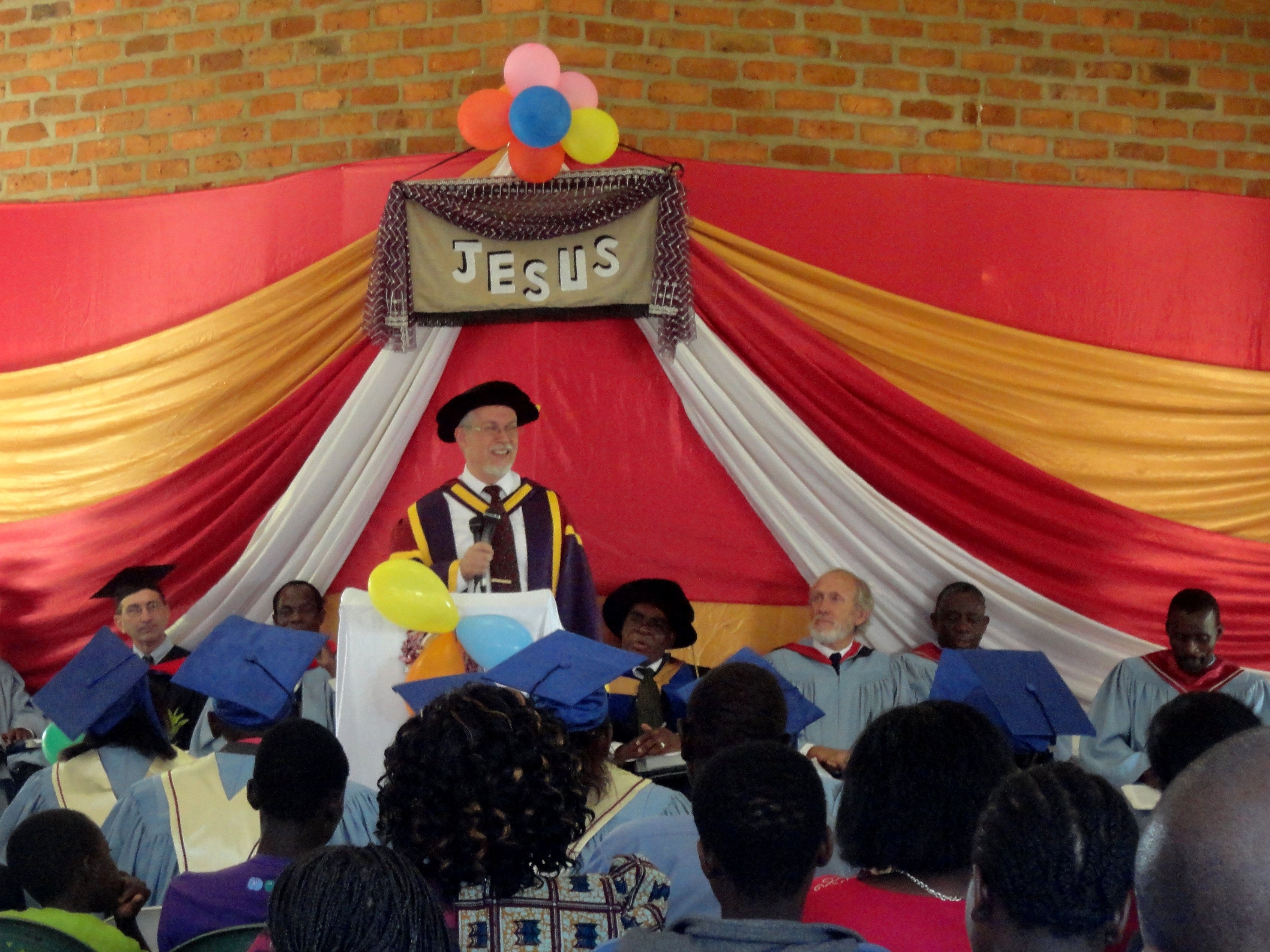
Dr Dave Restrick, former Academic Dean of the SNM, interpreted into Portuguese.

Seminário Nazareno em Moçambique

30 November 2013

Opening remarks

Rev Margarida Langa, Rev José Moiane, members of the Board of Trustees, members of the administration and faculty, District Superintendents, Pastors, members of the Class of 2013, distinguished parents, friends and guests, all protocols observed –

It is my honor today to greet you in the strong name of Jesus Christ, our Lord and Saviour. I am also happy to bring you greetings from Dr Filimao Chambo, Regional Director of the Church of the Nazarene, Africa Region.

We come together on this grand occasion to honor the hard work of our graduates. Our congratulations go to them and to their families. Graduates, you have persisted through a rigorous course of study. Despite temptations to quit, despite moments of discouragement, you stayed in the race. Today, you cross the finish line, and we salute you.

I.  Introduction: The Optimism of Grace

You are heading into a lifetime of professional ministry. Even as you officially launch into that sacred vocation, storm clouds are gathering. Jesus said in Matthew 24 that we will hear of wars and rumors of wars, and today we hear war drums in Mozambique that beat ever more loudly. At such a time when fear threatens to paralyze us, what word of comfort would God have His children hear?

The shadow of the cross fell ever more darkly across the little band of disciples gathered in the Upper Room. According to John 14:27, Jesus comforted his disciples: “Peace I leave with you; my peace I give you. I do not give to you as the world gives. Do not let your hearts be troubled and do not be afraid” (NIV).

Today, instead of sipping from the poisonous cup of fear, let us drink deeply from the cup of Christian faith. As followers of Christ who belong to the Nazarene family, we know that the holiness message we preach is the hope for Mozambique, for Africa, and for the world. What is this message? It is the optimism of grace. Let us reflect this morning on that optimistic grace in three commands:

 1) Let God’s grace transform you.

2) Let God’s grace transform the church.

3) Let God’s grace transform society.

Continue reading “The Optimism of Grace: An Address to the 2013 Graduates of the SNM”

Posted in ecclesiology & sacraments, sermons & addresses

Paul’s 3 secrets for church unity and growth

These rice harvesters outside Antananarivo model good teamwork.
These rice harvesters outside Antananarivo (Madagascar) model good teamwork.

In two weeks, members of the Maraisburg Church of the Nazarene will vote on a new pastor. Here is the sermon I was honored to preach there this morning, in slightly modified form.
————————
SCRIPTURE READING: Ephesians 4:1-16 (Common English Bible)

I.  INTRODUCTION

There’s something about the word “secret” that draws attention. Marketers know this. Take KFC for example. They draw us in with talk of the Colonel’s “secret recipe” made from 11 tasty herbs and spices. Or what about the website, WebMD? A recent article spoke about “10 Diet secrets for lasting weight loss success.”

If a marketer had been assigned to the Apostle Paul, what might she have labelled Ephesians 4:1-16? Perhaps she would have spoken of “Paul’s 3 secrets for church unity and growth.” And here they are:

1) Keep the focus on Christ.

2) Find your niche and fill it.

3) Above all, let us love one another.

II. KEEP THE FOCUS ON CHRIST

When you read Ephesians 4:1-16, there’s no question about who the star of the show is. It’s Christ!

v. 1 – Paul was a prisoner for whom? The Lord Jesus Christ

v. 7 – our gifting is from Christ

vv. 9-10 – It is Christ who descended to earth and who ascended to Heaven

v. 12 – We are the body of Christ.

v. 13 – As his body, we are striving for the standard of the fullness of Christ.

v. 15 – We are to “grow in every way into Christ.”

Theologians like fancy words. They would say that our faith must be Christocentric. In other words, Jesus must be at the center.

By no means do I agree with all that the Roman Catholic Church teaches. However, one of things that I really like is the sanctuary. When I go into a Catholic church, very often there is a cross at the front, in the center, a cross depicting the crucified Christ. The old hymn says it well:

Since my eyes were fixed on Jesus

I’ve lost sight of all besides.

So enchained my spirit’s vision

Looking at the crucified.

It is far too easy for us as the church to be distracted by minor things and turn our gaze from Christ. We are tempted to put our eyes on minor things:

Why did our pastor not do that? Isn’t that her job?

Why would sister so-and-so say such a thing?

Why was the music too loud this morning? Why was it too soft?

And when we start down that negative path, our eyes are diverted from the One who brings us together and the One in whom we find our unity! I’m glad that I’m part of a denomination that has chosen to put Jesus in our name. We are the Church of the Nazarene. Who is the Nazarene? The Nazarene is Jesus Christ.

Yet what kind of a Christ do we preach? We preach a Christ who reaches out to the marginalized, the forgotten of our society. Because Jesus loves people, he is never content to leave us where we are. Rather, Jesus is all about setting us on a new path. We serve Christus Victor, the Christ who is victorious over the unholy Trinity of sin, death, and the devil. Because Jesus loves us so much, he can never be satisfied to leave us mired in our sin.

As the Church of the Nazarene, we’ve understood that historically. For example, in Kansas City, Missouri, in the early decades of the 20th century, we started a rescue mission for alcoholics, and to this day the churches of the Kansas City area support that rescue mission, loving the poor and homeless, many of whom are caught in the trap of substance abuse.

But who are the other marginalized people of our day, right here in South Africa? If someone stood up among us and admitted that he’s addicted to drugs, asking for God’s help and ours, would we not help him? Yet I wonder what our reaction would be if someone stood up in church and admitted being attracted to the same sex, then asked for God’s help and ours? Would we distance ourselves and reply: “No, there’s nothing to be done for that one”? Would we not welcome them with outstretched arms?

And so we keep Christ the Saviour, the one victorious over sin, death, and the devil, at the center of all we do. It is this Jesus that will draw people to himself and to his church.

Continue reading “Paul’s 3 secrets for church unity and growth”

Posted in sermons & addresses

Hate sin and love God by loving others – 1 John 3:7-18

The chapel of NTCCA was full as Greg addressed graduates, their families, and friends
The chapel of NTCCA was full as Dr. Crofford addressed graduates, their families, and friends

Note: This is the graduation address I presented at the commencement exercises of Nazarene Theological College of Central Africa (Lilongwe, Malawi) on 4 May 2013.

Scripture reading: 1 John 3:7-18

Text: 1 John 3:8b – “God Son appeared for this purpose, to destroy the works of the devil” (Common English Bible).

——————————-

“Hate sin and love God (by loving others)”

I.  INTRODUCTION

(salutation and all protocols observed)

We are gathered together today to honor the achievement of the graduates of Nazarene Theological College of Central Africa, both campus and extension students. You have persisted through many hours, days, and months of study, and all for one reason: To better equip yourself for the ministry to which our Lord Jesus Christ has called you in his church. Today, we pause on this auspicious occasion to say two words: Well done!

Many of you have already been involved in ministry in the local church. Some of you will be taking the role of pastor for the first time. At such a moment, what words of wisdom does the Bible have for you?

We have heard the Scripture reading from 1 John 3:7-18. In the passage, two commands repeat themselves:

1) hate sin;

2) love God, by loving others.

Continue reading “Hate sin and love God by loving others – 1 John 3:7-18”

Posted in sermons & addresses

Well-done, good and faithful servant!

Grace Ncube, Chair, Board of Trustees, awards Diploma in Theology to graduate Lindley April
Mrs. Grace Ncube, Chair, Board of Trustees, awards Diploma in Theology to graduate Lindley April as I look on.

Today was a tremendous day at Nazarene Theological College as 7 received their Diploma in Theology and 12 were awarded the Bachelor of Theology. Here is the address that I delivered to the graduates.

– Greg

“Well-done, good and faithful servant”

An address on the occasion of the 22nd Annual Commencement Exercises

Nazarene Theological College

Muldersdrift, South Africa

Gregory Crofford, Ph.D. — Regional Education Coordinator

March 16, 2013

Dr. Filimao Chambo (in absentia), Rev. Collin Elliott (in absentia), Rev. Mashangu Maluleka, Members of the Board of Trustees, District Superintendents, Pastors, Graduates of the class of 2013, students of NTC, parents, friends, honored guests, all protocols observed –

Jesus, teller of parables

Our Lord Jesus Christ was a man of the people. He knew their hopes and fears, their dreams and their disappointments. For 33 years, he walked among them as one of them, showing them both the dangers of self-love and the joy of loving God and others.

The Parable of the Talents retold

Jesus had a way of speaking to the people in their own language, and they loved him for it. His parables connected with people right where they lived. One such story is recounted in the 25th chapter of Matthew’s Gospel. The master was going on a journey, but before leaving, he called to him three of his servants. To the first he gave 5 “bags of gold” (as the TNIV puts it), to the second 2 bags of gold, and to the last servant, 1 bag. Some translations use the word “talent,” which was equivalent to 20 years of a day laborer’s wages.

Some time later, the master returned and called his servants in to give an account of the money that he had entrusted to them. “Look,” said the first servant. “You gave me 5 talents. I have gained five more!”  The master was delighted, and replied: ‘Well-done, good and faithful servant! You have been faithful with a few things; I will put you in charge of many things. Come and share your master’s happiness!’ Likewise, the man who had been entrusted with two talents came before his master, carry an additional two talents. He, too, received the blessing of his master. But the third man came before the master with a single bag of gold. “Here is the talent you entrusted to me,” he said. ‘I knew that you are a hard man, harvesting where you have not sown and gathering where you have not scattered seed.  So I was afraid and went out and hid your gold in the ground.”

The master was furious. “So you knew I was a hard man?” he demanded. “Then at very least you could have put the bag of gold on deposit at the bank so I would have it back with interest.” The master confiscated the bag of gold and gave it to the servant who already had 10 bags. He concluded: “For whoever has will be given more, and they will have an abundance. Whoever does not have, even what they have will be taken from them”(Matt. 25:29).  The story has a very sad ending. The master orders that the servant be thrown outside into the darkness, where there was weeping and gnashing of teeth.

Traditionally, preachers have three points to their message, but today, let’s look at four lessons gleaned from the parable of the talents.

Continue reading “Well-done, good and faithful servant!”

Posted in ecclesiology & sacraments, sermons & addresses

What is a Nazarene? (preceded by the case of the secret panel)

Greg discovers Tracy & Ingersol's What is a Nazarene? at a Johannesburg secondhand bookshop
Greg discovers Tracy & Ingersol’s What is a Nazarene? at a Johannesburg secondhand bookshop

Note: This sermon inaugurated a series entitled “Christian, Holiness, Missional: Core Values in the Church of the Nazarene” at the Maraisburg Church of the Nazarene in Johannesburg, Republic of South Africa. What follows is not a word-for-word transcript, but captures the essence of what I said.

——————————-

Opening remarks

It’s  a joy for Amy and me to be with you today. We’ve visited several churches in Johannesburg area, and knew when we worshiped with you that this would be our church home.

When I was a boy, for a period of about 10 years, my family traveled around to various churches and gave Gospel concerts. Looking at this building this morning, which used to belong to a Dutch Reformed congregation, I’m reminded of one of those concerts in Marion, New York. We sang at the Dutch Reformed church, and as usual, set up our sound equipment on the platform prior to the concert. Some of you who know sound equipment might remember high impedance systems. One curious thing about them was the microphone cords couldn’t be longer than 15 feet, or you would lose signal. Because of this, my dad that Sunday morning had to stretch the microphone cords about 4 feet high across the paneled wall at the back of the platform to plug into the amplifier.

My older brother, Mark – probably 11 or 12 at the time – was an avid reader of the Hardy Boys detective series. One of the books was entitled “The Case of the Secret Panel.” As we sat listening to the organist play the prelude, and the congregation filtered in, Mark looked at that front panel where the microphone cords were stretched taut. “Dad,” he said, “I think there’s a secret panel on that wall.” My dad rolled his eyes and said: “Mark, I think you’re reading too many Hardy Boys books.”

Strangely, we hadn’t seen the pastor in a while. All of the sudden, can you believe it? A panel in that platform back wall opened up, and out came the pastor. When he saw the cords there, much to the delight of the congregation, he nimbly hurdled them like an Olympic champion!

I want you to know this morning that I’ve checked the paneled back wall here at Maraisburg church, and I can assure you that there is no secret panel.

SCRIPTURE READING: 1 Peter 4:12-19 (TNIV)

– Prayer –

I.  INTRODUCTION

Today, we begin a series on the core values of the Church of the Nazarene.

That’s a fancy way of answering the question: What is a Nazarene?

You may have seen the booklet a few years back, authored by the General Superintendents of the Church of the Nazarene. Here’s how they answered that question, “What is a Nazarene?”

Nazarenes are…

1) Christian

2) Holiness

3) Missional

In coming weeks, Pastor Kenneth and other preachers will address the second and third points. Today, we’ll look at the first one:

What does it mean to say we are Christian?

Continue reading “What is a Nazarene? (preceded by the case of the secret panel)”

Posted in sermons & addresses

What difference does Christmas make?

cross-and-manger“What difference does Christmas make?”

Galatians 4:1-7

Preached at African Nazarene University Church

Nairobi, Kenya

Sunday, December 16, 2012

– Read passage in the NLT, followed by opening prayer –

I.          INTRODUCTION

What difference does Christmas make?

Is it just about eating chicken, going up-country to visit with relatives? Or, in my native country, drawing on German customs, is it just about making cookies and putting up a fir trees with lights and decorations?

What difference does Christmas make?

To answer the question, first we must change the question.

The word “Christmas” never appears in the Bible. It comes from Middle English prior to the 12th century, and refers to the mass devoted to Christ celebrating Christ’s birth.

So really, we instead should ask:

What difference does the incarnation make?

Now, I’m not suggesting that we change our greeting from “Merry Christmas” to “Merry incarnation.” That would take some getting used to! But it would be a more accurate description of what we’re actually celebrating. It is the feast of Christ’s coming to earth to save us.

John 1:14 (KJV) tells us: And the Word was made flesh, and dwelt among us, (and we beheld his glory, the glory as of the only begotten of the Father,) full of grace and truth.”

In the same way, the Apostle Paul thought long and hard about what difference Christ’s coming to earth made. As a Jewish man, his first concern was to relate the old thing that God had done through His covenant people with the new thing God had done through Christ. That’s really what Galatians is all about.

So in Galatians 4:1-7, we find at least three answers to the question, “What difference does the incarnation make?” The answers to that question can be summarized in three words:

1) freedom

2) adoption

3) inheritance

Continue reading “What difference does Christmas make?”

Posted in Bible, missions & evangelism, sermons & addresses

Three lessons on the lost – Luke 15

The Return of the Prodigal Son (1773), by Pompei Batoni

Here’s a sermon I recently wrote, based on Luke 15’s lost sheep, lost coin, and lost sons.

Some speak of Jesus’ “preferential option for the poor.” But I wonder if that isn’t too narrow a reading of Scripture? I would argue that Jesus had a “preferential option for the lost,” regardless of their socio-economic status; for him, that was irrelevant. Jesus sought out lost people from all walks of life.

In gratefulness for God’s grace toward us, do we do the same?

——————————————————–

SCRIPTURE READING:  Luke 19:9-10

“Jesus responded: ‘Salvation has come to this home today, for this man has shown himself to be a son of Abraham. And I, the Son of Man, have come to seek and save those like him who are lost.’ “

– re-tell briefly the stories of the lost sheep, lost coin, and lost sons (Luke 15)

PRAYER

I. INTRODUCTION

It’s hard to admit you’re lost. More than once, I’ve said to my wife when driving:

We’re not really lost. I just don’t know where we are.

Jesus, on the other hand, was not afraid to speak the truth. He cared enough about the lost to label them as such. That wasn’t hateful; that was loving. He understood that only when we acknowledge that people are lost will we do whatever it takes to rescue them.

Do we really believe that people without Jesus are hopelessly and finally lost?

I believe it because Jesus believed it.

When Zaccheus the tax collector repented of his sin, paying back up to four times as much as he had cheated from his victims, Jesus declared:

“Salvation has come to this home today, for this man has shown himself to be a son of Abraham. And I, the Son of Man, have come to seek and to save those like him who are lost.” – Luke 19:9-10 (NLT)

Four chapters earlier, in Luke 15, Jesus spoke to a crowd of tax collectors and “sinners,” plus some Pharisees and teachers of the law. In that context, in no uncertain terms, Jesus spoke of the lost. From the stories of the lost sheep, the lost coin, and the lost sons, we can learn three lessons about the lost:

1. The lost matter greatly to God;

2. The lost can be found;

3. God calls us to join in searching for the lost.

Continue reading “Three lessons on the lost – Luke 15”

Posted in sermons & addresses

Five questions about the Second Coming, answered

Note to the reader

This is a sermon I’ve preached recently in Kenya, Rwanda, and the DRC. It has been well-received, and I hope it will be  helpful to you as well.

All Scripture citations are from the New International Version.

———————————————-

Text: Acts 1:1-11

INTRODUCTION

It’s a famous line that’s been used in countless book titles. Just fill in the blank:

“Everything you always wanted to know about ______ but were afraid to ask.”

What would you put in that blank? Today, here’s how I’d like to fill it:

“Everything you always wanted to know about the Second Coming, but were afraid to ask.”

In some ways, this is a hard topic to preach since there’s no single “classic passage” that we can turn to. Rather, what we can determine about Christ’s return is scattered in various passages of the New Testament. So even though we’ve chosen one passage (Acts 1:1-11) as our official sermon text, today is really more of a topical sermon. I hope you have your Bible open, since we’ll be looking at a variety of Scripture portions. Together, let’s consider five questions about the Second Coming.

Continue reading “Five questions about the Second Coming, answered”

Posted in sermons & addresses

Three questions, three answers: a message on divine healing (James 5:13-16)

A Note to the reader:

 This is an outline of a sermon on divine healing given by Dr Greg Crofford at the ANU University Church of the Nazarene on November 27, 2011. At the close of the sermon, he lead in a one minute moment of silence, inviting all present to search their hearts and see if there was any sin standing between themselves  and God and – if so – to confess it. Afterward, he invited those seeking healing (whether physical, emotional or spiritual) to come to the altar to kneel. Those requesting anointing were given the option of sharing with those gathered what the specific need was, allowing for more specific prayers. Dr Crofford and Rev. Gift Mtukwa then invited the “elders” of the church (leaders) to lay hands on the sick person, at which time either Mtukwa or Crofford made a small cross of oil on the head of the individual, anointing in the name of the Lord Jesus, followed by a prayer for full healing. Approximately thirty came forward for prayer and anointing that morning, some on behalf of others not present. (Healing by proxy occurred in the case of the centurion who asked for healing for his servant, though the servant was back at home – see Matt. 8:5-13).

The original sermon contained illustrations that have been taken out. Anyone using this sermon is encouraged to develop their own contextualized illustrations for the various points.

Sermon Title: “Three questions, three answers”

Text: James 5:13-16 (Read passage)

 I.   INTRODUCTION

Three questions, three answers – That’s what we find in the passage from James 5 that we just read together. That shouldn’t surprise us. James, after all, is a simple book, and a practical one. It addresses a range of everyday issues, like temptation, trials, listening before speaking, faith and deeds, compassion toward the poor, taming the tongue, wisdom, and submission to God.

And so here again at the close of the book, James raises practical issues. He quickly and simply addresses them as answers to questions. Let’s look one-by-one at those three questions:

1. Is any of you in trouble?

2. Is anyone happy?

3. Is any of you sick?

Continue reading “Three questions, three answers: a message on divine healing (James 5:13-16)”