This sermon was first preached at Beacon of Hope Community Church (Moon Township, PA) on October 26, 2025.
INTRODUCTION
I was a little boy, maybe 6 years old. There was a bad thunderstorm one summer night, and I cowered under the bed covers. My mother heard me call out in fear; she came to my bedside to comfort me. “Don’t think of the loud thunder,” she advised. “Think of something you love, like ice cream cones.”
The “love” part was probably more the love embodied in my Mom coming to comfort me than it was in any sugary confection. Even if my mother borrowed a scene from “The Sound of Music,” the lesson endures. To drive out fear, I had to latch on to love.
TRANSITION TO SERMON
We’ve just read a passage from 1 John, the letter that John Wesley called “the deepest part of Holy Scripture” (Works 22:13, 352). Just like my mother made love tangible when she came to my bedside to console me during a storm, so Jesus made God the Father’s love tangible when he came and lived among us.
Let’s consider three truths drawn from the deep well that is 1 John:
God is the source of all love.
A loving God sent Christ to reconcile us.
Perfect love casts out fear.
GOD IS THE SOURCE OF ALL LOVE
Sometimes pop singers hit the nail on the head. Dionne Warwick made the lyrics of Burt Bacharach and Hal David memorable:
“What the world needs now Is love, sweet love It’s the only thing that there’s just too little of What the world needs now Is love, sweet love No, not just for some, but for everyone.”
It’s an interesting song in-part because it’s actually a prayer addressed to the “Lord.” She sings: “Lord, we don’t need another mountain.” Then later, she adds: “Lord, we don’t need another meadow.” What do we need? We need love, and by saying “Lord,” Bacharach and David quietly acknowledge that God is the source of all love.
This comes across clearly in 1 John 4:7 – “Dear friends, let us love one another, because love is from God, and everyone who loves has been born of God and knows God.” John is echoing the teaching of Jesus in Matthew 7 where he talks about false prophets. How can we know whether a prophet is genuine? Look at their fruit. If there’s good fruit, you know the tree is good. If there’s bad fruit, then the tree itself is bad.
The same principle is operating when it comes to love. Wherever we see love and its positive fruit, we can be sure that God is at-work. Rick Williamson in his commentary on 1 John insists: “Love flows from God through people, whether or not that person acknowledges God. Even atheists and agnostics are part of God’s work in the world when they act in love” (1, 2, & 3 John, New Beacon Bible Commentary [2010], 152). In theological terms, this is God’s prevenient grace, the grace of God that comes before our salvation. We don’t have to call what is good bad simply because it exists outside of a profession of Christian faith. If it’s good, it’s of God. God is the source of all love.
When Charlie Kirk was murdered, his widow, Erika, stood at her husband’s funeral and tearfully told the world about the assassin: “I forgive him.” It takes nothing away from the beauty of Mrs. Kirk’s statement for us to admit: Only God’s love could allow anyone to say that. On our own, we are powerless to love completely, yet even in the most excruciating circumstances, with time, we can tap into God’s reservoir. God is the source of all love.
Unless otherwise noted, all Scripture quotations are from the New International Version (Zondervan, 2011).
This message was preached at Freedom Pine Run Church of the Nazarene (Freedom, PA) on 10/13/24.
Click on page number at bottom to advance to next page.
__________________________
INTRODUCTION
We live in fearful times. In less than a month, we’ll have an election that everyone agrees will be historic, no matter the outcome. Overseas, new wars are waging and we wonder how long before the fire spreads. Hurricanes and floods lay waste to places considered safe from such disasters. It can all seem so overwhelming; we just want to turn our head toward heaven and say: “Maranatha – come, Lord Jesus.” While we work, awaiting his return, in the middle of so much fear, how can we practice spiritual resiliency? How do we cultivate a faith for anxious times?
TRANSITION TO PSALM 94: VENGEANCE BELONGS TO GOD
Psalm 94 can help us. The psalmist certainly lived in anxious times of his own. In fact, the overall tone of the psalm is dark. It begins with a prayer for vengeance: “The LORD is a God who avenges. O God who avenges, shine forth” (v. 1).
Here we learn something about God’s character. God doesn’t wink at evil; the LORD is not morally neutral. In fact, beginning in v. 4, the psalmist paints a contrast between God and evildoers. Unlike our loving God, the wicked are arrogant, boastful, and oppressive. Rather than lifting up those who are most vulnerable, they target them with special cruelty. Who are these vulnerable individuals? Look at v.5 – it’s the widow, the foreigner, the fatherless. When shamed, it’s almost as if evildoers reply: “So what? Who cares?” In verse 7 they insist: “The LORD does not see; the God of Jacob takes no notice.” But I ask you: Is God really an ally of those who abuse others? The answer is obvious: Not at all. On the other hand, the Psalmist calls out sinister rulers. These are powerful people, but they wield their power for unjust and selfish ends. Verse 20 asks the LORD: “Can a corrupt throne be allied with you – a throne that brings on misery by its decrees?” The answer is apparent: Not at all.
In the face of such evil, there are a couple courses of action possible. First, it’s important to notice what the psalmist does NOT do. He does not himself presume to play the role of avenger. That role belongs to God alone. In Romans 12:9 we read: “Do not take revenge, my dear friends, but leave room for God’s wrath, for it is written: ‘It is mine to avenge; I will repay, says the LORD.”
Yet it’s interesting to me that Paul is quoting Deuteronomy 32:35 when he could have quoted Jesus. In fact, Jesus takes it one step further than Paul when he calls us not only to avoid avenging ourselves on others, but to pray for them. Our Lord Christ teaches in Matthew 5:43-45:
“You have heard that it was said, ‘Love your neighbor and hate your enemy.’ But I tell you, love your enemies and pray for those who persecute you, that you may be children of your Father in heaven. He causes his sun to rise on the evil and the good, and sends rain on the righteous and the unrighteous.”
This sermon was preached at Beacon of Hope Community Church (Moon Township, PA) on 8/25/24.
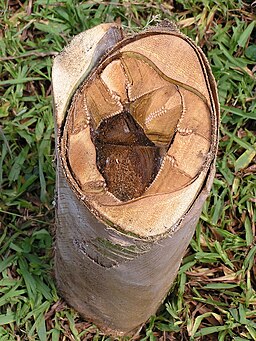
Coconut tree heart rot disease
All Scripture quotations are from the New International Version (Zondervan, 2011).
Read Micah 6:1-8
Prayer
INTRODUCTION
They call it “heart rot disease,” and one type is “brown rot.” You can look at a tree that appears to be perfectly healthy, yet inside, damage from fungus has already begun. The hemicellulose and cellulose begin to break down. The wood becomes dark brown and brittle, then when it dries, it makes the tree far less flexible. A strong wind can easily topple a tree suffering from brown rot. Indeed, the silent tree killer is rotting from the inside out. (Source: https://aaatrees.net)
TRANSITION TO MICAH: NATIONAL “BROWN ROT”
In the book of Micah, the fig tree is presented as a sign of prosperity and well-being. In Micah 4:4, the prophet envisions a time when “everyone will sit under their own vine and under their own fig tree, and no one will make them afraid, for the LORD Almighty has spoken.” Yet that is a vision of the distant future; in the present, the prophet instead sees nations that—like a tree with brown rot – are rotting from the inside out. Again and again, the prophet speaks of moral decay that manifests itself numerous ways. What are some of the evil actions that the leaders of both Samaria and Jerusalem are trafficking in?
SINS OF THE LEADERS
The first sin was idolatry. Micah 1:7 says that the LORD will break to pieces all her idols. Idolatry was a perennial problem for God’s people and had been from the start. God knew that when his people came into the promised land, they would discover those who worshipped other gods. Micah 5:14 mentions Asherah poles. Asherah was a Canaanite goddess often worshipped alongside Baal. It’s no accident that the first two commandments of the Decalogue – the “10 words” or commandments that God gave to Moses on Mt. Sinai – focus on gods (small “g”) and how they have no place in the worship of the people of God (capital “G”). “You shall have no gods other than me,” the LORD commanded, and “You shall not make for yourself an image in the form of anything in heaven above or on the earth beneath or in the waters below. You shall not bow down to them or worship them” (see Exodus 20:4).
A second sin is fraud. Micah 2:2 talks of those who confiscate property that doesn’t belong to them. Not just in Micah’s time but in our own, what makes for generational wealth is land and houses. To take these away without cause is to rob not only the present generation, but all generations to come. The tenth commandment forbids the people of God from coveting what doesn’t belong to us, yet they had forgotten the LORD’s directive.
A third sin – and you could add more to the list – is profiting off one’s position, corruption. Micah 3:9-12 warns: “Hear this, you leaders of Jacob, you rulers of Israel, who despise justice and all that is right; who build Zion with bloodshed, and Jerusalem with wickedness. Her leaders judge for a bribe, her priests teach for a price, and her prophets tell fortunes for money. Yet they look for the LORD’s support and say, ‘Is not the LORD among us? No disaster will come upon us.’ Therefore because of you, Zion will be plowed like a field, Jerusalem will become a heap of rubble, the temple hill a mound overgrown with thickets.”
Micah realized that the moral decay was far advanced. If these and other sins had weakened both the northern Kingdom (as represented by Samaria) and the southern Kingdom (as represented by Jerusalem), was there any hope? What solution does Micah propose to solve the problem?
What is most important? It’s a great question. We all have to decide what we value most in life, what is the “pearl of great price,” to use the words of Jesus, the things that count the most, that really matter.
That’s the frame of mind that Agur is in, when we read Proverbs 30. His name means “gathered,” and he the son of Jakeh meaning “pious.” In his life, we can imagine that Agur gathered a lot of things, but what things are the most important? “Before I die,” he prays, “LORD, grant me just two things.” First, let me forsake fraud and lying, and secondly, give me what I need, my “daily bread.” Let’s look at Agur’s “two things.”
I. FRAUD AND LYING
In Proverbs 30:8, Agur prays: “Keep falsehood and lies far from me.” The King James translates “falsehood” as “vanity.” It stems from the Hebrew word shaw, which indicates anything that is morally worthless. The Common English Bible uses the word “fraud” – “Fraud and lies – keep far from me!” The Hebrew word for “lies” is kazab. It refers to deception and the act of lying. Underlying this moral teaching is the understanding that God does not lie. Numbers 23:19 reminds us, through the prophecy of Balaam: “God is not human, that he should lie.” The basis of holiness is that we are to emulate God; God is our pattern, so if God does not lie, then how can we?
This carries over to the New Testament. Acts 2:44 says that “all the believers were together, and had everything in common.” The early Christians at Jerusalem lived off the proceeds of land that they sold individually, donating the proceeds to the group. One example appears in Acts 4:36-37, where it’s noted: “Joseph, a Levite from Cyprus, whom the apostles called Barnabas (which means ‘son of encouragement’) sold a field he owned and brought the money and put it at the apostles’ feet.” Acts 5 tells the fearful story of Ananias and Sapphira. They sold a piece of property, but held back part of the money for themselves. When Ananias brought only part of the money to lay at the apostles’ feet, Peter immediately confronts him. “You’ve lied to the Holy Spirit.” He then revealed what Ananias had done, and concludes in verse 4: “You have not just lied to human beings but to God.” When he heard this, Ananias fell down and died. Three hours later, his wife, Sapphira came in, unaware of what had happened to her husband. Peter asked her: “Is this the price you received for the land?” When she replied “yes,” Peter said: “Listen! The feet of the men who buried your husband are at the door, and they will carry you out also” (Acts 5:10). Saphirra falls over dead, and they buried her next to her husband. The story concludes with these words in verse 11: “Great fear seized the whole church and all who heard about these events.”
I don’t think any of us sets out to become what the late psychiatrist M. Scott Peck called “the people of the lie.” I do think, however, we can get into some lazy habits, and sometimes unwittingly model to our children what is less than truthful. For example, your granddaughter picks up your cell phone when it rings and says “hello?” It’s a friend of yours, she says, and you reply: “Tell her I’m not home.” There may be other times when telling the truth might seem embarrassing, but is that a reason to lie?
When I was in my early teens, “Sue” and her husband, “Jeff” watched me and my brothers for several days while my parents were away at an annual conference for my father’s work. Sue had laid her purse and a few things down on the desk in our living room, and nosy boy that I was, I saw a what looked like a square plastic holder containing little pills lined up in a row. I’ve never seen anything like it, and was curious. “Mrs. so-and-so” I asked, holding up the birth control pills, “what are these”? She could have made up any kind of story at that point and I wouldn’t have known any better, but to her credit, she answered truthfully, at a level I could understand. “Greg,” she said, “those pills prevent me from having a baby until Jeff and I are ready.” I put the pills down, satisfied with her answer, and having learned something new about human biology. I went back to playing with my little brothers. In retrospect, I’ve always appreciated that Sue answered honestly, and she modeled for me how we can be honest with our children in ways that are age appropriate.
In Dostoevsky’s The Brothers Karamazov, he urges: “Above all, don’t lie to yourself. The man who lies to himself and listens to his own lie comes to a point that he cannot distinguish the truth within him, or around him, and so loses all respect for himself and for others. And having no respect he ceases to love.”
We live in a day and age when honesty in is short supply. Especially during an election season, all kinds of claims are made about one’s opponents. Some are true, but many are plain false, or at least have been taken out-of-context. Other times, we may see a claim come across Facebook or other social media, saying that we as Christians should be angry because in some way our rights are being infringed. An example of a false claim is that Mark Zuckerberg is going to ban the Lord’s Prayer from Facebook, so Christian, it’s your duty to post up the Lord’s Prayer! It took just 15 seconds to Google the claim, and an article from Reuters, dated January 17, 2022, debunks the rumor. Meanwhile, it has been shared more than 500,000 on Facebook! Worse, it’s a resurgence of a rumor from 2020, when it was also debunked. What does this to our witness as Christians? It certainly leaves the impression that we’re uninformed, or paranoid, or at very least, too lazy to fact check before we bear false witness. Mark Twain once said: “A lie can travel halfway around the world while the truth is still putting on its shoes.” He’s in good company. Agur prayed: “Before I die, do not refuse me two things. First, keep falsehood and lies far from me.”
II. GIVE ME ONLY MY DAILY BREAD
Besides keeping him far away from fraud and lying, Agur asks the LORD for a second thing, in Proverbs 30:8 – “Give me neither poverty nor riches, but give me only my daily bread. Otherwise, I may have too much and disown you and say, ‘Who is the LORD?’ or I may become poor and steal, and so dishonor the name of my God.”
I like how the Common English Bible puts it: “Give me just the food I need.” It’s a reminder to the Jewish people of how God provided manna for them on a daily basis in the wilderness. They were instructed to gather only as much as they needed, and not to stock pile it. In Exodus 16:20, some disobeyed Moses’s clear directions, and kept some overnight. In the morning, it was full of maggots and started to smell. Only on Friday were they to gather enough for Friday and Saturday, since Saturday was the Sabbath and God provided no manna on that day.
When we come over to the New Testament, Jesus affirms the daily bread principle when he teaches his disciples to pray: “Give us this day our daily bread.” He seems to be quoting the words from Agur in Proverbs 30. It’s a reminder that we are to come to the Lord on a daily basis, to bring him our needs, physical and spiritual.
Agur is aware that danger always lies in the extremes. Get your eyes on prosperity and the blessings it brings, and soon money becomes your master. It becomes an end in itself and not a tool for providing for your own necessities, then seeing who else is in need. Your 43” TV works just fine, and has for a long time, but everyone at work is talking about their 70-inch TV, and you feel left out. I’ve learned that 2-word response to every sales pitch: “I’m good.” But if the prosperity Gospel – the teaching that following Jesus means you’ll become wealthy – is false, its opposite, the poverty Gospel, is equally wrong. God is not glorified by children who go to sleep at night on an empty stomach. A worker and his family are not ennobled by keeping them at poverty wages, maintaining a minimum wage that cannot pay for rising rent and food costs. Agur fears that if he is too poor, he will be tempted to steal. In short, we need not too much, nor too little, but the right amount to live with dignity and to commend the Gospel.
As holiness people, I believe we have something to offer in this area. When we come to Jesus and begin to live like him, some old habits will fall away. Some of those habits cost money. It’s not cheap to smoke, and lottery tickets aren’t free. If we begin to live cleanly, as the Holy Spirit gently guides us, we may be like Helen, who I pastored in Missouri years ago. When she came to the Lord, I didn’t need to tell her to quit smoking. She decided to do it on her own. “Pastor,” she said, “I’m going to save the quarters I would have spent on cigarettes and keep them in my change purse.” I later heard how proud she was when the day came that she’s saved enough to take a trip she’d always wanted to take, but she’d never had the money before. Now she did.
When you say the word “thrift,” it almost has a musty, old-fashioned smell to it, yet thrift if a word right at home with Agur’s proverb. John Wesley, the co-founder with his brother, Charles, of Methodism, opposed extravagance. Toward the end of his life, he noticed a strange phenomenon. As the decades passed, Methodists were moving up the social ladder. When they started to live in ways that pleased God, they began to prosper. John Wesley was concerned that they would begin to depend – like the rich man in Agur’s proverb – upon their wealth, and forget God. And so Wesley wrote a three-point sermon: 1) Earn all you can; 2) save all you can; 3) give away all you can. His advice at the close of the 18th century is still valuable today.
CONCLUSION
Agur was thinking about what was most important in this life. He desired just two things. “Before I die,” he said, “keep me away from fraud and falsehood. Secondly, he asked the LORD to provide not too much, nor too little, but just the amount that he could live in dignity, commending the Gospel to others, honoring God’s name through his actions. May the Lord grant that our prayer is like that of Agur’s, and may the LORD help us to live it out.
___________________________
All Scripture quotations are from the New International Version of the Holy Bible (Zondervan, 2017).




 Gregory Crofford