Posted in sermons & addresses

On Love, Fear and Hate

1 John 4:7-21 (Christian Standard Bible)

This sermon was first preached at Beacon of Hope Community Church (Moon Township, PA) on October 26, 2025.

INTRODUCTION

I was a little boy, maybe 6 years old. There was a bad thunderstorm one summer night, and I cowered under the bed covers. My mother heard me call out in fear; she came to my bedside to comfort me. “Don’t think of the loud thunder,” she advised. “Think of something you love, like ice cream cones.”

The “love” part was probably more the love embodied in my Mom coming to comfort me than it was in any sugary confection. Even if my mother borrowed a scene from “The Sound of Music,” the lesson endures. To drive out fear, I had to latch on to love.

TRANSITION TO SERMON

We’ve just read a passage from 1 John, the letter that John Wesley called “the deepest part of Holy Scripture” (Works 22:13, 352). Just like my mother made love tangible when she came to my bedside to console me during a storm, so Jesus made God the Father’s love tangible when he came and lived among us.

Let’s consider three truths drawn from the deep well that is 1 John:

  1.  God is the source of all love.
  2.  A loving God sent Christ to reconcile us.
  3.  Perfect love casts out fear.

GOD IS THE SOURCE OF ALL LOVE

Sometimes pop singers hit the nail on the head. Dionne Warwick made the lyrics of Burt Bacharach and Hal David memorable:

“What the world needs now
Is love, sweet love
It’s the only thing that there’s just too little of
What the world needs now
Is love, sweet love
No, not just for some, but for everyone.”

It’s an interesting song in-part because it’s actually a prayer addressed to the “Lord.” She sings: “Lord, we don’t need another mountain.” Then later, she adds: “Lord, we don’t need another meadow.” What do we need? We need love, and by saying “Lord,” Bacharach and David quietly acknowledge that God is the source of all love.

This comes across clearly in 1 John 4:7 – “Dear friends, let us love one another, because love is from God, and everyone who loves has been born of God and knows God.” John is echoing the teaching of Jesus in Matthew 7 where he talks about false prophets. How can we know whether a prophet is genuine? Look at their fruit. If there’s good fruit, you know the tree is good. If there’s bad fruit, then the tree itself is bad.

The same principle is operating when it comes to love. Wherever we see love and its positive fruit, we can be sure that God is at-work. Rick Williamson in his commentary on 1 John insists: “Love flows from God through people, whether or not that person acknowledges God. Even atheists and agnostics are part of God’s work in the world when they act in love” (1, 2, & 3 John, New Beacon Bible Commentary [2010], 152). In theological terms, this is God’s prevenient grace, the grace of God that comes before our salvation. We don’t have to call what is good bad simply because it exists outside of a profession of Christian faith. If it’s good, it’s of God. God is the source of all love.

When Charlie Kirk was murdered, his widow, Erika, stood at her husband’s funeral and tearfully told the world about the assassin: “I forgive him.” It takes nothing away from the beauty of Mrs. Kirk’s statement for us to admit: Only God’s love could allow anyone to say that. On our own, we are powerless to love completely, yet even in the most excruciating circumstances, with time, we can tap into God’s reservoir. God is the source of all love.

[click on page number below to continue]

Posted in Bible

Experience and the Bible

For Christians, experience has always been important. As a boy, I sang the hymn “He Lives” on many Sundays, but especially on Easter. One line concludes:

“You ask me how I know he lives? He lives within my heart.”

Experience is one factor that helps the church confirm calling. My first application for a District Minister’s License included questions about my religious experience, questions like:

When were you saved? When were you sanctified wholly? Why do you think God has called you to preach?

Recounting our life-changing experience with the Lord also encourages others, inviting them to participate in the things of God. In church jargon, these are called testimonies, and there’s biblical precedent for them. When Jesus cast demons out of the demoniac in the Gerasenes (Luke 8:26-39), the man was restored to health. The Lord commanded him:

“Go back to your family, and tell them everything God has done for you” (v. 39, NLT).

In the same way, the woman at the well in Samaria was so impressed by the words of Jesus to her, she went back to the village of Sychar and proclaimed: “Come and see a man who told me everything I every did! Could he possibly be the Messiah?” (John 4:29, NLT).

Experience confirms doctrine and practice. It can help establish the validity of divine calling, and it winsomely points other to Christ.

Experience informs our thinking

Let’s focus for the rest of this essay on the first point, that experience confirms doctrine and practice. John Wesley (1703-91) understood the role of experience as related to our faith and how we live it out. In the 1760s, some Methodists were testifying to having experienced entire sanctification (see 1 Thessalonians 5:23-24). He carefully interviewed many men and women about what had happened to them. Wesley knew that if the Methodists had interpreted Scripture correctly regarding the nature of sanctification, then they should expect validation of their viewpoint through on-the-ground testimonies. In the end, he was re-assured that the doctrine of Christian perfection as taught by himself, his brother, Charles, and the other Methodist preachers was indeed valid. It was confirmed through lived experience.

Whatever the Methodist understanding of Scripture arrived at through Bible study, Wesley knew that interpretations were always open to review. Interpretations are fallible because the Bible is always interpreted by human beings, with all their foibles and propensities toward error. If an interpretation is correct, then we can expect it to be confirmed “where the rubber hits the road.” The implication is simple: When there is a disconnect between a given understanding of the Bible and what Christians experience when applying it, then we must go back to the drawing board and – like a mathematician – check our work.

A musical illustration may help. There’s an old Sunday School chorus I learned to sing as a child. The lyrics say:

“I’m inright, outright, upright, downright happy all the time. Since Jesus Christ came in, and cleansed my heart from sin, I’m inright, outright, upright, downright happy all the time.”

For my young mind, the lesson was: “If I am saved and sanctified, then I’ll always be happy. Likewise, if I’m not always happy, then I can question whether I’ve really been saved and sanctified.”

My older self realizes that these lyrics — though sung by Sunday School children over decades – are nonetheless false. Christians may be saved and sanctified, but we are also human, with all the ups-and-downs that a full range of emotions bring. How did I come to this conclusion? It was because I found that far from being happy all the time, I sometimes was sad. My experience didn’t validate the theology of that children’s chorus. So, I went back to the drawing board, and checked my work. That’s when I realized that – however catchy the tune – that song’s lyrics were just plain wrong.

It’s important to note that experience isn’t just individual; groups also experience things. On the Day of Pentecost, the 120 who had gathered in the upper room experienced the Holy Spirit together. In our Western, individualistic outlook, we too often overlook this truth.

Let’s apply to a contemporary question the Wesleyan principal that experience validates (or calls into question) given interpretations of Scripture. Many churches believe that the role of pastor is reserved for males only. To make their point, they cite 1 Corinthians 14:34 – “Women must remain silent in the church.” Also highlighted is 1 Timothy 2:12, which seems to categorically forbid women to have authority over men. The question is:

Does the church’s experience validate this interpretation or call it into question?

John Wesley did not allow women to preach, until his mother, Susanna, insisted he come and listen to a woman who was leading a Methodist Society meeting in London. He couldn’t deny that the female leader was anointed by the Holy Spirit when she expounded the Scripture. He could have refused to even go with his mother to the meeting, considering the question of male only preaching a long-settled issue. Or having gone, he could have chosen to double down on his previous understanding of Scripture, telling the brave woman to sit down. For Wesley, this would have been to view what was happening in that Methodist meeting through the lens of his existing biblical interpretation. Instead, he went and listened with an open mind and heart. He let the new light he received inform his thinking. He did not jettison the Bible, but he adjusted his former interpretation to accommodate his new observation. The Church of the Nazarene follows in this understanding, believing that both men and women are called by God to preach, and can serve in any leadership capacity in the church.

John Wesley allowing experience to inform his doctrine was nothing new; he was following a well-worn New Testament path. For Peter, the question of clean and unclean animals was settled doctrine, having been addressed in the Old Testament purity laws. By extension, he understood that the children of Israel were the sole objects of God’s saving concern, the “clean” vs. the Gentiles, who were “unclean.” God was about to shake him up. On a rooftop in Joppa (Acts 10), Peter fell into a trance and had a vision. A sheet was let down from heaven, filled with all kinds of unclean animals, including reptiles and birds. Then, a voice commanded him: “Get up, Peter. Kill and eat them” (v. 13). Peter objected that he could not eat anything that Jewish law had declared unclean. The command came three times, then the sheet went back up to heaven.

The rest of the chapter recounts the arrival of messengers from Cornelius, a God-fearing centurion, a Gentile, and therefore (in Peter’s thinking) “unclean”. The Holy Spirit commands Peter to go with them to Cornelius, where Peter preaches the gospel and the Holy Spirit falls upon them, as evidenced by them speaking in languages they had never learned (vv. 44-46). Peter is astounded, and accepts Cornelius and his household as fellow Christians. Later, in Acts 15, he tells the story again, explaining how the experience of the Holy Spirit falling on Cornelius and his household had forced him to rethink what he thought he knew about Jews, Gentiles, and salvation.

Put yourself in the place of the elders in Jerusalem. Surely, Peter’s words must have seemed strange to them at first. After all, the understanding that salvation is limited to the Jews was a centuries-old interpretation of the Old Testament on the matter, yet they listened. They were willing to discuss together respectfully, allowing God to use the experience of Cornelius’ conversion to reshape their thinking. As for me, I’m glad Peter’s argument carried the day, or we would not as Gentiles be included in the church!

Coming into the 19th century, the principle of experience forcing a re-think of cherished biblical interpretations shows up again around the issue of slavery. Slave-owners in the United States viewed slaves as property, as sub-human. They could quote plenty of Bible passages that seemed to confirm that God held nothing against owning slaves. It was interaction with slaves and their undeniable humanity that led abolitionists to take up the cause of liberation: “Chains shall He break, for the slave is my brother, and in His name all oppression shall cease” (“O Holy Night,” 1855). Experience forced them to go back to the Bible and look again at longstanding, historic interpretations that had caused so much pain. They found better interpretations more in-line with love, a central tenet of the Christian faith.

Conclusion

I’m glad that the Church of the Nazarene historically has left a large place for experience in how we understand our faith and practice. I wonder: What other issues are we facing in the 21st century that need further study of Scripture, in-light of our individual and group experience? Will our fear prevent us from praying, studying, and talking together? Will anxiety lead us to sanction prophets among us who call us to this hard but holy work? May God grant us the grace and courage to re-evaluate interpretations of the Bible that – though longstanding – can cause harm, setting up stumbling blocks for those who otherwise might follow Christ.


Posted in sermons & addresses

On fear and perfect love

1 John 4:7-21 (NRSV)

By Greg Crofford

This sermon was preached on January 8, 2023 at Norwin Church of the Nazarene, Irwin, PA.

INTRODUCTION

Jay Withey, 27, got caught in a terrible snowstorm in Buffalo, NY the weekend of Christmas. According to a report on CBS Mornings, Jay knocked on the door of several houses where he saw lights, and even offered $ 500.00 if he could stay the night on the floor. Every time, he was turned away. He went back to his car, and picked up two strangers who huddled with him. They ran the engine for heat, until the gasoline was gone. Desperate, Jay noticed a light on in an elementary school, and broke a window to gain entry to the warm building. He then went out back out into the storm several times, inviting others into the building, including some elderly. They found food in the cafeteria and sheltered overnight until the storm subsided the next day. Jay left a note for the school principal, apologizing about the break-in and accounting for what they had eaten. School authorities released his note to the public, along with photos from school security cameras showing people wrapped up in blankets around cafeteria tables. It soon became clear: Jay was no burglar. He was a hero, and had bravely saved two dozen lives.

TRANSITION TO 1 JOHN 4

It’s a wonderful story because it has several angles. Why did Mr. Withey have to break into the school in the first place? Why wasn’t the school just open to begin with, as a storm shelter? That’s certainly a good discussion to have, maybe at the next meeting of the school board, or Buffalo city council. But today I’d like to look at this story with a happy ending through the lens of fear and love. Faced with a stranger at their door, people had to decide: Do I let him in, or do I turn him away? What emotions are at play in-the-moment that push us in one direction or the other? Today, let’s look at those two words – fear and love – in the light of 1 John 4:7-21, then we’ll finish with three recommendations that can help us both individually and as a church live out the Gospel.

FEAR

First, let’s talk about fear. There are types of fear that are healthy. For example, we know that there are evil adults who prey on children. It’s normal and necessary for parents to teach their children about “stranger danger.” A second healthy type of fear is reverence or respect. This is what we mean when saying we should “fear God.” It’s a good thing to be God-fearing, and when I look at our society today, we need to recapture our respect for God.

1 John 4:18, however, is about another kind of fear altogether, one that is unhealthy. The Greek word for “fear” in this verse is phobos. This is where we derive the English word “phobia.” Webster’s Online Dictionary defines “phobia” as an “exaggerated usually inexplicable and illogical fear of a particular object, class of objects, or situation.” An example of this might be the fear of heights (acrophobia) or the fear of tight spaces (claustrophobia). Notice that fear is illogical. It doesn’t make a lot of sense when you analyze it. Instead, it just wells up as an emotion in the moment. Fear can paralyze us. That’s why a lion roars first before it attacks a gazelle. It paralyzes its prey by instilling fear, giving the lion time to pounce. A second response to fear is withdrawal. It’s a defensive response, like a clam closing up or a crab scurrying behind a rock on the ocean floor. It’s the little West African boy who lived on the remote island who apparently had never seen a white missionary before. When he saw me and another missionary coming down the trail, he jumped into some reeds and peeked out at us, his eyes big.

John says in the same 18th verse that “fear has to do with punishment.” The believer need not fear the day of judgment. According to verse 17, on that day, we can have boldness. How so? If we have asked God to forgive us our sins – the wrong things we have done or the good things that we’ve refused to do – then we have been adopted into God’s family. We can have confidence because God has transformed us and sealed us with the Holy Spirit (see Ephesians 4:30).

John is never satisfied to stop with the human/divine aspect, the vertical dimension. Having looked ahead to Judgment Day, he returns to the present and considers the human/human dimension, the horizontal aspects. What does it look like in our relationships with each other when fear is allowed to dominate? Beginning in verse 20, John answers this question. He writes: “Those who say, ‘I love God’ and hate their brothers or sisters, are liars; for those who do not love a brother or sister whom they have seen, cannot love God whom they have not seen” (1 John 4:20, NRSV).  Like a weed, when fear takes root, love is choked out.

LOVE

This brings us to the second major word in 1 John 4:7-21. That word is love. The stores have already marked down and sold all the leftover Christmas items. Have you seen what they put in their place? It’s all about Valentine’s Day! In fact, the first kind of love that usually comes to mind when we use that word is romantic love, from the Greek word eros, from which we derive the English word erotic. A second word for love is philia, or “brotherly love.” So we say “Philadelphia,” the city of brother love. But in our passage, the Greek noun for love is agape. The NRSV translates this noun and its various verbal forms as “love” and as such it appears 27 times in this passage. For this reason, John has been called the “apostle of love.” Agape is the kind of selfless love that originates in God but is exemplified in life-giving interactions between human beings who reflect God’s image. Agape is “love that seeks the welfare of all” (Vines, 1981; see “love”). Michael Curry describes agape as “love that looks outward” (Love is the Way: Holding on to Hope in Troubling Times [2020], 14).

John speaks not only of love, but “perfect love.” Perfect love is love that is complete, lacking nothing. If love were cheese, then perfect love would be cheddar cheese aged to sharp deliciousness. If love were chocolate, then perfect love would be a Hershey’s bar with almonds. If love were athletic ability, then perfect love would be Franco Harris’ “immaculate reception.” Perfect love is love that has reached its ultimate form and cannot be improved.

And so we come to 1 John 4:18 – “There is no fear in love, but perfect love casts out fear.” As a holiness preacher, I’ve always wondered why this verse doesn’t say “perfect love casts out sin.” John Wesley described God’s work of sanctification in our hearts as “love excluding sin.” Yet here we read that loves casts out fear. Rick Williamson notes that the term for “cast out” (exo ballei) is the same term used when describing Jesus who cast out devils (See Williamson, New Beacon Bible Commentary, 1, 2, 3 John: A Commentary in the Wesleyan Tradition [2010], 151).  

What is John saying? Love and fear cannot co-exist in our hearts. If love takes the upper hand, fear will be banished. “Perfect love casts our fear.” But I wonder: Have we sometimes let perfect fear cast out love? Does the media we consume – the news channels we watch, the websites we read, the radio commentary that we listen to – stir-up in us fear of others, or does it encourage love and compassion for others? John teaches us in this passage that when we open our hearts to fear, hatred is never far behind. Likewise, when we open our hearts to love, then God abides within us, and we begin to look just like Jesus. In verse 17, John puts it this way: “Because as he is, so are we in this world.”

THREE RECOMMENDATIONS

So far we’ve looked at fear, and saw that stirring up fear can allow our love to wither and open the door to hatred. We also discovered that love is the antidote to fear and hatred, that “perfect love casts out fear.” Now let’s take a few minutes to consider three recommendations for living out 1 John 4:7-20 both individually and as a church family:

  1. Lead with love. In Mark 10, the rich young ruler came to ask Jesus what he needed to do to inherit eternal life. Jesus didn’t beat around the bush. He told him to go and sell all that he had and give it to the poor, but sometimes we skip right over Mark’s aside about Jesus’s demeanor just before issuing that command. Mark 10:21a records: “Jesus looked at him and loved him.” Jesus always leads with love. In the same way, St. Francis instructed his monks: “Preach always. When necessary, use words.” The old adage is still true: “People won’t care how much you know until they know how much you care.” Sometimes I wonder how many opportunities to share our faith we’ve short-circuited because we got preachy before we even earned a hearing.
  2. Avoid enlisting in the latest fear-driven crusade. Most Church historians agree that the low-point for Christianity came between the 11th and 13th centuries when Christian “crusaders” raised armies to take back Jerusalem and the Holy Land from Muslims. The atrocities done in the name of Christ will always be a black-eye for Christianity. I wonder if that same counterproductive crusading spirit lives on today in the various culture wars we’re asked to join? Sometimes it seems like we’re asking non-Christians in our country to behave in Christian ways, when that’s nothing they ever signed up for. Why should they be subject to a Book they’ve never agreed to as their guide, whatever the Bible might be for us as believers? It’s worth asking whether lurking beneath the surface of Christian action against x, y, or z is the fear factor, fear that we are being sidelined in a society that seems less-and-less interested in what we have to say or in supporting the church? I certainly don’t have all the answers; I’m not sure I have any answers about how to win back those who used to be with us but are long gone. What I do know is this: John is calling us away from fear, and calling us back to love. Madeleine L’Engle put it this way: “We do not draw people to Christ by loudly discrediting what they believe, by telling them how wrong they are and how right we are, but by showing them a light that is so lovely that they want with all their hearts to know the source of it.”
  3. Trust in God’s prevenient grace. Prevenient grace is the action of the Holy Spirit that draws men, women, and children to God. It is God in love reaching out before we ever did, God taking the initiative. 1 John 4:10 teaches: “In this is love, not that we loved God but that he loved us and sent his Son to be the atoning sacrifice for our sins” (NRSV). If we believe that God has already been working in the heart of every human being at some level long before we encounter them, how can we possibly fear them? They may look different than we do, come from a different country, speak a different language, dress differently, like different music, or a dozen other factors, but this we have in common: God wants to draw them to Christ in the same way that God drew us!  Which course of action will better allow us to become partners with God in their salvation – fear, or love?

CONCLUSION

On Christmas weekend, Jay Withey, 27, got caught in a Buffalo snowstorm and sought shelter. He knocked on doors, but everyone in fear turned him away. Norwin Church of the Nazarene: Who is knocking on our door? Will we turn them away? God forgive me when I have allowed my fear to banish my love. Instead, together, let us lead with love, avoid enlisting in fear-driven crusades, and trust in God’s prevenient grace. May perfect love cast out our fear, today and always.

SHALL WE PRAY…

_____________________

Image credits

Jesus: Thecatholicguy, CC BY-SA 3.0 https://creativecommons.org/licenses/by-sa/3.0, via Wikimedia Commons

Fear emoji: Vincent Le Moign, CC BY 4.0 https://creativecommons.org/licenses/by/4.0, via Wikimedia Commons

Love: RickObst, CC BY-SA 4.0 https://creativecommons.org/licenses/by-sa/4.0, via Wikimedia Commons

Posted in discipleship, reflections

Radical love and the church

Note: This post from September 2021 seems still very relevant as the United States reels this week from multiple mass-shooting events. I’ve republished it below.

________________________________________________________

We holiness folks sometimes have looked askance at love. It seems too simple. There must be more to it; it has to be more complex than that.

One of my seminary professors in the 1980s derided love as “too soft.” Notably, his book on entire sanctification hardly contained the word.

But what Mildred Wynkoop in her A Theology of Love: The Dynamic of Wesleyanism (Beacon Hill Press, 1972) did was make it safe for holiness preachers to talk about love again. For too long, the emphasis had been on the negative side of the equation, of how sin is cleansed away and how a holy person should behave. Legalism was always lurking at the door. But Wynkoop portrayed a positive holiness, a holiness that cannot be understood apart from love.

What would happen if love became the lens through which we saw everything?

The epistle of 1 John does exactly that. Again and again, John returns to love as the glue that holds it all together. For all the verses that touch on love, 1 John 4:7 (NRSV) is the most striking:

“Beloved, let us love one another, because love is from God; everyone who loves is born of God and knows God.”

In junior high, when we played basketball or soccer, Mr. Davis would break out his box of red and blue jerseys. It was the easiest way to know who was on your team. If you were on the blue team, you’d look for players wearing a blue jersey before you pass them the ball.

John is saying: Do you want to know who’s on your team? Look for the “jersey” of love. If they’re clothed in love, you’re playing on the same side.

So what does love look like?

First, love places the interests of others above our own. Jesus modeled this when he went to the cross, putting our well-being above his own. The same self-sacrificial nature of love showed up on August 3, 2019 at a Walmart in El Paso, Texas. Jordan Anchondo covered her baby boy with her body, cradling him protectively while a gunman’s bullets rained down on her. She died, but her boy lived, escaping with only broken bones.

Besides placing the interest of others above our own, secondly, love includes. Jesus spoke of this in his Parable of the Great Dinner (Luke 14:15-24). When those whom the master had invited to the feast started making flimsy excuses for not coming, the master said to his servants:

“Go out at once into the streets and the lanes of the town and bring in the poor, the crippled, the blind, and the lame” (v. 21).

These were the supposed “undesirables,” those who were not included in the original invitation, yet here they are, invited and offered a place at the table. In the Kingdom of God, the norm is radical inclusion.

Edwin Markham (1852-1940) captured the sentiment brilliantly in a few lines:

He drew a circle that shut me out,

Heretic, rebel, a thing to flout.

But Love and I had the wit to win:

I drew a circle and took him in!

The first time I heard that poem, it was read by one of my lecturers at college. He criticized it roundly. But my fifty-something ears hear the poem differently than the ears of an 18-year-old.

I’ve heard many criticisms of others:

“He is so selfish.”

“She just doesn’t care.”

“I can’t believe how hateful he is towards everyone.”

One critique I’ve never heard is this: “She is just too loving toward others.”

Let’s face it: Love is radical. Love, when practiced the Jesus way, puts the interest of others first. Love, the kind that looks like Jesus, includes the so-called “undesirables,” inviting them to the party.

What would churches look like if we practiced this kind of love? What about our polity would need to change? Watch out! Love – the radical, Jesus kind of love – may just lead to revival.


Image credits

Woman and baby: Beardobot, CC BY-SA 4.0 https://creativecommons.org/licenses/by-sa/4.0, via Wikimedia Commons

Circle of friends: Isabel.Yate, CC BY-SA 4.0 https://creativecommons.org/licenses/by-sa/4.0, via Wikimedia Commons

Posted in book reviews, reflections

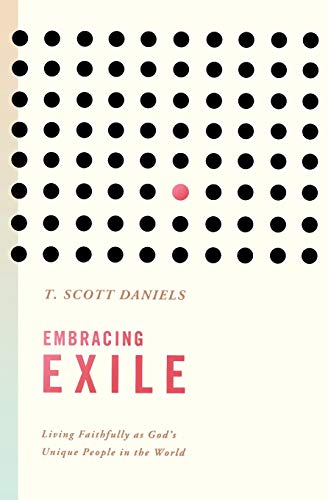
Scott Daniels on exile and the stories we live by

scott-daniels
Scott Daniels

How are Christ followers to live when society seems increasingly hostile to the church? T. Scott Daniels in Embracing Exile: Living Faithfully as God’s Unique People in the World (Beacon Hill, 2017, Kindle edition) takes up this question, mining the biblical metaphor of “exile” for insights that can serve the People of God at a moment when – in the United States – our cultural influence is waning.

It wasn’t always this way. There was a time when Christian clergy were paid deference, and the church was closer to the center of civic life. For Daniels, the word “exile” – evoking the 70 years that the Jewish people were in captivity in Babylon following the fall of Jerusalem in 586 A.D. – is appropriate to describe the sense of disorientation Christians feel in 2020 America. Daniels observes: “People who live in exile feel displaced. They feel like resident aliens. They feel like a people who have to live counterculturally” (location 56).

One of the key fears of Christian parents – according to Daniels – is that they will lose their children to the surrounding culture. To pre-empt this outcome, he emphasizes that we must formulate a story and the practices to sustain that story (location 111).

Daniels cites the 19th century German philosopher Nietzsche who famously concluded that “God is dead.” If this is true, then meaning must be made by each individual. But is this enough? Daniels thinks not:

Without God there is no more certainty or hope about the future. When the only meaning life has is the meaning an individual creates, it ceases to have any real or lasting significance. When the story that gave people meaning and purpose – the story of God – is gone, all that remains is a kind of hopeless despair (location 605).

In subsequent sections, Daniels outlines what alternative stories people live by. These include the “success” story, the “nation” story, the “humanist” story, or a fragmented story that weaves together elements of each (See Chapter 3, “This is My Story.”) Daniels summarizes well the non-God stories that thrive.

embracing exile

Overall, Daniels has written a helpful book that resonates with our cultural moment. Each chapter includes engaging discussion questions that let readers expand on the ideas presented. But where Embracing Exile comes up short is its failure to examine what version of the God story large segments of the American church have been communicating in recent decades. Is it possible that the messages we’ve been communicating have been more reactionary than Spirit-led? As the broader culture changes rapidly, has our response come from a place of fear rather than a heart of love?

In the church where I grew up in the 1970s, we often sang the hymn “I love to tell the story.” The lyrics by Ian Eskelin have stayed with me:

I love to tell the story,

‘Twill be my theme in glory.

To tell the old, old story

Of Jesus and his love.

Love is at the center of the Gospel message (Romans 5:8, John 3:16), but is love what we’re still all about?

A store in a mall became concerned about the number of teenagers who were loitering. Some suggested they were shoplifting or keeping older shoppers from entering. The manager did some research and learned that the highest frequencies can only be heard by those younger than 18.  So he installed a machine that would broadcast painful high frequencies near the store entrance. When younger teens came close, their ears hurt, so they hurried away. On the other hand, those 18 or older kept coming in. Their ears weren’t hurt; they couldn’t hear the painful high tones.

At the center of the Good News is love, but is love what we’re now broadcasting? Is it possible that what used to be a story of love with an attractive melody has mutated into a discordant and shrill refrain? Has what we believe to be Good News instead become Bad News in their ears, driving them away?

It’s possible that many youth turn to other meaning-making stories – what Daniels calls “metanarratives” (location 501) – not because they have rejected the historic, winsome Jesus story of loving God and loving others (Mark 12:30-31) but because that’s not what we’re broadcasting anymore.

Here are three areas where our story – rather than attracting youth – may have repulsed them:

  1. Caring for the Earth – A strong stewardship ethic is apparent in Genesis and the Psalms, yet how often have we heard Christians mocking “tree huggers” or ridiculing those who advocate for phasing out the energy sources driving climate change? How might Lisa, an 11-year-old girl forced to flee with her family from a forest fire engulfing their Colorado home, respond if she overheard such comments?
  2. Gun violence –  Tonya, a 13-year-old girl near Pittsburgh, practices an active shooter drill with her classmates at middle school. After school, she steps off the bus and spots her churchgoing neighbor’s political yard sign touting “God, guns, and country.” If you were Tonya, what reaction might this produce?
  3. Two moms – In Chicago, Antonio, a 15-year-old boy long passed-over in the foster system, is finally adopted by a lesbian couple. At home one night, taking a break from his homework, he picks up his phone and begins scrolling through social media. He clicks on a viral YouTube video of a preacher who insists that “homosexuals are going to hell.” How would you feel if you were Antonio?

Note: Each of these scenarios ends with a question mark because I’m raising questions, not drawing definitive conclusions. Here’s another question: Rather than “Blessing Babylon” – as Daniels titles Chapter 5 – have we (with every good intention) unwittingly been “Cursing Babylon”?

The “exile” metaphor (while certainly present in Scripture) presupposes that a hostile culture has in some way marginalized a faithful church. (The Babylonians forcibly marched the Jewish mobility into exile, after all). This metaphor seems to imply that the church is the “good guys” and everyone else the “bad guys.” Yet as Wesleyans, we believe that God’s prevenient grace is active in every corner of God’s creation (John 1:9; Romans 2:14-15).

An emphasis upon “exile”- while well-intended for all the reasons Daniels outlines – may foster a back-door self-righteousness, a “batten down the hatches” approach that sequesters itself at just the moment when a world drowning in hate needs the engagement of a church turbo-charged by love. We are a missional people. Does talk of “exile” fuel that mission or impede it?

This short essay passes over other themes that Scott Daniels covers, themes that deserve their own consideration. Daniels, to his credit, gently invites us to think together about how we engage the world in faithful ways, without being “squeezed into the world’s mold” (Romans 12:2, Philips). We should thank Pastor Daniels for a well-written and thought-provoking book.

Posted in Christian ethics, Christlike justice, pastoral care, reflections

A people of hope: Nazarenes on abortion

Environmental_day_specialAbortion legislation is coming fast-and-furious in the U.S. setting.  Multiple state legislatures  have been emboldened to pass restrictions, since the compositon of the U.S. Supreme seems to have recently shifted in a conservative direction, calling into question whether the landmark 1973 decision, Roe v. Wade, will be overturned. At such a time, it’s helpful to review what our Nazarene Manual (2017-2021) has to say about abortion.

[Note: For those not part of the denomination, a bit of context is in order. Every four years, the Church of the Nazarene around the world sends delegates to a General Assembly. At the GA, decisions are made that govern the church. These decisions are codified in the Manual, the current version being for 2017-2021. The Manual also contains statements on social issues.]

Here’s the relevant section, from Manual 30.1, under the larger heading of “The Sanctity of Human Life”:

30.1. Induced Abortion. The Church of the Nazarene affirms the sanctity of human life as established by God the Creator and believes that such sanctity extends to the child not yet born. Life is a gift from God. All human life, including life developing in the womb, is created by God in His image and is, therefore, to be nurtured, supported, and protected. From the moment of conception, a child is a human being with all of the developing characteristics of human life, and this life is dependent on the mother for its continued development. Therefore, we believe that human life must be respected and protected from the moment of conception. We oppose induced abortion by any means, when used for either personal convenience or population control. We oppose laws that allow abortion. Realizing that there are rare, but real medical conditions wherein the mother or the unborn child, or both, could not survive the pregnancy, termination of the pregnancy should only be made after sound medical and Christian counseling.

Responsible opposition to abortion requires our commitment to the initiation and support of programs designed to provide care for mothers and children. The crisis of an unwanted pregnancy calls for the community of believers (represented only by those for whom knowledge of the crisis is appropriate) to provide a context of love, prayer, and counsel. In such instances, support can take the form of counseling centers, homes for expectant mothers, and the creation or utilization of Christian adoption services.

The Church of the Nazarene recognizes that consideration of abortion as a means of ending an unwanted pregnancy often occurs because Christian standards of sexual responsibility have been ignored. Therefore the church calls for persons to practice the ethic of the New Testament as it bears upon human sexuality and to deal with the issue of abortion by placing it within the larger framework of biblical principles that provide guidance for moral decision making.

(Genesis 2:7, 9:6; Exodus 20:13; 21:12-16, 22-25; Leviticus 18:21; Job 31:15; Psalms 22:9; 139:3-16; Isaiah 44:2, 24; 49:5; Jeremiah 1:5; Luke 1:15, 23-25, 36-45; Acts 17:25; Romans 12:1-2; 1 Corinthians 6:16; 7:1ff.; 1 Thessalonians 4:3-6)

The Church of the Nazarene also recognizes that many have been affected by the tragedy of abortion. Each local congregation and individual believer is urged to offer the message of forgiveness by God for each person who has experienced abortion. Our local congregations are to be communities of redemption and hope to all who suffer physical, emotional, and spiritual pain as a result of the willful termination of a pregnancy.

(Romans 3:22-24; Galatians 6:1)

Continue reading “A people of hope: Nazarenes on abortion”

Posted in discipleship, reflections

Loving the world, forsaking the world

worldBurt Bacharach crooned: “What the world needs now, is love, sweet love. It’s the only thing that there’s just too little of.”


Jesus would have agreed. At the last supper before his arrest and crucifixion, he taught his disciples:

A new command I give you: Love one another. As I have loved you, so you must love one another. By this everyone will know you are my disciples, if you love one another (John 13:34-35, NIV).

The Lord was only asking them to do what his Father had already done. It was because God “so loved the world” that he sent Jesus (John 3:16). And Jesus in turn showed his love for the world, laying down his life for the world (John 1:29). It follows that what the Father and Son have done, we are called to do, loving the world in the power of the Holy Spirit.

Yet there’s an interesting tension in the New Testament books attributed to John. While there is a positive love of the world that fuels our service to God and others, there’s a negative kind of “loving the world,” one that chokes off our zeal for God and withers our concern for others. John warns:

Do not love the world or anything in the world. If anyone loves the world, love for the Father is not in them (1 John 2:15, NIV).

So which is it: Should we love the world or not? The answer is: BOTH.

Make no mistake: Our call is to love the world – all that God has made – wholeheartedly and unreservedly, in order that the world may be reconciled to God. We long for the day when heaven and earth will be one (Revelation 21:1-5). God has a loving concern for creation, the cosmos. What God has created, God longs to salvage and to renew. To this task God calls us, to partner with heaven to redeem the earth, including humans who have rebelled against God. If we do not love what God loves, how can we cooperate for its restoration?

Continue reading “Loving the world, forsaking the world”

Posted in Christology

The counterintuitive God

clockCounterintuitive: different from what you would expect (Merriam-Webster’s Online Dictionary). Like a clock that runs backwards, there’s little doubt: God is counterintuitive.

Take the incarnation, the eternal Christ clothing himself in human flesh. If the choice had been up to us, we might have chosen huge and flashy. Instead, to bear Emmanuel – “God with us” – the LORD chose someone humble and unknown.

Luke 1:28 (NIV) tells the story:

Greetings, you who are highly favored! The Lord is with you.

Who was this “highly favored” person? Mary was a young Jewish girl. There was nothing noteworthy about her. She had no powerful connections, no high birth to commend her. Yet God – who has a habit of doing the unexpected – chose her to bear the Christ child.

Besides using the unknown Mary as Christotokos – the mother of Christ –  another counterintuitive element of Christmas is tactics. Christ’s coming to earth was hardly the Powell Doctrine. The former American Joint Chiefs of Staff believed that – as a last resort – if the military must be used, then go big. Amass huge quantities of soldiers and equipment, then overwhelm the enemy. But on Christmas, God didn’t get the memo. He didn’t dispatch an army of angels (though an angel choir did sing for a handful of shepherds). Instead, God parachuted an infant Jesus quietly behind enemy lines, like a single SEAL in camouflage. In a world under the destructive thumb of the devil and his sinister band of brothers (1 John 5:19, Ephesians 6:12 ), this underwhelming response seemed counterintuitive.

Besides choice of people and tactics, a final counterintuitive aspect of the incarnation is love. For a creation that had hatefully snubbed its Creator, one might expect in return well-derserved wrath, God paying back hate with greater hate. Yet to our utter amazement, this “SEAL” sent by God came armed with only one “weapon.” Hate could never overcome hate; only love could do that:

For God so loved the world, that he gave his only son…

Paul in the cross discerned heaven’s jujitsu, writing to the Romans: “Do not be overcome by evil, but overcome evil with good” (Romans 12:21, NIV). The cross is a counterintuitive demonstration of God’s love for us sinners who despised him (Romans 5:8). While God’s self-denying modus operandi makes little sense to human calculus, love is the powerful magnet that for twenty centuries has drawn people to their knees at manger, cross, and empty tomb.

Humble Mary, baby Jesus, love – These are three indications that we worship a counterintuitive God. The LORD acts differently than what you would expect. For the sake of our world, may we as Christ’s followers recommit ourselves to doing likewise.

Posted in ecclesiology & sacraments, sermons & addresses

Paul’s 3 secrets for church unity and growth

These rice harvesters outside Antananarivo model good teamwork.
These rice harvesters outside Antananarivo (Madagascar) model good teamwork.

In two weeks, members of the Maraisburg Church of the Nazarene will vote on a new pastor. Here is the sermon I was honored to preach there this morning, in slightly modified form.
————————
SCRIPTURE READING: Ephesians 4:1-16 (Common English Bible)

I.  INTRODUCTION

There’s something about the word “secret” that draws attention. Marketers know this. Take KFC for example. They draw us in with talk of the Colonel’s “secret recipe” made from 11 tasty herbs and spices. Or what about the website, WebMD? A recent article spoke about “10 Diet secrets for lasting weight loss success.”

If a marketer had been assigned to the Apostle Paul, what might she have labelled Ephesians 4:1-16? Perhaps she would have spoken of “Paul’s 3 secrets for church unity and growth.” And here they are:

1) Keep the focus on Christ.

2) Find your niche and fill it.

3) Above all, let us love one another.

II. KEEP THE FOCUS ON CHRIST

When you read Ephesians 4:1-16, there’s no question about who the star of the show is. It’s Christ!

v. 1 – Paul was a prisoner for whom? The Lord Jesus Christ

v. 7 – our gifting is from Christ

vv. 9-10 – It is Christ who descended to earth and who ascended to Heaven

v. 12 – We are the body of Christ.

v. 13 – As his body, we are striving for the standard of the fullness of Christ.

v. 15 – We are to “grow in every way into Christ.”

Theologians like fancy words. They would say that our faith must be Christocentric. In other words, Jesus must be at the center.

By no means do I agree with all that the Roman Catholic Church teaches. However, one of things that I really like is the sanctuary. When I go into a Catholic church, very often there is a cross at the front, in the center, a cross depicting the crucified Christ. The old hymn says it well:

Since my eyes were fixed on Jesus

I’ve lost sight of all besides.

So enchained my spirit’s vision

Looking at the crucified.

It is far too easy for us as the church to be distracted by minor things and turn our gaze from Christ. We are tempted to put our eyes on minor things:

Why did our pastor not do that? Isn’t that her job?

Why would sister so-and-so say such a thing?

Why was the music too loud this morning? Why was it too soft?

And when we start down that negative path, our eyes are diverted from the One who brings us together and the One in whom we find our unity! I’m glad that I’m part of a denomination that has chosen to put Jesus in our name. We are the Church of the Nazarene. Who is the Nazarene? The Nazarene is Jesus Christ.

Yet what kind of a Christ do we preach? We preach a Christ who reaches out to the marginalized, the forgotten of our society. Because Jesus loves people, he is never content to leave us where we are. Rather, Jesus is all about setting us on a new path. We serve Christus Victor, the Christ who is victorious over the unholy Trinity of sin, death, and the devil. Because Jesus loves us so much, he can never be satisfied to leave us mired in our sin.

As the Church of the Nazarene, we’ve understood that historically. For example, in Kansas City, Missouri, in the early decades of the 20th century, we started a rescue mission for alcoholics, and to this day the churches of the Kansas City area support that rescue mission, loving the poor and homeless, many of whom are caught in the trap of substance abuse.

But who are the other marginalized people of our day, right here in South Africa? If someone stood up among us and admitted that he’s addicted to drugs, asking for God’s help and ours, would we not help him? Yet I wonder what our reaction would be if someone stood up in church and admitted being attracted to the same sex, then asked for God’s help and ours? Would we distance ourselves and reply: “No, there’s nothing to be done for that one”? Would we not welcome them with outstretched arms?

And so we keep Christ the Saviour, the one victorious over sin, death, and the devil, at the center of all we do. It is this Jesus that will draw people to himself and to his church.

Continue reading “Paul’s 3 secrets for church unity and growth”

Posted in reflections

Where did Bresee get his catchy phrase? And does it help?

Phineas F. Bresee
Phineas F. Bresee

Last week, a Preacher’s Conference convened at Nazarene Theological Seminary. Though I was unable to attend, I caught my mind wandering back through the halls of NTS. Hanging on a wall in one of those hallways is a pencil sketch of Phineas F. Bresse, next to a framed quotation. Bresee, a key force behind the union of holiness groups in 1908 to form the Pentecostal Church of the Nazarene, cautioned:

“In essentials, unity; in non-essentials, liberty; but in all things, love.”

I’m not sure why the administration chose to hang those wise words where everyone could see them. Maybe it was to prevent lively theological discussions from morphing into something toxic? Whatever the motivation, there is something I’ve since discovered: The words aren’t original with Bresee. In fact, a quick internet search shows lots of people past and present quoting them.

The original quotation was from Peter Meiderlin (1582-1651 CE), also known as Rupertus Meldenius, an obscure Germain theologian. Discussing whether the late divine Johann Arndt had been orthodox in his thinking, Meiderlin cautioned:

“In a word, were we to observe unity in essentials, liberty in incidentals, and in all things charity, our affairs would be certainly in a most happy situation.”

Apart from the origin of the phrase, it may be asked: Does it help?

As some have noted, it depends what parties to a conversation consider “essential” vs. “non-essential.” For example, some seem willing to fight to the death over whether God created the universe in 6 twenty-four hour days. Others are more flexible, allowing God whatever time frame necessary, even billions of years, as long as we affirm that God is the Creator. So, group 1 sees so-called “youth earth creationism” as essential to the whole structure of Christian faith, while group 2 decidedly does not.

Some light can be had when we look back through history to see what a group has judged to be “essential” vs. “non-essential.” In the Church of the Nazarene, we have never had a statement committing us one way or another on the timing of the return of Christ. Instead, we have always merely insisted that he will one day return. We’ve left the particulars up to individual conscience. On that issue, we have always embraced “wiggle room.” The onus then is on the group that wants to jettison history and change direction.

Though it makes the phrase less catchy, we might amend it to say:

“In what we’ve always thought essential, unity; in what we’ve always believed non-essential, liberty…”

When all is said and done, the best way to read Meiderlin’s phrase may be in reverse and with some modification: “In all things remember love, even as we discuss things some consider essential but others think are non-essential.” Our starting point is always love. Otherwise, tempers may flare and we may forget our first duty, to love our neighbor as ourselves. May love always be our watchword and song!

————————

Photo credit: Nazarene.org