 I’ve never been a fan of the National Enquirer. They really ought to change their name to the National Meddler. To the captive audience in a narrow check-out line, it broadcasts the failings and misfortunes of the prominent. Such headlines should evoke our pity, not our delight. Does anyone deserve such brutal gawking?
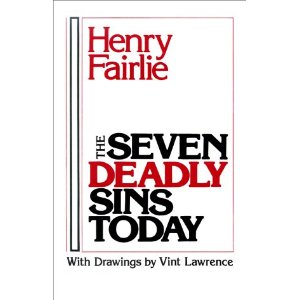
What lies behind our frequent urge to tear people down? In Chapter Two of The Seven Deadly Sins Today (Notre Dame, 1978), Henry Fairlie answers the question. Reveling in the bad things that happen to others is a sign of envy, or invidia. Of all sins, Fairlie calls it the “nastiest, the most grim, the meanest.” It is “sneering, sly, and vicious” (p. 61), hence the expression to be “green with envy.” While other sins (suggests Fairlie) can give what seem to be “moments of elevation,” envy is “servile” and “never straightens its back” (p. 62). It poisons not only the ones whom it targets but those who wield it as a weapon.
Let us first consider briefly what envy is, as explained in the Bible and clarified by Henry Fairlie. Next, we’ll look at some of the negative social effects of envy in modern life, outlined in Chapter 2. Finally, we’ll conclude with what Fairlie prescribes as God’s remedy for envy.
Envy in Scripture and in life
The boomerang effect of envy is clear in Job 5:2 – “Resentment kills a fool, and envy slays the simple.” Likewise, Proverbs 14:30 advises that “A heart at peace gives life to the body, but envy rots the bones.” Jesus taught that envy is one of the evils that come from inside of us, a vice that (among others) ends in our defilement (Mark 7:21-23). Finally, Paul lists envy as one of the characteristics of idolatry, of those whom God has given over to a “depraved mind” – see Romans 1:28-30.
In short, the Bible underscores the deleterious effects of envy. Envy goes beyond covetousness, the Tenth Commandment in the Decalogue. It looks at a promotion received by another or a fine talent and wishes that the other did not have it, since in comparison he or she feels inadequate: “The envious person is moved, first and last, by his own lack of self-esteem, which is all the more tormenting because it springs from an inordinate self-love” (p. 67). Slothful, it seeks to tear down the good name of others, an offense that Fairlie calls “second only to murder” (p. 66).
Here one may quibble with the author. Envy may be slothful, but it can also exist among the hard-working. When an industrious person is passed over for a promotion in lieu of one who is less qualified but politically better connected, he or she may be tempted to lash out from envy.
As a boy, I successfully challenged the answer of a good friend in a teen Bible quizzing match, leading to his disqualification. If I had let it pass, we would have advanced together to the next level of competition. At first, I was self-righteous about my motives. A wrong answer is a wrong answer, is it not? Only time has exposed my green-eyed envy of his achievement that day, an envy stemming from my buried resentment that he was a notch or two brighter than I, and so I had to study harder than he did to succeed. Surely I deserved the bigger trophy that day, not him! Our close friendship never recovered, despite later awkward attempts at reconciliation between us. Envy can result in lasting damage.
Continue reading “Celebrating others’ misfortunes: Henry Fairlie on envy”


 Gregory Crofford