Posted in book reviews

N.T. Wright gets back to basics

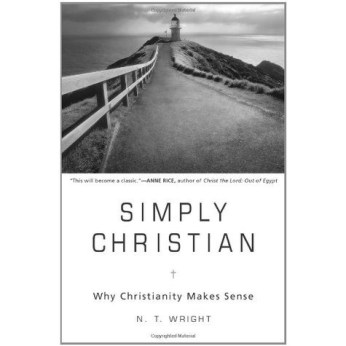
christianBishop N.T. Wright is arguably the most prolific biblical theologian of our time. Capable of treatises that challenge long-cherished interpretations of doctrines – such as his expansive Paul and the Faithfulness of God addressing justification- Wright’s versatility shows through in a different approach targeted both to the believer and to the intelligent seeker. Simply Christian: Why Christianity Makes Sense (Harper Collins, 2006; Amazon Kindle edition) is one such book.

Part One, “Echoes of a Voice,” invites the reader into a conversation. By examining injustice (and the human desire to correct it), the “hidden spring” of an undeniable thirst for spirituality in the human heart, relationships between persons and the role of beauty for meaningful existence, Wright examines longings common to all human beings, asking important questions for whom the only sensible answer is God.

Part Two launches into a review of who God is and how God has chosen to relate to creation. He briefly reviews (pp. 60-63)- and dismisses – traditional approaches to God, including what he calls “Option 1,” namely, pantheism (“all is God and God is all”), panentheism (“all is in God”), and “Option 2,” deism (where God creates then removes himself). In its place, he proposes Option 3, a scheme where heaven and earth are “overlapping and interlocking” (p. 63). The biblical narrative of both Old and New Testaments bears witness to this engagement between Creator and Creation, but why is such engagement necessary? Wright clarifies (p. 66):

In particular, this God appears to take very seriously the fact that his beloved creation has become corrupt, has rebelled and is suffering the consequences.

With this premise given, much of the rest of the book (including Part 3) falls into place as a solution to a problem. The Kingdom of God (chapter 7), Jesus as the one who rescues and renews (chapter 8) and New Creation (chapter 16) can be viewed in this light. Other themes include worship (chapter 11), prayer (chapter 12) and the nature of Scripture (chapter 13), to name a few. In each case, Wright keeps things simple, remaining faithful to his goal of helping those who are new to faith or considering following Jesus.
n-t-wright-206x300
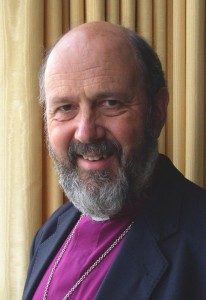
Bishop N.T. Wright

A great strength of the book is its stories. Wright is quick to spin a tale, such as the powerful dictator who decided to control the unpredictability of springs and the floods they cause by paving them over. In their place, he introduced a complicated system of pipes from which water would flow. What happens when people realize that there is far better water to drink than the bland brew that comes out of rusty pipes? Religion taps the deep wells that authorities have forbidden and that many have forgotten, springs that – when tapped – can produce unexpected results. Wright (p. 20) concludes:

September 11, 2001, serves as a reminder of what happens when you try to organize a world on the assumption that religion and spirituality are merely private matters, and that what really matters is economics and politics instead. It wasn’t just concrete floors, it was massive towers, that were smashed to pieces that day, by people driven by ‘religious’ beliefs so powerful that the believers were ready to die for them. What should we say? That this merely shows how dangerous ‘religion’ and ‘spirituality’ really are? Or that we should have taken them into account all along?

Where Wright shines is his treatment of the meaning of resurrection. While he fleshes out his eschatology in greater detail in Surprised by Hope: Rethinking Heaven, the Resurrection and the Mission of the Church (Harper Collins, 2008), in Simply Christian (p. 114), he previews his later thoughts: “Resurrection isn’t a fancy way of saying ‘going to heaven when you die.’ It is not about ‘life after death’ as such. Rather, it’s a way of talking about being bodily alive again after a period of being bodily dead.” In any case, Wright places his accent in the same place as the New Testament, namely, on resurrection as the cornerstone of Christian faith and the basis of Christian hope.

(Read my review of Surprised by Hope by clicking here.)

Simply Christian isn’t flawless. A survey like Wright’s doesn’t have the space to delve too deeply into topics. One example is his description of King Saul’s reign as a “false start” (p. 77). There’s no acknowledgment that Saul’s reign has been estimated as having lasted between 10 and 40 years. By comparison, David ruled for 40 years (1 Kings 2:11) so Saul’s reign was a healthy duration by any measure.

This is the second book I’ve read by N.T. Wright. His writing are appealing in large part because they major on interpreting the biblical witness, avoiding a speculative, philosophical approach to theology. Though he doesn’t allude to John Wesley, one can’t help but think that Wesley would have been a fan of the former Bishop of Durham.

——-

Photo credit (N.T. Wright): Patheos.com

 

Posted in From soup to nuts

Pumpkin and sugar bean curry

Pumpkin and sugar bean curry

I’m not a vegetarian but this vegetarian dish was tasty!

Here’s the recipe as given on the side of the box of Rajah mild & spicy curry powder:

  1. Sort and clean 2 cups of dry sugar beans and soak in water overnight. (I used red beans instead).
  2. Boil in clean water for 60 minutes or until soft, then drain.
  3. Heat some vegetable oil (2-3 tablespoons should do) in pot and fry 1 sliced onion and 1 chopped green pepper until soft.
  4. Add 2 tbs. of Rajah Mild and Spicy curry powder and 2 chopped tomatoes and fry for about 2 minutes. (Note: I’m sure other brands would work fine, too).
  5. Add 2 cups peeled and cubed pumpkin (or butternut squash), 2 cups of water and beef stock cube, then bring to boil. Turn down the heat and simmer for 20 minutes with the lid on frying pan.
  6. Add the cooked beans and allow to simmer for 10 minutes more.
  7. Season to taste with salt and pepper
  8. Serve with rice. MAKES ENOUGH FOR 4-6.
Posted in sermons & addresses

What’s love got to do with it?

crossHere’s the sermon I preached last Sunday at the Regents Park Church of the Nazarene (Johannesburg, RSA). In some ways, love is both the easiest topic to preach on and the most difficult. I’m preaching to myself as much as anyone else.

————

“What’s love got to do with it?”

Text: 1 John 4:16-21

Intro

The word “love” is one of the most powerful words in any language. When we think about music, there’s a whole category of songs that we call “love songs”. So many different lyrics from different songs could be recited, but for some reason what came to mind was Tina Turner’s 1984 hit, “What’s Love Got to Do with It?” The words ask:

What’s love got to do, got to do with it
What’s love but a second hand emotion
What’s love got to do, got to do with it
Who needs a heart when a heart can be broken

Now it would be quite a meeting if Tina Turner met the Apostle John, the disciple of Jesus who wrote our Scripture reading today. What would someone from the 1st century have to say to someone from the 21st? What would they talk about? What would they possibly have in common? Yet they have more in common than you might think at first glance. May I suggest that the entire book of 1 John is in fact an extended reply to the question: “What’s love got to do with it?” And the simple answer is: Love has everything to do with it when it comes to our Christian faith. Sure, it’s not the romantic love spoken about by Tina Turner, but it is a deeper love, a more lasting love, a love that brothers and sisters in Christ have for each other – or at least should have – because of our Lord.

Transition and sermon plan

Today, we’ve only read a few verses from the letter. I’d encourage you to take the time later today to read all of 1 John. It’s short, so it shouldn’t take you too long. If you read it all, you’ll see that a single theme is woven through the book like a golden strand. How can we summarize that theme? Here it is: “If you say you love God, then prove it by loving others.” It’s pretty simple, really. But since we don’t have time to see the whole forest, let’s sharpen our focus and at least examine a few of the trees in that forest. The three “trees” are really three short sentences:

  1. God is love.
  2. There is no fear in love.
  3. We love because he first loved us.

Continue reading “What’s love got to do with it?”

Posted in book reviews

Ray Bakke’s winsome theological vision for the city

bakkeThe world is moving to the city.

The tipping point came in 2010 when 52% of the world’s population lived in cities. Estimates are that by 2050, 2/3 of planet Earth’s human beings will be urban dwellers.

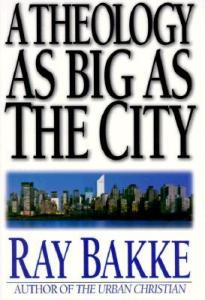
Ray Bakke is a prominent Chicago pastor and professor who has wrestled with the implications of rapid urbanization for the church. In A Theology as Big as the City (IVP, 1997) – a follow-up to his acclaimed The Urban Christian (IVP, 1988) – Bakke emphatically answers the mistaken notion that the Bible views cities uniformly in a negative light. Instead, he systematically surveys both Old and New Testaments, painting a picture of cities that are the object of divine love and concern. The implication is clear: If God loves cities and the people who live in them, can the church do any less?

While there are many themes raised in Theology as Big as the City, let’s take a look at three key ideas advanced by Bakke:

1) God’s hands are in the mud;

2) Jesus as an agent of personal and social transformation;

3) The role of an urban pastor.

God’s hands are in the mud

Ray Bakke begins his biblical survey of urban themes by looking at the creation narratives in Genesis 1-2. Genesis 2 depicts God as one down in the dirt, using his hands to form Adam from the “dust” of the earth (2:7).

Urban ministry is not aloof but engaged. It acknowledges hard realities yet works toward change. Bakke (p. 37) affirms:

We acknowledge that inner-city neighborhoods are often ugly, and the systems are broken. We all know a healthy person needs a healthy family, and a healthy family needs a healthy community…Yet there’s a sense that if Christ is with me in the midst of the slum, the neighborhood is a slum no longer. For Christ lives in me, and his kingdom agendas confront the neighborhood.

Our motive to work alongside God in “the mud” is not the need that exists. Rather, ministry in cities is fueled because “God has done a work of grace in my life that compels me to share. It overflows”(p. 36).

Continue reading “Ray Bakke’s winsome theological vision for the city”

Posted in pastoral care, reflections

Overeating in Christian perspective

forkIt’s the beginning of the new year and lots of people are making promises to lose weight. As Christians, how can we overcome the sin of gluttony (overeating)?

Disclaimer: This essay does not look at the medical side of obesity, only gluttony as a spiritual issue. It is always appropriate to consult with medical professionals and to learn to choose healthy foods.

Bear with me as we take what may seem like an unrelated detour. I promise to bring the plane in for a smooth landing.

Addressing the question of why we eat too much requires us as followers of Christ to ask another preliminary question:

Who am I?

As human beings, we are not accidents, a random conglomeration of atoms and cells. Rather, we are purposefully and lovingly molded by God, the One who creates and sustains all that is.

The Psalmist affirmed:

I praise you because I am fearfully and wonderfully made; your works are wonderful, I know that full well. (Psalm 139:14, NIV).

Who am I? I am the exquisite creation of God, so I have great value.

A second answer to the “Who am I?” question emerges from the story we find in Scripture. Not only did God fashion us as part of a wonderful creation. Importantly, we are created for relationship with God and others. This is beautifully symbolized in the first two chapters of Genesis. God placed Adam and Eve together in the garden and they had fellowship with each other and with God.

Third – and this one ties most directly with our topic of overeating – God created me as an embodied being. God fashioned Adam out of the dust of the earth (Gen. 2:7). The “dust” symbolizes substance or matter. At the end of each creation day, God stepped back and beheld various parts of creation, pronouncing them “good” (Gen. 1:3, 9, 24, to cite a few). Only when God at last had created Adam did he call creation “very good” (1:31).

Our bodies are excellent!

This has implications for how we view ourselves. For all of his merits, more than any other theologian, Augustine of Hippo (b. 354 AD) did much to make Christians feel guilty about sex. While Paul had advised that self-control must characterize all our behavior, including our sexuality (Galatians 5:23, 1 Cor. 6:18-20), Augustine posited that it was the sex act itself – even between spouses – that was sinful, the way that original sin was transmitted. Augustine’s influence has led in the West to a preoccupation with sins of a sexual nature, making them first order sins even as we ignore what a neutral observer might conclude we judge to be lesser sins (if sins at all), including eating too much.

To say we are embodied is not to imply that we are immortal souls living inside mortal bodies. That’s dualism, a Greek philosophical weed that (unfortunately) has blown into Christianity’s garden and taken root. The soil in which Christianity grew up is Hebrew soil, Old Testament teaching. Genesis 2:7 explains that human beings are matter (“dust”) into which God has breathed the breath of life. This is called holism; we are unities. I don’t have a body; I am a body animated by God.

Continue reading “Overeating in Christian perspective”