Posted in book reviews

Preston Sprinkle on scandalous grace

charisWhy do we need one more book on grace? It’s a fair question. In Charis: God’s Scandalous Grace for Us (David C. Cook, 2014), author Preston Sprinkle gives a convincing though incomplete answer.
Preston Sprinkle is best known for co-authoring with Francis Chan Erasing Hell (2011). This time around, Sprinkle goes solo, painting a handful of biblical portraits mostly from the Old Testament, each one an example of the relentless pursuit of God’s grace (Gk. charis). It is through these pictures of grace that Sprinkle targets his objective:

Rich, poor, successful, homeless, healthy, disabled, black, white, brown, young, old, famous, abused, pervert, or priest – whoever you are and whatever you have done or have not accomplished – if you are human, then you are cherished and prized and honored and enjoyed as the pinnacle of creation by a Creator who breeds charis (p. 38).

Too often, we don’t take the time to plumb the height and depth of grace. Too quickly – Sprinkle maintains – we move on to other aspects of salvation without marveling in this, God’s “gift” to all of us, the undeserving. His observation is a fair one. Dwelling upon grace can be an important remedy for those who have grown up in a legalistic setting where “working out our own salvation” (Phil. 2:12) leaves believers with the nagging feeling that they’ll never quite measure up.

Sprinkle – though a PhD in Bible from the University of Aberdeen – wears his learning lightly. With language that is picturesque but not ornate,  gritty yet not vulgar, he refuses to PhotoShop the blemishes of OT characters like Samson, Rahab, Abraham, and David. His point is that God’s grace reaches us as we really are and not as we pretend to be. We cannot earn grace. Rather, “God loves you because of who He is and because of what Christ has done” (p. 108).

What shall be our response to God’s scandalous grace?

The author purposely leaves this to the Epilogue, in order to allow the reader to bask sufficiently in God’s grace. Yet one wonders: Will the reader who only makes it halfway through the book end up with a balanced, biblical picture? For though God comes to us where we are with all His grace, it is never his intention to leave us in our mess. The angel announced that Jesus would “save his people from their sins” (Matt. 1:21), not save his people in their sins. It is the concept of transformation following repentance that rounds out the Good News. Though in the Epilogue Sprinkle addresses the vital role of obedience, repentance (a change of mind regarding sin) is never mentioned, making the book incomplete. Neglecting to tease out the relationship between grace and repentance is an omission that –  from the perspective of Wesleyan theology with its deep concern to avoid antinomianism (lawlessness)  – is nothing short of glaring.

Yet on balance, Charis is a welcome book. The old Methodist hymn said it well:  “It’s not my brother, not my sister, but it’s me, O Lord, standing it the need of prayer.” The gift of God’s grace is not for those who think they are healthy but for those who are convinced that they are sick and powerless to make themselves well. And that, truth be told, includes us all.

———-

Image credit: Amazon.com

Posted in book reviews

Brian Zahnd and the peace of Christ that opposes Empire

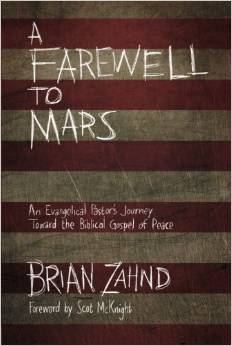
indexIt’s all the rage, this little anti-war tome, A Farewell to Mars: An Evangelical Pastor’s Journey Toward the Biblical Gospel of Peace (David C. Cook, 2014; Kindle edition). Pastor Brian Zahnd has written an insightful and controversial book that will push many followers of Christ to re-evaluate what Jesus would do not just in our lives as individuals but as nations sharing one planet.

Pastor Zahnd – like many Americans at the time of the invasion of Iraq in 2003 – was solidly behind the foray into the country ruled by Saddam Hussein. Zahnd had led in public prayers for the troops, bellicose war prayers for which God later gently nudged the pastor toward repentance. Gradually, Zahnd re-examined his position and is now as staunch a proponent of peace as he is an opponent of Empire, no matter what country is behind it. In place of Empire, Zahnd espouses a different more durable kind of arrangement:

“The resurrection is not only God’s vindication of his Son; it is the vindication of all Jesus taught. Easter Sunday is nothing less than the triumph of the peaceable kingdom of Christ.”- location 231

Herein lies an attractive feature of Zahnd’s work: It’s mostly about Jesus. It’s hard to argue with that methodology if we are going to be Christians, little Christs. Yet ironically, have we as followers of the good and gentle shepherd who “lays down his life for the sheep” (John 10:11, NIV) justified wars in his name? Zahnd argues convincingly that we have. Citing the disastrous medieval military campaigns to take back Jerusalem from Muslims, he concludes: “The crusades are perhaps the most egregious example of how distorted Christianity can become when we separate Christ from his ideas. Yet we continue to do this – we worship Jesus as Savior while dismissing his ideas about peace” (location 160).

Pastor Zahnd rightfully protests the melding of Christian and militaristic symbolism, recounting a visit to the chapel at the U.S. Air Force Academy where the “cross” at the front of the sanctuary was made up of swords. Zahnd concludes that this becomes a strange composite, a tribute more fitting to the Roman god of war (Mars) than Jesus, the Prince of Peace. The danger is that the church – which should be promoting the kingdom of God – unwittingly becomes a mere chaplain to the state. He explains:

“Our responsibility is not to chaplain the state but to call the state to repentance and to surrender to the King who is Lord. Our responsibility is to be an alternative to the state. Christians would do far more good for our country by learning not to look to DC for solutions but to the glorious Son of God, who loves us and gave himself for us and, in doing so, gave us a whole new way of life – one not shaped by the power of force but the force of the gospel ” (location 35).

Yet Zahnd’s argument suffers from off-putting elements for the otherwise open-minded reader. Rejecting the label of “pacifist,” he concludes: “But I am not a political pacifist. What I am is a Christian” (location 1354).Does this imply that those who have reached different conclusions on war and peace are not Christian? My experience is that Mennonites – who are unashamedly part of the peace church tradition – avoid statements like Zahnd’s that appear to demonize Christian brothers and sisters outside their circle. Further, Zahnd’s two caustic poems in the book may leave readers with the same bad taste in their mouths.

Beyond the question of the sometimes acerbic tone is that of biblical interpretation. It only makes sense that the “peaceable kingdom” of Isaiah 2:2-4 would figure prominently in Zahnd’s thinking, the famous vision of swords beaten into plowshares. What he neglects to mention is the prophet Joel’s contrary admonition: “Hammer your plowshares into swords and your pruning hooks into spears. Train even your weaklings to be warriors” (Joel 3:10). Joel’s is an end times vision of the armies of the earth gathering together for battle. So this prophecy is all the more important for Zahnd to address since war talk among 21st century American Evangelicals is often wrapped-up with apocalyptic scenarios.

At times Zahnd’s arguments are not sufficiently developed. While it is clear he opposes the offensive use of military force that Empires require, he leaves unaddressed the defense of nations or loved ones under attack that is the arena for Just War Theory.

Weaknesses aside, Brian Zahnd’s A Farewell to Mars makes an important and timely contribution. Zahnd’s writing style is engaging. He succeeds in presenting from Scripture an historic and peaceful alternative to the well-worn path of war that for America and the world has too often yielded little but bitter fruit.

———–

Image credit: Amazon.com

Posted in book reviews

When soteriology and ecology embrace: Howard Snyder’s expansive vision

Howard Snyder
Howard Snyder

“Ecology” is one of those musty words crowded out by more trendy fare, terms like “environmentalism” and “Creation Care.” But if theologian Howard Snyder has his way, ecology will soon be on everyone’s lips.

In Salvation Means Creation Healed: The Ecology of Sin and Grace: Overcoming the Divorce Between Earth and Heaven (Eugene, Oregon: Cascade Books, 2011; Kindle edition), Snyder – a theologian of mission and John Wesley scholar –  boldly challenges the Church to broaden its narrow conception of salvation to encompass the full panorama of God’s loving concern, as presented in Scripture. If the ideas championed in his book were to take hold, the mission of the Church in the world would look radically different than it has for much of the past 100 years.

John Wesley often structured his sermons in terms of “sickness/cure,” and Howard Snyder adopts a similar methodology. Following Chapter 1, a treatment of the “divorce of heaven and earth” due to a dominant neo-Platonism that prioritizes the value of spirit over matter, Snyder details a “fourfold alienation”  under the heading of the “ecology of sin” (see pp. 68-78):

1) alienation with God;

2) alienation from one another;

3) alienation from ourselves (internal division), and

4) alienation from the land.

Following a time-honored Wesleyan paradigm, Snyder treats sin as a moral disease. Because sin is fourfold in nature , the Gospel as cure must address each aspect of the condition or be incomplete. Snyder argues that evangelical soteriology (the doctrine of salvation) has indeed been grossly inadequate. While we have effectively addressed the first point (alienation from God) – preaching tirelessly about justification and sanctification – we’ve had less to say about points 2 and 3 and until recently were wholly silent on point 4. (Note: Snyder correctly points out that John Wesley himself later in life had much more to say about God’s concern for all creation, not just human beings).

For Snyder, the one biblical concept that covers all four alienations is that of healing. This healing is not a far-off, wholly spiritual prospect reserved for an ethereal “heaven.” Rather, healing is for the here-and-now, an expansive, cosmic restoration of all creation in which the Church – empowered and gifted by the Holy Spirit – actively participates. Snyder argues (p. 38):

But an agenda remains. The church spread throughout the earth but often doesn’t see the earth. The church is still far from realizing its potential to renew and heal the land. Millions of people have been reconciled to God. Yet the full promise of salvation as creation healed is yet to become real and visible worldwide.

Turning from sickness to cure, the book capably unpacks the meaning of the covenant with Noah (Genesis 9:8-15). This first covenant is both everlasting and for the “preservation of creation” (Snyder, p. 55). Importantly, it is a three-way covenant, i.e. between God, humans, and creatures. Snyder observes that it “has never been revoked, and largely defines stewardship on earth” (p. 90). In Chapter 6, “The Groans of Creation,” the reader uncovers what such stewardship means in relation to climate change, the overstressed oceans, and deforestation. At its core, taking care of the earth is a human question since it is poor people who are first and most affected by human practices that throw the earth’s systems out of kilter. Synder rightly observes: “Creation care is pro-life” (p. 83). Later, he concludes: “If we are passionate about people, we will be passionate about their world” (p. 152).

Salvation Means Creation Healed is an ambitious book, perhaps too ambitious. Chapter 11 delves into the nature of the Church, introducing material on worship styles that – while interesting – is tangential to the  main thrust of the book. That central concern is relating soteriology to ecology. Thankfully, Snyder finds his footing once again at the end of Chapter 12, speaking of how the “stigmata” ( the marks of the Church) should be practiced through four principles as related to Creation (pp. 198-200):

1) the earthkeeping principle;

2) the Sabbath principle;

3) the fruitfulness principle;

4) the fulfillment and limits principle.

These four principles provide a positive agenda for how the Church can rectify the fourth alienation, our distance from and poor stewardship of God’s good earth.

Howard Snyder adds his voice to a rising chorus of those who have concluded that the Church’s mission – particularly the modus operandi of its Evangelical branch – has been too other-worldly. His is a clarion call to rediscover the biblical Gospel, the full scope of God’s concern for all creation and our duty under God to care for the land. Since Evangelicals – including the descendants of John Wesley – have placed soteriology at the center, Snyder’s re-casting of ecology in soteriological terms is very welcome. May both his tribe and readership increase.

————

Image credit: Greenville College

Posted in book reviews

Bonhoeffer: a new portrait for a new generation

bonhoeffer_featureI’ve always enjoyed a good biography, but have to tell you: Eric Metaxas’ Bonhoeffer: Pastor, Martyr, Prophet, Spy (Thomas Nelson, 2010; Kindle edition) is not good. It is very good.

Dietrich Bonhoeffer (1906-45) was a world-class theologian who opposed the regime of Adolf Hitler and ultimately was jailed and hanged for his involvement in the plot on the Führer’s life. That episode is the best-known part of the German martyr’s story. What Metexas adds is a vivid description of Bonhoeffer’s life prior to that chapter, painting with a clear and readable style a sympathetic portrait of the man celebrated for The Cost of Discipleship and Life Together.

Much in Metaxas’ portrayal was new to me, including the extent to which Karl Barth’s theology influenced Bonhoeffer and the latter’s distaste for the liberal theology prominent at New York’s Union Theological Seminary where he studied  in 1930-31. Also endearing was Bonhoeffer’s love of music – he was an accomplished pianist – and the details of his engagement and letter writing to his fiancée, Maria von Wedemeyer.

The book is replete with excerpts from Bonhoeffer’s books, addresses, and letters. These reveal how important he thought practical and recurrent experience in pastoring was. In this way, theology never becomes distant or detached. Instead, it was to be hammered out in the life of the community of faith. He pastored churches in Barcelona and London, and always sensed tension between his hunger to pursue both the life of theological academia and the work of a parish minister.

Here’s a sample of some of the sections I highlighted as I was reading:

“For many Germans, their national identify had become so melted together with whatever Lutheran Christian faith they had that it was impossible to see either clearly. After four hundred years of taking for granted that all Germans were Lutheran Christians, no one really knew what Christianity was any more.” – Metaxas, p. 174

“The question is really: Christianity of Germanism? And the sooner the conflict is revealed in the clear light of day, the better.” – D. Bonhoeffer, cited by Metaxas, p. 183

“He was convinced that a church that was not willing to stand up for the Jews in its midst was not the real church of Jesus Christ. On that, he was quite decided.” – Metaxas, p. 186

“First they came fo the Socialists, and I did not speak out – because I was not Socialist. Then they came for the Trade Unionists, and I did not speak out – because I was not a Trade Unionist. Then they came for the Jews, and I did not speak out – because I was not a Jew. And then they came for me – and there was no one left to speak for me.” – Martin Niemöller, cited by Metaxas, p. 192

“Bonhoeffer was constantly joking, whether verbally or in other ways.” – Metaxas, p. 201

“Battles are won, not with weapons, but with God. They are won when the way leads to the cross.” – D. Bonhoeffer, cited by Metaxas, p. 241

“Bonhoeffer advocated a Christianity that seemed too worldly for traditional Lutheran conservatives and too pietistic for theological liberals. He was too much something for everyone, so both sides misunderstood and criticized him.” – Metaxas, p. 248

“Things do exist that are worth standing up for without compromise. To me it seems that peace and social justice are such things, as is Christ himself.” – D. Bonhoeffer, cited by Metaxas, p. 260

Dietrich Bonhoeffer has become a Protestant saint. For this reason, it is frowned upon to criticize him. To his credit, Metaxas does not present him as a perfect man. Bonhoeffer’s doubts and fears emerged particularly in his conversations with Eberhard Bethge, who was a close friend and became a confessor to him. In Metaxas’ estimation, Bonhoeffer could also come across as an elitist, stand-offish to the point of seeming arrogant. These are darker shades that add texture to the canvas.

One weakness in the book is the tone of the discussion questions at the end. They are written in a time and culture-bound way, from an American, right-wing Republican perspective. This is unfortunate for the international reader, introducing a parochial and ephemeral element to a book that otherwise deals with universal, lasting themes.

The book’s and Bonhoeffer’s weaknesses aside, there is much to admire about the young German man who was not content to rest in the realm of theory. Instead, he moved to action at a time when action and not merely discussion was most needed. Eric Metaxas is to be commended for winsomely introducing a new generation to an exceptional leader.

——–

Image credit: Baylor Institute

Posted in Uncategorized

On Law and Grace: Thoughts on Javert and Jean-Valjean

Les-MiserablesVictor Hugo’s Les Misérables is a perennial source of reflection on the human heart. Long-time pastor and professor Doug Samples in 2012 put together a blog site entitled: “The Les Mis Project: Finding the Gospel in the Music of Les Miserables.” The site is a tag-team effort and well worth your time.

Doug wrote about inspector Javert’s suicide in this entry. He speaks about the “Law Keepers” in holiness churches, the people who like to play “gotcha!” They are a graceless bunch. I’ve known a few like that across the years, but looking at where we are as a church today, we are arguably careening toward the other ditch, that of antinomianism, or lawlessness. The Wesleyan Way is the via media, finding the balance between extremes. That’s what I had in mind when I posted this commentary in response to Doug’s blog:

Hello Doug –

I’m a bit late joining in the conversation! Thanks to your weblog, though, it’s all here a couple months later, and I’m grateful. Please keep it here for others.

My wife and I saw the latest movie with Russell Crowe, Hugh Jackman and others. I can’t remember a time when I’ve sat through a movie with such rapt attention. By nature, I’m one who fidgets, but not that night.

Looking at Javert is like looking in the mirror of my younger self. I won’t go into needless details, but by the grace of God, I’m trending toward Jean Valjean these days. Still, the “Are you John Valjean or Javert?” is too simple a question. Strangely enough, I’m something of a mixture. I find, however, than when I have a “Javert moment,” it can freeze relationships.

On the other hand, it may be too simple to say that pre-Road to Damascus Paul was Javert and afterwards he was Jean Valjean. He never lost the Pharisee streak in his thinking, and quite frankly, I’m glad he didn’t. For all the attempts to say they contradict each other, Paul and James have more in common than the first glance would suggest. James speaks of the “perfect law of liberty” (James 1:25). May I suggest that there are many in our churches coming out of the “anything goes” life of sin that really need some Javerts? They need the boundaries, the discipline – and that is a big word in spiritual formation, is it not? – that is an important thread in the Christian faith. Wise is the pastor who can channel such individuals in the direction of a Javert, someone who can provide the other “wing” on the airplane without which grace easily becomes license.

Lots to think about here! “Law” and “grace” are both necessary. Let us not condone a lawless grace, nor a graceless law. There is a via media that puts the two together.

Thanks again, Doug, Nate, and John for this excellent blog. I read most of the sermons yesterday, and came away inspired. Good job!

– Greg

It’s easy to talk about balance but much more difficult to find it. How do you keep flexibility and discipline together in your life?


Posted in reflections

Holiness? I choose the Jesus kind.

sanThere are two kinds of “holiness.” One looks like the scribes and Pharisees; the other looks like Jesus. I choose the Jesus kind.

If the scribes and Pharisees of Jesus’ time lived today, they’d buy stock in hand sanitizer. Their holiness was a fragile one, a righteousness maintained only through vigilant separation. It was on the defensive. Sinners? Keep ’em at arm’s length. Otherwise, they feared being contaminated.

That which was unholy was always in danger of spoiling that which was holy.

Jesus would have nothing of it. He turned the equation around. The Jesus kind of holiness was no frail religion. Far from being defensive, it went on the offensive. Rather than fearing infection from “sinners,” it brought cleansing to sinners. Jesus insisted: “I have not come to call the righteous, but sinners to repentance” (Luke 5:32). On another occasion, he responded: “It is not the healthy who need a doctor, but the sick” (Mark 2:17). Lepers – those with the disfiguring skin disease – had to call out to one-and-all : “Unclean!” Yet Jesus reached out with a healing touch.

He who was holy sought out and cleansed those whom others called unholy.

Far from being himself “contaminated,” Jesus “infected” them with God’s cleanness! *

Pope Francis prays for a man with a disfiguring neurological condition.
Pope Francis touches  a man with a non-infectious but disfiguring neurological condition.

For followers of Christ, the implications are huge. God’s call to us is to “Be holy, as I am holy” (1 Peter 1:16). But what does this mean? Christ’s actions clarify his Father’s intentions: Don’t worry about sin being catching. It’s holiness that is loving, winsome, contagious. Go spread it!

When talking about how holiness should impact our world, Jesus loved metaphors. He spoke of salt, light, and yeast (Matthew 5:13-14, 13:33). Salt preserves, light disperses darkness, and yeast makes a loaf of bread rise. What is striking about all three is that they must come into contact with what they would act upon in order to be effective. Salt must touch the meat, light must shine in darkness, and the baker must fold the yeast into the batch of dough. If the salt stays in the shaker, the light stays covered by a shade, or the yeast remains in the packet, then the meat will rot, the darkness will reign, and the dough won’t rise. What does that tell us about how we as followers of Christ are to interact with the world?

It’s inspiring reading on Facebook about people being salt, light, and yeast. Jacob Wright and his three siblings make up the band The Wright Brothers. From Tulsa, Oklahoma, Jacob lists himself as a “revivalist.” He’s a deep thinker, and often talks theology on his FaceBook page but also shares his faith wherever he goes. He wrote about he and some friends sharing their faith with Steve, who works at the porn shop. Now Steve has accepted their invitation to church. Jacob concluded: “No place is off limits for the kingdom to invade.”

Prudence is essential. A recovering alcoholic is not the person to evangelize in bars (see Galatians 6:1), but someone who isn’t tempted in that way may be the right one to sip only ginger ale, offer a listening ear and a ride home to someone who has had too much to drink. Others who need us may be as close as the neighborhood store. Katie Jones commented on Jacob’s page:

One night He just had us go to Walmart and encourage the employees. We prayed for two people but that was after they asked why in the world we would stop and tell a stranger they’re doing a great job at work. One was an elderly man who ended up getting his kidney healed and the other was a witch, who practically begged us to come back on her next scheduled day off.

That’s the kind of holiness I want, the Jesus kind, the kind that – with love as its only weapon – goes on the offensive. It’s not frail and defensive. Rather, it’s infectious. That kind of holiness will change the world.

_____________

* I am indebted to Old Testament scholar Dwight Swanson for this insight into the difference between holiness in the Old Testament vs. in the Gospels.

____________

Image credits:

Sanitizer – UPMC My Health Matters

Pope with disfigured man – Imgur

Posted in book reviews

Square Peg: “Wesleyan” fundamentalists?

Dr Morris Weigelt taught my “Hermeneutics” course at Nazarene Theological Seminary. One day he advised: “When reading anyone’s work, ask yourself this question: What are they reacting to?”

Weigelt’s advice has served me well across the years, and his question is relevant when considering the book edited by Al Truesdale, Square Peg: Why Wesleyans Aren’t Fundamentalists, Amazon Kindle edition (Beacon Hill Press, 2012). Eight writers take up diverse topics including the historic meaning of Fundamentalism, Christian faith and science, unity/diversity in the Church, and the authority of Scripture. In-turn, formal responses give the book the feel of a dialogue. Square Peg responds to what Paul Bassett called the “Fundamentalist leavening of the Holiness Movement” [see Wesleyan Theological Journal 13 (Spring 1978):65-91], which has manifested itself most recently in the activities of groups like the “Concerned Nazarenes.” [See also my essay, “Nazarene or Baptarene? When Traditions Collide,” available here].

In the introduction (p. 8), Al Truesdale lays out the book’s thesis:

“We shall see that differences between fundamentalism and Wesleyan theology are so important that denominations in the Wesleyan tradition cannot adopt fundamentalism without forfeiting essential parts of what it means to be Wesleyan.”

The volume’s strengths are several. Fred Cawthorne’s chapter, “The Harmony of Science and the Christian Faith,” is alone worth the book’s price, as he ably takes the reader through cosmology (including the “Big Bang”) and evolutionary biology from a theistic perspective, making a convincing case for the compatibility of Christian faith and scientific inquiry. I especially appreciated how he validated the role of the Creator God as both “upholding and sustaining,” affirming that God not only began the creative evolutionary process but actively oversees and shepherds the emerging universe. Cawthorne (pp. 104-105) contends:

“If we say that God cannot create through a gradual, progressive process such as evolution, then we limit God’s transcendence and immanence…his full participation in nature and his gracious empowerment of nature…Consideration of evolution should deepen our affirmation that God works above, in, and through creation; it should strengthen, not threaten, our faith.”

Also particularly helpful is Joel Green’s contribution, “A Wesleyan Understanding of Biblical Authority: The Formation of Holy Lives.” It is one thing to mentally assent to God’s Word as “authoritative,” but what does that mean if we rarely crack open a Bible or meditate upon Scripture? Green laments (p. 128): “…there is no necessary path from claims about the trustworthiness of the Bible to living lives oriented toward the Scriptures.” Yet John Wesley taught that the “written word of God” is the “sufficient rule of both Christian faith and practice” [see Wesley’s “The Character of a Methodist,” cited by Green, p. 131). Practically speaking, this means adopting “habits of reading and prayer that lead to the conformity of our thoughts, feelings, beliefs, and behaviors to God’s will revealed in Scripture” (Green, p. 134). In short, it is the life-transforming nature of our engagement with Scripture that validates Holy Writ as inspired by God. In the wording of the old saying : “The proof is in the pudding.”

Square Peg, though valuable, could have been better. The introduction gives no explanation of the “Why it Matters” responses to each chapter nor how they work. Some responders mention the focus group format, even naming the participants. Others write as if they alone are responding, making no mention of having processed the material with others. This is confusing, and makes for a disjointed format. Also, there are no discussion questions included, diminishing the value of the book as a tool for Bible studies, adult Sunday School, or small groups.

Though not perfect, Square Peg opens up a conversation that is long overdue among us. Wesleyan-Holiness pastors would do well to put it in the hands of every new member, particularly those coming from other ecclesiastical backgrounds. To remain true to our Wesleyan theological heritage, we will need to be more intentional than we have been. To that end, Al Truesdale and company have rendered all denominations in the Wesleyan-Holiness orbit a service.

——————

Image credit: Amazon.com

Posted in From soup to nuts

5 unhelpful expressions that should ride into the sunset

artworks-000035838294-00naux-t200x200O.K., I admit it: I spend too much time reading what other people have to say online, usually in responses on comment threads. One lesson I’ve learned is that communication is not just what the transmitter thinks he or she means but what the receiver interprets them to say. With that in mind, here are 5 unhelpful expressions that – like the cowboy at the end of a Western – need to ride into the proverbial sunset:

1) “Let’s just love on our kids.” – In Disney’s “Angels in the Outfield,” one memorable line from radio announcer, Ranch Wilder, is: “Less is more.” When it comes to the sentimental saying, “Let’s just love on our kids” or some variation thereof, Ranch’s “less is more” dictum comes to mind. How about “Let’s just love our kids?” “Loving on” sounds creepy.

2) “It’s all good.” – Context is everything. Usually people are trying to re-assure the other person that something they think they’ve done wrong is not world-ending. But is “It’s all good” merely a polite “cut to the chase” reply, a way of signaling that I don’t have time for this conversation? And by the way, it’s not always all good. Optimist that I am, sometimes it’s just all bad.

3) “Love the sinner, hate the sin.” –  Only reluctantly does this one make my list, since I’ve used it plenty. Though the phrase itself doesn’t appear in Scripture, the idea does, modeled by Jesus’ interaction with the woman caught in adultery  (John 8:1-11). Yet what people often hear in this well-intended line is not love but condescension, not Christlikeness but “holier than thou-ness.” Comedian Mark Lowry had the best come-back:

“Love the sinner, hate the sin? How about: Love the sinner, hate your own sin! I don’t have time to hate your sin. There are too many of you! Hating my sin is a full-time job. How about you hate your sin, I’ll hate my sin and let’s just love each other!”

Mark Lowry
Mark Lowry

4) “Dude” – You know the schtick: “Hey dude, what’s up?” Can we just drive a stake through the heart of this monster? It’s a perfect example of the American (yes, I’m American) tendency to take a bulldozer to all social distinctions, to drag down to our level persons of dignity who merit respect. This faux egalitarianism comes across as juvenile and in many places in the world is about as welcome as a horsefly at a picnic. Call me old-fashioned, but I’d put a “sir” in place of every “dude” and I’d devise a way to say “vous” in English. (See your old high school French 1 notebook for more information).

5) “If it be your will” – Should an attorney want to devise an escape clause in our prayers to God, this would be it! Yet didn’t Jesus pray: “Not my will, but yours be done” (Luke 22:42)? He did, but the context was Gethsemane. It was a prayer of submission to God’s will, Christ signaling his willingness to go along with God’s plan. Note that it’s a prayer he prayed for himself, not for another. It’s a different animal altogether when we intercede for someone else, for a person who is suffering. But how often do we pray in the presence of sick individuals: “Lord, if it be your will, heal Jane of her cancer.” Don’t send that kind of wishy-washy, escape clause prayer to God on my behalf. When I’m too weak to do it myself, storm the gates of heaven for me! Grab the throne of grace with a firm grip, and plead my cause (Hebrews 4:16). Pray a prayer that lets faith rise within me, don’t anoint me for burial with a half-hearted “If it be your will.”

There’s my list. Now it’s your turn. To what unhelpful sayings would you bid farewell?

————————-

Photo credits:

Cowboy – Sound Cloud

Mark Lowry – The Grand Macon


Posted in Uncategorized

Check out the Annesley Writer’s Forum

annesley-web-logoYou’ll notice that I have relatively few links in my blog roll to Wesleyan-Holiness women theology bloggers. It’s not that I don’t want to link them, but there are relatively few out there.

That’s why I’m happy to add to my blog roll the Annesley Writers Forum. Sponsored by The Wesleyan Church, it’s an internet space whose mission is listed as “Expanding the Voices of Women in the Wesleyan Tradition.” Though it is not strictly a theology blog, their home page currently includes articles on Ash Wednesday, Lent, and living redemptively with people of modest means.

On the name Annesley: It was Susanna Wesley’s maiden name, Susanna being the mother of the famed John and Charles Wesley.  Susanna’s father, Samuel Annesley, was a prominent non-conformist pastor in late 17th century England. Maybe the Annesley Writer’s Forum should explain that somewhere on their site?

Here’s to long life and growing influence for the Annesley’s Writer’s Forum!

______

Image credit: Annesley Writer’s Forum

Posted in sermons & addresses

Can any good come out of Dark Saturday?

DSCN4031Yesterday, 19 April 2014, I was honored to preach at Maraisburg Church of the Nazarene (Florida, South Africa), our home church here in Africa. There is always a “pre-game excitement” for me when I get to share from the Scriptures. Here is my sermon.

——————–

“Can any good come out of Dark Saturday?”

Matthew 27:62-66

I.  INTRODUCTION

Throughout the world this week, all those who bear the name of Christ have been commemorating the final, climactic week in the life of Jesus of Nazareth. “Nazareth” – It was Jesus’ home town. People would say: “Can good anything good come out of Nazareth?” And for 3 years, Jesus had shown them – in teaching, miracles, and by loving – exactly what good could come out of that backwater.

And now Jesus lay cold in the tomb. Just yesterday, Friday, they had crucified their Lord, yet Sunday has not yet dawned. It is Saturday, the time in-between. The Church calls this day Holy Saturday, or sometimes Black Saturday. I will call it dark Saturday. I wonder:  “Can any good come out of Dark Saturday?”

Tonight, let’s look at three lessons from the darkness.

II.  DARKNESS COMES TO ALL OF US AT SOME POINT ON THE JOURNEY.

A few weeks ago, Amy and I were driving home through heavy rain. Eventually, the rain lightened and the sun came out. On the horizon appeared a beautiful rainbow, brilliant with many colors. As much as we would like for life to be only rainbows, rainbows only come after a storm. Jesus said to his disciples in John 16:33: “In this world you will have trouble.” But preacher, aren’t you going to complete the verse? You’re right. The verse continues: “But be of good cheer. I have overcome the world.” Sometimes we are in a rush to get to the second half, the overcoming part. Yet on Dark Saturday, in this fallen world, we acknowledge that the first part of the verse – the trouble part – lingers for far too many. How will we come alongside those who in the dark and help them overcome?

Jesus gave us a model of how we as his followers can enter dark places and bring the light of Christ. George F. MacLeod commented:

I argue that the Cross be raised again at the center of the market place as well as the steeple of the Church. I am recovering the claim that Jesus was not crucified in a Cathedral between two candles, but on a cross between two thieves; on the town garbage heap; on a crossroads so diverse that they had to write his title in Hebrew, Latin, and Greek; at the kind of place where cynics talk smut, thieves curse, and soldiers gamble. Because that is where he died and that is what he died about. And that is where the Church should be and what the Church should be about.

I wonder: Do you see anyone sitting in a dark place? Their dreams have been shattered, financially, through divorce, through joblessness, through the death of a loved one? You do not have to convince them that it’s not so bad. Denial is more than a river in Egypt! As the people of God, we are not about denial. No, darkness is bad. Yet in that dark place, we can bring the light of Christ. Will we?

III. WHILE WE’RE IN THE DARK, BE AWARE OF THE DEVIL’S PLOTS.

Scripture tells us very little about Dark Saturday. There’s no record of where Peter is, or James, or John, or the other disciples. Judas had hung himself. It’s fascinating that the only ones doing anything we know about on that in-between day are the bad guys! Matthew 27:62-66, the passage we read, talks of Pilate, the Pharisees, and the soldiers. They are active on Dark Saturday, and what are they up to? They place a seal on the tomb, assigning guards, in short, making sure that Jesus stays dead!

It reminds me of cockroaches. They are certainly not my favorite insect. When you turn on the light, they run for the shadows. In fact, cockroaches are most active in the dark. They prefer it.

In the same way, times of death and suffering are when the Devil, like a cockroach, is busy. And for the believer, dark times are especially vulnerable times. When things are dark, the Devil plants seeds of doubt. He comes to whisper in our ear: “Where is God now?” Or maybe: “Looks like you were a fool to follow Jesus.” And what we must consider right now before the Dark Saturdays of our lives is how we will answer this question:

“Will I let this make me bitter or better?”

And so Matthew’s Gospel forewarns us that in the darkness, the Devil is always active. There are only two outcomes possible. Either we will let tough times destroy our faith or we will hold tighter to God’s hand and let him use the tough times to make our faith stronger.

IV.  NEVER FORGET IN THE DARKNESS WHAT YOU LEARNED IN THE LIGHT

So far we have seen that there are dark times that come to everyone at some point on the journey. It is our duty and joy to come alongside each other and bring the light of Christ. We also were reminded that the Devil will use the Dark Saturdays of our lives to try to distract us from God’s way, so we must be on the alert. Finally, Holy Saturday teaches us to never forget in the darkness what we learned in the light.

In Acts 16, Paul and Silas were walking along when a slave girl with a spirit by which she foretold the future began to pester them. Day after day, she would cry out: “These men are servants of the most high God who are telling you the way to be saved.” Finally, Paul had had enough of this mockery, and cast the demon out of her. The girl’s owner was angry, since the slave girl could no longer tell the future. His source of money was gone, so he complained to the magistrates and had Paul and Silas thrown into jail. Verse 25 tells us:

“Around midnight Paul & Silas were praying and singing hymns to God, and the other prisoners were listening to them.”

Amazing! Paul and Silas could have been bitter. They could have said: “Lord, we’ve been working hard for you, and what do we get in return, a cold jail cell?” Yet instead they chose to praise God for his faithfulness, even in that low, dark moment. They didn’t deny the darkness. Instead, they overcame it with praise. And what’s especially interesting is the second half of verse 25. They earned an audience. People listened.

Sometimes we think that our best testimony is when we say: “Look at my new car. Isn’t God good?” Or: “God blessed me with a new job.” I’m not saying we shouldn’t thank God for His blessings. Surely we should, but could it be that the world most wants to know how the people of God handle adversity?  And for that reason, let us never forget in the darkness what we learned in the light. God is faithful. He has not abandoned us. He knows what is going on. Trust Him.

V.  CONCLUSION

This sermon is but a chapter in the story. To find out the ending, come at 6 a.m. tomorrow. But lest we flip to the back of the novel too quickly to see how the story ends, let us take our time and on this Dark Saturday, let God make it for us a Holy Saturday, something that God can set apart for our good. Let us remember:

1) Darkness comes to all of us at some point on the journey. Don’t let your brother or sister go through darkness alone. Be the Christ light for them.

2) The Devil is especially active during the dark moments of our lives. Be warned that he will do all he can to turn you away from God’s path. Decide now before the Dark Saturdays come to not become bitter, but to let God make you better.

3) Finally, let us never forget in the darkness what we learned in the light. God is faithful, and He will never leave us and never forsake us.