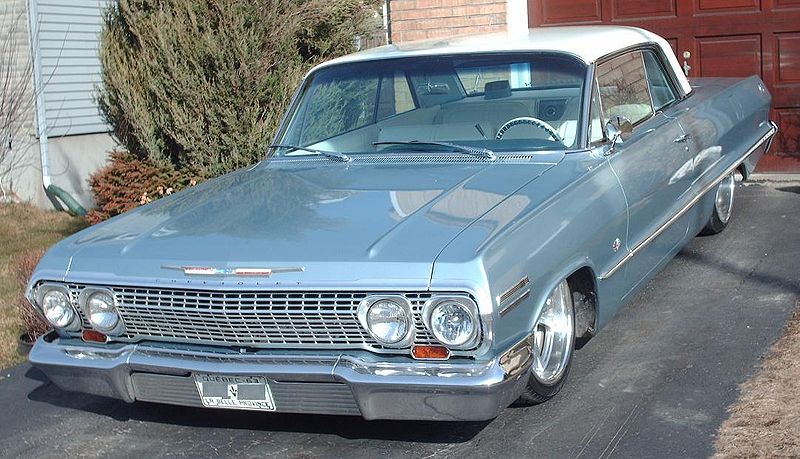
A Sunday morning drive in our ’63 Chevy Impala meant we’d soon be at church.
I was just a boy of three. It was Sunday, and time to go to church.
We lived near Clinton, New Jersey, but because there was no Nazarene church nearby, my parents loaded me and my two older brothers into our ’63 Chevy Impala. We drove 45 minutes down the highway to the Edison Church of the Nazarene.
When I would see the turn-off ramp, I would know that we were close to church. Excitedly, I’d say to my father: “Church, Dad!” I’d keep repeating the phrase until Dad would give-in and respond: “Yes, church, Greg.” I’d then make the rounds: “Church, Mom!” Finally, I’d insist on the same “Yes, church, Greg” response from my older brothers, David and Mark. It was a fun game…at least the first thirteen times.
My brothers grew tired of it. As we climbed into the Chevy the next Sunday morning, they made their case. “Dad,” they pleaded, “Tell Greg he can’t say that anymore. It’s annoying.” One parental lecture later, I’d learned my lesson. As we got to the turn-off this time, I solemnly intoned: “I’m not going to say ‘church, Dad.” When there was no response, I repeated: “I’m not going to say ‘church, Dad.”
What was true for me as a young boy is still true today: Being excited about going to church depends upon understanding what church is all about.
The Oscars are over, and Daniel Day Lewis won the best actor award for his portrayal of our 16th President in “Lincoln.” Somewhere over the Atlantic, I treated myself to the movie, thoroughly impressed at how it captured a period that has always fired my imagination. (Bill O’Reilly’s Killing Lincoln was one of my favorite reads from last year, a book my dad and mom enjoyed and that kept me up until 2 a.m. one morning when visiting them).
Most of us know at least part of the famous “Gettysburg Address.” Far fewer are familiar with the majestic cadences of Abraham Lincoln’s Second Inaugural Address. Delivered on March 4, 1865, the speech is now engraved on the right wall of the Lincoln Memorial in Washington, D.C. After climbing the long stairs leading up to the shrine, I snapped this shot of the speech:
The Second Inaugural Address of Abraham Lincoln, 16th President of the United States
Like many words, “fundamentalist” can be a slippery one. At the turn of the 20th century in the United States, the word was made popular by a series of books called The Fundamentals, a 1910 work including 90 essays outlining orthodox Christian teaching. In recent years, however, the term has come to represent more an attitude than a doctrinal stance. Fundamentalists are those who seem focused on why they are “in” and others are “out.” It is a combative approach that emphasizes doctrinal purity over loving God and neighbor.
Nothing crystallized this sour-faced, narrow approach to religion better than our Gospel concert at the Temple. (The name of the church has been changed). My family was a Gaither rip-off, “The Croffords: Musical Messages with Warmth and Love.” Our high water mark was in ’75/’76 when my dad, mom, my five brothers and I recorded albums at Pinebrook in Alexandria, Indiana, the studio owned by Bill and Gloria Gaither. Usually we sang only on weekends, but this was at the time of Jerry Falwell’s “Moral Majority.” A meeting of pastors was being held during the week at the Temple, and – not knowing the political agenda – my dad agreed for us to come and present a mini-concert for those gathered.
We pulled out all the stops. Dad took off work, as did my oldest brother. Very exceptionally, my parents released us from school a few hours early that day so we could perform. Before the concert, we had changed into our outfits in the men’s room and had to step around a barber chair. Yes, they were giving haircuts in the men’s room of the church! That was odd, to say the least.
Now this was the day of polyester leisure suits, extended sideburns, and (for boys of any age) long hair. After the concert, we were packing up the sound equipment when one of the men from the local church came up to talk to my dad. “See those sons of yours?” (He pointed to two of my little brothers, aged 6 and 7 at the time). “You really need to get their hair cut. They look like girls. Don’t you know that the Bible says that ‘It’s a shame to a man to have long hair'”?
My dad is soft-spoken, but this man had captured his attention, and not in a good way. “Really?” he countered. “Where exactly does it say that in the Bible?” The accuser left and huddled with a few others in the back of the sanctuary. In a few minutes, he returned and confidently intoned: “1 Corinthians 11:14 – ‘Does not even nature itself teach you, that, if a man has long hair, it is a shame unto him?” Nonplussed, my dad replied: “And what does ‘long’ mean? I have a friend whose hair is very short. He’d say that your hair is too long!” “Oh, no” he answered. “My hair is just right!”
Seeing that the conversation was going nowhere, my dad concluded: “You know, I took off work today. So did my oldest son. Exceptionally, we even pulled our other sons out of school so we could come today as a family and sing this concert because the Temple asked us to do so and we hoped to be a blessing. And after all that, did you come up to tell me that you appreciated the concert, that you had been blessed? No – instead, all you have told me is that my sons’ hair is too long. I think that’s pretty sad.”
That story happened 37 years ago, yet in some quarters, little has changed. There are still groups of sour-faced fundamentalists in churches whose mission is finding fault with other believers. They criticize professors who try to clothe the gospel in terms that will resonate with the current generation, even though the essence of the timeless Gospel message they present remains unchanged. Rather than penetrating the culture in winsome ways, sending out our young people to change the world, fundamentalism is the “pull up the drawbridge” mentality. It is always “us” vs. “them.” It has forgotten that the most effective evangelism is not hiking up the hems of our holy robes so as not to be sullied by the “world.” Rather, it is finding areas of common humanity with all people, then using these to build relationships with those who so desperately need Jesus. If all we ever read are Christian novels, listen only to Christian music, and limit ourselves to “churchy” things, what springboards for conversation will we have with those who have no interest in all that?
Can’t do the “Harlem Shake” – that’s demonic.
Can’t read (fill in the name of popular fun book) – that’s “worldly.”
Can’t listen to this music, or that.
Can’t, can’t, can’t…
And then we’re surprised when we’re unable to sustain a 5 minute conversation with a non-Christian?
In the Garden of Eden, God told Adam and Eve that they could eat of any of the many trees in the garden, except one (Gen. 2:16-17). So why are we hanging “don’t touch” signs on so many trees, wholesome activities that God has made for our enjoyment?
There was a time when I was ready to do battle over a long list of things. Maybe it’s just that I’m growing older and realize that life is only so long, but my list of “non-negotiables” has gotten a lot shorter. Yes, there are things we should avoid. Some activities are not wholesome and – if persisted in – will begin to cut off our relationship with God. But we should be careful in our world that has lost its sense of moral direction not to over-react, erring in the opposite direction, placing out-of-bounds many of the good things God intended for our benefit.
Paul gives us helpful advice:
“Finally, brothers, whatever is true, whatever is noble, whatever is right, whatever is pure, whatever is lovely, whatever is admirable–if anything is excellent or praiseworthy–think about such things”(Phil. 4:8, NIV).
What an amazing world God has gifted to us! Let’s shake off the fault-finding, narrow spirit of fundamentalism. Let’s turn our young people loose; let’s send them out to affirm all that is good in God’s creation, modeling a wholesome life centered around loving an incredible Saviour, a love that can’t help but love others. Now that’s Good News!
James Dobson, Ph.D., well-known child psychologist
On December 14, 2012, a gunman entered Sandy Hook elementary school in Newtown, Connecticut. After a shooting rampage, 26 lay dead, among them mostly children.
Inevitably, there was a single question that arose in the face of such a tragedy: Why?
Many answers have been offered to that question, but one of the most ill-advised was that of Dr. James Dobson. In a December 27, 2012 radio broadcast (click here to listen), Dobson spent the first ten minutes or so reading a letter he had produced thirty years earlier, lamenting the breakdown of the family. Here he was on solid footing, clearly commenting within the area of his own professional expertise. Though Dobson has chafed in the past when critics have wrongly called him a preacher or evangelist, this did not prevent him from speculating about how God fits into the picture, comments picked-up and critiqued in multiple media outlets:
I am saying that something has gone wrong in America. We have turned our back on God. Millions of people have decided that God doesn’t exist or He’s irrelevant to us. And we have killed 54 million babies…I think we have turned our back on the Scripture and upon God Almighty, and I think He has allowed judgment to fall upon us. I think that’s what’s going on.
Like James Dobson, I lament the 54 million unborn babies lost to abortion since the legalizing of Roe v. Wade in 1973. However, there are multiple problems theologically with Dobson’s statement. Here are some of the questions that arise:
1. Would God retaliate for 54 million abortions by allowing the killing of elementary school children?
These are not Dobson’s words as such, but in context, it is his clear implication. God allowed – on Dobson’s reading – “judgment” to fall on America. Apparently, the gunman was the instrument of that wrath. Yet did not Jesus say: “He who has seen me has seen the Father” (John 14:9b, NIV)? If you want to know what God is like, look at Jesus. Our Savior is the one who took little children on his lap, hugged them, laughed with them, and told us that if we want to enter the Kingdom, we must become like them (Matt. 18:3). What a picture of unconditional love! God is not let off the hook by Dobson’s insertion of the word “allowed,” as if making God a bystander somehow lessens the offense. Child protection agencies recognize that child abuse is not the only way children are harmed; child neglect can be equally harmful to a child’s well-being. By Dobson’s logic, by allowing the gunman to go on his rampage, God neglected those children that day, supposedly to allow God’s “judgment” to fall. If Dobson is correct, how could we worship such a God?
2. Is there an “evil streak” in God?
We serve a God who is just. God cares deeply about sin, and constantly warns us against its negative effects (Galatians 6:7, Romans 6:23). But James Dobson’s comments go beyond the image of a God of justice, painting instead an evil God.
I’m reminded of a story of a old golfer with salty language. One day, his pastor invited him out to golf. On the first hole, the old man stepped up to the tee, swung at the ball and totally failed to connect. “Darn’t!” he cried. “I missed.” Surprised, the preacher warned him: “You need to watch your language. God doesn’t like it when we talk that way,” to which he replied: “Nah, it’s no big deal.” On the second hole, the same scenario repeated itself – another swing, another miss. “Darn’t, I missed” he swore. “I told you on the last hole, God doesn’t appreciate that kind of talk” the pastor warned. Again, the old man shrugged it off. Finally, on the third hole, he swung like before and totally whiffed. Yet again, he griped: “Darn’t! I missed.” Suddenly, the skies opened up and a bolt of lightning descended, striking the pastor dead. Then came a booming voice from heaven: “Darn’t! I missed!”
If the killing of 26 at Sandy Hook was truly a demonstration of God’s judgment, we must admit that God had lousy aim, punishing the wrong individuals. In Ezekiel 18, God affirms that each of us bear the weight of our own sin, that judgment comes upon the guilty party and not upon the innocent. To say that God allowed a gunman to mow down school children in a hail of bullets is to make God the de facto executioner . In this way, shall we passively attribute to our just and loving God such a callous and wicked act? To do so would be to project upon God a darkness that is foreign to the divine nature. John affirms:
God is light. In him is no darkness at all (1 John 1:5, NIV).
A dark cloud, an evil presence, invaded Sandy Hook on that day. A Hindu could believe that God – like the Force in Star Wars – has a “dark side” and a “light side,” but Christians dare not tolerate such a foreign idea in our theology. Shall we claim that God had anything to do – even passively – with that dark presence at Sandy Hook? How does that begin to fit with what we know about the character of God as revealed in Christ?
3. Are God and humans the only actors on the stage?
A final concern with James Dobson’s comments touch upon who exactly are moral agents with the power of free will. In theologies that over-accentuate the sovereignty of God – a God who controls all events in the minutest of detail – one is obligated to try to discern God’s plan in every circumstance, even the most egregious acts. Either God directly caused it or – to use Dobson’s language – “allowed” it. On the other hand, Gregory Boyd in God at War argued that God is not all powerful in so far as others also have volition that God has freely granted to them.
Who are these others?
These include human beings but also faithful angels and rebellious angels, including the devil and his demons. Since the Fall in Eden, Boyd argues that earth has become a battlefield. On such dangerous terrain, innocents are sometimes caught in the cross-fire. They may be injured, even killed. Through the Christ event – his incarnation, life, death, resurrection and ascension – God has won a decisive battle, but the war will not end until the return of Christ in triumph. Meanwhile, we live in the precarious parentheses when the reign of Christ has been inaugurated but awaits final consummation. In this “already/not yet” of human history, terrible things still happen, yet we put our trust in a God who ultimately will defeat the forces of evil.
This acknowledgement of multiple actors on the stage frees us up to imagine other possibilities. I don’t for one minute believe that God had anything to do with the massacre at Sandy Hook, either actively or passively. What was God doing that day? God was surely seen in the heroic, selfless acts of administrators and teachers who laid down their lives for their students. God was there in the great calm granted to other teachers as they comforted their students, leading them hand-in-hand to havens of safety outside. God was there as reflected in the quick thinking of some teachers who hid their children in classroom closets and cupboards, and God was there in the warm embrace of first responders and churches who brought solace to the grieving. Evil showed up at Sandy Hook that day, but it was hardly a sign of God’s judgment. Rather, in the face of that evil our active and loving God was on the job as always, using people as divine instruments to bind up the wounds of the traumatized and the brokenhearted.
Conclusion
Dr. Dobson has earned the respect of many for giving sound advice on the family across the years, but in this instance, I think he misspoke, for the reasons I’ve outlined. Of course, this happens to all of us now and then. Hopefully he can revisit the issue in a later broadcast and clarify his remarks.
Greg discovers Tracy & Ingersol’s What is a Nazarene? at a Johannesburg secondhand bookshop
Note:This sermon inaugurated a series entitled “Christian, Holiness, Missional: Core Values in the Church of the Nazarene” at the Maraisburg Church of the Nazarene in Johannesburg, Republic of South Africa. What follows is not a word-for-word transcript, but captures the essence of what I said.
——————————-
Opening remarks
It’s a joy for Amy and me to be with you today. We’ve visited several churches in Johannesburg area, and knew when we worshiped with you that this would be our church home.
When I was a boy, for a period of about 10 years, my family traveled around to various churches and gave Gospel concerts. Looking at this building this morning, which used to belong to a Dutch Reformed congregation, I’m reminded of one of those concerts in Marion, New York. We sang at the Dutch Reformed church, and as usual, set up our sound equipment on the platform prior to the concert. Some of you who know sound equipment might remember high impedance systems. One curious thing about them was the microphone cords couldn’t be longer than 15 feet, or you would lose signal. Because of this, my dad that Sunday morning had to stretch the microphone cords about 4 feet high across the paneled wall at the back of the platform to plug into the amplifier.
My older brother, Mark – probably 11 or 12 at the time – was an avid reader of the Hardy Boys detective series. One of the books was entitled “The Case of the Secret Panel.” As we sat listening to the organist play the prelude, and the congregation filtered in, Mark looked at that front panel where the microphone cords were stretched taut. “Dad,” he said, “I think there’s a secret panel on that wall.” My dad rolled his eyes and said: “Mark, I think you’re reading too many Hardy Boys books.”
Strangely, we hadn’t seen the pastor in a while. All of the sudden, can you believe it? A panel in that platform back wall opened up, and out came the pastor. When he saw the cords there, much to the delight of the congregation, he nimbly hurdled them like an Olympic champion!
I want you to know this morning that I’ve checked the paneled back wall here at Maraisburg church, and I can assure you that there is no secret panel.
SCRIPTURE READING: 1 Peter 4:12-19 (TNIV)
– Prayer –
I. INTRODUCTION
Today, we begin a series on the core values of the Church of the Nazarene.
That’s a fancy way of answering the question: What is a Nazarene?
You may have seen the booklet a few years back, authored by the General Superintendents of the Church of the Nazarene. Here’s how they answered that question, “What is a Nazarene?”
Nazarenes are…
1) Christian
2) Holiness
3) Missional
In coming weeks, Pastor Kenneth and other preachers will address the second and third points. Today, we’ll look at the first one:
Most of us are concerned about our children. We hope and pray as they grow up that they will stick with the faith we tried to instill in them as they grew up. Much of this “education” we leave to the Church, however, which isn’t always successful in making our hopes and prayers come true with our children.
I came across an essay by a guy named Marc Solas about this very point. I don’t know much about him but he makes some good points that all of us in the Church should consider. Let me quickly add that many of the points which he makes do not fully describe the church I currently attend, or have attended or pastored in the past, but all his points should give us something to consider as we seek to be the church God calls us to and further seek to preserve our…
As believers, do we follow grace, or do we follow law? And the answer is…
YES.
John Wesley spoke as much as anyone about grace. On the other hand, he cautioned against “antinomianism” (lawlessness). He realized that the same Scripture that speaks of the grace that saves us through faith (Eph. 2:8) also extols the perfect law of liberty (James 1:25).
In the Bible and in Wesleyan thought, grace and law must kiss.
I’ve always loved “America the Beautiful.” The lyrics by Katharine Lee Bates portray this delicate balance. The rarely sung second verse appeals:
O beautiful for pilgrim feet Whose stern impassioned stress A thoroughfare of freedom beat Across the wilderness! America! America! God mend thine every flaw, Confirm thy soul in self-control, Thy liberty in law!
“Liberty” and “law” are not mutually exclusive, but complement each other.
Pastors are charged with the “cure of souls,” and for that cure to be successful, first a diagnosis must be made. Thirty years ago, I knew too many Nazarenes who for the sake of law, lost sight of grace. The early 20th century story (likely apocryphal) is told of the old woman who asked General Superintendent Phineas F. Bresee whether Nazarene women should wear makeup. His reply?
I’ve always said that if the barn needs painting, paint it!
That woman’s question betrays a graceless law, a piling up and keeping of rules as the be-all and end-all of faith. In such a context, an emphasis on grace was desperately needed, and eventually the corrective came.
But as Bob Dylan used to sing, the times, they are a changin’! Once heated discussions of whether we go to the movie theater, wear makeup or jewelry or participate in “mixed bathing” are relegated to cold and musty issues of the Herald of Holiness and Teens Today. When Christian teens in 2013 show the same rates of sexual activity prior to marriage as those who claim no faith, when cheating on a test is winked at and often there seems to be no difference between the integrity of those attending church and those who never darken its doors, then clearly the issue for the Church is no longer graceless law. Rather, we have arguably careened into the ditch on the other side of the road, that of lawless grace, the antinomianism John Wesley warned us about and that Paul deplores in Romans 6:1 —
Shall we sin that grace may abound? God forbid! (NIV).
And here is where we come back to the pastor’s diagnosis. In a church where graceless law is the malady, more preaching on grace is a must. After all, you wouldn’t add more salt to a spaghetti sauce that is already too salty!
But for 90% of our churches, in the name of grace, I wonder: Are we stuck in the ditch of lawlessness? Lawless grace is every bit as dangerous, after all, as graceless law. In such a church, the pastor today in his or her preaching will speak often of Christian ethics, of the righteous standards to which God calls His people. When the spaghetti sauce is too bland, add a pinch of salt.
At the end of the day, neither graceless law nor lawless grace can satisfy God’s people. Grace and law must kiss. We need gracious law now more than ever.
The songs we sing betray the theology we hold. In a church we recently visited, two lines from the choruses jumped out at my wife and me:
“I am a friend of God…He calls me friend.”
“He took the fall, and thought of me above all.”
There’s nothing wrong with experiential religion. As Wesleyans, we celebrate John Wesley’s “heartwarming” experience on Aldersgate Street in London 24 May 1738 when he received the assurance of his sins forgiven and reconciliation with God. God loves and cares for us and wants to enter into relationship with us. Still, I wonder: Does God exist for my sake, or do I exist for God’s?
Researchers Christian Smith and Melinda Lundquist Denton set out in 2005 to understand the religious worldview of American teenagers. What they discovered was a truncated Christian understanding that they dubbed MTD – Moralistic, Therapeutic Deism. MTD gives little thought to historic beliefs like resurrection, incarnation, sin, justification, or sanctification. Instead, what matters most is “being nice,” acting like a good, moral person – the “M.” Heaven exists and good people one day will get to go there. Further, God is someone to whom we can turn in times of trouble, but most days God doesn’t enter our consciousness – the “T.” But if skyscrapers start falling as on September 11, 2001, we run to God to comfort us. Finally, God is like the remote deity of 18th century deism, the Creator who is far away, uninvolved in our lives on a daily basis – the “D.”
How did we get to the place where God is nothing more than our lucky charm, a grandfatherly, non-demanding life coach to help us succeed? Albert Mohler places much of the blame at the feet of grown-ups:
All this means is that teenagers have been listening carefully. They have been observing their parents in the larger culture with diligence and insight. They understand just how little their parents really believe and just how much many of their churches and Christian institutions have accommodated themselves to the dominant culture. They sense the degree to which theological conviction has been sacrificed on the altar of individualism and a relativistic understanding of truth. They have learned from their elders that self-improvement is the one great moral imperative to which all are accountable, and they have observed the fact that the highest aspiration of those who shape this culture is to find happiness, security, and meaning in life.
Mohler doesn’t criticize evangelism plans, so I’ll do it for him. For years, the 4 Spiritual Laws was the default method for presenting the Gospel. That presentation begins with the affirmation that “God has a wonderful plan for your life.” Notice who is at the center of that message? It’s YOU! You’re the one that counts. You’re so important that the God of the universe’s reason for being is you and this supposed tailor-made plan. You are the sun, and God is merely Jupiter, the largest planet revolving around you.
I don’t buy it. The Bible lays out principles for living that don’t put us at the center, but God. There are general guidelines for living — “Love God, love your neighbor.” There are the 10 Commandments and the Beatitudes. If we live those out, then we are accomplishing God’s will for our lives. It’s all about God, not about us. Find out where God is at work, and join God’s mission. You don’t need a special invitation. We already received one in Scripture.
But let’s go back to those choruses cited above. They fail because they place the individual at the center rather than God. I’m not interested in fighting the so-called “worship wars” all over again, but you have to admit that some of the old hymns got it right. They exalted the Divine, God’s glorious attributes, effacing us and praising the Lord:
Immortal, invisible, God only wise!
In light inaccessible, hid from our eyes.
Most blessed, most glorious, the Ancient of Days
Almighty, victorious, Thy great name we praise.
Bring back the theological debates. Let’s discuss predestination, free grace, sovereignty, salvation and providence. At least these weighty topics are worthy of our time and point us away from ourselves and self-interest to the character of God and how we can bring God glory. The only antidote for those infected with MTD is to get our eyes off ourselves and our own petty interests, to put God back at the center where God belongs, in both our lives and our worship.
I remember the moment when I first heard the word “abortion.” It was 1979 in Mrs. Ruch’s 10th grade English class and it was student debate day. In a twist on “show and tell,” my female classmate arguing against abortion brought pictures. They say a picture is worth a thousand words. From that day forward, I knew that abortion was to be avoided.
Theologians speak of the “optimism of grace.” But what does it have to contribute to the topic of abortion? The grace described in Scripture extends to all individuals. There is no nook or cranny of God’s creation where God’s seeking grace is not actively present! It reaches to the condemned prisoner on death row, to the woman unhappily pregnant, and to the developing child in her womb. The Psalmist’s words celebrate this pervasive presence of God:
Where can I go from your Spirit?
Where can I flee from your presence?
If I go up to the heavens, you are there;
if I make my bed in the depths, you are there.
If I rise on the wings of the dawn,
if I settle on the far side of the sea,
even there your hand will guide me,
your right hand will hold me fast.
If I say, “Surely the darkness will hide me
and the light become night around me,”
even the darkness will not be dark to you;
the night will shine like the day,
for darkness is as light to you.
For you created my inmost being; you knit me together in my mother’s womb. I praise you because I am fearfully and wonderfully made;
your works are wonderful,
I know that full well.
My frame was not hidden from you
when I was made in the secret place,
when I was woven together in the depths of the earth. Your eyes saw my unformed body;
all the days ordained for me were written in your book
before one of them came to be.
– Psalm 139:7-16 (NIV, bolding added)
The Christmas story recounts how God used a baby to answer the cries of the downtrodden, people suffering under the crushing dual burden of oppression and sin. The incarnation – God taking on flesh – was a rescue plan. Jesus was Immanuel, literally “God with us” (Matthew 1:23). The LORD saw a dilemma and devised a solution. To solve problems, God uses people. In the case of Mary, God used an unwed mother in shameful circumstances to change the course of human history.
Environmentalists speak eloquently of deforestation as the destruction of cures for diseases known and yet unknown. When we clear-cut rain forest, we are destroying forever undiscovered medicines that one day could have cured cancer or a hundred other ailments.
Why is it what we understand about the earth’s natural resources we are blind to when it comes to human resources? In the United States, among the 55 million unborn children aborted since Roe v. Wade became law in January 1973, it is sobering to think of the immense lost potential. Yes, some would have become criminals; let’s not be naive. That is the human condition in a fallen world. Yet others would have been painters, sculptors, teachers, inventors, nurses, plumbers, and carpenters. Perhaps a half-dozen Nobel Prize winners never saw the light of day, the “smoldering wicks” (Isaiah 42:3) that God intended to fan into bright and blazing fires. How many intractable problems persist because the solutions we so long prayed for – creative solutions that God was sending our way in the form of babies – were short-circuited in the womb?
The optimism of grace is really the optimism of love. It says that no matter what mistakes any of us have made – including abandoning our responsibility as would-be dads and moms – there is a place of beginning again! None of us is so broken that Jesus can’t bind up our wounds. And as Jesus brings healing and forgiveness, each of us is part of his restoration team. Are we willing to put an arm of comfort around those who mourn poor choices? Are we willing to be practical support for each other in community solidarity? As Reuben Welch used to preach, “We really do need each other.”
Abortion is the tragic failure of imagination. Together, we can do better.
It was a stunning victory, a serpent-smashing triumph. Paul explains:
When you were spiritually dead because of your sins and because you were not free from the power of your sinful self, God made you alive with Christ, and he forgave all our sins. He canceled the debt, which listed all the rules we failed to follow. He took away that record with its rules and nailed it to the cross. God stripped the spiritual rulers and powers of their authority. With the cross, he won the victory and showed the world that they were powerless (Colossians 2:13-15, NCV, bolding added).
This militant tone is woven through Colossians 1 & 2. In 1:13, the Apostle rejoiced that “God has freed us from the power of darkness, and he brought us into the Kingdom of his dear son” (NCV). Having been liberated, we must avoid being recaptured through “philosophy and empty deception” (2:8, NASB).
Sometimes theologians are uncomfortable with the Christus Victor motif in the New Testament. It doesn’t seem to fit very well with “loving God and neighbor,” the watchword of relational theology. But the two needn’t be seen as contradictory. If someone is captive, only love is a strong enough motivation for daring raids behind enemy lines.
Yet Paul understood the importance of balance. In Colossians 3, he urges patience, compassion, and humility, then caps it off with a call to love:
Beyond all these things put on love, which is the perfect bond of unity. Let the peace of Christ rule in your hearts, to which indeed you were called in one body; and be thankful (vv. 14-15, NASB).
There is a place in Christian theology for both Mildred Wynkoop and her emphasis upon love and Gregory Boyd and his image of earth as a spiritual battlefield. There is room for both because the New Testament speaks of both. What God has joined together, let no one put asunder.





 Gregory Crofford