Posted in reflections

Ayn Rand, Blaise Pascal and atheism

Ben Witherington of Asbury Seminary dug up a fascinating Phil Donahue interview with the late objectivist philosopher, Ayn Rand.


In the interview, Rand calls religious faith “a sign of psychological weakness.” Also, like astronomer Carl Sagan, she subscribed to the so-called “steady state theory,” that the universe has always existed, obviating a need for a Creator God.

You can read my take on Rand’s philosophy in my review of her massive and meandering Atlas Shrugged.

Ayn Rand is not alone in her atheism. According to the Pew Research Center, 12% of the population of the United States self-identifies as atheist. In college, I became acquainted with “Pascal’s Wager”(or “Gambit”)  by reading Blaise Pascal’s most famous work, Pensées. In Thought 233, Pascal affirms:

Let us weigh the gain and loss in wagering that God is. Let us estimate these two chances. If you gain, you gain all; if you lose, you lost nothing. Wager then without hesitation that God is.

Many have lodged objections to Pascal’s Wager. Could the same argument, for example, not be made for any god, not just the Christian God?

At the end of the day, while Pascal’s Wager may re-affirm a believer in his or her faith, I don’t think a non-believer can be argued into belief in the God of Scripture. Even Pascal famously admitted: “The heart has its reasons, which reason does not know” (Thought 277). Experience plays a huge role in our decision to affirm faith or renounce it. But what systematic thinking about our faith can do is to engage our intellect in the love of God. Jesus calls us to love God with heart, soul, strength, and mind (Luke 10:27). Our faith should be a reasoning faith, even if ultimately in this world it rests outside the realm of proof.

————

Photo credit: Britannica Kids

Posted in From soup to nuts

A Publishing House for a Peculiar People

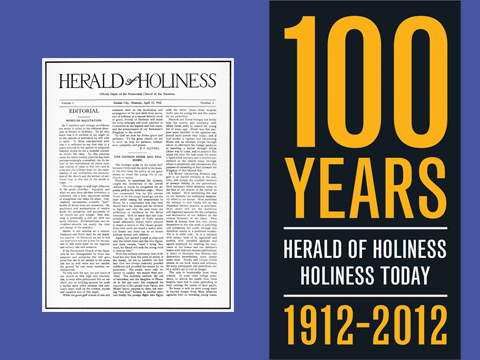
Here’s a taste of an essay I wrote for the NNU Wesley Center, looking back at the Herald of Holiness 100 years ago:

Multiple editorials in the early pages of Vol. 1 No. 25 urged pastors, evangelists, and church members to view theHerald and books that would be produced as an essential way to increase the effectiveness of holiness evangelism.  As a former pastor who has heard many sales pitches at District Assembly from a representative of Nazarene Publishing House, it’s intriguing to see that this approach has a long pedigree!

Read the whole blog here.

Plus ça change…

Posted in missions & evangelism

Team spirit wins the gold

How is being a missionary different than another position like a pastor or an evangelist? – Ben Mauldin (student, Southern Nazarene University)

The Church is like the Olympic Games. Every follower of Christ represents “Team Jesus,” yet each team member competes in a limited number of events. No doubt a basketball player in a pinch could play table tennis and a water polo player could swim the 50m freestyle, but would that be the best use of their abilities? Likewise, God recognizes that the Church will be most effective in fulfilling its purpose if believers are allowed to specialize. In Ephesians 4:11-12, there are several such specialized roles listed, including pastor, evangelist, and apostle.

The dominant image in the New Testament for pastor is shepherd. Peter urged: “Be shepherds of God’s flock that is under your care…”(1 Peter 5:2, NIV). In the same passage, Peter calls them to “oversee” those entrusted to their care. The pastor provides spiritual care through preaching, administration of the sacraments, hospital visitation, counseling and other means. Sometimes this is directly, but as the church grows this is often done by organizing others with similar gifting to fulfill these roles.

Continue reading “Team spirit wins the gold”

Posted in missions & evangelism

Looking at life through Congolese glasses

I’ve been in Goma (Democratic Republic of the Congo) teaching a course to 23 students, both pastors and lay persons. What a city this is! They say that 150 non-governmental organizations (charities) have set-up shop in this dusty town that lies in the shadow of active volcanoes. As my driver has shuttled me back-and-forth to class over the bumpy roads, I’ve often wondered how my life would have been different if I was born here instead of the United States.

Though I’ve lived in Africa at various times – cumulatively for 12 years – I don’t pretend to know everything there is to know about this amazing continent. First of all, there is no such thing as “African culture.” Africa is a big place, and sub-Saharan Africa has many cultures.

In Paul Hiebert’s book, Anthropological Insights for Missionaries, he outlines 14 characteristics of a Western missionary’s worldview. These formed the basis for one of my class lectures. Since turn-about is fair play – and effective adult education – I gave my Congolese students a homework assignment. “Imagine” I said “that you were sent as a missionary to Brooklyn, New York. Make a list of five characteristics about Congolese culture where you live that these Americans would need to know about you.

Continue reading “Looking at life through Congolese glasses”

Posted in ecclesiology & sacraments, missions & evangelism

Advance through Storm: Theological Education in the Church of the Nazarene

I.   The  Storm of False Teachings

Storms don’t exist only in the physical realm; they are also a spiritual reality. The Church is like a ship. As we take on passengers who were adrift, lost and perishing in their sin, the enemy of our souls will do his best to stir up “storms,” anything to impede our progress and keep us from our primary mission. If possible, he’d love to sink the ship!

Indeed, the apostle Paul compared false teachings to dangerous high winds. In Ephesians 4:14, he warns against being “blown here and there by every wind of teaching and by the cunning and craftiness of people in their deceitful scheming” (NIV). But how can this be avoided? Verse 13 gives the answer. We must be both unified and mature, a result of the “knowledge of the Son of God.”

Sadly, knowledge of the basics of true Christian faith is often lacking, making the unsuspecting vulnerable to false teaching. When visiting recently with one of our Nazarene church leaders in an African country, I asked: “What is the greatest challenge our church faces in your country?” It only took a few seconds of reflection before he replied: “The prosperity message.” He was concerned that this false idea was destroying churches, disillusioning people by promising them great riches. When the promised return never comes, they tend not to blame the charlatan who pockets their money but the God who they think let them down. They become inoculated to the genuine Gospel, a version of the old proverb: “Once burned, twice shy.”  The “high wind” of false teaching can carry away those who are not properly anchored in sound doctrine.

Continue reading “Advance through Storm: Theological Education in the Church of the Nazarene”

Posted in missions & evangelism

Meet Duane and Mary Spaulding, World Christians

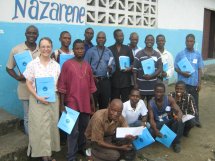
Dr. Mary Spaulding with students in Monrovia, Liberia

I.          What is a “World Christian”?

What do you think of when you hear the term “world Christian?” According to David Bryant in his article, “To Be a World Christian,” the term was first coined by Daniel Fleming in his 1920 YMCA book, Marks of a World Christian.  Bryant described a “World Christian” as one who is driven to “reach out with God’s love to the ends of the earth.” Because there is a “Gap” between God’s purpose for humankind and the fulfillment of that purpose, the World Christian will re-orient his or her life to help close that Gap. Bryant observed:

Some World Christians are missionaries who stand in the Gap by physically crossing major human barriers (cultural, political, etc.) to bring the Gospel to those who can hear no other way. But every Christian is meant to be a World Christian, whether you physically “go”,or stay at home to provide the sacrificial love, prayers, training, money, and quality of corporate life that backs the witness of those who “go.”

source:  http:// http://www.thetravelingteam.org/articles/be-world-christiantravelingteam.org

The history of missions in the Church of the Nazarene is filled with stories of men and women who stood in the gap. Some of the personalities are well known and loom large, names such as Harmon Schmelzenbach and Esther Carson Winans. Others are merely a footnote, but each has the common element of answering the call from Isaiah 6:8: “Whom shall I send? And who will go for us?”  To this Isaiah answered: “Here am I! Send me!” (v.9).

Continue reading “Meet Duane and Mary Spaulding, World Christians”

Posted in missions & evangelism

The Global South: Christianity’s Cutting Edge

 I.  Introducing the “Global South”

Take a minute and think about the “typical Christian.” Where do they live? How old are they? Are they male or female? If you’re like many Westerners, you probably thought of a middle-aged white man living in Nashville, Tennessee or London, England. According to the missions website, “The Traveling Team” (www.thetravelingteam.org), that description would have been accurate in 1907, but in 2007, just one hundred years later, the portrait has drastically changed. The “typical Christian” is now black, African, female, and around the age of 28!

Philip Jenkins in The Next Christendom: The Coming of Global Christianity, traces this shift in Christianity’s center of gravity to what he calls the “Global South.” If current trends continue, Christian churches found in Western countries like the United States, France, Italy and the United Kingdom will see further decline, in part due to low birth rates and strong secular trends.   At the same time, a rising tide of conversions to Christ and higher birthrates on three continents – Africa, Asia and Latin/South America – means that Christianity will continue the explosive growth that began in the 20th century. By 2025, Jenkins estimates that there will be 2.6 billion Christians in the world. Of this figure, 66% will be living in the Global South. Likewise, by 2050, for every two Muslims worldwide, there will be three Christians (Jenkins, 2-3, 6).

Continue reading “The Global South: Christianity’s Cutting Edge”

Posted in missions & evangelism, The Wesleys and Wesleyan theology

Three Wesleyan Reasons Why We Send Missionaries

“If you take missions out of the Bible, there is little left but the covers.” This statement from Nina Gunter captures a central theme in Scripture, the theme of the Church moving out into the world in response to the missio Dei, the “mission of God.”  Indeed, all that we do cross-culturally in the name of “missions” arises out of our understanding of God’s “mission.” God’s mission refers to God’s plan through Christ to save all of creation but especially the peoples of the world that are creation’s crowning achievement.

Because of the missio Dei, the Church moves out in missions. We do missions in a variety of ways, from preaching to teaching, compassionate ministry among the poor and oppressed and medical work with the sick and dying. But whatever form missions takes, we will not be able to sustain the work over the long-term if we lose sight of the reason why we send missionaries.

Theologians from various Christian traditions have emphasized different aspects of God’s mission. In this lesson, we will look at three biblical themes that apply to a Wesleyan view of mission: God as loving and holy, prevenient grace, and the need for humans to respond to God’s salvation offer. By looking at these themes, we will be reminded of the rationale for the sacrifices we make as a church. In times of discouragement and economic hardship, we will be encouraged to keep giving of our prayers, time and resources.

Continue reading “Three Wesleyan Reasons Why We Send Missionaries”

Posted in Christian ethics

Stanley Hauerwas and The Peaceable Kingdom: Part 4 of 4

“You can be committed to the Church but not committed to Christ, but you cannot be committed to Christ and not committed to the Church.” So said Joel Osteen.

Exactly why the church is important is unclear from Pastor Osteen’s quote. Such is not the case for Stanley Hauerwas. Like Osteen, he sees a large place for the church, but Hauerwas ties it directly to how we develop Christian ethics, particularly the ethic of non-violence.

In previous posts, we examined ideas from Chapters 1-6 of Hauerwas’ The Peaceable Kingdom: A Primer in Christian Ethics (Notre Dame, 1983). In this final essay, we turn to two ideas gleaned from Chapters 7-8, namely, the role of the Church in forging a Christian ethic and the “grace of doing one thing.”

Christian community and moral convictions

In earlier chapters, Stanley Hauerwas insisted that the Peaceable Kingdom was not about just any ethic, but the Christian ethic. The Christian ethic – in distinction from ethics that could be formed in other communities – is hammered out in a community with a unique story. The Christian community was brought into being by reflecting upon the story of Israel (Old Testament) and the life of Christ (New Testament) and continues to embody the ramifications of those stories. This narrative element is crucial in understanding Hauerwas’ methodology. The Christian ethic is modeled in positive ways by the life of the community, through the actions of individuals in the context of the group.  As an example, Hauerwas introduces the topic of abortion, observing about the positive modeling of community (p. 119):

…you learn about the value of life, and in particular human life that comes in the form of our children, because your community and your parents acting on behalf of your community, do not practice abortion. Therefore the negative prohibitions of a community though they often appear to apply to anyone because of their minimal character (e.g., do not murder) in fact gain their intelligibility from that community’s more substantive and positive practices. Prohibitions are the markers for the outer limits of the communal self-understandings. In short, they tell us that if we do this or no longer disapprove of that, we will no longer be living out the tradition that originally formed us.

Continue reading “Stanley Hauerwas and The Peaceable Kingdom: Part 4 of 4”

Posted in ecclesiology & sacraments

What will your contribution be?

Dan Ketchum gives an excellent summary of team leadership principles from John Maxwell. The key line? It takes teamwork to make the dream work.

Of the five principles given, the one that grabbed my attention was the “law of the niche.” Like on a football team, each person has a position where he or she plays best.

When I was pastoring, “Susan” (not her real name) was one of our most committed church members. At the time, we had a Caravan program (like Scouting) that was effectively serving our community. Susan admitted that working with children wasn’t her strong point, but she was willing, so she accepted the “Guide’s” book and reported for duty. Three months later on a Sunday night before the service, she came to me with tears in her eyes. “Pastor,” she said,  laying the guide book down, “I just can’t do this anymore. I tried, but I can’t.”

What had happened? Susan was a player playing in the wrong position. Later, she got involved in the women’s ministry program and did an excellent job. She had found her “niche.”

In “The Emperor’s Club,” Mr. Hundert knew about how important it was for people to find their niche, the place where they could most effectively serve. He teaches ancient history in an all-boys school. He mocks an arrogant and violent conqueror who later becomes a virtual unknown. Then he asks the wide-eyed students this haunting question:

“What will your contribution be?”

It’s a big world, and God needs world Christians. The question is: What is your niche? What will your contribution be?

——

Photo credit: Allmoviephoto.com