Posted in book reviews, reflections

New series on sin begins Saturday

It was one of those conversations not easily forgotten. “Greg,” a female colleague assured me, “when it comes to theology, I look at how most people are leaning, and I lean the other way.”

My professor friend understood that balance is a key to maintaining truth in the church. These days, I hear many extolling God’s soft side, lifting up grace and love. After all, isn’t that what good news is all about? But if we speak only about the solution and never about the problem, aren’t  we in danger of making salvation a remedy for an illness people don’t even know they have? The evil we have never acknowledged is the evil we are powerless to overcome.

Have we bought into the lie that people are by nature good? In our world of “I’m O.K. and you’re O.K.,” it’s time to remember that none of us is O.K. Left to our own devices, we’re all desperately  evil. That’s a nearly forgotten message, but profoundly biblical. For the sake of balance, it’s time to lean in the other direction. It’s time to face the bad news.

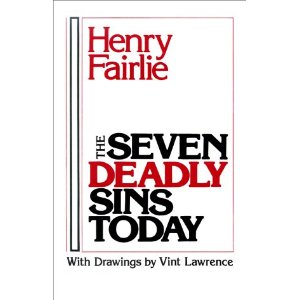
Enter Henry Fairlie’s The Seven Deadly Sins Today (Notre Dame Press, 1979). Chris Pollock, Senior High pastor at Bethany First Church of the Nazarene, recommended it, and at long last, Chris, I’m diving in! The book is divided into nine chapters. Beginning on Saturday, we’ll look at one chapter per week. I’m hoping that God will use this study as a mirror, showing me areas in my life where sin may still have a foothold, areas where God’s power still needs to cleanse and transform me.

How about you? Care to join me on the journey? See you Saturday!

Posted in book reviews

Howard Snyder on the kingdom

A group of theologians was discussing the Gospels. After a long exchange, one lamented: “Jesus promised us the kingdom, and instead all we got was the church!”

Many of us can identify with the frustration of our sister. She looked at the church with its divisions and failings and she desperately longed for something better.

If we ache for the full in-breaking of the kingdom of God in human history, there’s a reason. Jesus was the one who taught us to pray: “Your kingdom come, your will be done on earth as it is in heaven” (Matthew 6:10, NIV). The word “kingdom” appears 54 times in Matthew’s gospel alone. By comparison, the word “church” appears a mere three times. For this reason, some have called Matthew the “Gospel of the kingdom.”

For an idea so important to Christian theology, one would think that there would be unanimity about is meaning. If only life were so simple. In Models of the Kingdom: Gospel, Culture, and Mission in Biblical and Historical Perspective (Wipf and Stock, 2001), Howard Snyder investigates eight distinct ways that Christians across the centuries have interpreted the kingdom concept:

1. The kingdom as future hope;

2. The kingdom as inner spiritual experience;

3. The kingdom as mystical communion;

4. The kingdom as institutional church

5. The kingdom as countersystem;

6. The kingdom as political state;

7. The kingdom as Christianized culture;

8. The kingdom as earthly utopia.

The models evaluated

The first option only sees God’s kingdom in terms of Revelation 21, the New Jerusalem descending at God’s command. The kingdom is none of our concern; God will bring it about only as the final curtain descending on the stage of history. The second and third options allow for a present experience of the kingdom but spiritualize it. Jesus said: ” The kingdom of God is within you” (Luke 17:21, KJV). Howard Snyder (p. 41) calls this “Inner Kingdom” of the second option the most individualistic of all eight, whereas the “mystical communion” model at least has the merit of including a communal aspect. While John Wesley had some room in his thinking for other models, it is here where he placed his accent by underscoring the necessity first to save one’s own soul before turning to other tasks, such as helping others work out their own salvation or overturning the kingdom of Satan to set up the kingdom of Christ (Snyder, 62). Continue reading “Howard Snyder on the kingdom”

Posted in book reviews, Christian ethics

When rights are secondary: Duty rediscovered

Under guard and carefully preserved in the refrigerated atrium of the National Archives in Washington D.C. are the precious parchments upon which our country was founded. We reverently shuffled past the glass display cases, the low light barely illuminating the faded documents. To the left resides the Declaration of Independence while in the center is the Constitution. As we made our way to the right of the chamber a third document came into view. Dimly visible was the Bill of Rights, the sacred words that make up the first ten amendments to the Constitution.

Talk of “rights” is nothing new on the American scene. A course in American history is replete with the concept of rights, whether the rights of slaves to be free, the rights of women to vote or the rights of citizens to have access to affordable health care. But in our rush to claim our rights, more people are beginning to ask:

What is my duty?

Meic Pearse is one such voice. In Why the Rest Hates the West: Understanding the Roots of Global Rage (InterVarsity Press, 2004), he writes to those who have trouble understanding the context that gave rise to the atrocities of September 11, 2001. His argument is far-ranging, but a key plank in his thesis is the “me” orientation of Western (North American and European) culture vs. the “we” perspective of the non-Western world, what Pearse calls “the rest,” i.e. Africa, South America, and Asia. If the West were content to live out its radically individualistic credo without exporting it to the rest of the world, conflict could be avoided. However, in myriad ways, Pearse insists that countries like the United States are engaged in cultural imperialism, imposing our supposed superior values on others. One powerful source for this imperialism is media which includes sources on both sides of the political spectrum. Pearse observes (see Kindle location 1942):

Continue reading “When rights are secondary: Duty rediscovered”

Posted in book reviews, missions & evangelism

Dive deeper with THE HEAVENLY MAN

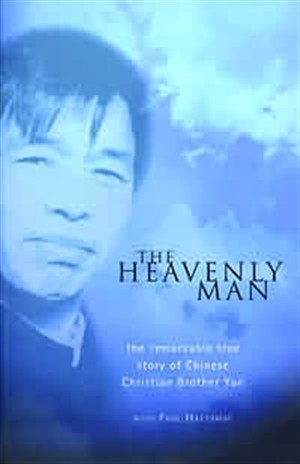
When it comes to knowing Christ, are you tired of splashing around in the kiddie pool? This year, if you want to dive deeper in your Christian experience, pick up a copy of The Heavenly Man (Monarch Books, 2002).

This story by Paul Hattaway of Asia Harvest Mission chronicles the tribulations and victories of Chinese evangelist Liu Zhenying, better known as Brother Yun. The title of the book comes from his first arrest by Chinese authorities. As he was be being interrogated and beaten, they asked him where he was from. Pastor Zhenying shouted: “I am a heavenly man!” For his refusal to stop preaching the gospel,  Brother Yun was locked away on three occasions, spending years in prison. Many of his guards came to faith in Christ, as did other prisoners. During his first stint in prison, he refused to eat or drink, laying immobile for 74 days. While that appears medically impossible, who are we to discount what God can do? In the same vein is Yun’s miraculous escape from prison, reminiscent of Peter in the Book of Acts.

There are several “take aways” after reading The Heavenly Man:

1. Memorize the Word of God. Often, Brother Yun was locked away by himself with no Bible. He had to rely upon what he had committed to memory. How well would we as Western Christians fare if the only Scripture portions we had were what was in our head?

Continue reading “Dive deeper with THE HEAVENLY MAN”

Posted in book reviews, missions & evangelism

Keeping missions aloft in the winds of change

I stepped onto a Boeing 737 headed for South Africa, admiring its sleek design and powerful engines. “What would Wilbur and Orville Wright have thought of this bird?” I asked my missionary colleague.  In a little over 100 years, aviation has changed massively. Yet despite the changes, some things have stayed the same. The same aeronautic principles that allowed the Wright brothers to float just above the beach at Kitty Hawk also lifted us thousands of feet into the air.

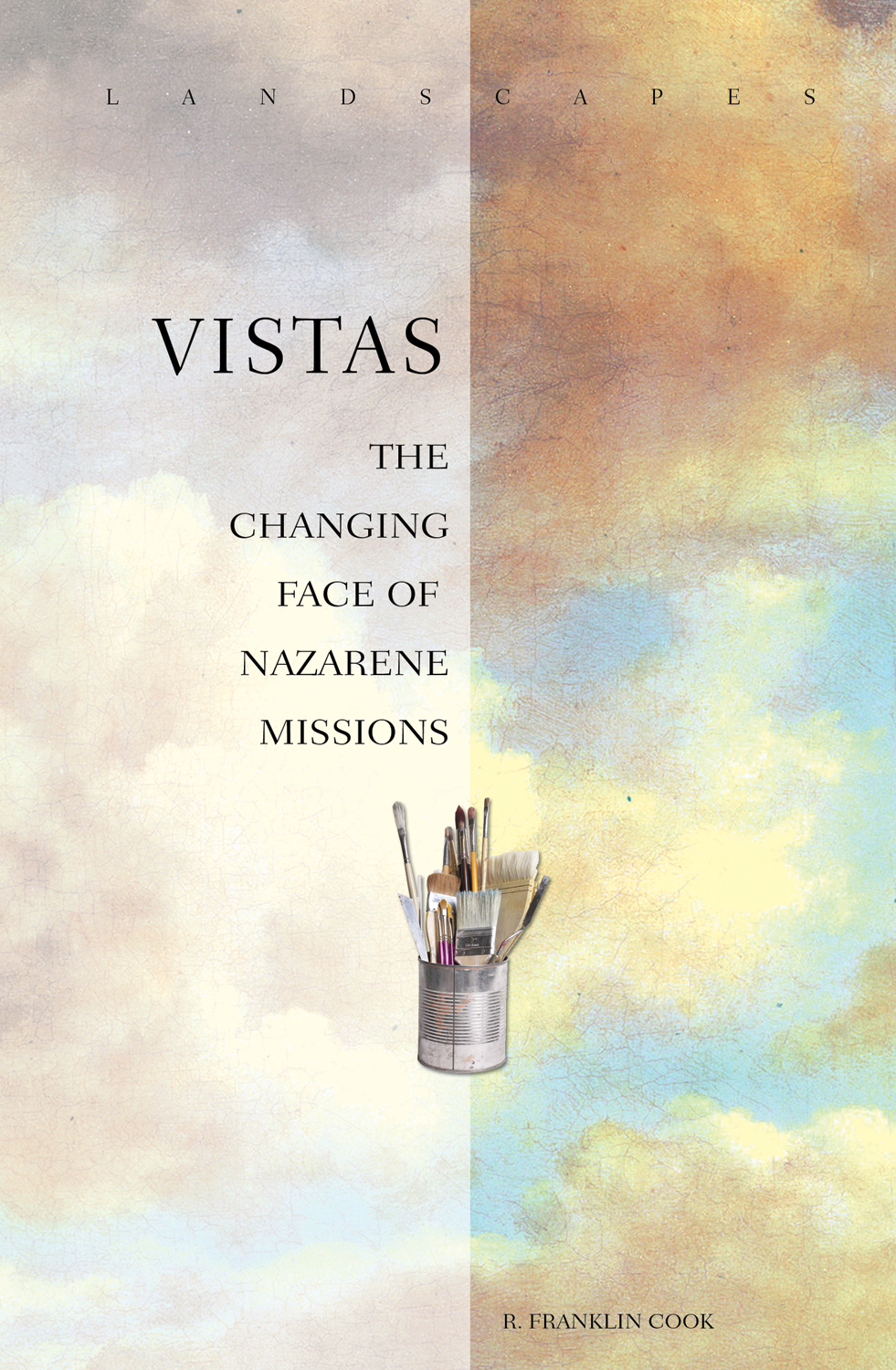
As with aviation, so it is with world missions. Amidst changes in how we carry out the mission, some principles have stayed the same. This is the message of Franklin Cook and five other veteran Nazarene missionary writers in the collection, Vista: The Changing Face of Nazarene Missions (Beacon Hill Press, 2009). Church planting movements and creative access missions are two of the new things that God is doing. Yet getting these efforts off the ground and keeping them aloft requires the “old fashioned” practices of prayer, discipleship, giving and education.

Some may argue that church planting movements are as old as the book of Acts, yet God does seem to be outdoing himself these days. Howie Shute describes the contours of a Nazarene Church Planting Movement (CPM) in Ethiopia, an exciting move of the Holy Spirit in our time. Growth happens most rapidly where focus is upon multiplication rather than addition. Shute emphasizes the necessity of passing along the “right DNA,” which means preaching and living holiness, churches planting churches in rapid succession and using local resources to get the job done (p. 48).

Continue reading “Keeping missions aloft in the winds of change”

Posted in book reviews

Randy Maddox recommends ‘Streams of Mercy’

Randy Maddox has recommended my monograph, Streams of Mercy: Prevenient Grace in the Theology of John and Charles Wesley (Emeth Press, 2010). Here’s what Maddox wrote in the on-line document, “Recent Dissertations in Wesley Studies, 2001-2008,” on the Duke Divinity School website:

Crofford provides the most thorough study to date of the roots of John Wesley’s understanding of prevenient grace in 16th-18th century Anglican, Puritan, and Dissenting theologians, with particular emphasis on Wesley’s indebtedness to Robert Barclay. To this Crofford adds the first detailed exposition of the theme of prevenient grace in the writings of Charles Wesley.  He concludes with a survey of how recent Wesleyan theologians have appropriated and applied the theme of prevenient grace.

To order the book from Amazon, click here.

Posted in book reviews

‘The Language of Science and Faith’ – a review

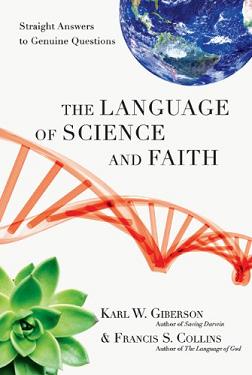
We love either/or thinking. Problems are solved either in one way, or in another. When someone comes along and offers a third possibility, it’s like a breath of fresh air in a stuffy room. Karl W. Giberson’s and Francis S. Collins’ The Language of Science and Faith: Straight Answers to Genuine Questions (InterVarsity, 2011) is one such book.

Giberson (a physicist) and Collins (a geneticist) organize their discussion around responses to frequently asked questions. These include:

Can we really know the earth is billions of years old?

– How does God fine-tune the universe?

– Why is Darwin’s theory so controversial?

Concluding that the term “theistic evolution” now carries too much baggage, the authors substitute BioLogos, but the meaning is the same: God created all that is, and when it comes to life on earth, the means by which God did so was evolution.

Continue reading “‘The Language of Science and Faith’ – a review”

Posted in book reviews

‘Surprised by Hope,’ by N.T. Wright – Part 2

Take away resurrection, and you take away the central message of the New Testament. This is the conclusion of N.T. Wright, renowned New Testament scholar and author of Suprised by Hope : Rethinking Heaven, the Resurrection, and the Mission of the Church (HarperOne, 2008).

Wright maintains that Scripture emphasizes not a disembodied existence after death, but the resurrection (or new creation) of our bodies at the return of Christ, a continuation of meaningful service in the Kingdom of God. This is not “life after death” but “life after life after death.” An interim period after death – a time marked by our conscious existence with Christ – will be crowned on “that great, getting’ up mornin’” with life eternal.

What makes N.T. Wright’s book challenging is that he’s not content to leave the resurrection as an abstract, future doctrine. He is determined to bring the future into the present. We say in the Apostles’ Creed: “I believe in the resurrection of the dead” – so what? How will this radical doctrine affect the way the Christian church operates in the here-and-now? Wright observes (p. 197):

As long as we see salvation in terms of going to heaven when we die, the main work of the church is bound to be seen in terms of saving souls for that future. But when we see salvation, as the New Testament sees it, in terms of God’s promised new heavens and new earth and of our promised resurrection to share in that new and gloriously embodied reality – what I have called life after life after death – then the main work of the church here and now demands to be rethought in consequence.

Continue reading “‘Surprised by Hope,’ by N.T. Wright – Part 2”

Posted in book reviews

‘Suprised by Hope,’ by N.T. Wright – Part 1

At Easter each year, we celebrate Christus Victor, the victory of our Lord over sin, death, and the devil. It’s the perfect season to reflect on the meaning of the resurrection, and N.T. Wright’s lucid Surprised by Hope: Rethinking Heaven, the Resurrection, and the Mission of the Church (Harper, 2008) helps us to do just that.

Why does it matter to say as we do in the Apostles’ Creed, “I believe in the resurrection of the body”? N.T. Wright tackles the question with gusto, putting the resurrection back on center stage where it belongs. This begs the question: And exactly what has been front and center? Wright argues that a form of Platonic dualism (even Gnosticism) dominates, where “salvation” has been narrowed to whether we’re ready to go to heaven. Lurking behind such thinking is a downgrading of the importance of our bodies. In this mistaken view, what is important is an immortal soul and whether it’s fit for an eternal dwelling in heaven. Such a position narrows our focus to the next world, undercutting our engagement in this one — more on that in Part 2 of this review.

N.T. Wright maintains that the New Testament does not teach that every human being has an immortal soul. Rather, 1 Cor. 15:53 is clear that what is mortal (our present body) must put on what is “immortal” (our resurrection body). At the same time, Wright affirms that there is consciousness that continues after our death. In an illustration borrowed from John Polkinghorne, he writes (p. 163):

“God will download our software into his hardware until the time when he gives us new hardware to run the software again.”

Continue reading “‘Suprised by Hope,’ by N.T. Wright – Part 1”

Posted in book reviews, missions & evangelism

Mission to the Skeptics: Reflections on Timothy Keller’s ‘The Reason for God’

Billy Graham peppered his sermons with the phrase, “The Bible says.” A direct appeal to the authority of the Christian Scriptures made sense when his listeners came from cultures that respected Christianity. But times are changing. Timothy Keller – pastor of an vibrant church of six thousand in multi-cultural Manhattan, New York – realizes that to reach an urban audience, today’s missionary must first clear away a pile of stumbling blocks. In The Reason for God: Belief in an Age of Skepticism (Riverhead Books, 2008), Keller addresses seven common doubts about Christian faith, followed by seven “reasons for faith.” At least three topics raised by Keller impact our theology of mission, namely, religious pluralism, hell, and the resurrection.

Religious pluralism

Many of Timothy Keller’s sophisticated New York City listeners would identify with what Wes Tracy called “the scandal of particularity.” In a world filled with many religions, how could Peter claim boldly concerning Jesus that “Salvation is found in no one else, for there is no other name given under heaven by which we must be saved” (Acts 4:12, TNIV)? One student lamented to a panel of Christian, Jewish, and Muslim clerics: “We will never come to know peace on earth if religious leaders keep on making such exclusive claims!” (Reason for God, 4).

Continue reading “Mission to the Skeptics: Reflections on Timothy Keller’s ‘The Reason for God’”